
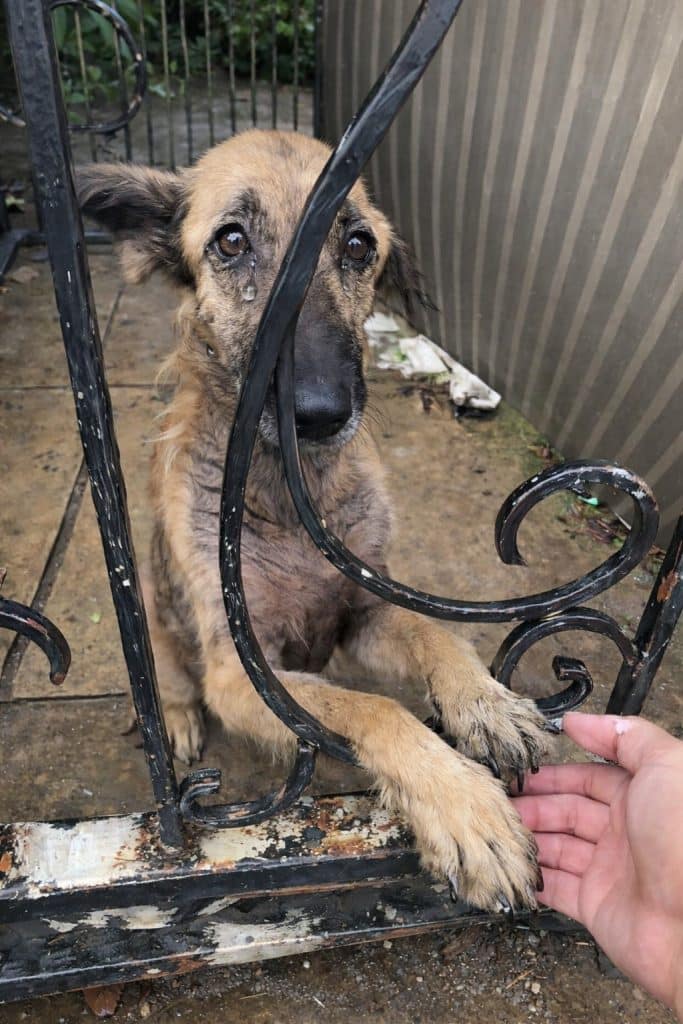
The German Shepherd stood behind the iron gate, her thin body showing the effects of years without proper care.
Much of her fur was gone. Her skin looked irritated, and the neglected yard surrounding her offered little comfort.
A young man had come to investigate a report about a dog living alone on an abandoned property. What he found was deeply troubling.
But when he approached, the dog did something unexpected.
She wagged her tail.
There was no aggressive response. No attempt to escape his attention. Just a small, gentle movement from an animal who had spent years without the companionship she needed.
That quiet greeting would become the beginning of a remarkable change.
The dog would eventually receive a new name: Melda.
And although nobody could give her back the years she had lost, someone was finally ready to help her build a different future.
Behind the Gate, a Life Almost Forgotten
From outside the property, the rusty iron gate separated the abandoned home from the surrounding world.
Behind it was a German Shepherd whose condition immediately suggested that she had been struggling for a long time.
Her frame was noticeably thin. Large areas of her coat were missing, exposing skin that appeared uncomfortable and unhealthy.
The yard was scattered with rubbish and debris. There was no clear sign of a suitable resting area or a reliable supply of clean drinking water.
Nothing about the surroundings suggested that an animal was receiving the attention and care she deserved.
The house itself appeared empty.
Yet the dog remained.
For an animal as social and responsive as a German Shepherd, life without regular companionship can be particularly difficult. These dogs are known for forming close connections with people and benefiting from daily activity and interaction.
Here, however, there was little of either.
The young rescuer had learned about her situation through a report shared by someone concerned about the animal.
Rather than simply reading about it, he decided to visit.
And when he saw her condition, it became clear that this was more than a dog needing an occasional meal.
She needed someone to take responsibility for her well-being.
What stayed with him was that first greeting.
Her tail still moved when someone came near.
The physical consequences of neglect were visible. But her willingness to approach a person suggested that she had not entirely lost her openness to human contact.
She had been overlooked for years.
Now, at last, someone was looking back.
The Lonely Years Nobody Could Give Back
As the young man learned more about the property, he began to understand how the dog had ended up in such difficult circumstances.
According to the account, the property's former owner had left after experiencing serious financial losses.
When contacted about the German Shepherd, the former owner reportedly declined to take responsibility for her.
The house remained abandoned, and the dog was left behind the gate.
Her isolation had not always been complete.
Neighbors recalled that two other dogs once shared the property with her. Whatever companionship they provided ended when both animals died years earlier.
After that, she was alone.
There was no regular household activity to engage her, no family coming home, and no dependable human presence.
A concerned neighbor occasionally threw food over the fence.
That kindness may have been one of the reasons she managed to survive.
But surviving on occasional food was not the same as receiving proper care.
Her deteriorating body made that painfully clear.
She needed nutritious meals, clean water, medical attention, and an environment where she would no longer have to depend on chance.
The neighbor's efforts had provided temporary support, but they could not resolve the larger problem.
For the young rescuer, walking away was becoming increasingly difficult.
He had seen her condition.
He had seen the neglected property.
And he had seen that small wag of her tail.
The dog had responded to his presence with gentleness. He now had an opportunity to respond with something more lasting.
A Stranger Who Kept Coming Back
The first visit was not the end of the young man's involvement.
He began returning regularly, bringing food and fresh water.
Each visit gave the German Shepherd something important that had been largely absent from her life: reliable attention.
Over time, she began recognizing him.
That growing familiarity mattered.
An animal that has spent years without consistent care cannot have every need met through a single kind encounter.
Food can relieve hunger.
Water can address immediate thirst.
But trust and security are built through repeated experiences.
The rescuer's return visits gave her an opportunity to become familiar with someone who was trying to help.
Still, her physical condition remained a serious concern.
Her damaged skin needed professional attention. Her thin body required appropriate nutrition, and the surroundings offered little protection from ongoing hardship.
The situation could not continue indefinitely.
Temporary assistance had helped keep her going.
What she needed now was a genuine rescue.
Eventually, arrangements were made to take her away from the property.
For a dog that had remained within the same confined space for years, leaving was an enormous change.
The rescue was handled carefully, recognizing that even a positive change could be unsettling after such prolonged isolation.
Then the barrier that had separated her from the outside world finally opened.
Melda stepped beyond the gate.
She was still weak.
Her body still carried the consequences of neglect.
But she was no longer confined to the abandoned yard.
For the first time in years, her life was moving in a new direction.
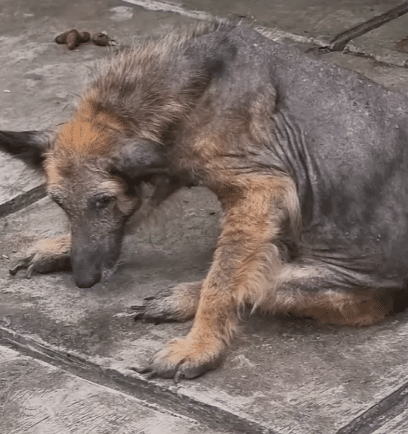
VIDEO: Forgotten Behind an Iron Gate for Years, This German Shepherd Finally Walked Toward a Second Chance
The Medical Care She Had Needed for So Long
Getting Melda away from the property was only the first part of her recovery.
The next challenge was helping her body recover from the damage caused by prolonged neglect.
At the veterinary clinic, an examination revealed several health concerns that needed attention.
Her eyes were inflamed.
Her ears showed signs of chronic infection.
Her skin was in poor condition, and her body was underweight and exhausted.
These were not problems that could be resolved simply by moving her somewhere safe.
They required medical care, adequate nutrition, monitoring, and time.
The veterinary team began a treatment plan suited to her condition.
Medicated baths were used to help care for her skin. Nutritious meals supported her physical recovery, while regular observation allowed her caregivers to follow her progress.
There was no sudden transformation.
A dog that has experienced prolonged neglect may require sustained care before visible improvements begin to appear.
And Melda had a considerable journey ahead.
Her missing coat could not be restored overnight. Her body needed to respond to consistent nourishment, and the irritation affecting her skin needed time to subside.
But one essential thing had already changed.
Her needs were no longer being ignored.
At the abandoned property, there had been little evidence of ongoing treatment or dependable care.
At the clinic, those same health concerns became the focus of daily attention.
There were people checking on her.
There were meals prepared for her.
There was a plan to help her recover.
For Melda, the difference between those two environments was enormous.
She was no longer merely getting through another day.
She was receiving the care she had needed for years.
Forty Days of Small but Meaningful Changes
Recovery unfolded gradually.
At first, the progress was found in ordinary things.
Melda's appetite improved.
She began standing with greater confidence.
Her body slowly responded to the nourishment and medical attention she was receiving.
These changes might have seemed small when considered individually.
But together, they showed that her condition was moving in a healthier direction.
Her skin began to improve as treatment continued.
The irritation lessened, and the discomfort associated with her neglected condition gradually eased.
Then another visible sign of recovery appeared.
Her fur started returning.
Not all at once, and not in the form of an immediate, complete coat.
It began in smaller areas.
As the weeks passed, the new growth became increasingly noticeable.
The dog who had arrived with extensive hair loss was slowly regaining the appearance of a healthy German Shepherd.
Her eyes looked brighter.
Her body became stronger.
And her overall condition continued to improve.
Yet some of the most meaningful changes were not visible in her coat or weight.
They appeared in the way she interacted with the world around her.
The dog who had once stood quietly behind an iron barrier began showing more curiosity.
She appeared increasingly comfortable around her caregivers.
Her behavior became more playful and engaged.
These were important developments for an animal who had spent so many years in isolation.
Her recovery involved more than addressing physical illness.
It also meant giving her opportunities to experience regular companionship, attention, and a safer daily routine.
By the fortieth day, the difference was remarkable.
Melda looked very different from the frail German Shepherd first discovered at the abandoned property.
Her coat had improved substantially. Her strength had returned, and her personality was becoming more apparent.
She had not forgotten how to respond to kindness.
That first wag of her tail had already shown a willingness to connect.
Now, with proper care, that gentle nature had room to emerge.
The progress was not the result of one dramatic moment.
It came from dozens of ordinary acts repeated over time.
A meal.
A treatment.
A careful check on her condition.
Another day in an environment where someone was paying attention.
Those seemingly simple things helped change the direction of her life.
A Safe Place Where She Could Belong
After reaching an important stage in her recovery, Melda was ready to leave the veterinary clinic.
This departure was very different from the one that had taken her away from the abandoned property.
She was no longer leaving because her surroundings had become unbearable.
She was moving forward because her health had improved enough for the next stage of her new life.
Her destination was a safer environment shared with other rescued dogs.
For an animal who had spent years without canine companionship, this represented another significant change.
The other dogs greeted her with gentle curiosity.
Their interactions were described as peaceful, offering Melda the opportunity to become part of a social environment once again.
She no longer had to live by herself behind the same iron gate.
There were other animals nearby.
There were people responsible for her care.
There was a place where her needs mattered.
And with this new chapter came the name Melda.
The name gave a personal identity to the dog who had previously been known primarily through the circumstances of her abandonment.
She was more than a neglected German Shepherd.
More than a photograph of an animal standing behind a fence.
More than an example of what happens when a pet is left without proper care.
She was Melda.
A dog with her own gentle nature, her own developing confidence, and the possibility of many better days ahead.
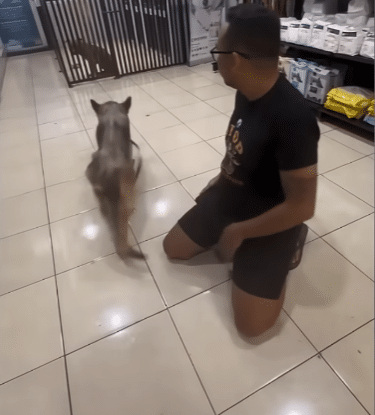
The Gentle Tail Wag That Changed Everything
There is something especially moving about the way Melda responded when help first approached.
She had spent years in an environment that provided little of the care she needed.
She had lost the companionship of the two dogs who once shared her space.
Her former owner was no longer looking after her.
Her body showed unmistakable signs that her needs had gone unmet for a long time.
Yet when a stranger appeared outside the gate, she wagged her tail.
That movement did not erase her suffering.
It could not tell anyone exactly what she was feeling or what she had experienced during those lonely years.
But it gave the rescuer a gentle greeting at the beginning of their relationship.
From that moment, the story developed through a series of decisions.
Someone shared a report about a dog in need.
A young man chose to investigate.
He returned with food and water rather than leaving after one visit.
He recognized that temporary help was insufficient.
And eventually, Melda was taken somewhere she could receive professional treatment.
Each step mattered.
Without the initial report, her circumstances might have remained unnoticed.
Without the follow-up visits, she might have continued relying only on occasional food from a neighbor.
Without veterinary attention, the health problems affecting her eyes, ears, skin, and overall condition might have remained untreated.
Her recovery required more than sympathy.
It required action, consistency, and patience.
That is what makes her transformation meaningful.
Not simply that her fur grew back or that she gained strength.
But that someone recognized her needs and continued helping until her circumstances had genuinely improved.
No Longer Waiting Behind the Iron Gate
The strongest image from Melda's past is a lonely German Shepherd standing in a neglected yard, separated from the outside world by a locked gate.
The strongest image from her new life is very different.
She has received veterinary care.
Her physical condition has improved.
Her coat has begun to recover, and she has become more confident and playful.
She has also moved into a safer setting where other rescued dogs provide the possibility of companionship.
The available account does not describe a permanent adoption into a private family home.
What it does confirm is already meaningful: Melda was rescued from prolonged neglect, received treatment, experienced substantial recovery, and gained a safer place to live.
For a dog who once depended on occasional food passed over a fence, those changes represent an entirely different quality of life.
Her story also carries a reminder that neglect is not always immediately visible to the wider world.
Sometimes it happens quietly.
Behind a gate.
Inside a property that no longer attracts attention.
In a place where an animal remains present long after the people responsible for its care have gone.
Melda could not explain what she needed.
Her declining health revealed part of the truth, and her living conditions revealed the rest.
Fortunately, someone noticed.
And once the young rescuer understood her situation, he did not limit his concern to a single visit.
He kept returning.
He helped her leave.
And he made it possible for her to begin recovering.
The years Melda spent alone cannot be undone.
But they no longer have to define everything that comes afterward.
She has a name.
She has companionship.
She has experienced the comfort of consistent care.
And the German Shepherd who once watched the world from behind an iron gate finally has a future that reaches beyond it.
Sometimes, a second chance begins with something as small as a dog wagging her tail.
And someone choosing not to walk away.


