
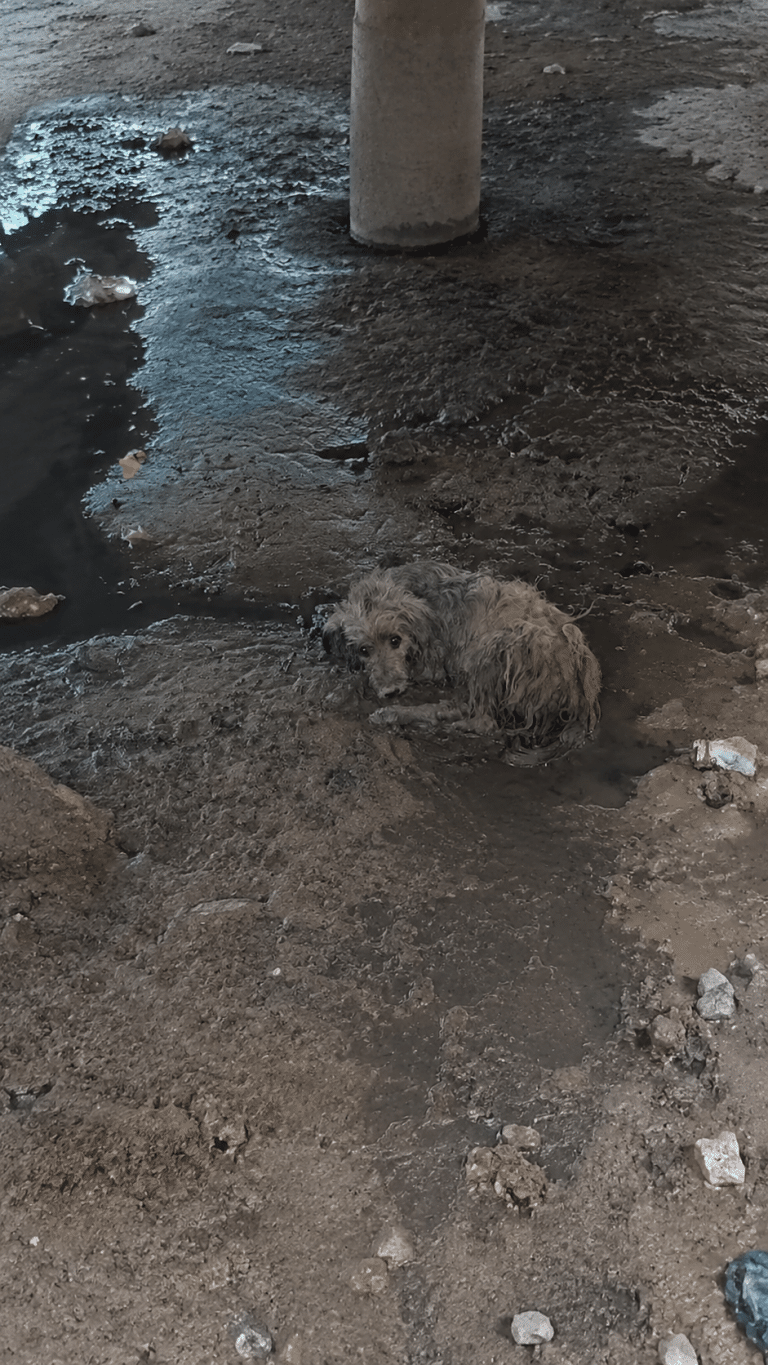
Beneath a small home with a metal roof, a frightened dog lay almost motionless in a narrow drainage tunnel.
Mud and dirty water surrounded his exhausted body. There was barely enough room to move, and every unfamiliar sound seemed to make him more afraid.
For two days, he remained hidden inside that cramped space.
He had no access to food, no comfortable place to rest, and no way to reach safety on his own.
But when help finally arrived, escaping the drain would prove only the beginning of his struggle.
The people who came to rescue him soon discovered that he was not simply frightened of his surroundings.
He was terrified of them.
The dog would later receive the name Beach. At the time, however, his rescuers knew almost nothing about what he had endured.
What they could see was a severely weakened animal whose fear made even a gentle attempt to help feel threatening.
Saving him would require more than getting him out of the tunnel.
It would require patience, medical care, and time to rebuild the trust he appeared to have lost.
Two Days Beneath a Home, Hidden From Safety
The drainage tunnel was an unforgiving place for an already vulnerable dog.
It was narrow, dirty, and difficult to access. Mud and sewage had soaked into Beach's fur, leaving him cold and uncomfortable.
With little room to maneuver, he had few options.
Remaining still may have seemed like the safest response to everything happening around him.
According to neighbors, Beach had reportedly been chased and mistreated by several teenagers before he disappeared into the drain.
The account suggested that he had fled in panic and fallen into the narrow passage beneath the house.
The full circumstances of what happened before his rescue were not independently established in the account.
Still, his behavior when rescuers approached made one thing unmistakable.
Human contact had become a source of intense fear.
He did not appear to recognize the difference between someone approaching to hurt him and someone approaching to help.
By the time rescuers located him, he was exhausted and unwilling to come forward.
The people trying to save him faced an immediate challenge.
They had to reach a frightened, physically compromised dog inside a space that barely allowed them to move.
And they had to do it without increasing his distress.
It was a situation in which good intentions alone were not enough.
Every movement mattered.
Every attempt to get closer could either bring Beach nearer to safety or cause him to retreat further into fear.
When the Helping Hands Were the Ones He Feared
At first, Beach reacted defensively whenever someone tried to approach him.
He barked, showed his teeth, and attempted to bite the hands reaching into the tunnel.
To someone unfamiliar with his circumstances, those reactions might have seemed aggressive.
But the rescuers could see that he was profoundly frightened.
He was trapped, physically weak, and unable to understand why strangers were reaching toward him.
The confined setting made everything more difficult.
There was little space for Beach to move away, and the rescuers could not simply walk beside him or guide him toward an open exit.
They needed to bring him out carefully.
That meant giving him time.
Rather than abandoning the attempt, the rescuers continued speaking softly and approaching as gently as the situation allowed.
They could not erase his fear with a few reassuring words.
They could only avoid making it worse.
A dog who has become frightened of human contact may need repeated experiences of safety before allowing someone close.
For Beach, even the first step was difficult.
The rescuers had to find a way to handle him without causing additional distress.
Eventually, one of them managed to place a towel around his body.
The towel provided a way to support and control his movements while carefully guiding him out of the narrow passage.
It was a delicate moment.
Beach was still frightened, and the people helping him did not yet know the full extent of his injuries.
Slowly, they brought him out of the filthy drain.
For the first time in two days, he was no longer trapped beneath the house.
But the relief of getting him into the open was quickly accompanied by concern.
His body was extremely thin.
He was cold, exhausted, and in obvious need of veterinary attention.
The rescue had removed him from immediate danger.
It had not yet revealed why his condition was so serious.
VIDEO: Terrified Dog Trapped in a Sewer for Two Days Finally Reaches Safety With Patient Rescuers
A Veterinary Examination Revealed More Than Exhaustion
After Beach was removed from the drainage tunnel, his rescuers took him to a veterinary clinic.
The first priority was to assess his condition and begin addressing the effects of his ordeal.
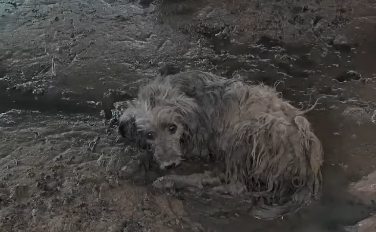
His coat was heavily contaminated with mud, waste, and tangled material from the drain.
Before the veterinary team could properly evaluate his body, much of the matted fur needed to be removed.
The cleaning process was an important part of his early care.
It helped remove the dirt that had accumulated during his time inside the tunnel and allowed the team to examine him more thoroughly.
As the mud disappeared, the extent of his physical weakness became clearer.
Beach weighed only about 15 pounds.
He was severely underweight and showed signs of significant malnutrition.
His condition suggested that his problems extended beyond the two days he had spent trapped in the drain, although the source did not establish how long he had been struggling before that.
Veterinary testing revealed additional concerns.
Bloodwork indicated anemia and an elevated white blood cell count.
These findings raised concerns about infection and physical stress, adding to the challenges already facing the weakened dog.
But the most consequential discovery came from diagnostic imaging.
X-rays revealed that Beach had suffered serious spinal trauma.
The injury had left both of his hind legs paralyzed.
What had initially appeared to be a rescue involving exhaustion, fear, and exposure was now something far more complicated.
Beach could not walk using his back legs.
He also required assistance with basic bodily functions because of his condition.
For the people caring for him, the implications were significant.
His recovery could not be measured simply by whether he began eating more regularly or became less frightened.
He would need substantial ongoing support.
His mobility was severely affected, and the damage to his spine meant that his future remained uncertain.
There was no indication that a quick treatment could restore his ability to walk.
The veterinary team and rescuers were now facing a much longer commitment.
Getting Beach out of the sewer had taken patience.
Helping him live safely with his injuries would demand even more.
The Daily Care That Became His New Lifeline
Once the seriousness of Beach's condition was understood, his routine had to be organized around his physical limitations.
He could not simply stand up, walk outside, and take care of himself.
His paralysis meant that ordinary tasks required human assistance.
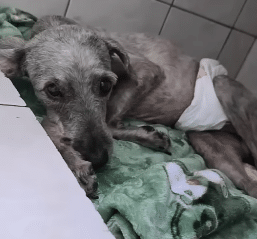
One of the most important parts of his care involved helping him empty his bladder.
His rescuer had to do this manually several times a day.
It was not an occasional task.
It was a necessary part of maintaining his comfort and protecting his health.
Beach also needed frequent diaper changes to reduce the risk of infections.
These responsibilities required close attention, consistency, and a willingness to continue helping even when progress was slow.
There was nothing dramatic about much of this work.
It involved meeting the same needs every day.
Keeping Beach clean.
Making sure he remained comfortable.
Helping him with the functions his body could no longer manage independently.
And doing all of it while remembering that he was still deeply frightened of people.
Physical care and emotional recovery could not be separated.
Every necessary interaction brought a person close to a dog who had initially responded to approaching hands with fear.
The people caring for him needed to complete important tasks without overwhelming him.
For Beach, that meant gradually becoming accustomed to the very contact he once tried so desperately to avoid.
The challenge was not merely to keep him clean and medically supported.
It was to help him feel safe during the process.
A gentle touch was not a small thing for a dog in his situation.
Neither was a calm voice.
Each ordinary caregiving interaction offered another opportunity for him to experience human contact without harm.
That was how the slow work of rebuilding trust began.
The First Signs That His Fear Was Softening
In the beginning, Beach remained extremely cautious.
When someone approached too quickly, he sometimes showed his teeth.
His defensive reactions reflected how uncomfortable he still felt around people, even after being removed from the drain.
His new surroundings were safer, but he had not yet learned to feel secure in them.
The difference mattered.
A dog can be physically protected from danger and still react as though danger is approaching.
Beach needed time to adjust.
The rescuers did not expect an immediate transformation.
They continued providing the care he needed while allowing his confidence to develop gradually.
There was no single dramatic moment when all his fear disappeared.
Instead, the changes emerged in small ways.
He began to tolerate gentle contact.
His reactions became less defensive.
People could approach him without always triggering the same anxious response.
And eventually, he was able to rest calmly beside the humans who were helping him.
For a dog who had once tried to bite anyone reaching toward him, that was meaningful progress.
The people around him were no longer only associated with fear.
They were becoming part of a familiar and safer routine.
The same hands that helped him with his daily needs could also offer comfort.
The same voices he had initially feared were now part of his care.
Beach's physical limitations had not disappeared.
His hind legs remained paralyzed, and he continued to require assistance.
But emotionally, something important was changing.
He was becoming more comfortable in the presence of people.
That progress could not be captured by an X-ray or a blood test.
It was visible in his behavior.
A less fearful response.
A moment of stillness during gentle handling.
The ability to relax near someone rather than immediately trying to defend himself.
These were modest changes compared with the enormous medical challenges ahead.
Yet for Beach, they represented a different kind of recovery.
He was beginning to experience what it meant to be cared for without being frightened.
A Future That Still Requires Patience and Care
Beach's rescue did not end with a complete physical recovery.
His spinal injury remained a serious concern, and the challenges associated with his paralysis continued.
According to the account, his future would likely involve long-term rehabilitation and therapy.
The veterinarians remained hopeful that improvement might be possible, but the extent of any eventual recovery was uncertain.
There was no confirmed outcome showing that Beach had regained the use of his hind legs.
His situation therefore required a realistic understanding of what progress might mean.
For some injured animals, rehabilitation can lead to improved function.
For others, ongoing support remains necessary.
Beach's eventual level of mobility could not be guaranteed from the information available.
What was clear was that his rescuers had accepted the responsibility of caring for him.
They were continuing to meet his needs despite the demanding nature of his condition.
The commitment was especially significant because his care extended beyond ordinary feeding and companionship.
He needed help with bodily functions.
He required close attention to cleanliness.
His physical limitations had to be considered throughout his daily routine.
And alongside all of those practical needs, his emotional well-being remained important.
The frightened dog found beneath the house was still learning to feel comfortable around people.
His progress could not be rushed simply because the most dangerous part of his rescue was over.
That is one of the difficult realities of caring for a severely injured rescue animal.
The moment of being saved may be visible and immediate.
The work that follows can continue for months or longer.
It is carried out through consistency rather than dramatic gestures.
For Beach, the rescue team's continued involvement meant he no longer had to face his condition without assistance.
His caregivers had made their intention clear.
They did not plan to abandon him because his needs were complicated.
What Beach's Journey Teaches About Learning to Trust Again
There is a striking contrast between the dog Beach was when rescuers first reached into the drain and the dog he gradually became under their care.
At the beginning, he reacted to human contact as though it represented another threat.
He barked.
He snapped.
He tried to protect himself from anyone who came too close.
Those reactions made the rescue difficult, but they did not prevent the people helping him from recognizing his need.
They approached with patience.
They brought him out of the tunnel.
They arranged veterinary treatment and continued caring for him after learning that his injuries were serious.
Over time, Beach began responding differently.
He allowed gentle contact.
He became less frightened when people approached.
He learned to rest beside his caregivers.
None of those changes meant that his spinal injury had healed.
They did not remove the need for rehabilitation or daily assistance.
But they showed that his experience of human companionship was beginning to change.
The tunnel beneath the small house had been a place where Beach was cold, isolated, and unable to escape.
In care, his circumstances were different.
There were people attending to his medical needs.
There was help with the basic tasks he could not manage alone.
And there was the repeated experience of being handled with patience rather than fear.
His story does not need an extraordinary ending to carry meaning.
The available account does not promise that he will walk again.
It does not describe a completed rehabilitation or a final adoption.
Instead, it leaves Beach in a place where he is receiving ongoing care and slowly building confidence.
That is an important outcome in its own right.
For a dog who once could not bear an approaching hand, learning to rest peacefully beside a person represents a remarkable change.
Beach still has challenges ahead.
His body needs support, and his future remains uncertain.
But the terrified dog who spent two days hidden inside a filthy drainage tunnel is no longer facing those challenges alone.
Sometimes the beginning of healing is not a dramatic physical transformation.
Sometimes it is simply the moment a frightened animal can finally relax beside someone who has chosen to stay.
For Beach, that quiet change may be one of the most meaningful steps in the long journey ahead.


