
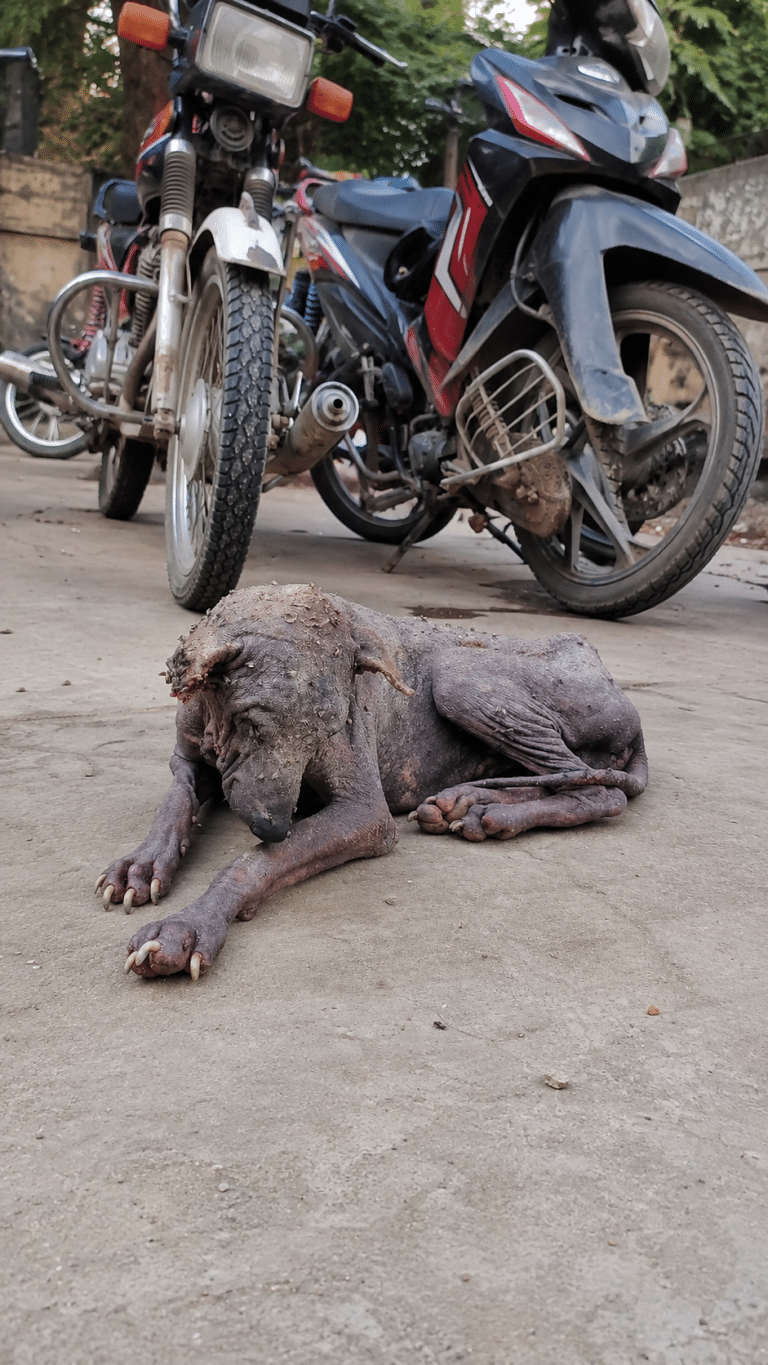
By the time rescuers reached Yogi, he was lying beside the road with almost no strength left to respond.
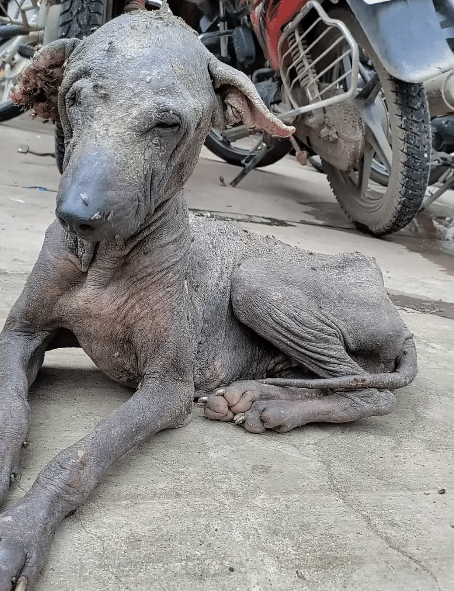
His body was painfully thin. His fur was completely gone. And the skin that should have protected him had become a source of constant discomfort.
There was no barking for attention.
No attempt to run away.
Just a fragile dog lying quietly, seemingly exhausted by a struggle that had gone on for far too long.
For the people from RASA India who discovered him, the sight was deeply troubling. Yogi's condition suggested that he had been living with serious skin disease and physical weakness for an extended period.
Yet the rescuers saw more than his appearance.
They saw a life that still deserved help.
And although no one could promise how quickly he might recover, they were determined to give him the care he desperately needed.
A Dog Who Had Almost Nothing Left
Yogi's condition was difficult to overlook.
Severe mange had affected his entire body, leaving him without a healthy coat of fur. His skin was inflamed and covered with areas of thickened, irritated tissue.
His ribs were clearly visible beneath his thin frame.
Even the smallest movement appeared to require more energy than he could comfortably manage.
The illness had taken away much of his physical comfort. Without fur to protect his skin, he was especially vulnerable to irritation.
But what made his situation particularly concerning was his weakness.
Yogi was not simply a dog with a skin condition.
He was an animal whose overall health had deteriorated to the point where he could barely move.
The full circumstances of his life before the rescue were unknown. There was no confirmed explanation for how long he had been suffering or why his condition had become so severe.
What the rescuers could see, however, was enough.
He needed more than a meal or a temporary place to rest.
He needed sustained care, medical attention, and a safe environment where his body could begin recovering.
And first, someone had to get him away from the roadside.
The Moment RASA India Stepped In
Approaching Yogi required care.
Although he was extremely weak, he was also frightened. The rescuers understood that an unfamiliar person coming too close could create additional stress for an animal already struggling.
They could not simply rush toward him.
Instead, the team used a large safety net to secure him as gently as possible.
It was a cautious rescue, designed to move him without placing unnecessary pressure on his fragile body.
Yogi offered little resistance.
Under different circumstances, a frightened dog might have tried desperately to escape. But Yogi's condition left him with very little energy.
His lack of movement was not a sign that everything was fine.
It showed how exhausted he had become.
The rescuers carefully lifted him and brought him into their vehicle.
That was the first significant change in his circumstances.
Only moments earlier, he had been lying outside with no immediate access to the treatment he needed.
Now, he was being transported to a shelter where people were prepared to help him.
He was still seriously ill.
His skin still needed treatment.
His strength had not suddenly returned.
But he was no longer facing those problems without assistance.
For Yogi, reaching safety was only the beginning.
It was also the first essential step toward having a chance to heal.
VIDEO: Yogi Was Too Weak to Move and Had Lost All His Fur — Watch His Gentle Rescue Begin
The First Bath Was About More Than Getting Clean
Once Yogi arrived at the rescue center, the team began addressing his immediate needs.
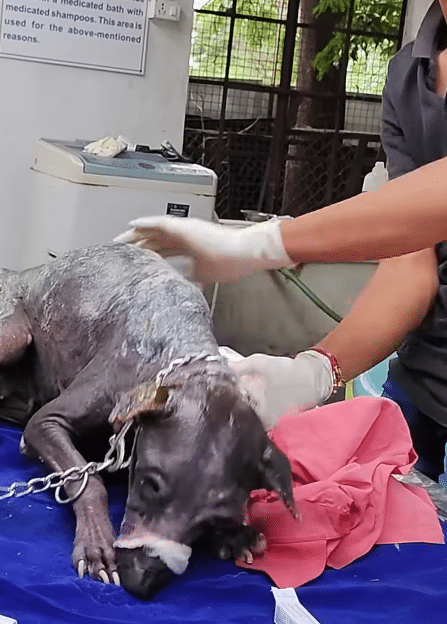
One of the earliest steps was a medicated bath.
For a healthy dog, a bath might be a simple routine. For Yogi, whose skin had been badly affected by mange, the process required considerably more caution.
His caregivers had to work slowly.
The surface of his skin was sensitive, and the thickened layers of damaged tissue needed gentle attention.
Warm water helped soften the crusted buildup while the rescuers carefully washed his body.
This was not about making him look better for a photograph.
It was about helping his skin become cleaner and more comfortable so that further treatment could begin under better conditions.
The team paid particular attention to the affected areas, removing accumulated debris and cleaning his skin without rushing.
Even a necessary treatment can be uncomfortable for an animal in such poor condition.
That made the rescuers' careful approach especially important.
Yogi had been found in a state where his body appeared to have very little strength to spare. Every part of his care needed to take that weakness into account.
The bath could not repair months of illness in a single session.
It could not immediately restore his missing coat.
And it certainly could not guarantee a complete recovery.
But it provided something he had been missing for a long time: direct care for a condition that had been allowed to worsen.
For the first time in this part of his story, Yogi was receiving the attention his damaged skin needed.
Treating the Illness Beneath His Appearance
The severity of Yogi's mange meant that bathing alone would not be enough.
Veterinary treatment was necessary to address the underlying problem and reduce the risk of complications.
According to the rescue account, the medical team administered antibiotics to help control infection and began treatment with Ivermectin to combat the parasites associated with his mange.
His affected skin was also cleaned and treated.
These steps were important because Yogi's condition involved more than the visible absence of fur.
His skin had endured prolonged inflammation, while his thin body showed how much his general health had suffered.
Treating one symptom would not instantly solve the others.
The team needed to address his condition through continuing medication, skin care, proper nutrition, and close attention to his progress.
There was no simple way to reverse everything at once.
Recovery from severe mange can require weeks or months of consistent treatment, depending on the animal's condition and response to care.
For a dog as weak as Yogi, patience was essential.
His caregivers could not judge success only by whether new fur appeared.
They also needed to see whether his skin was becoming less irritated, whether his physical condition was stabilizing, and whether he could gradually become more comfortable.
These are quieter signs than a dramatic before-and-after photograph.
But they matter.
Because the earliest stages of recovery are often about helping an animal become stable enough to continue healing.
Yogi had reached a place where that process could finally happen.
Small Changes That Began to Tell a Different Story
The days following Yogi's rescue were devoted to continuing care.
He received nutritious food, prescribed medication, skin treatment, and gentle attention from the people looking after him.
Nothing about his progress was instant.
He did not suddenly regain a thick, healthy coat.
His body did not transform overnight.
Instead, the changes appeared gradually.
His irritated skin began to look calmer.
His physical condition slowly became more stable.
And the distant, exhausted expression that had marked his first days started to soften.
These were modest improvements, but they were meaningful in the context of how seriously ill he had been.
A dog who had once been too weak to react was now receiving the consistent support necessary for continued recovery.
The difference was not simply that he was in a shelter.
It was that his needs were being addressed every day.
Food helped support his weakened body.
Medication targeted the medical problems that required treatment.
Gentle skin care helped manage the discomfort caused by his illness.
And the calm attention of his caregivers meant that he no longer had to face each day without assistance.
The rescue footage did not present an immediate, complete transformation.
Instead, it captured the beginning of something slower and more realistic.
A dog whose health had deteriorated over time was starting to show signs that treatment was helping.
That distinction matters.
A rescue can happen in a single day.
Healing often cannot.
Learning to See Progress Beyond a New Coat of Fur
It would have been easy to measure Yogi's recovery only by his appearance.
After all, the complete loss of his fur was one of the most noticeable signs of his illness.
But his condition could not be understood through photographs alone.
His body needed nourishment.
His skin needed time.
The medical treatment had to continue.
And his overall health needed an opportunity to improve after such a difficult period.
The early changes reported by his rescuers suggested that he was responding to the care he received.
His skin was beginning to settle.
His body was becoming more stable.
The exhaustion visible at the beginning of his rescue seemed less overwhelming.
None of these signs meant that his recovery was finished.
He still had a considerable journey ahead of him.
But they showed why sustained care was so important.
For an animal suffering from an advanced skin condition, even a small reduction in discomfort can be a meaningful development.
For a dog found lying almost motionless beside a road, becoming physically stronger is an important goal.
And for a rescue team, witnessing those first improvements can provide a reason to remain hopeful while continuing the work.
Yogi's progress was not measured by a single extraordinary moment.
It was reflected in the gradual changes made possible by regular treatment.
Day after day, the focus remained the same.
Help him become healthier.
Help him become more comfortable.
Give him the time and care needed to keep moving forward.
He Was Finally Given What He Had Needed All Along
There is something particularly moving about Yogi's rescue because the people who helped him did not begin with any guarantee of success.
They found a dog in extremely poor condition.
They saw the severity of his skin disease.
They recognized that his strength had been badly depleted.
And they chose to intervene.
The rescue itself was careful rather than dramatic.
The first bath required patience rather than speed.
His medical treatment involved consistent attention rather than a single solution.
And the improvements that followed were gradual instead of immediate.
That is what makes his story meaningful.
It shows that helping a vulnerable animal is not always about one remarkable act.
Sometimes, it is about many small acts of care repeated over time.
The decision to approach gently.
The effort to lift him safely.
The work of cleaning damaged skin.
The responsibility of continuing medication.
The simple but necessary act of providing proper food and a protected place to recover.
Each of those steps contributed to the opportunity Yogi now had.
Before his rescue, he had been lying beside the road, visibly weakened by a serious illness.
After RASA India stepped in, he was receiving shelter, veterinary treatment, and ongoing support.
His journey was still unfinished, and the available account did not confirm a complete recovery or adoption.
There was no need to invent a perfect ending.
The improvement already documented was important enough.
Yogi had been given a chance to recover from a condition that had left him almost helpless.
A Second Chance That Is Still Being Written
Yogi's story is a reminder that the animals most in need of assistance may not always have the strength to ask for it.
Some cannot run toward someone offering help.
Some cannot lift their heads easily.
Some simply remain where they are, waiting through circumstances they cannot change on their own.
When RASA India found Yogi, he was one of those animals.
He had lost all his fur, his skin was seriously affected, and his body was dangerously weak.
But his condition did not determine whether his life was worth saving.
The rescuers responded to what they saw with patience and practical care.
They gave him a safe place.
They began the treatment he needed.
And they continued supporting him as the first signs of improvement appeared.
His future recovery would depend on time, proper medical care, and how his body responded.
Those uncertainties remained.
Yet one important part of his story had already changed.
Yogi was no longer lying alone beside the road, struggling without the help he needed.
He had people caring for him.
He had treatment.
And, perhaps most importantly, he had been given the opportunity to heal.
Sometimes, compassion does not produce an instant transformation.
Sometimes, it simply gives a fragile life another day, another chance, and the care needed to begin again.
For Yogi, that chance made all the difference.


