
A tiny black puppy was suspended above rough water, caught in a tangled blue tarp beside a rocky cliff. Below it, waves moved against the rocks. Above it, the steep terrain made reaching the frightened animal dangerous.
The puppy had nowhere safe to go.
Yet someone was already preparing to climb down.
It was one of several remarkable rescue moments captured in a collection of videos showing people responding when animals found themselves in situations they could not escape alone.
Some rescues demanded ropes and specialist equipment. Others required little more than patience, careful hands, and a willingness to notice a vulnerable creature.
What connected them was not the size of the animal or the scale of the danger.
It was the decision to help.
A Small Puppy, a Rocky Cliff, and One Careful Descent
The black puppy's situation was precarious.
Trapped inside the blue tarp near the cliff, it hung above turbulent water with little room to move. The surrounding rocks made the location difficult to approach, and a mistake during the rescue could have placed both the animal and its rescuer in danger.
A young man prepared a rope and secured it around himself before beginning the descent.
Getting close enough to reach the puppy was only part of the challenge.
He had to navigate the uneven rock face while maintaining his balance and approaching an animal that appeared overwhelmed by fear.
The puppy barely moved.
That stillness made the scene especially difficult to watch. It was impossible to know what the small dog understood about the person coming toward it, but its limited movement suggested how frightened it had become.
The rescuer continued carefully.
He moved down the rocks, closed the distance, and eventually reached the trapped animal.
Then came the moment that mattered most.
With deliberate movements, he lifted the puppy away from its dangerous position.
The little dog was finally out of immediate danger.
There was no need for a dramatic celebration. The rescue itself was enough.
A fragile animal that had been hanging above rough water had been reached by someone willing to take considerable care to bring it to safety.
The footage does not establish what happened to the puppy afterward. It does, however, show the essential outcome: the animal was removed from the cliffside danger.
And that alone was a meaningful victory.
Beneath Broken Concrete, Another Life Was Waiting
Not every trapped animal can be seen clearly from a distance.
In another rescue, several people gathered beside a damaged wall where a small creature had become caught beneath concrete and scattered debris.
The obstruction was substantial.
Heavy pieces of material stood between the rescuers and the frightened animal below.
How long it had been trapped was unknown.
There was no clear account of how the animal had ended up beneath the rubble, either. What the rescuers could see was enough to recognize that intervention was necessary.
Instead of attempting to pull the animal through the obstruction, they worked to remove the material surrounding it.
Piece by piece, the debris began to disappear.
The effort required cooperation and persistence. Each removed section created a little more space, bringing the rescuers closer to the creature they were trying to reach.
It was a different kind of tension from the puppy on the cliff.
There was no rushing water immediately beneath the animal, and no steep descent to negotiate.
Here, the danger came from being confined beneath heavy material.
The rescuers continued until they could finally reach the small creature and lift it free.
Its escape brought visible relief to the people gathered around the damaged wall.
That moment was a reminder that a successful rescue does not always begin with someone knowing exactly how to solve the problem.
Sometimes it begins with several people refusing to leave a trapped animal behind.
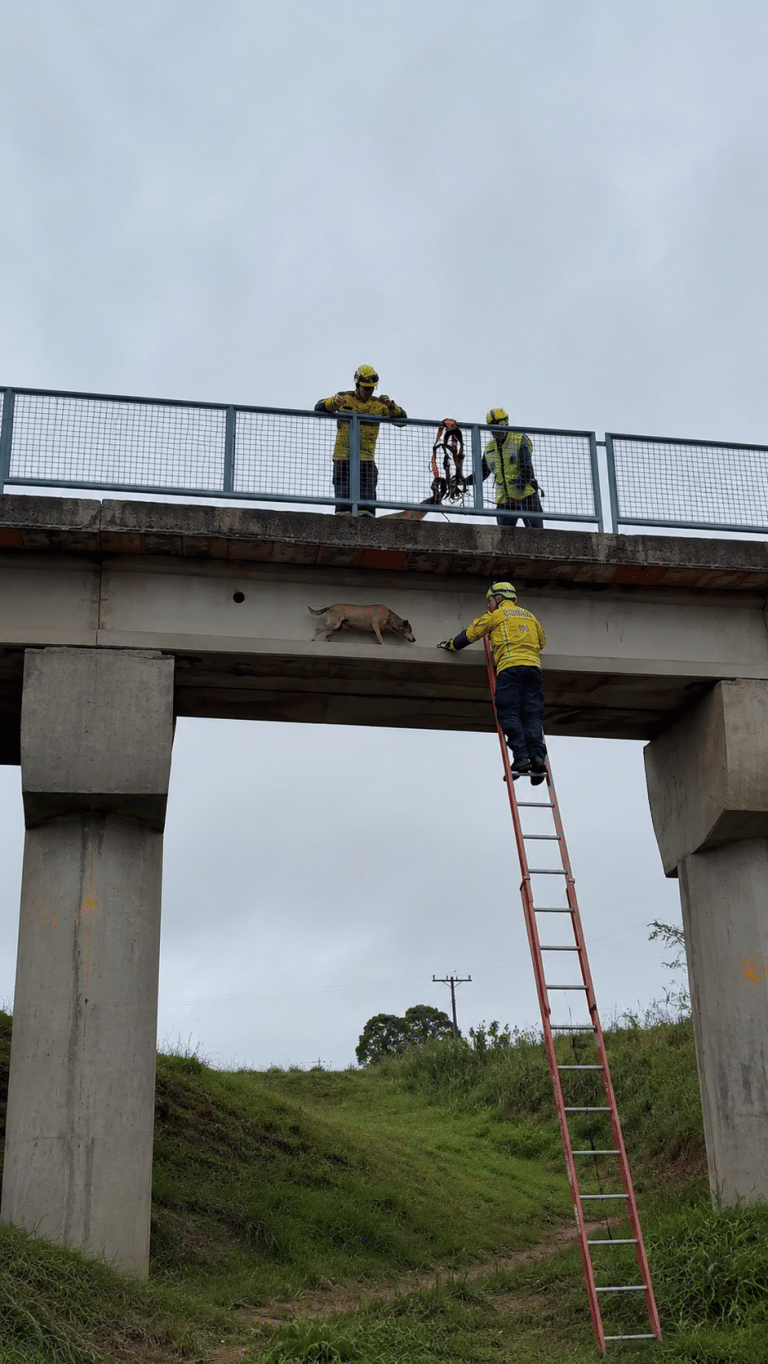
A Terrified Dog Stranded Beneath a Busy Overpass
High above a roadway carrying moving traffic, another dog faced a frightening predicament.
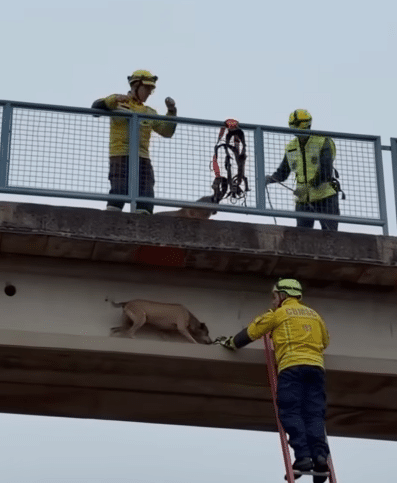
It had become stranded on a narrow structure beneath an overpass.
The position offered no obvious safe route down.
Below, vehicles continued along the road. Above and around the dog, the bridge structure created a challenging environment for anyone attempting to reach it.
Firefighters responded with ladders and rescue equipment.
But equipment alone could not resolve the situation.
The dog was frightened and trembling. Reaching it safely required the team to approach carefully rather than make sudden movements that might worsen the danger.
Every part of the rescue depended on patience.
The firefighters worked their way toward the animal, taking the difficulties of the elevated location into account.
The surrounding traffic added to the unsettling atmosphere.
For a frightened dog already stranded in an unfamiliar place, the noise and height could only make the scene appear more intimidating.
Eventually, the rescuers succeeded.
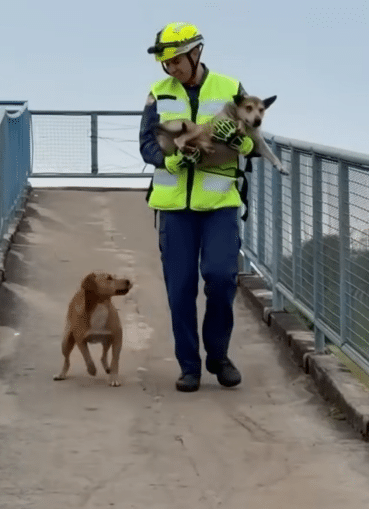
The dog was brought back to solid ground.
And then something small happened that made the entire effort feel especially moving.
Its tail began to wag.
A moment earlier, the dog had been trembling on a narrow structure above traffic.
Now, with its paws on safe ground, it showed a simple, visible change in behavior.
The footage cannot tell us exactly what the animal was thinking.
But the contrast was unmistakable.
Fear had defined the scene on the bridge. Safety defined the moment afterward.
VIDEO: From a Puppy Hanging Above the Waves to a Dog Trapped Under a Bridge — The Rescues That Brought Them to Safety
When Rising Water Left a Dog With Nowhere to Escape
The collection also includes a rescue in which danger was not beneath an animal or above it.
It was everywhere around it.
Floodwater had risen high enough to leave a dog stranded on a narrow window ledge.
Muddy water rushed past the structure, cutting off any ordinary path to safety.
The dog remained on the ledge because there was nowhere else for it to go.
For an animal trapped in that position, waiting was not simply a choice. The surrounding current made escaping without assistance extremely difficult.
A rescuer entered the powerful water.
The current reached chest height as the person pushed toward the stranded dog.
It was a demanding approach.
Moving through deep, fast-flowing water requires determination, and the rescuer had to reach the animal without losing control in the current.
Meanwhile, the dog remained in its limited space.
There was no dramatic attempt to leap through the flood.
It waited.
The distance between the rescuer and the ledge gradually closed.
Then, at last, hands reached the frightened animal.
The dog was lifted from its position and carried away from the rising floodwater.
What made the rescue so moving was the contrast between the scale of the water and the size of the life being protected.
The flood was powerful, indifferent, and dangerous.
The animal was alone and unable to escape.
But a person chose to cross that water for it.
The available account confirms the dog was carried to safety. It does not describe subsequent veterinary treatment or long-term recovery, so the strongest part of the story remains the rescue itself.
One frightened animal had been stranded as the water rose.
Someone reached it before the situation became worse.
A Horse Sinking Into Mud Needed Patience, Not Panic
Another rescue took place near a muddy riverbank.
This time, the animal was much larger.
A horse had become deeply trapped in thick mud, unable to pull itself free despite repeated efforts.
Its size did not make the situation easier.
The surrounding mud restricted its movement, and attempts to escape were not enough to return it to stable ground.
The rescuers understood that the animal needed assistance, but their approach was careful rather than hurried.
They worked together to support the horse.
Wooden boards were positioned beneath it, helping provide a firmer surface as the team guided the struggling animal.
The process required coordination.
A frightened horse caught in deep mud could not simply be lifted free by hand. The rescuers had to create conditions in which the animal could regain its footing.
Progress came gradually.
The horse remained trapped while people continued adjusting their efforts and guiding it toward firmer ground.
Then the situation changed.
It finally broke free.
After struggling in the mud, the exhausted animal was able to stand safely again.
There was something especially reassuring about that sight.
The rescue did not depend on a single dramatic gesture. It depended on people working patiently with the animal's physical limitations and the difficult conditions around it.
The horse's final movement onto safe ground showed why that patience mattered.
Sometimes helping an animal means acting quickly.
Other times, it means resisting the urge to rush.
A Cat Above the Street and the Stranger Waiting Below
In a crowded urban setting, a cat was clinging to the edge of a large billboard high above a road.
The animal's position was dangerous.
It was elevated above the street, and its grip appeared increasingly difficult to maintain.
People gathered below, concerned about how to help.
One man climbed onto a vehicle carrying a large piece of cardboard.
He positioned himself beneath the cat, preparing to catch it if it fell.
This was not a conventional rescue involving a ladder reaching directly to the animal.
Instead, the man responded to the possibility that the cat might lose its hold before anyone could reach it.
For a brief period, the outcome remained uncertain.
The cat continued clinging above the street.
The stranger stayed below.
Then the animal slipped.
It fell from the billboard.
But it did not land on the roadway.
The man caught the cat safely before it reached the street beneath.
It was a rescue defined by timing and attention.
Someone had recognized the danger and placed himself where he could make a difference.
The scene also showed that protecting an animal sometimes involves preparing for what might happen rather than waiting until the danger becomes unavoidable.
The cat's fall could have ended very differently.
Instead, the stranger's quick response brought it to safety.
The Small Acts of Kindness That Matter Just as Much
Not every moment in the collection involves dramatic heights, heavy debris, or powerful water.
Some of the rescues are quieter.
A squirrel is seen with a plastic cup stuck around its head.
A woman carefully removes the obstruction, freeing the small animal from something it cannot remove by itself.
Elsewhere, a mother duck and her ducklings need to cross a road.
A couple intervenes to stop traffic long enough for the family to move across safely.
There is no climbing or complicated equipment involved.
Just two people recognizing that the birds are vulnerable among passing vehicles.
Another scene follows a young deer caught in netting in a wooded area.
A rescuer works to release the animal from the material restricting its movement.
And along a busy road, someone picks up a turtle and carries it away from passing traffic.
These moments might seem modest beside a firefighter's rescue high above a roadway.
Yet they share the same essential purpose.
Each animal was facing a problem it could not easily resolve on its own.
Each needed someone to notice.
A plastic cup, a stretch of roadway, and a length of netting may appear ordinary to people.
For the animals caught in those situations, however, they represented real obstacles to safety.
The value of these rescues is not measured by how impressive they look on camera.
It lies in the difference between leaving an animal exposed to danger and helping it move beyond that danger.
What These Rescues Reveal About Compassion
Watching so many different rescues together creates an unusual perspective.
The animals are not the same size.
They are not trapped in the same kinds of places.
Their rescuers do not all have the same skills or resources.
A firefighter working beneath an overpass faces different challenges from a woman helping a squirrel.
A person navigating chest-high floodwater cannot use the same approach as a group supporting a horse trapped in mud.
Yet the underlying choice remains remarkably similar.
Someone identifies an animal in danger and decides to respond.
For the puppy on the rocky cliff, that response meant a rope and a careful descent.
For the dog beneath the bridge, it meant a team equipped with ladders and the patience to approach a trembling animal.
For the flood-stranded dog, it meant a rescuer moving through powerful water.
For the horse, it meant coordinated effort and wooden supports.
And for the cat above the street, it meant one man positioning himself to catch the animal before it struck the ground.
None of those actions should be treated as invitations for untrained people to attempt dangerous rescues without appropriate help.
Cliffs, moving floodwater, unstable structures, and frightened large animals can put human rescuers at serious risk.
Professional emergency services and trained animal rescue teams are often the safest people to contact when an animal is trapped in a hazardous location.
Still, the footage offers something meaningful beyond the dramatic moments.
It demonstrates that compassion can take many forms.
Sometimes it requires professional equipment.
Sometimes it calls for teamwork.
Sometimes it begins with an ordinary person noticing a problem that others may not have seen.
The collection does not provide complete histories for all the animals, nor does it document their lives after rescue.
We do not know where each one eventually went or whether further care was needed.
Those unanswered questions matter because a rescue is often only the beginning of an animal's journey.
But the absence of a longer follow-up does not diminish what the footage clearly shows.
Animals were trapped.
People intervened.
And those animals were brought away from immediate danger.
The Difference One Person Can Make
Perhaps the most memorable moment is not the most dangerous one.
It may be the sight of the dog wagging its tail after being rescued from beneath the overpass.
Or the black puppy finally being lifted clear of the rocks.
Or the exhausted horse standing again after being freed from the mud.
These are small moments compared with the effort that came before them.
Yet they carry the emotional weight of each rescue.
A vulnerable animal that could not escape has reached safety.
A difficult situation has changed because people were willing to help.
There is no need to imagine what every animal felt or to claim that each rescue led to a perfect future.
The visible outcomes are meaningful enough.
These scenes remind us that compassion is not always an extraordinary act performed by an extraordinary person.
Sometimes it is an attentive stranger.
Sometimes it is a group of people working together.
Sometimes it is a trained rescuer using skill and patience when an animal has nowhere else to turn.
Across cliffs, bridges, floodwaters, muddy riverbanks, city streets, and quiet roads, the same truth emerges.
The animals could not ask for help in words.
But someone recognized that help was needed.
And in those moments, choosing to care made all the difference.


