
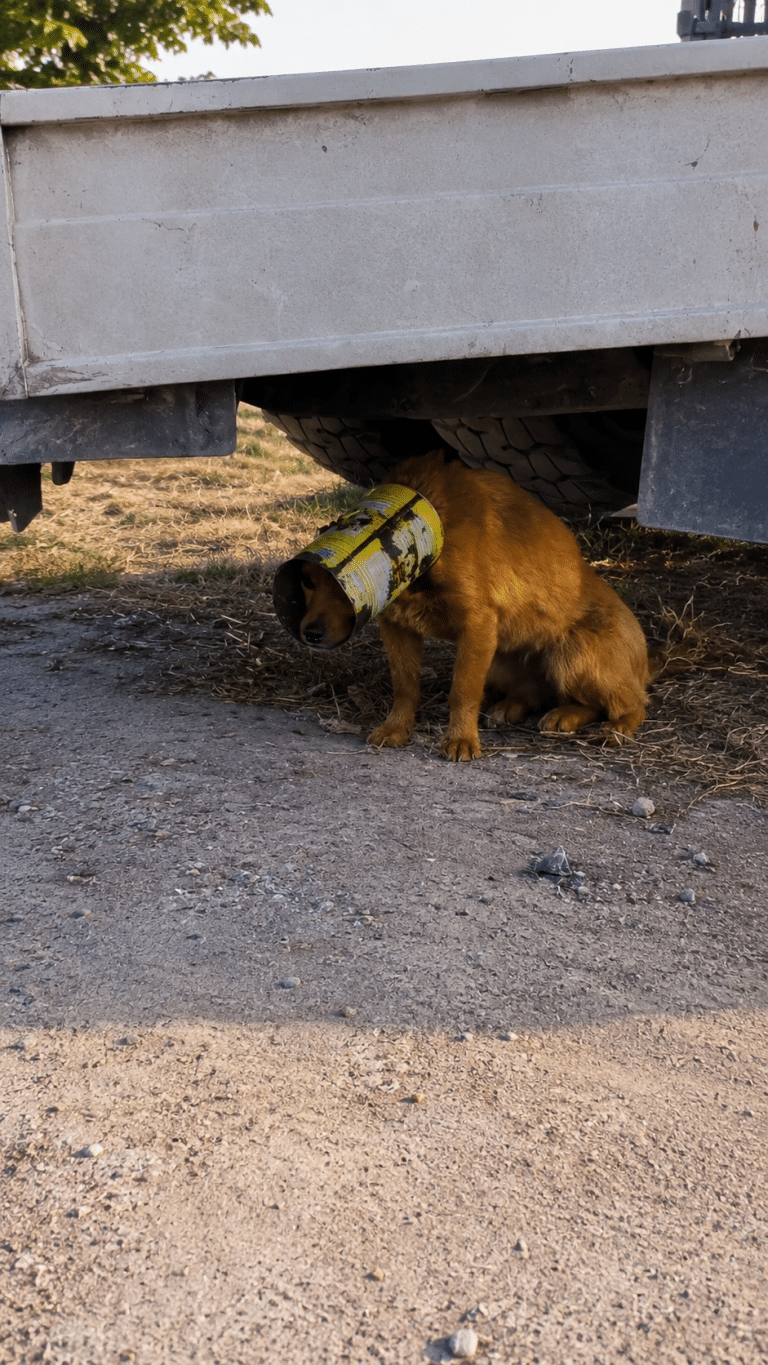
The yellow metal bucket covered his head so completely that even moving through the streets had become a struggle.
People occasionally spotted the frightened stray dog rushing through alleyways and parking areas, trying desperately to escape anyone who approached.
He was not chasing anything.
He was trying to get away.
But wherever he ran, the heavy metal object went with him.
Nobody knew exactly when the bucket had become trapped around his head and neck. Rescuers believed he had been living this way for a terribly long time, possibly months.
By the time help finally reached him, his condition had become deeply concerning.
He was painfully thin, dehydrated, and exhausted.
And the very people who wanted to save him were the ones he kept running from.
A Life Trapped Behind a Yellow Bucket
For a stray dog, surviving on the streets already comes with countless challenges.
Finding enough food and water can be difficult. Staying away from danger requires constant awareness of the surroundings.
But this dog faced another obstacle that made even the simplest parts of daily life nearly impossible.
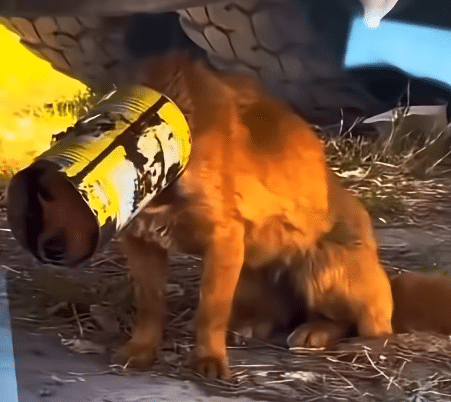
A metal bucket had become firmly lodged around his head.
It restricted his vision and made eating and drinking extremely difficult. Each attempt to move also brought the discomfort of metal pressing against his neck.
There was no easy way for him to remove it.
The more he struggled, the more helpless his situation became.
Imagine trying to find food when you can barely reach it. Imagine moving through unfamiliar surroundings without being able to see clearly.
For this dog, those were not passing difficulties.
They had become part of his daily existence.
People saw him in different corners of the neighborhood, sometimes moving through alleyways, sometimes disappearing into parking structures.
Yet whenever someone came close, he fled.
His behavior might have seemed confusing to anyone who did not understand what he had been experiencing.
He clearly needed assistance.
But accepting that assistance was another matter.
Fear had shaped his response to nearly everything around him.
Even as hunger and exhaustion weakened his body, the instinct to escape remained strong.
And each unsuccessful encounter meant another period of struggling alone.
The Search That Could Not Be Abandoned
A local rescue team, working alongside a veterinarian, began searching for the frightened dog.
They understood that removing the bucket was urgent.
His ability to eat and drink had been compromised, and the prolonged pressure against his neck had caused injuries that needed attention.
But finding him was only the beginning of the challenge.
Getting close enough to help was far more difficult.
The dog had spent so long avoiding people that approaching him could trigger another desperate escape.
Even when visibly exhausted, he still tried to run.
The rescuers had to balance two important concerns.
They needed to reach him before his condition deteriorated further.
But they also needed to avoid frightening him into another dangerous attempt to flee.
For several days, the search continued.
His movements through the neighborhood made it difficult to secure him safely. Every unsuccessful approach meant the team had to keep trying.
There was something especially painful about this situation.
The dog could not understand that the people following him were attempting to end his suffering.
From his perspective, they were simply another reason to be afraid.
And so the distance between him and the help he needed remained painfully difficult to close.
Until the search finally led to an underground parking garage.
The Underground Garage Where Everything Changed
After days of trying to reach him, rescuers managed to corner the dog inside a crowded underground parking structure.
It was the breakthrough they had been working toward.
But the moment carried a troubling realization.
The dog was no longer strong enough to make another escape.
The same exhaustion that had made his survival so uncertain had finally allowed the team to approach him.
He was frightened and trembling.
Still, the rescuers knew they needed to move carefully.
A sudden movement could increase his panic, and the metal surrounding his head made every attempt to help more complicated.
They spoke gently and approached with caution.
The veterinarian and rescue team then prepared for the delicate task of removing the object.
It could not simply be pulled away.
The bucket was fitted too tightly, and the surrounding skin had already suffered from prolonged contact with the metal.
Removing it carelessly could cause further harm.
Specialized cutting tools would be needed.
At last, after so much searching, the dog was close enough for someone to begin freeing him.
VIDEO: After Months Trapped Inside a Metal Bucket, This Frightened Stray Finally Received the Help He Needed
A Careful Rescue, One Piece of Metal at a Time
Freeing the dog required more than cutting through an unwanted object.
It required patience, concentration, and an understanding of just how vulnerable he had become.
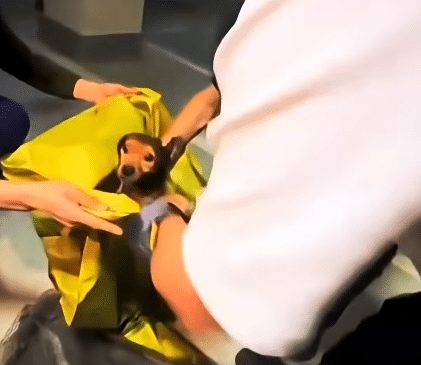
The rescuers gently restrained him to prevent sudden movements while the cutting tools were positioned.
They worked carefully.
The metal had to be separated piece by piece, with close attention to the dog's neck and head.
There was little room for error.
After months of restricted movement and discomfort, the last thing he needed was another injury during the rescue itself.
The process took several tense minutes.
The team continued methodically, making sure each movement served the purpose of freeing him without adding to his pain.
Then the final section gave way.
The bucket fell to the floor.
For the first time in what rescuers believed had been months, the dog was no longer trapped inside the metal object.
The team responded with relief.
It was the moment they had been searching and working toward.
Yet the removal of the bucket was only the first part of his recovery.
Now they could finally examine what had been hidden beneath it.
And what they found made the importance of the rescue unmistakable.
The Injuries That Had Gone Unseen
Once the bucket was removed, rescuers could see how severely the prolonged contact had affected the dog's neck.
The surrounding skin showed significant injuries and irritation.
His fur was dirty and badly tangled, particularly near the affected areas. The condition of his neck suggested that the metal had been causing considerable discomfort for a long time.
He was also extremely weak.
The difficulty of obtaining food and water had taken a serious toll on his body.
There was no way to know exactly how many days he had struggled without adequate nourishment or how often he had tried unsuccessfully to free himself.
But the physical consequences were clear.
The dog needed medical attention, proper nutrition, and a safe environment where he could rest.
Perhaps the most meaningful change was also the simplest.
His head was free.
No heavy bucket restricted his movement.
No metal barrier surrounded his face.
After so long struggling under its weight, he could finally move his head without the object holding him back.
That freedom did not erase his injuries or exhaustion.
But it gave him something he had been missing for a very long time.
A chance to begin healing.
The First Steps Toward Feeling Safe
At the rescue center, the focus shifted from reaching the dog to helping him recover.
His immediate needs were straightforward but essential.
Food.
Clean water.
Medical care.
A safe place to rest.
These were ordinary necessities that had become extraordinarily difficult for him to obtain while the bucket remained trapped around his head.
Veterinary caregivers began treating the injuries around his neck and addressing the effects of his weakened condition.
His recovery also required attention to the nutritional problems and infection described by rescuers.
The dog had endured prolonged physical stress.
Removing the bucket ended the immediate restriction, but his body still needed time and care.
Recovery could not be measured only by whether the metal was gone.
It also depended on how he responded to treatment, nourishment, and the people caring for him.
For an animal that had spent so long fleeing human contact, even a gentle approach could be unfamiliar.
The rescuers understood that his fear would not disappear simply because he had reached safety.
Trust would have to develop gradually.
There was no reason to rush that process.
The same patience that had helped the team finally reach him would remain important as he adjusted to receiving care.
A Different Kind of Healing
During his time at the rescue center, the dog's behavior began to change.
The frightened animal who once reacted to approaching people by running away slowly became more accepting of gentle human contact.
It was a meaningful shift.
For so long, a nearby person had been something to avoid.
Now human hands were providing treatment, nourishment, and comfort.
His physical condition began improving under veterinary care, while his fear gradually became less overwhelming.
These changes were not an instant transformation.
They were the early signs of an animal becoming accustomed to a safer environment.
That distinction matters.
A rescued dog does not necessarily understand immediately that the danger has passed.
The body may be free from its immediate burden while the animal remains cautious about unfamiliar experiences.
In this dog's case, the rescuers had already seen how persistent his fear could be.
He had continued trying to escape even when he was dangerously weak.
Yet with consistent care, he began to respond differently.
The urgency that once defined his movements started giving way to quieter behavior.
He no longer had to drag the bucket everywhere he went.
He could receive food and water without that same physical barrier.
And he could rest while his injuries were being treated.
The improvement was visible in the contrast between his earlier distress and the calmer moments recorded during his care.
His recovery was still a process.
But the direction of that process had changed.
He was no longer struggling alone.
What One Discarded Object Can Do
There is an important lesson in the circumstances of this rescue.
A single metal bucket became a serious danger when it trapped a vulnerable animal that could not remove it.
The dog's situation was not complicated by a mysterious illness or an unusual environment.
It began with an everyday object.
Once the bucket became lodged around his head, however, it interfered with the basic activities he needed to survive.
Eating became difficult.
Drinking became difficult.
Moving safely became difficult.
And because he was terrified of people, the ordinary act of approaching him to help became difficult as well.
The original circumstances of how the bucket became trapped were not established.
What is clear is how much suffering followed.
The rescue also demonstrates why frightened stray animals sometimes require considerable patience.
A dog that runs away from help is not necessarily rejecting kindness.
It may simply be responding to fear.
That fear can remain powerful even when the animal is hungry, injured, or exhausted.
For the rescuers, understanding his behavior was essential.
They continued searching instead of giving up after the first unsuccessful attempt.
They approached cautiously when the opportunity finally came.
And they took care to remove the metal without unnecessarily worsening his injuries.
Each step mattered.
Not because the rescue was dramatic, but because the dog depended on people taking the time to do it properly.
From Constant Fear to a Moment of Peace
The dog seen resting during treatment bears little resemblance in behavior to the frantic stray who had been running through the streets with a metal bucket surrounding his head.
The difference is not that every consequence of his ordeal has disappeared.
His healing was still underway.
But the immediate danger that had controlled his daily life was gone.
He no longer had to carry the heavy object.
He no longer had to struggle with the same obstruction while trying to eat or drink.
And he was finally receiving the attention his condition required.
The closing moments of the rescue video show a quieter animal receiving care rather than desperately trying to escape.
That simple change carries much of the story's emotional weight.
There is no confirmed account here of a permanent home or a completed recovery.
Those chapters remain beyond what the available story establishes.
What is known is already significant.
A dog who had survived for an extended period in an extremely difficult condition was finally reached by people who refused to stop trying.
The bucket was removed.
His injuries were treated.
And the fear that once shaped every encounter with people began to ease.
For months, those who caught glimpses of him saw a frightened stray disappearing through the neighborhood.
The rescuers looked beyond his attempts to run away and recognized an animal in urgent need.
Their patience gave him the opportunity to experience something different.
Not another escape.
Not another day trapped behind metal.
But rest, care, and the beginning of a safer life.
Sometimes, the most meaningful part of a rescue is not a dramatic ending.
It is the quiet sight of an exhausted animal finally able to rest without the burden it had been carrying for so long.


