
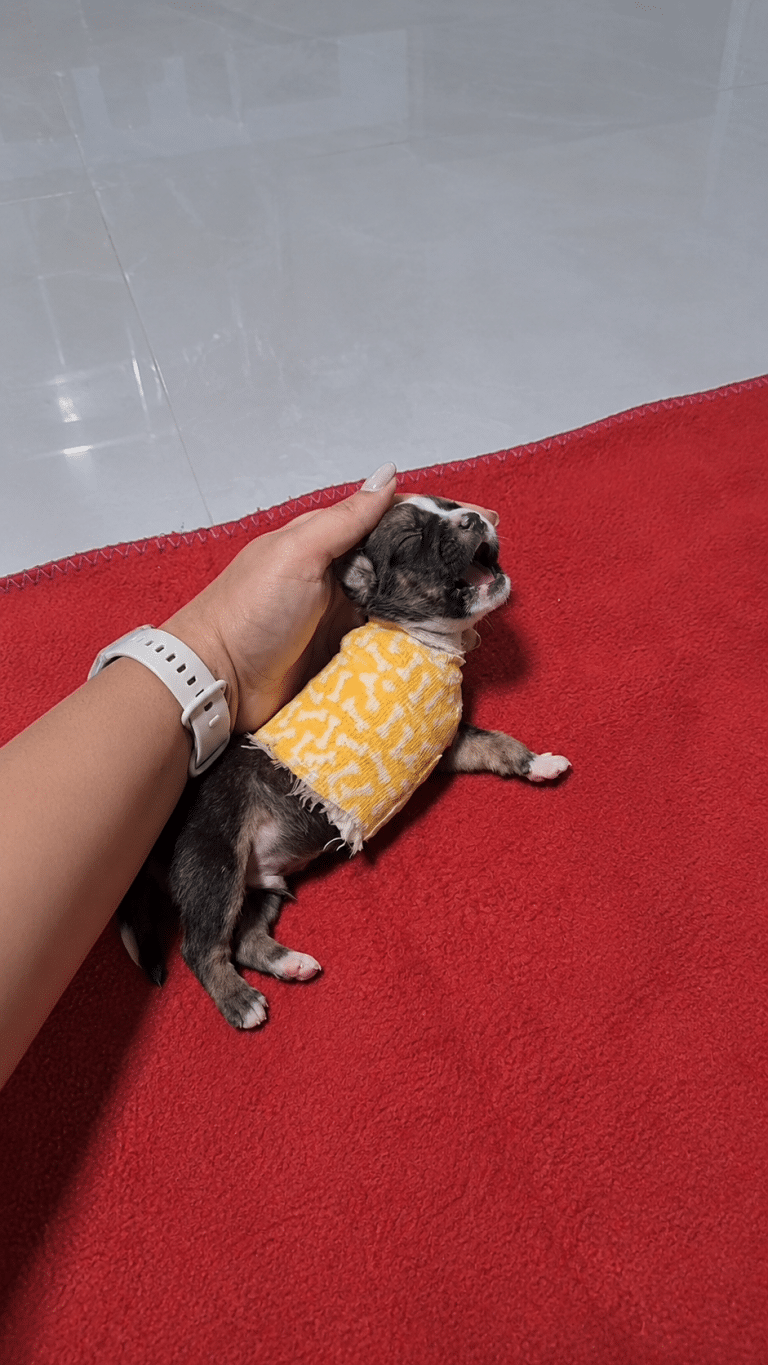
At just ten days old, Happy was lying beside a pile of garbage, too weak to move much and carrying an injury that threatened his fragile life.
He was barely old enough to understand the world around him.
At that age, a puppy should be surrounded by warmth, receiving milk regularly and spending most of his time sleeping safely.
Happy's beginning was very different.
One of his tiny legs was seriously injured. His body had little strength to spare, and even crying seemed to require more energy than he could manage.
Nobody knew how long he had been there or exactly what had happened before rescuers found him.
What was clear was that he needed help immediately.
And when someone finally brought him to safety, the challenge of keeping him alive was only beginning.
A Small Life Facing an Enormous Challenge
The rescuers who discovered Happy understood that his condition was serious.
He wasn't simply a hungry puppy who needed somewhere warm to rest. His injured leg required urgent veterinary attention, and his age made every stage of treatment especially delicate.
He was rushed to a veterinary clinic, where the medical team examined the damage.
The news was difficult.
His leg could not be saved.
To give Happy the best chance of surviving, the veterinarians needed to perform emergency surgery and amputate the damaged portion of his leg.
For such a young puppy, this was a tremendous ordeal.
But leaving the injury untreated was not a viable path toward recovery.
The decision marked the beginning of a long period of medical care, careful feeding, and close observation.
Happy had already endured more than a newborn animal should have to experience.
Now, his future depended on whether his tiny body could recover from surgery.
There were no guarantees.
Yet the people caring for him were prepared to give him the attention he needed.
The Difficult Days After Surgery
Surviving the operation did not mean Happy was suddenly out of danger.
His recovery required constant care.
Because he was still a newborn, caregivers had to bottle-feed him every two hours to help him receive the nourishment needed for growth and healing.
His medical routine also involved medication, injections, and careful cleaning of the surgical area.
These were not comfortable experiences for such a small puppy.
There were difficult nights when Happy cried and struggled to rest.
He also developed fevers during the early stages of recovery.
For those looking after him, each setback was a reminder of how vulnerable he remained.
His body was still developing. He had just undergone major surgery, and he needed time to regain strength.
Recovery could not be rushed.
Milk had to be offered regularly.
His medical needs had to be managed.
Every change in his condition mattered.
The rescuers could provide warmth, food, and treatment, but they could not know immediately whether those efforts would be enough.
That uncertainty made even the smallest improvement meaningful.
Happy's journey was not defined by one dramatic moment of rescue.
It was shaped by the steady work that followed.
The repeated feedings.
The careful attention.
The willingness to keep caring for him through the hardest days.
For a puppy who had started life in such a vulnerable condition, that consistency made an enormous difference.
When the Smallest Signs Began to Matter
At first, progress was difficult to recognize.
There was no sudden transformation.
Happy still needed medical attention, and his caregivers continued watching his condition closely.
But gradually, the pattern began to change.
He started drinking his milk more eagerly.
His weight slowly increased.
These were ordinary milestones for a growing puppy, yet in Happy's circumstances, they carried special importance.
A stronger appetite meant he was accepting the nourishment his body needed.
Gaining weight suggested that he was beginning to move beyond the most fragile stage of recovery.
Then came another encouraging sign.
His little tail started moving when the people caring for him approached.
It was a small gesture.
But after days marked by pain, fever, and uncertainty, seeing Happy respond with growing energy offered a welcome glimpse of the puppy he might become.
He was no longer only enduring treatment.
He was beginning to participate in life around him.
The injury had changed his body permanently.
It had not taken away his capacity for playfulness or affection.
VIDEO: Found at Just 10 Days Old, Happy Survived Losing a Leg and Learned to Run Again
Learning That Life Could Be Gentle
As the weeks passed, Happy experienced more of the ordinary comforts that puppies need.
Warm baths.
Soft blankets.
Toys he could explore and chew.
Gentle hands that held him close.
These experiences may sound simple, but they represented an important change from his earliest days.
The puppy once found helpless beside garbage was now receiving consistent care.
His life was no longer centered entirely on urgent medical needs.
There was room for comfort.
Room for curiosity.
And eventually, room for play.
His caregivers could see changes in both his strength and his behavior.
The puppy who had once barely been able to move was growing into a more active companion.
He began seeking attention, responding to the people around him, and showing the lively nature that had been hidden beneath his initial weakness.
His recovery was still an ongoing process.
Losing part of a leg meant that movement would require adjustments as his body grew.
But Happy was reaching a stage where he could begin discovering what he was capable of doing.
Three Legs, Many Stumbles, and a Growing Sense of Confidence
Walking presented an entirely new challenge.
Happy had to learn how to distribute his weight and balance his body with three functional legs.
At first, his efforts were unsteady.
He stumbled.
Sometimes he tilted sideways as he tried to move.
Activities that might have been straightforward for another puppy required more practice from him.
Yet his attempts continued.
As he became stronger, his movements grew more coordinated.
The frequent stumbles gradually gave way to more confident steps.
Before long, he was hopping around and following his rescuers.
He also became increasingly eager for affection, seeking cuddles from the people who had helped him through recovery.
It was a striking contrast.
The same puppy who had once been too weak to move beside a pile of garbage was now actively exploring his surroundings.
His missing limb remained part of his physical reality.
But it was no longer the only thing that defined his days.
There were toys to investigate, people to follow, and opportunities to move around with growing independence.
Happy's progress also revealed something important about dogs living with limb loss.
Their movement may look different, and their needs can vary considerably, but many can learn to adapt with appropriate support.
For Happy, that adaptation was becoming visible one step at a time.
And his caregivers were considering another possibility that could support his mobility in the future.
A New Possibility for Happy's Future
During Happy's surgical treatment, veterinarians had preserved part of his remaining limb.
This decision created the possibility that he might eventually be able to use a prosthetic leg.
A prosthetic would not undo what had happened to him.
It would not erase the difficult beginning or the challenges he had already faced.
But it offered another potential way for him to move.
For a growing dog, learning to use an artificial limb would require patience.
The device would feel unfamiliar.
His balance would need to adjust.
He would have to discover how to coordinate movements that were different from the ones he had already learned.
There was also no certainty about how quickly he would accept it.
When Happy's custom prosthetic finally arrived, that uncertainty became part of the next stage of his journey.
He had already learned to move on three legs.
Now he was being introduced to something entirely new.
The First Steps With His Prosthetic
Happy did not immediately understand his new artificial limb.
At first, he appeared confused by the unfamiliar attachment.
His movements were hesitant.
He had to adjust to the presence of the prosthetic and learn how it affected his balance.
The people caring for him approached this process patiently.
They encouraged him and used treats to help make the experience more positive.
There was no instant transformation.
Instead, progress came through repeated attempts.
A small movement.
A moment of uncertainty.
Another attempt to step forward.
Gradually, Happy began discovering how to move with the new limb.
His early steps were wobbly, but each effort gave him another opportunity to adjust.
The same determination he had shown while learning to move on three legs was evident once again.
With practice and encouragement, he became more comfortable using the prosthetic.
The change was especially meaningful because of everything that had preceded it.
Happy had survived emergency surgery as a newborn.
He had endured difficult days of medical treatment.
He had learned to balance on three legs.
And now he was learning another way to move through the world.
The prosthetic was not a magical solution.
It was a tool that, together with patient care and Happy's growing confidence, helped him take another step forward.
From a Fragile Newborn to a Playful Young Dog
Over the following months, Happy continued to grow.
The changes in his appearance and behavior became increasingly noticeable.
He was no longer the tiny, motionless puppy his rescuers had discovered.
He had become energetic, affectionate, and eager to play.
Running was now part of his life.
So was chasing after the people around him.
He could enjoy the movement and activity that had once seemed so uncertain.
And after playing, he could settle comfortably into the arms of his caregivers.
These ordinary moments were among the clearest signs of how far he had come.
His story was not simply about learning to use a prosthetic.
It was about reaching a point where his days could be filled with the experiences that make a dog's life enjoyable.
Play.
Comfort.
Attention.
The freedom to explore.
Happy had needed extraordinary care to reach these everyday pleasures.
But the result was a young dog whose personality could finally shine beyond his injury.
By Christmas, his transformation was particularly moving.
The puppy who had once been fighting to survive was now surrounded by love and receiving the care he had needed from the beginning.
His physical differences had not disappeared.
They were part of him.
But they no longer prevented him from enjoying an active, affectionate life.
What Happy's Journey Reveals About Rescue
Some animal rescues are remembered for the moment a dog is first brought to safety.
Others are remembered for the difficult recovery that follows.
Happy's experience includes both.
Finding him beside a pile of garbage was the beginning of his rescue, but it was not the end of the work.
His recovery depended on emergency veterinary treatment, regular feeding, ongoing medical attention, and weeks of patient support.
Later, helping him develop confidence on three legs became another important part of that care.
And when the opportunity arose to try a prosthetic limb, his caregivers continued supporting his progress.
There was no single act that transformed his life.
Instead, many small acts came together.
Every bottle of milk offered during his earliest days mattered.
Every effort to keep him comfortable during recovery mattered.
Every patient attempt to help him adapt to movement mattered.
His story also offers a reminder that successful rescue does not always mean returning an animal's body to the way it was before an injury.
Sometimes recovery means learning to live well with permanent differences.
Happy could not regain the leg he had lost.
But he could gain strength.
He could become comfortable with movement.
He could experience affection, playfulness, and the security of being cared for.
That is what made his transformation so meaningful.
The puppy who once had so little strength was given the opportunity to discover how much life he could still enjoy.
Happy's journey began with an uncertain future and a serious injury at just ten days old.
It continued through surgery, careful nursing, difficult nights, and gradual improvements.
And it led to something wonderfully ordinary.
A happy dog running, playing, and resting peacefully with people who loved him.
His name turned out to be a fitting one.
Not because his early life was easy.
But because the people who rescued him gave him the chance to experience happiness despite everything he had endured.
Sometimes, the deepest meaning of rescue is found not in one extraordinary moment, but in the patience to remain beside an animal until ordinary happiness becomes possible again.


