
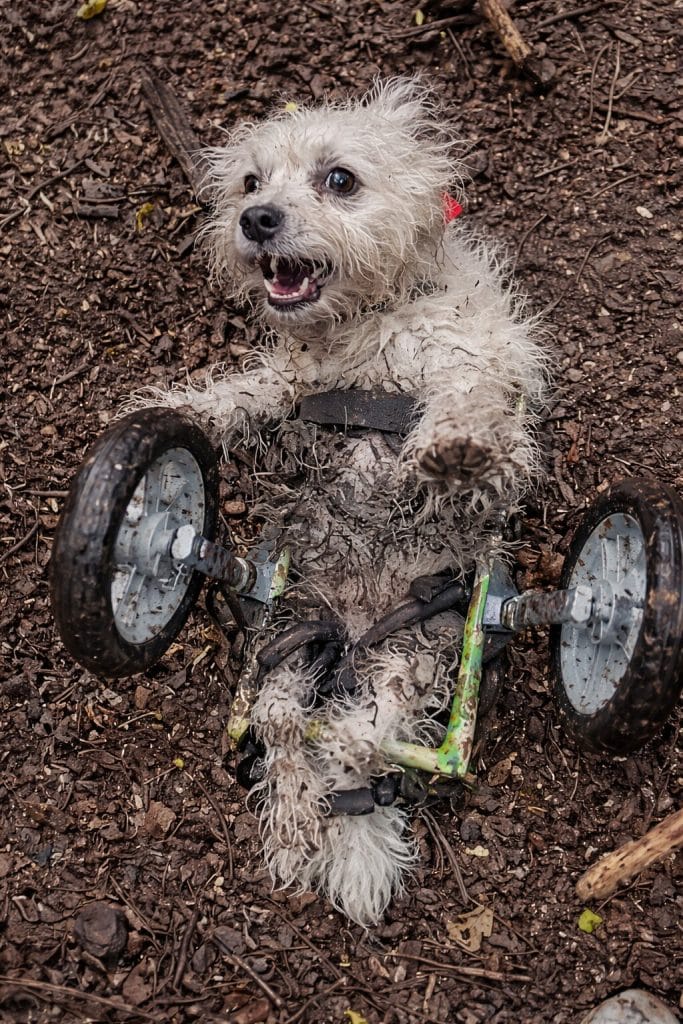
The little white dog was upside down on the forest floor, his wheelchair wheels turning helplessly above him.
For a moment, Jack couldn't go anywhere.
Then he barked.
It wasn't the frightened cry someone might expect from a dog who had suddenly lost his balance. It was a familiar call for assistance, one that his mom had learned to recognize.
And when she came to help, the moment that followed revealed something wonderful about Jack.
He wasn't finished exploring.
Not even close.
For this determined West Highland White Terrier, a fall is rarely enough to spoil an adventure. Sometimes, all he needs is someone to put his wheels back on the ground.
A Little White Terrier With an Extraordinary Love of Freedom
Jack may be small, but the way he approaches the outdoors suggests a dog with an enormous appetite for adventure.
He is a West Highland White Terrier, a breed recognizable for its compact body and fluffy white coat.
Yet there is something different about the way Jack moves.
He cannot use his back legs.
For many dogs, losing the ability to move naturally on all four legs would create significant challenges. Everyday activities could become difficult, particularly in places where the ground is uneven.
Jack has found another way to get around.
A small wheelchair supports his rear body and allows him to move forward using his front legs.
It is a simple but meaningful form of independence.
The wheelchair doesn't make every obstacle disappear. Roots, turns, and rough surfaces can still create problems. But it gives Jack the freedom to keep participating in the activities he clearly enjoys.
And few places seem to bring out that enthusiasm quite like the woods.
There, surrounded by winding trails and scattered leaves, Jack moves with remarkable energy.
He doesn't appear interested in taking the easiest possible route.
He wants to explore.
For him, the wheelchair is not something that defines the boundaries of his world.
It is what helps him move through that world.
Where Other Dogs Might Slow Down, Jack Keeps Going
The forest is hardly a perfectly smooth place for a small wheeled cart.
There are exposed roots crossing the trails, patches of uneven ground, and turns that demand careful maneuvering.
These are the kinds of obstacles that might make a person watching Jack feel a little nervous.
But Jack's response is strikingly different.
He moves quickly.
He takes corners.
He continues along the trails with the enthusiasm of a dog who has found exactly where he wants to be.
His front legs provide the motion while his small rear wheels follow behind.
The contrast is touching.
A dog who cannot use his back legs is nevertheless enjoying the movement and excitement of an outdoor adventure.
Nothing about his behavior suggests that he is spending much time worrying about what could happen if he loses his balance.
He simply keeps going.
That doesn't mean the terrain is always easy for him.
His adventures occasionally lead to a predicament that he cannot solve without help.
And when that happens, Jack has developed a wonderfully direct way of communicating.
One Wrong Turn, and Suddenly His Wheels Are in the Air
A hidden root can change everything.
So can a tight turn or a wheel catching the ground at an awkward angle.
With his small wheelchair navigating an unpredictable forest trail, Jack sometimes loses his balance.
The cart tips.
His body rolls over.
And suddenly, the same wheels that were carrying him forward are pointing into the air.
For a dog who relies on those wheels to move, being overturned creates an immediate problem.
Jack cannot simply continue along the trail.
He needs someone to help him return to an upright position.
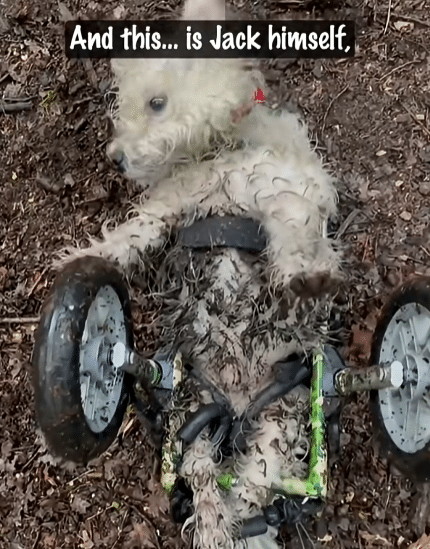
It would be easy to interpret the scene as a moment of defeat.
A little dog stuck on the ground, unable to resume the activity he was enjoying just seconds earlier.
But that isn't how Jack's story unfolds.
Instead of remaining silent, he makes himself heard.
He barks.
Loudly enough to call attention to his situation.
And the most remarkable part isn't simply that he asks for help.
It's how familiar the entire exchange appears to be.
Jack calls.
His mom responds.
And together, they solve the problem.
There is something deeply reassuring about that simple routine.
VIDEO: Jack's Wheelchair Tips Over in the Woods — His Bark Brings Mom to the Rescue
The Familiar Bark That Brings His Mom Running
Dogs communicate in countless ways.
A bark can express excitement, alertness, frustration, or a desire for attention.
In Jack's case, his mom recognizes a particular call that means he needs assistance.
When his wheelchair overturns, he doesn't have to remain stuck and hope someone eventually notices.
He has a way of making his situation known.
And he has someone who understands.
His mom comes over and gently helps him back into position.
She lifts him carefully, restores his balance, and makes sure his wheels are once again touching the ground.
It is not a complicated rescue.
There is no dramatic struggle or lengthy process.
Just a person responding to a dog who needs a little assistance.
Yet the simplicity of the moment makes it especially meaningful.
Jack's physical limitations have not prevented him from enjoying the world around him, and his mom's help allows those limitations to remain manageable during his adventures.
She doesn't need to turn every fall into a reason to end the outing.
She simply helps him get moving again.
And Jack makes his intentions clear almost immediately.
The adventure isn't over.
Seconds Later, He's Back on the Trail
Many people might expect a dog who has just overturned in his wheelchair to hesitate before continuing.
Perhaps he would pause.
Perhaps he would remain close to the person helping him.
Perhaps the experience would make him reluctant to approach another difficult stretch of ground.
Jack, however, shows little interest in slowing down.
Once his mom sets him upright and his wheelchair is balanced again, he takes off.
Back toward the trees.
Back over the uneven forest floor.
Back to the activity that had captured his attention before the interruption.
The speed of that transition is what makes the moment so memorable.
One instant, his wheels are in the air and he is calling for help.
The next, those same wheels are carrying him along the trail.
There is no visible sense of embarrassment or lingering defeat.
Jack simply resumes exploring.
For the person watching, the fall may be the most dramatic part of the experience.
For Jack, it appears to be a temporary interruption in a much more interesting day.
His eagerness to continue offers a gentle reminder that needing help and enjoying independence are not opposites.
A dog can depend on someone for assistance in one moment and still be eager to move freely in the next.
Jack demonstrates that balance with every return to the trail.
A Bond Built on Understanding, Not Restriction
One of the most beautiful parts of Jack's routine is the relationship between him and his mom.
She knows that his wheelchair makes outdoor adventures possible.
She also understands that rough terrain can occasionally cause him to overturn.
Rather than keeping him away from the places he enjoys, she stays close enough to help when necessary.
That balance matters.
Caring for a dog with mobility limitations often requires attention to both safety and quality of life.
For Jack, movement is clearly an important part of his enjoyment.
His mom's response respects that.
She doesn't treat every obstacle as proof that he should stop exploring.
She recognizes when he needs assistance, helps him, and allows him to continue.
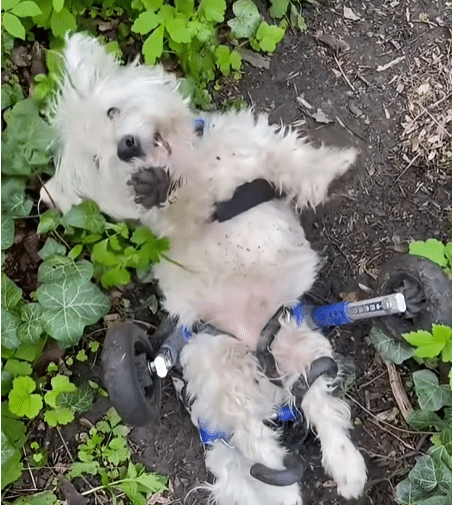
The result is a relationship that combines support with freedom.
Jack can race along the trails knowing that help is available when he gets stuck.
His mom can watch him enjoy himself while remaining ready to step in when his wheelchair needs to be righted.
It is a quiet form of teamwork.
Neither part would look quite the same without the other.
The wheelchair gives Jack mobility.
His mom provides the occasional assistance that makes his adventures easier to continue.
And Jack brings the enthusiasm.
Lots of it.
His Wheelchair Is Part of His Life, Not the Whole Story
When people first notice a dog using a wheelchair, their attention naturally goes to the equipment.
They may wonder why the dog needs it or how he manages to move.
Those are understandable questions.
But watching Jack makes it difficult to focus only on what his body cannot do.
There is so much more to see.
His eagerness to explore.
The quick movement of his front legs.
The way he approaches forest trails without appearing discouraged by the challenges they present.
And, of course, that distinctive bark when he needs someone to lend a hand.
His wheelchair is an important part of his everyday mobility, but it is not the most interesting thing about him.
What stands out is his personality.
He is energetic, determined, and clearly enthusiastic about being outdoors.
His physical condition remains real, and the occasional overturned wheelchair is a reminder that he still faces practical limitations.
But those difficulties have not taken away his opportunity to enjoy movement and exploration.
With appropriate support, Jack is able to experience the woods in his own way.
Not every dog with limited mobility will have the same abilities or needs. The equipment and assistance that work for one animal may not be suitable for another.
Jack's experience is his own.
And it is a lovely example of how mobility support and attentive care can help preserve activities that bring an animal joy.
What Jack's Little Bark Says About Trust
There is something especially moving about the fact that Jack knows how to ask for help.
He doesn't have to manage every challenge alone.
When his wheels are no longer beneath him, he makes a sound that his mom understands.
She comes to help.
And once he is upright, he goes right back to being the adventurous little terrier he was before.
That familiar exchange speaks to a bond built through attention and understanding.
His mom has learned to recognize what he needs.
Jack, in turn, appears comfortable communicating when something has gone wrong.
It is a kind of trust that doesn't require words.
Just a bark.
A gentle hand.
And a quick return to the trail.
The scene also challenges a common assumption about independence.
Being independent doesn't always mean doing absolutely everything without assistance.
Sometimes it means having the freedom to make choices, explore, and enjoy life while knowing that support is available when necessary.
For Jack, that might mean racing through the woods on his little wheels, encountering an obstacle, and calling for his mom when he can't get himself upright.
The moment of dependence doesn't erase all the freedom that came before it.
Nor does it diminish the excitement that follows.
It simply becomes one small part of the experience.
A Small Dog, a Big Adventure, and a Simple Lesson
Jack's story doesn't need a dramatic transformation to be meaningful.
He doesn't suddenly regain the use of his back legs.
His wheelchair doesn't become unnecessary.
And the forest trails don't magically become smooth.
The challenges remain.
What makes the difference is that Jack has a way to move, someone willing to assist him, and the determination to keep enjoying the world around him.
His story is not about pretending that limitations don't exist.
It is about discovering how much life can still offer when those limitations are met with practical support and love.
The image of Jack overturned on the forest floor might initially inspire concern.
But the scene that follows leaves a different impression.
His mom reaches him.
His wheels return to the ground.
And off he goes again.
It's difficult not to smile at that little white dog disappearing along the trail, eager for whatever lies ahead.
There is no need to imagine grand thoughts or heroic intentions behind his actions.
Jack is simply doing what he loves.
Exploring.
Moving.
Enjoying his freedom.
And when he needs help, he knows how to ask.
Perhaps that is the most touching part of all.
A fulfilling life doesn't have to mean never encountering obstacles. It can mean having the support to get past them and the freedom to continue doing what brings joy.
For Jack, sometimes all it takes is one bark, one helping hand, and four little wheels back on the ground.
Then the adventure begins again.


