
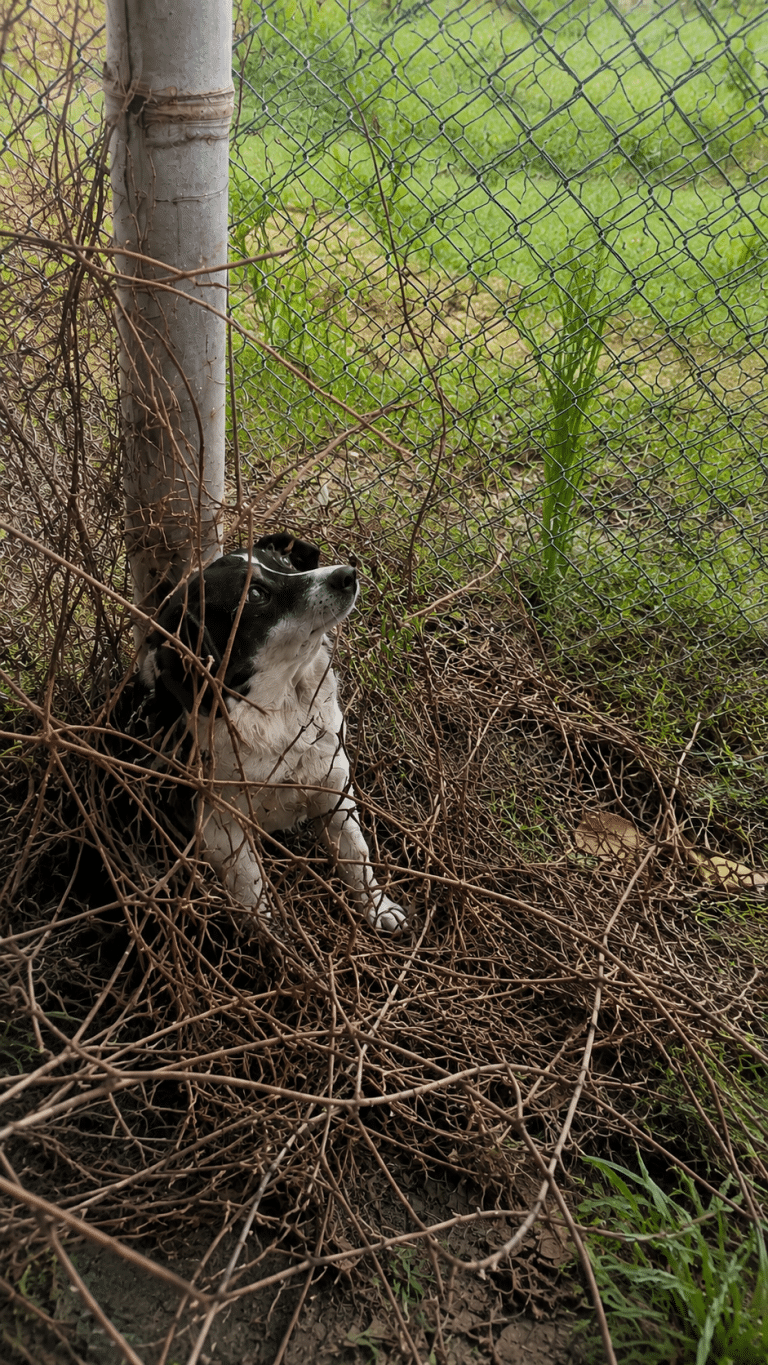
The little black-and-white dog pressed himself behind a wire fence, trembling so badly that even his attempts to appear threatening could not hide how frightened he was.
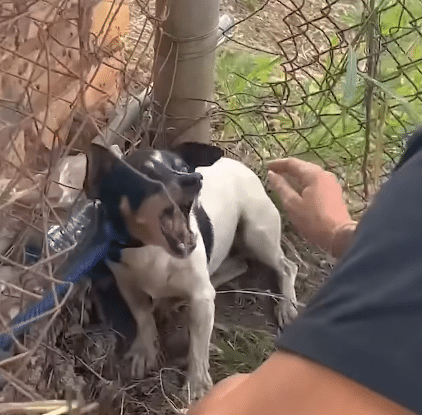
Whenever someone moved closer, he barked.
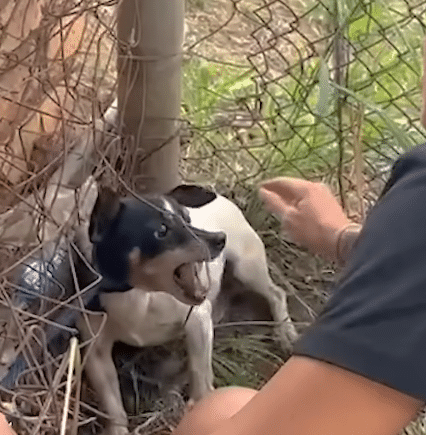
When they continued approaching, he growled and showed his teeth.
And when the distance became too small for comfort, he lunged forward as though he had no other way to protect himself.
His name was Jerri.
To someone unfamiliar with frightened animals, his behavior might have looked like aggression. But the rescuers who encountered him understood that the small dog was not trying to be difficult.
He was trying to feel safe.
And in that moment, safety seemed to mean keeping every human being as far away as possible.
Nobody knew the complete story of what Jerri had experienced before he was discovered. There was no confirmed explanation for why he reacted so strongly to people.
But one thing was painfully clear.
He had learned to expect danger where other dogs might expect affection.
Helping him would require much more than simply bringing him away from the fence.
The rescuers would have to show him, slowly and consistently, that he no longer needed to defend himself against every approaching hand.
Behind the Fence, Fear Was His Only Defense
Jerri was small enough to appear vulnerable, yet his reactions could make him seem intimidating.
His body shook.
His muscles remained tense.
His barking continued whenever someone entered the space he was trying to protect.
The contrast was difficult to ignore. Here was a little dog who appeared deeply frightened, doing everything he could to convince others to stay away.
Growling was his warning.
Showing his teeth was his boundary.
Lunging was his last attempt to keep a frightening situation from becoming even more overwhelming.
For the rescuers, understanding that distinction was essential.
A dog that growls out of fear is communicating discomfort. Punishing or overwhelming that animal can make an already difficult situation worse.
Jerri needed people who could recognize the fear beneath his behavior.
Fortunately, the team approaching him did not mistake his defensive reactions for proof that he was beyond help.
They recognized a frightened animal who needed patience.
What had happened before their arrival remained unknown. It would have been easy to imagine a painful history, but the rescuers did not need to know every detail to understand what mattered in the present.
Jerri was afraid of human contact.
That fear deserved to be taken seriously.
Leaving the Fence Did Not Mean Leaving Fear Behind
Being brought into rescue care was an important turning point for Jerri.
He was no longer the little dog hiding behind the wire barrier where he had first been discovered.
But a change of surroundings could not immediately change the way he responded to people.
At the rescue center, his anxiety remained apparent.
Unfamiliar movements unsettled him. Unexpected sounds caused him to startle. When interactions became uncomfortable, he preferred to retreat rather than move closer.
The fence was no longer the central problem.
The fear he carried was.
For dogs in Jerri's situation, a safe environment can be the beginning of recovery, but it does not automatically create a sense of security.
A person may know that an animal is finally protected.
The animal may still need time to experience that protection before it begins to relax.
That difference shaped the rescuers' approach.
Instead of demanding affection or expecting Jerri to become friendly immediately, they accepted that his progress would happen at his own pace.
There was no reason to force a frightened dog into an interaction he could not yet handle.
What he needed was the opportunity to discover that ordinary human presence did not have to lead to something unpleasant.
For Jerri, that discovery would become the foundation of everything that followed.
VIDEO: Jerri Growled and Trembled Behind a Fence — Until Patient Rescuers Helped Him Learn to Trust
A Safe Routine Began Changing What He Expected
The team understood that trust could not be created through one reassuring gesture.
It had to develop through repeated experiences.
They began providing Jerri with a quieter, more predictable environment. Caregivers used gentle voices and avoided unnecessary pressure during interactions.
These choices may have seemed simple.
But for a dog who reacted fearfully to unfamiliar movements, predictability mattered.
He needed to experience the same reassuring pattern again and again.
People could approach without frightening him.
Human voices could remain soft.
An ordinary interaction could end without anything unpleasant happening.
The rescuers did not expect him to recognize all of this immediately.
Instead, they allowed the environment to become familiar.
Gradually, the things that once seemed threatening began to lose some of their power.
One particularly important part of Jerri's care involved other rescue dogs.
The team allowed him to spend time near calm, friendly dogs who were comfortable around people.
This gave Jerri something different from direct encouragement.
It gave him the chance to observe.
He could watch another dog approach a caregiver without becoming frightened.
He could see that being touched gently did not necessarily lead to danger.
He could witness ordinary moments of companionship and play.
Nobody had to force him to participate before he was ready.
For a little dog who had responded to human contact with growling and trembling, simply being able to watch these interactions was valuable.
The other dogs provided examples of a relationship he had not yet learned to trust.
And eventually, those examples began to make a difference.
The First Signs Were So Small They Were Easy to Miss
Jerri's transformation did not begin with an enthusiastic greeting or a sudden desire to be held.
It started with changes that were much quieter.
He trembled a little less.
His expression gradually became more relaxed.
Sometimes, instead of immediately retreating when someone was nearby, he remained where he was.
Each of these moments represented a small departure from the frightened behavior rescuers had first witnessed.
There was no dramatic announcement that he had changed.
No single interaction erased everything that had made him afraid.
But the caregivers could begin to see that their patience was helping.
Jerri was becoming more comfortable with the world around him.
For someone looking only for obvious progress, those early changes might not have seemed especially important.
After all, the little dog was not yet behaving like the confident, affectionate companion he would eventually become.
But learning to remain near a person without immediately trying to escape was meaningful for an animal who had once reacted so defensively.
It meant he was beginning to tolerate something that had previously overwhelmed him.
The rescuers continued to respect his boundaries.
They did not turn every improvement into a reason to push him further.
Instead, they allowed each small step to become part of a growing sense of familiarity.
Then came a moment that showed just how far he had already traveled.
Jerri allowed a person to touch him.
Without growling.
Without lunging.
Without responding as though the contact itself were a threat.
It was a gentle, ordinary interaction.
Yet compared with the terrified dog hiding behind the fence, it represented an extraordinary change.
One Gentle Touch Meant More Than It Seemed
For many dogs, being petted is an everyday experience.
They lean into a familiar hand, enjoy a little attention, and return to whatever they were doing.
But Jerri had not begun his rescue journey with that kind of confidence.
At first, even the approach of a person was enough to make his body tense.
Now he could remain calm while someone touched him.
That difference was the result of time, consistency, and many interactions in which the rescuers had allowed him to feel more secure.
The importance of that first accepted touch was not simply that someone could finally pet him.
It was that Jerri no longer appeared to feel the same immediate need to defend himself.
He was beginning to discover another possibility.
Human contact could be gentle.
Closeness could be comfortable.
A hand reaching toward him did not always have to mean something frightening.
The rescuers continued building on that progress.
They kept offering the same patience that had helped him reach this point, allowing his confidence to develop without rushing the process.
As he became more comfortable, his defensive behavior began to fade.
The barking and snarling that had defined his earliest interactions were no longer his constant response to people.
His willingness to accept affection continued to grow.
Eventually, Jerri could be held gently in someone's arms.
For a dog who had once tried so desperately to keep humans away, that was a remarkable change.
The rescuers had not taught him that fear was unacceptable.
They had given him enough reassuring experiences that he no longer needed to rely on it in the same way.
The Little Dog Who Once Ran Away Began Running Toward People
Over time, Jerri's behavior became almost unrecognizable compared with those first moments behind the fence.
The dog who had once growled at anyone approaching him was now willing to seek out human company.
Instead of retreating whenever someone moved closer, he began running toward people with enthusiasm.
He also became more confident around other dogs.
The calm companions who had helped him observe positive human interactions were now part of a social environment he could enjoy.
Jerri played with other dogs rather than remaining overwhelmed by what was happening around him.
His expression had changed, too.
The tense, frightened look that rescuers remembered from the beginning was replaced by a softer, more relaxed appearance.
He no longer seemed controlled by the same constant anxiety.
He could participate in moments of affection and companionship that had once been too frightening for him to accept.
The significance of that transformation becomes clearer when remembering where his journey started.
Behind a wire fence.
Shaking.
Barking.
Trying to frighten away the very people who wanted to help him.
Nothing about those early reactions suggested that Jerri was incapable of becoming a loving companion.
They showed that he needed a different approach.
And when the rescuers gave him that approach, his behavior began to tell a different story.
He was no longer simply trying to keep people away.
He was learning to welcome them.
What Jerri's Journey Teaches Us About Frightened Dogs
One of the most important lessons from Jerri's experience is that an animal's behavior does not always reveal the emotion beneath it.
A growl can sound threatening.
A bark can seem hostile.
A dog showing his teeth may appear unwilling to accept help.
But those behaviors can also be signs that the animal feels overwhelmed and is trying to create distance from something frightening.
That was the distinction Jerri's rescuers recognized from the beginning.
They saw fear where someone else might have seen only aggression.
And that understanding shaped how they cared for him.
They did not expect immediate gratitude.
They did not insist that he accept affection before he was comfortable.
They gave him calm surroundings, predictable interactions, and opportunities to learn from other dogs.
Most importantly, they allowed his trust to develop gradually.
Jerri's progress also reminds us that emotional recovery is not always visible through dramatic milestones.
Sometimes it appears in a body that trembles less.
Sometimes it is a frightened animal choosing not to retreat.
Sometimes it is the first quiet moment when a dog accepts a gentle touch.
These changes may be small when considered separately.
Together, they can represent an entirely different way of experiencing the world.
Of course, not every frightened dog will respond in exactly the same way. Different animals have different histories, needs, and comfort levels.
But Jerri's experience demonstrates why patience and careful attention to behavior matter so much.
Trust cannot simply be demanded from an animal who feels unsafe.
It develops when that animal has repeated opportunities to experience safety.
From Fear to the Comfort of Being Loved
The most moving part of Jerri's story may be the contrast between two simple moments.
In the first, he was curled behind a fence, trembling and warning everyone to stay away.
In the second, he was comfortable enough to accept affection, enjoy time with other dogs, and approach people willingly.
Between those moments were countless opportunities for the rescuers to remain calm, respect his fear, and let him progress at a manageable pace.
There was no instant solution.
No single gesture that made everything better.
Just a consistent willingness to meet a frightened little dog where he was and help him move forward.
Jerri's earlier experiences remain largely unknown.
What matters is that his fear did not have to define the rest of his life.
With patient care and companionship, he developed the confidence to experience human closeness in a different way.
The hands he once feared became hands he could trust.
The people he once tried to avoid became people he was happy to approach.
And the little dog who had once seemed determined to keep the world at a distance finally found comfort in being part of it.
Jerri's journey is a reminder that frightened animals deserve understanding before judgment.
Sometimes the most meaningful act of kindness is not reaching out more quickly.
It is giving someone enough time to feel safe enough to come closer.
For Jerri, that patience opened the door to a life filled with affection, companionship, and trust.
The fence was only where rescuers first found him.
It was never where his story had to end.


