
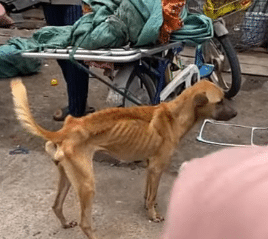
The little dog was standing beside a pile of roadside garbage, trembling so badly that keeping his balance seemed almost impossible.
His body was painfully thin. His legs shook beneath him, and there was little strength left in his small frame.
A man riding past on a motorbike nearly missed him.
Among torn garbage bags and scattered rubbish, the dog was easy to overlook. Nothing about the scene suggested that help was coming.
Yet somehow, he was still standing.
The dog would later be called Còi.
His rescue would bring him into the care of people determined to give him a chance. But his condition was far more serious than anyone could have known from that first encounter.
And the days that followed would become a painful reminder that sometimes, even when a life cannot be saved, kindness can still change its final moments.
The Small Figure Almost Hidden Among the Garbage
Còi was not running along the road or approaching strangers in search of attention.
He was simply standing near a collection of discarded rubbish, his fragile body shaking continuously.
The man passing on his motorbike might easily have continued without noticing him.
Instead, Còi was seen.
That small moment of attention mattered more than anyone could have imagined.
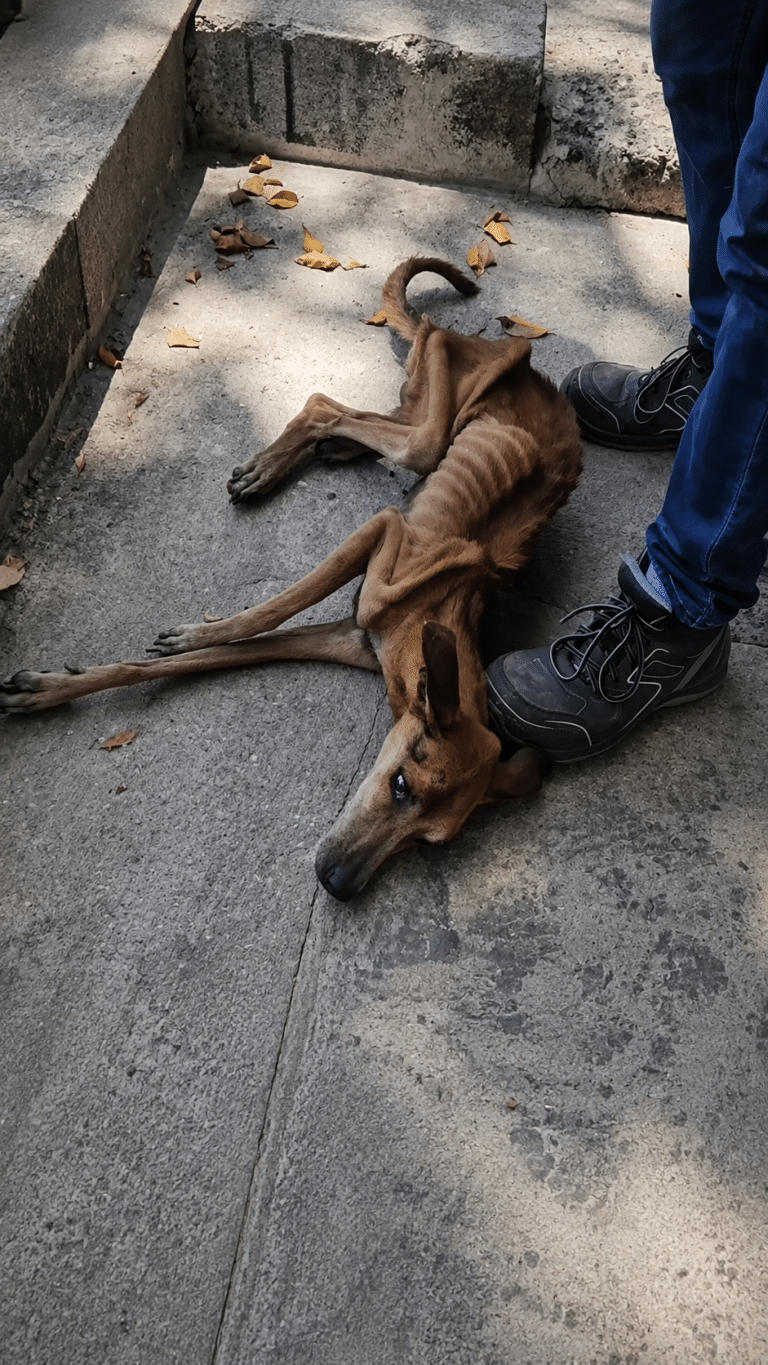
The dog's physical condition suggested that he had been struggling for some time. His ribs were clearly visible, and his body had become severely underweight.
There was no healthy energy in his movements.
Even the basic act of remaining upright appeared to require enormous effort.
His trembling was especially concerning. It was not an occasional shiver that passed after a few seconds. His weakness was persistent, leaving him looking exhausted before he had even attempted to move.
For anyone familiar with a healthy dog, the difference was impossible to ignore.
Dogs normally explore their surroundings, react to movement, and respond to the world around them.
Còi could barely stand.
And while the roadside was filled with discarded objects, the little animal beside them was not something that could simply be forgotten.
He was alive.
He needed help.
Most importantly, someone had finally noticed.
He Had an Owner, but the Care He Needed Had Never Come
As rescuers learned more about Còi's situation, another troubling detail emerged.
According to local residents, the dog belonged to a woman who collected recyclable scrap materials in the area.
He was not entirely without an owner.
But having someone who was considered responsible for him had not meant receiving the medical attention his condition required.
By the time rescuers became involved, Còi was already seriously ill.
His body had weakened to a point where ordinary care alone would not have been enough. He needed professional veterinary treatment, and he needed it urgently.
The full history of how his condition had deteriorated was not established.
What was visible, however, was the result.
A small dog stood beside roadside trash, dangerously thin and shaking, without the strength to escape his circumstances on his own.
There was something especially moving about the way he responded when people approached.
Còi did not attempt to run away.
He did not bark or resist.
When gentle hands reached toward him, he remained still and allowed himself to be touched.
Perhaps he was simply too exhausted to react.
Perhaps the quiet approach gave him some reassurance.
Whatever the reason, his response allowed rescuers to help him without a struggle.
After speaking with the woman identified as his owner, they received permission to take Còi for treatment.
It was an important turning point.
For the first time in the part of his life documented by the rescuers, his urgent needs were being addressed.
He was carefully placed into a carrier.
The roadside garbage was left behind.
And Còi was taken to a veterinary clinic, where the people caring for him hoped there was still enough time to make a difference.
A Fragile Life Reaches the Veterinary Clinic
Arriving at the clinic brought Còi into a very different environment.
There were people ready to examine him, medications that might help, and a team prepared to respond to his medical needs.
But reaching professional care did not mean the danger had passed.
The veterinarians quickly recognized that his condition was critical.
His body showed signs of severe neglect and prolonged illness. Parasites and ticks had affected him, and his physical weakness was accompanied by other alarming symptoms.
His gums and ears appeared unusually pale.
His body temperature had fallen dangerously low.
These were not minor problems that could be resolved with rest and a regular meal.
Còi needed immediate medical intervention.
The veterinary team began evaluating what was happening inside his already weakened body.
Blood testing would reveal just how serious the situation had become.
Until then, rescuers could only hope that the little dog they had brought in from the roadside still had a chance.
It was difficult to reconcile the severity of his condition with his quiet behavior.
He had allowed himself to be rescued without resistance.
He had endured the journey to the clinic.
Now he was surrounded by people who wanted him to survive.
But the most difficult part of his journey was only beginning.
VIDEO: Found Trembling Beside Roadside Trash, Còi Was Rushed to Safety as Rescuers Fought to Save Him
The Test Results Revealed How Little Time He Had
The blood test results confirmed the veterinary team's concerns.
Còi was suffering from a severe blood parasite infection.
He also had profound anemia, a condition that had left his already fragile body struggling under an extraordinary physical burden.
His pale gums, low body temperature, weakness, and persistent trembling were part of a medical picture that demanded urgent attention.
The veterinarians determined that he needed an emergency blood transfusion.
Without that intervention, his chances of survival were extremely limited.
Even with treatment, the outcome remained uncertain.
A blood transfusion offered an opportunity to support his body during the crisis. It could not erase the damage already caused by severe illness or guarantee that he would recover.
Still, the veterinary staff and rescuers continued.
They had brought Còi away from the roadside because they believed his life deserved an effort.
That belief did not change when his medical condition proved worse than expected.
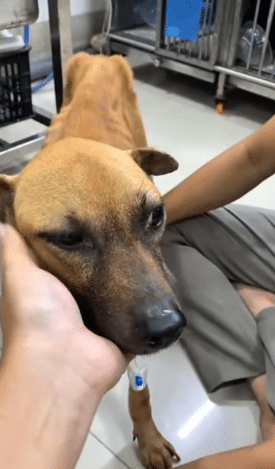
Treatment began, with the team providing medication, fluids, warmth, and close monitoring.
Each part of his care addressed a different immediate need.
His body required medical support.
His temperature needed attention.
His extreme weakness made even basic nourishment an important concern.
And throughout it all, the people caring for him understood that the next hours could be decisive.
There was no simple treatment that could instantly restore the strength he had lost.
Còi's recovery, if it happened, would depend on whether his body could respond to the medical care being provided.
The team could offer treatment.
They could offer careful attention.
They could offer him the best chance available under the circumstances.
But they could not promise that his fragile body would be able to recover.
Small Bites of Food Became Reasons to Hope
During his time at the clinic, Còi received care that went beyond urgent medical procedures.
The rescuers and veterinary staff stayed attentive to his needs, trying to keep him comfortable while treatment continued.
They also encouraged him to eat.
Small pieces of beef were offered gently by hand, a simple way to help him take in nourishment despite his weakness.
For a healthy dog, accepting food might be an ordinary moment.
For Còi, it meant something very different.
His body had so little strength that even a small interest in eating gave those around him a reason to hope.
There were moments when he responded to food.
Other times, he attempted to lift himself.
These changes were modest, but they were meaningful to the people watching over him.
It was possible, for a little while, to imagine that the treatment might be helping him turn a corner.
Nothing about his improvement was dramatic.
He did not suddenly become an energetic dog.
He did not recover enough to walk confidently out of the clinic.
Instead, his caregivers watched for the smallest signs that he still had the strength to continue.
A little movement.
An interest in another bite.
An effort to raise his weakened body.
When an animal is critically ill, moments like these can become important measures of hope.
Còi was receiving the support he had needed so desperately before his rescue.
And although nobody knew whether it would be enough, he was no longer facing his illness without medical attention.
That was a meaningful change.
For the rescuers, the work was about more than seeing an immediate recovery.
It was about making sure that Còi received care while there was still a chance to help him.
Even when his progress was uncertain, they continued to provide the attention his condition demanded.
When Hope Could No Longer Overcome His Illness
Despite the transfusions, medication, and continuous care, Còi's condition remained extremely serious.
The moments of improvement did not develop into a lasting recovery.
His strength began fading again.
The little dog who had arrived from the roadside was still fighting the effects of a severe illness, and his body had already endured an enormous amount of physical stress.
Those caring for him had done what they could.
They had brought him to a clinic.
They had secured emergency medical treatment.
They had helped him eat when he showed interest.
They had provided warmth and careful attention while hoping for signs of recovery.
But not every rescue ends with a dog regaining its strength.
Sometimes, medical care arrives when an illness has already progressed too far.
That was the painful reality facing Còi.
After two days of treatment, he passed away.
The rescue had not ended in the recovery everyone had hoped to see.
There would be no happy photograph of Còi running through a garden.
No account of him growing stronger over the following weeks.
No new home waiting at the end of a long rehabilitation.
His life came to an end at the clinic, despite the efforts made to save him.
It was a deeply sad outcome.
But it was not the same ending he might have faced if nobody had stopped beside that pile of roadside rubbish.
During his final days, Còi had been seen, carried to safety, medically examined, and cared for by people who recognized that his life mattered.
He had experienced the gentleness of people trying to help him.
He had been offered food by hand.
He had been kept warm.
And he had not spent those last days alone beside the garbage where he was found.
That distinction could not take away the grief of losing him.
But it gave his rescue a meaning that extended beyond the outcome of his treatment.
A Quiet Farewell for a Dog Who Deserved Better
After Còi passed away, the people who had cared for him prepared a peaceful resting place.
Flowers and soft blankets were arranged around him.
It was a quiet gesture of respect for an animal whose life had ended far too soon.
There was no way to undo the illness he had endured.
No way to give him back the strength he had lost.
And no way to turn those final two days into the long, healthy life his rescuers had wanted for him.
But they could still honor him.
They could make sure his passing was treated with dignity rather than indifference.
The flowers and blankets could not change what had happened.
They represented something simpler and deeply human: the belief that even a small, vulnerable animal deserves tenderness and respect.
Còi's farewell stood in painful contrast to the place where he had been discovered.
At the roadside, he had been surrounded by scattered rubbish, barely able to remain standing.
At the end of his life, he was surrounded by signs of care.
The difference was not a miracle recovery.
It was compassion.
The Kindness He Received Still Matters
Còi's story is difficult because it does not offer the ending people naturally wish for when they read about an animal being rescued.
There is no complete transformation from a desperately ill dog into a healthy companion.
No joyful reunion.
No adoption celebration.
Instead, his story asks us to recognize another part of rescue work that is often less visible.
Sometimes, the opportunity to save an animal comes too late for treatment to succeed.
That does not make the decision to help meaningless.
Còi was suffering when he was discovered beside the road.
His condition required urgent attention, and without someone stepping forward, he might never have received the examination and treatment he needed.
The man who noticed him helped bring attention to an animal who was easy to overlook.
The rescuers took responsibility for getting him to professional care.
The veterinary team responded to a serious medical emergency.
And throughout his final days, Còi was treated as a life worth caring for.
His story also raises an important question about the responsibility people have toward animals in their care.
Having an owner does not automatically mean an animal's needs are being met.
When a dog becomes severely underweight, weak, or visibly ill, timely veterinary attention can be essential.
Waiting until an animal can barely stand may leave far fewer treatment options available.
Còi's experience is a painful example of why changes in an animal's health should never be ignored.
At the same time, his story reminds us how much can begin with one person paying attention.
The motorcyclist could have passed without noticing the trembling dog.
Instead, Còi became visible to people who were willing to help.
They could not give him a new life.
But they could give him care during the little time he had left.
There is no need to describe that as a miracle.
It was an act of kindness, offered when kindness was desperately needed.
And perhaps that is what makes Còi's story so difficult to forget.
He was a small dog standing beside a pile of rubbish, too weak to stop shaking.
For a long time, the care he needed had not reached him.
Then someone finally saw him.
Although his life could not be saved, his final days were no longer defined solely by illness and isolation.
They also held warmth, gentle hands, and the determined efforts of people who wanted him to live.
Còi deserved more time.
He deserved to experience good health and the simple comforts every dog should know.
That future never came.
But in the end, he was not treated as something forgotten beside the road.
He was treated as someone worth saving.
And when saving him was no longer possible, he was still worthy of love.


