
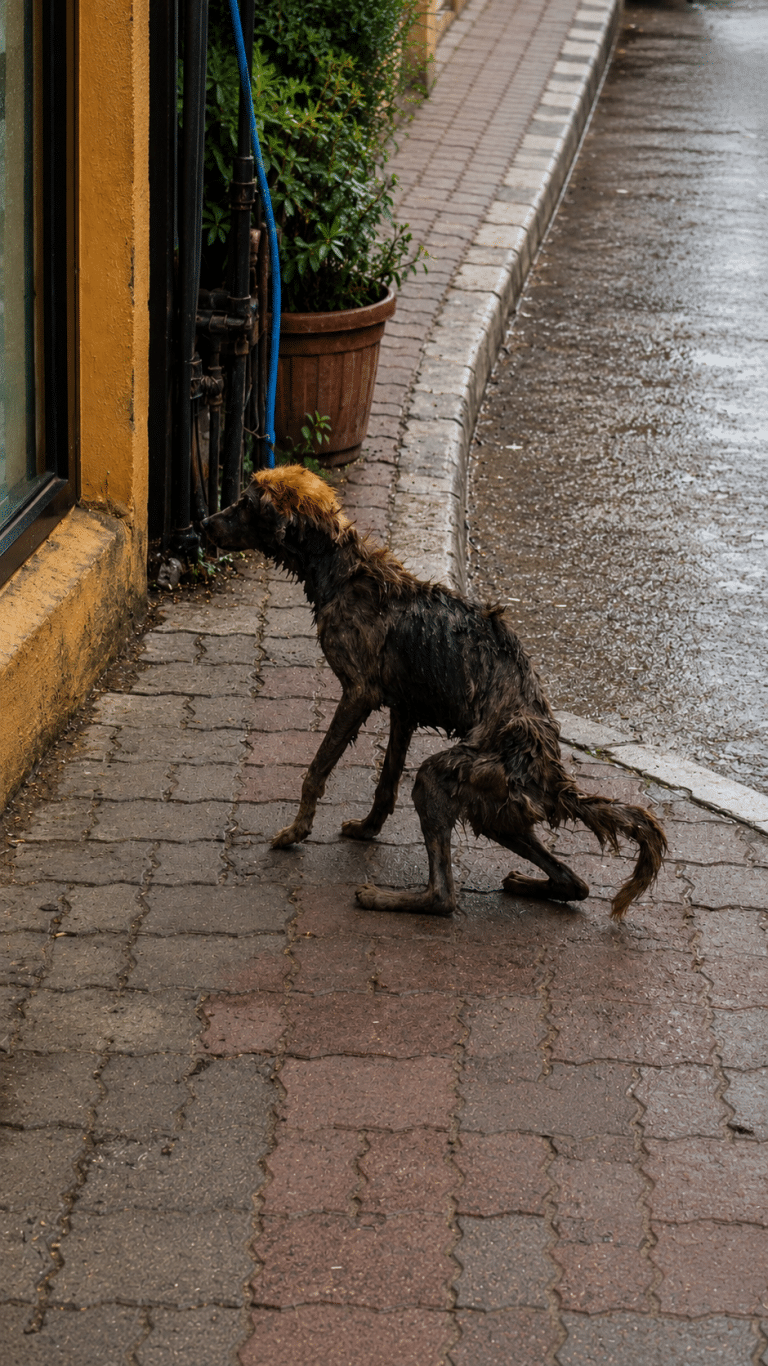
Maddie was only a short distance from a stranger’s door when she stopped moving forward.
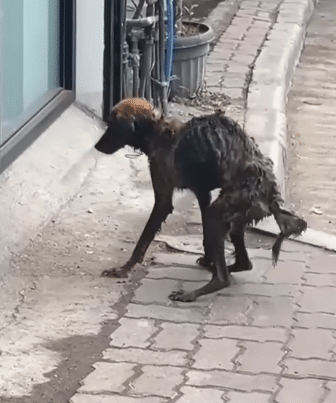
She had somehow reached the area outside a home, but she appeared too frightened to approach any closer. Her thin body trembled, her skin was irritated, and much of her fur was gone.
Eventually, she curled up on the ground.
There was no dramatic attempt to attract attention. No determined walk toward the doorway. Just a severely weakened dog lying quietly within sight of a place where someone might notice her.
Nobody knew how long Maddie had been surviving alone on the streets. Nobody could say what experiences had made her so fearful of people.
But one thing was painfully clear.
She needed help, and she had very little strength left to find it.
The Little Dog Who Stopped Outside a Stranger’s Home
By the time Maddie was discovered, her physical condition suggested that she had been struggling for some time.
Her body was extremely thin. Large areas of irritated skin had lost their protective covering of fur, and parasites had added to her discomfort.
Even ordinary movement appeared exhausting.
For a healthy dog, walking a few more steps toward a house might have meant very little. For Maddie, it had become a difficult choice between approaching unfamiliar people and remaining where she was.
She stayed back.
It was impossible to know exactly what she had experienced before arriving there. Perhaps she had been frightened away from other places. Perhaps repeated encounters with people had taught her to keep her distance.
Those possibilities remained unanswered.
What rescuers could see was a dog whose fear had not disappeared simply because she desperately needed assistance.
She seemed caught between two powerful instincts.
The need to survive.
And the urge to escape anything unfamiliar.
The result was a quiet, troubling scene: a vulnerable animal resting outside a home, close enough to be seen but seemingly unable to ask for the help she needed.
Fortunately, someone did notice.
A Passing Stranger Made the Call That Changed Everything
A passerby spotted Maddie lying outside the property and recognized that her condition required attention.
Instead of ignoring her, the person recorded a short video and contacted Stray Paws Animals Rescue.
That decision gave Maddie something she had been missing during her time on the streets: an opportunity for people to intervene.
When rescuers reached the area near Khan’s Tofu Shop, where Maddie had previously been seen, they quickly understood how serious her situation was.
She was visibly underweight, physically depleted, and extremely frightened.
Yet even in that weakened state, Maddie tried to get away.
Her trembling body struggled to move beyond the rescuers' reach. The people approaching her intended to help, but she had no way of understanding their intentions.
Her reaction was not a sign that she was dangerous.
It showed how difficult human contact had become for her.
The rescue therefore required more than simply picking her up.
It required patience.
The rescuers avoided sudden movements and approached slowly, speaking to Maddie in gentle tones. They allowed the frightened dog time to adjust to their presence while working to secure her safely.
For Maddie, every unfamiliar movement seemed to matter.
She had already reached a point where standing and moving were difficult, yet fear continued to drive her attempts to retreat.
Eventually, the team managed to place her carefully inside a transport crate.
It was a necessary step, but also a significant turning point.
Maddie was no longer lying outside the stranger’s home without assistance. She was finally on her way to veterinary care.
The road ahead was uncertain, and her rescuers still did not know whether she would recover.
But her circumstances had changed.
For the first time in this part of her story, people were taking responsibility for helping her survive.
VIDEO: Too Weak to Keep Walking and Too Frightened to Approach — Maddie’s Rescue Begins
The Medical Examination Revealed How Much She Had Endured
At the veterinary clinic, the examination confirmed that Maddie needed urgent treatment.
Her malnutrition was severe, and she was dangerously dehydrated. Her body was struggling with several health problems at once, leaving little reserve for recovery.
Veterinarians identified hookworms, blood parasites, and serious digestive difficulties.
They also found fragments of chicken bones in her stool.
That detail offered a troubling glimpse into her life before rescue. It suggested that Maddie had been surviving, at least in part, on discarded food rather than reliable, nourishing meals.
The clinic could not reconstruct every day she had spent alone.
But the evidence of prolonged hardship was difficult to overlook.
Her temperature was unstable, and she responded very little when touched.
These findings made the immediate priority clear: Maddie needed stabilization, nutrition, medical treatment, and careful observation.
The veterinary team began providing fluids, antibiotics, and supplements as part of her care.
Because she was so weak, caregivers also helped her eat using a syringe.
Warm blankets were used to support her while the team monitored her fragile condition.
There was no instant transformation.
No sudden return of energy.
Maddie had reached the clinic alive, but the following days remained deeply uncertain.
Her body needed time to respond to treatment. Addressing her dehydration was only one part of the challenge. The parasites, digestive problems, poor nutritional state, and extensive skin discomfort all required attention.
Even as caregivers worked to stabilize her, they could not guarantee the outcome.
That uncertainty made every small change important.
For a dog in Maddie’s condition, recovery would not be measured by one dramatic event.
It would be measured through ordinary things that had become difficult: accepting food, responding to people, holding up her head, and gradually finding enough strength to move again.
The rescue had removed her from immediate danger on the streets.
Now the slower work of healing had begun.
A Few Bites of Chicken Became a Reason to Hope
After several days of intensive care, Maddie did something that marked a meaningful change in her recovery.
She ate a few small pieces of boiled chicken on her own.
It was a simple action.
There was no great distance traveled and no sudden burst of energy. She was still fragile and still needed medical attention.
But she had managed to eat without being fed by syringe.
For the people caring for her, that small achievement mattered enormously.
Until then, Maddie had depended heavily on assistance to receive the nourishment her body needed. Eating voluntarily was an encouraging sign that her condition was beginning to improve.
Her progress continued through a series of small but important changes.
Medicated baths helped remove the parasites affecting her skin. The irritation that had caused so much discomfort was receiving consistent treatment.
Her eyes gradually appeared brighter.
She began lifting her head when caregivers entered the room.
These were not the dramatic milestones people usually imagine when thinking about a rescued animal's transformation.
They were quieter than that.
A little more awareness.
A little more interest in her surroundings.
A little more energy for the ordinary movements that had once seemed almost beyond her ability.
Each improvement suggested that Maddie was responding to the care she had received.
It also showed why recovery could not be rushed.
A severely malnourished dog does not regain health simply because food and shelter become available. Maddie's body had been placed under considerable strain, and rebuilding her strength required ongoing veterinary attention.
The team continued monitoring her condition while supporting her nutritional needs.
Gradually, the dog who had barely reacted to touch began showing more signs of engagement with the world around her.
Her progress was slow.
But it was progress.
And after the uncertainty of those first days, that was enough to give her caregivers renewed hope.
Learning to Walk Again, One Careful Step at a Time
As the weeks passed, Maddie continued making improvements.
Her appetite became more consistent, allowing her to move toward more substantial meals.
The discharge that had affected her eyes and nose gradually cleared.
Her overall condition was improving, but the effects of her earlier weakness had not disappeared.
Her legs still struggled to support her.
For an animal recovering from severe malnutrition, even a short movement can demand considerable effort. Maddie needed help rebuilding the ability to walk comfortably.
Her rescuers began using a supportive harness during walking exercises.
The harness allowed them to assist her while she attempted to move her weakened legs.
Each step was modest.
Each attempt required effort.
There was no reason to expect an immediate return to normal movement, and the rescue team continued supporting her at a pace her body could manage.
Maddie kept trying.
That persistence became one of the most encouraging parts of her recovery.
The dog who had once been too exhausted to continue outside a stranger’s home was now making assisted attempts to walk again.
She still had limitations, but she was no longer in the same condition in which rescuers had found her.
Veterinarians also began deworming treatment as part of the continuing effort to address the parasites affecting her health.
Her rehabilitation involved several connected needs.
She required nourishing food to rebuild her depleted body.
She needed treatment for the medical problems identified at the clinic.
She needed assistance with movement while her legs remained weak.
And just as importantly, she needed a safe environment where people could approach her without becoming another source of fear.
Those needs were different, but none could be ignored.
Physical recovery and emotional adjustment were unfolding together.
The Fear in Her Eyes Slowly Began to Fade
Maddie’s early reaction to her rescuers had been unmistakable.
She trembled and tried to escape, even though she had barely enough strength to move.
At that moment, the presence of people appeared frightening rather than reassuring.
Her behavior began changing as her treatment continued.
She started raising her head when caregivers came into the room. Her growing appetite showed that eating was becoming easier. Her improving physical condition gave her more opportunities to respond to the care around her.
Trust was not something anyone could demand from Maddie.
It had to develop through repeated experiences of safety.
The gentle approach used during her rescue was only the beginning. In the clinic, she received ongoing attention from people who were trying to make her comfortable while addressing her medical needs.
Over time, her behavior showed a growing willingness to engage with her surroundings.
The difference was especially meaningful when compared with those first moments outside the house.
Then, human contact had prompted an attempt to flee.
Now, caregivers entering the room could draw her attention.
It would be impossible to know precisely what Maddie understood or felt.
But the visible changes were encouraging.
She was becoming more responsive, more comfortable, and stronger.
Her recovery was not simply a matter of looking healthier. It was also about having the chance to experience human contact under circumstances very different from those she had faced on the streets.
She no longer had to search through discarded scraps for food.
She no longer had to remain outside an unfamiliar home, too frightened to approach.
She had regular care and people attending to her needs.
Those changes provided the foundation for the progress that followed.
A Different Life for the Dog Who Once Waited in Silence
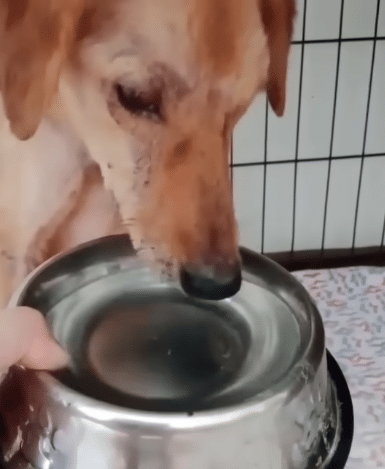
The latest update in Maddie’s story describes a dog who is finally safe and continuing to enjoy the benefits of her recovery.
She can sit comfortably without assistance.
She eats eagerly.
And the defeated appearance that concerned her rescuers when they first found her has gradually given way to a more alert, curious expression.
These changes carry particular meaning because of how severe her condition had been.
When Maddie was discovered, she had almost no energy to spare. Her body was affected by malnutrition, parasites, dehydration, and extensive skin irritation.
She needed emergency treatment merely to begin stabilizing.
Now, ordinary activities have become signs of how far she has come.
Sitting comfortably.
Eating with enthusiasm.
Showing interest in the people around her.
The transformation did not happen overnight, and her story does not require an exaggerated ending to be meaningful.
The confirmed progress is powerful enough.
There is also an important distinction between rescue and recovery.
Removing an animal from danger may be the first urgent step, but it does not automatically restore everything that has been lost.
Maddie needed medical treatment, nutritional support, help with movement, and time to become more comfortable around people.
Her rescuers provided those things without expecting immediate results.
Some days, progress could be seen in a small amount of food eaten independently.
At other times, it appeared in the movement of her head or a carefully supported step.
Eventually, those small achievements became part of a much larger change.
The frightened stray who once lay motionless outside a stranger’s home became a dog capable of sitting comfortably, eating eagerly, and responding to her surroundings with growing curiosity.
There is no need to invent an adoption or a perfect future to recognize what Maddie has already gained.
She is safe.
She has received treatment.
And she has been given the opportunity to continue healing.
Sometimes Kindness Begins With Simply Noticing
Perhaps the most memorable part of Maddie’s story is how quietly it began.
She did not arrive at a rescue center seeking attention.
She did not approach a stranger confidently.
She stopped outside a home, frightened and exhausted, with little strength left.
Someone happened to see her.
That person recorded her condition and reached out for help, setting in motion the rescue that brought Maddie to veterinary care.
From there, her recovery depended on many small acts of patience.
The rescuers who approached without rushing.
The veterinary professionals who treated her serious health problems.
The caregivers who helped her eat when she could not manage alone.
And the people who supported her as she gradually regained the strength to move.
None of those efforts offered an instant solution.
Together, they changed what was possible for Maddie.
Her story is a reminder that frightened animals do not always respond to kindness in ways people expect. Some run away. Some freeze. Others remain quiet because they are too weak to do anything else.
Fear does not mean an animal is beyond help.
And a slow recovery does not make that recovery any less worthwhile.
Maddie's future beyond the reported recovery remains unknown. What is certain is that she no longer faces the same immediate hardship that brought her to a stranger's home.
The little dog who once stopped several feet short of a doorway has discovered a safer world through the care of the people who refused to overlook her.
Sometimes, a second chance begins without a sound.
It begins when someone notices a life in need — and chooses not to walk away.


