
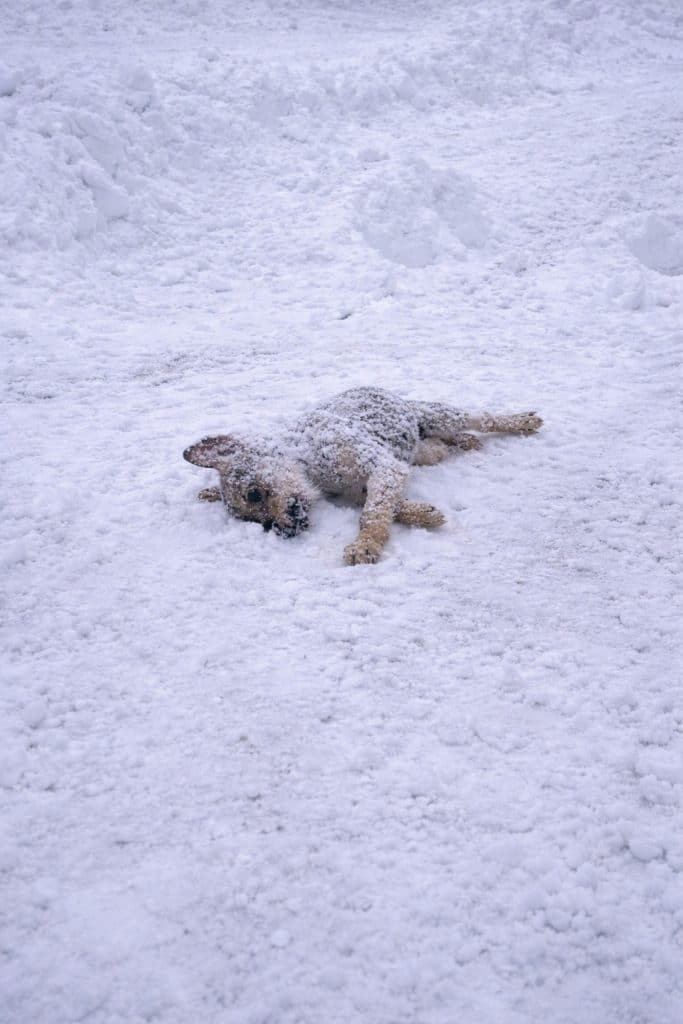
The puppy was so small that rescuers almost missed him among the scattered trash.
In the cold darkness, his little body trembled. Every so often, a faint cry broke the silence, barely loud enough to reveal where he was hiding.
He was injured, exhausted, and completely alone.
The rescuers did not yet know his name. They did not know how much he had endured or whether he could survive the injuries that had left him so helpless.
They knew only that he needed help immediately.
That frightened little puppy would eventually be called Hana. And although nobody could have predicted it during that first desperate night, his journey would lead from emergency surgery to something his caregivers had almost been afraid to hope for.
The chance to stand on his own feet again.
A Faint Cry in the Cold Darkness
The search began with an urgent message shared in a local animal rescue group.
A concerned resident reported that a small stray puppy had been attacked by a neighbor's dog. According to the information provided, the injured animal had then been taken away and left somewhere nearby.
The report offered few details.
There was no precise location, and nobody could say exactly how long the puppy had been alone.
For the rescuers, that uncertainty was deeply troubling.
An injured puppy, particularly one so young and small, could deteriorate quickly without proper care. Exposure to the cold added another concern, especially when his physical condition was still unknown.
Rather than waiting for more information, the rescuers began searching.
They moved through the area carefully, examining dark corners and places where a frightened animal might have ended up. Their calls were gentle, intended to help them locate the puppy without causing further distress.
For a while, they found nothing.
The darkness made the search difficult, and the vague directions offered little reassurance.
Then came the sound they had been hoping to hear.
A weak, almost disappearing cry.
Following it, the rescuers discovered a tiny puppy curled up among discarded rubbish.
His body was shaking. He appeared barely able to respond to the people approaching him.
There was nothing dramatic about his attempt to attract attention.
He simply cried.
And someone finally heard him.
In that moment, the search was over, but the struggle to keep him alive had only begun.
From a Pile of Trash to an Emergency Clinic
Seeing the puppy up close made the seriousness of the situation impossible to ignore.
He was cold, visibly weak, and showing signs of significant injury.
The rescuers had no way of knowing the full extent of the damage without veterinary examination. Even so, it was clear that delaying treatment could place him in greater danger.
They wrapped him carefully in a blanket and arranged for him to receive emergency medical attention.
The change in his surroundings was immediate.
Instead of remaining exposed to the cold, Hana was now surrounded by people working to give him a chance.
But warmth alone could not resolve what had happened to his little body.
At the veterinary clinic, the medical team began examining him and performed X-rays to better understand his injuries.
The findings were serious.
Hana had suffered severe trauma to his head, affecting his condition and the way his body responded.
The veterinary team determined that emergency surgery was necessary.
For the people who had rescued him, the news was frightening. They had managed to bring him out of the darkness, yet there was no assurance that he would survive the treatment ahead.
Hana was exceptionally small.
His body had already been weakened by the injuries and the shock of what he had experienced.
Every stage of his care required close attention.
There was no simple solution and no promise of a quick recovery.
Only a difficult medical procedure, a vulnerable little patient, and a group of people unwilling to abandon him.
Two Hours That Could Change His Future
The operation required delicate work from the veterinary team.
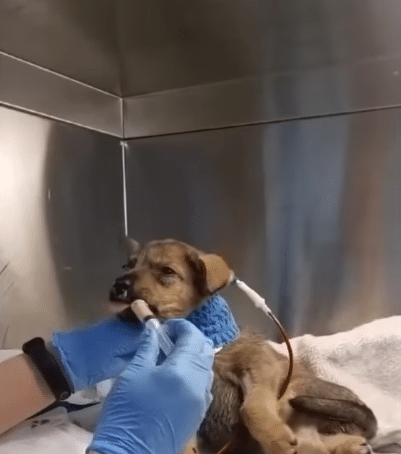
Alongside the surgical treatment, Hana received a blood transfusion to help support his weakened condition.
For a puppy of his size, the seriousness of the situation made the process especially concerning.
While the veterinarians worked, the rescuers could only wait.
They had already witnessed how fragile he was when they found him. Now they had to trust that the treatment would give his body enough support to continue fighting.
Nearly two hours passed before a small but meaningful change appeared.
Hana began showing signs of responsiveness.
There was slight movement and a reaction to the voices around him.
It was not proof that every danger had passed. His condition remained delicate, and the coming days would still require careful monitoring.
But he had made it through an important stage.
For the rescuers, that was enough to offer a measure of relief.
Around this time, the tiny puppy received the name Hana.
Until then, he had been an unidentified stray whose suffering had reached people through an urgent message.
Now he had a name that his caregivers could use while accompanying him through recovery.
He was no longer simply the injured puppy someone had reported.
He was Hana.
And his story was still unfolding.
VIDEO: Tiny Hana Was Found Freezing and Badly Injured — Watch His Fight to Stand and Walk Again
The Smallest Signs of Improvement Meant Everything
Surviving emergency surgery was an important achievement, but it was not the same as being fully recovered.
Hana remained under veterinary supervision during the days that followed.
His caregivers continued monitoring his condition, including his ability to maintain body temperature and respond to his surroundings.
At this stage, recovery could not be measured through dramatic changes.
It was found in much smaller signs.
His breathing became steadier.
His reactions gradually grew stronger.
There were moments when he appeared more aware of the people caring for him.
Each improvement mattered because of how seriously he had been injured.
The puppy who had barely been able to move when rescuers discovered him was slowly showing that his body could respond to treatment.
Still, the process required patience.
There was no reason to rush him.
He needed medical attention, warmth, appropriate nourishment, and time to regain strength.
Three days after surgery, Hana reached another encouraging milestone.
He managed to drink a little milk.
For a healthy puppy, drinking milk might seem like an ordinary activity. For Hana, following such a difficult medical emergency, it represented meaningful progress.
His caregivers had been watching for signs that his body was becoming stronger.
Now he could take in a small amount of nourishment.
It was a modest step, but an important one.
The people looking after him continued providing medicine, gentle handling, and a stable environment.
They understood that his recovery would not move forward at the same speed every day.
There could be progress followed by periods when he needed more rest.
What mattered was ensuring he received consistent care without demanding more than his fragile body could manage.
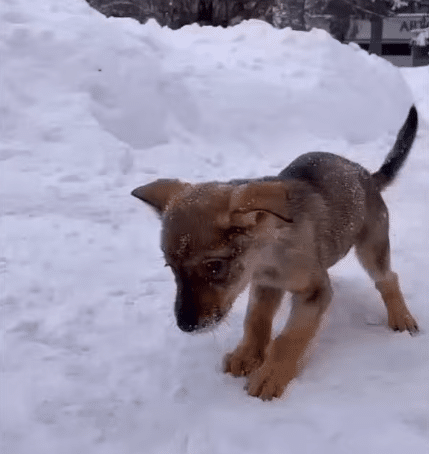
There is a particular kind of patience involved in caring for an animal recovering from serious trauma.
The animal cannot explain where it hurts.
It cannot describe what feels different.
And it cannot understand why treatment, examinations, and unfamiliar surroundings are necessary.
Caregivers must rely on careful observation and veterinary guidance while allowing the animal enough time to recover.
For Hana, that meant celebrating progress that might have seemed insignificant to someone unfamiliar with his condition.
A stronger response was encouraging.
A little more awareness was encouraging.
The ability to drink milk was encouraging.
None of these moments meant the struggle was finished.
Together, however, they showed that the puppy was beginning to move in a better direction.
Ten Days Later, a Different Kind of Healing Began
Ten days after his operation, Hana had improved enough to leave the veterinary clinic.
This was another major transition in his recovery.
He no longer needed to remain hospitalized, but his condition still required attention. Continued monitoring, medication, and supportive care were necessary as his body healed.
The change of environment offered something valuable.
A warm and secure place to rest.
Soft bedding.
Regular nourishment.
And familiar people providing gentle, consistent care.
Those things might appear simple, but they represented a profound difference from the circumstances in which rescuers first discovered him.
Hana had been found trembling among rubbish, with no immediate protection from the cold.
Now his daily routine was centered around helping him recover.
There were no expectations that he should immediately behave like a healthy, energetic puppy.
His caregivers allowed his strength to return gradually.
His experience had also made trust an important part of the healing process.
As the days passed, Hana became more familiar with the voices and hands around him.
Being lifted or touched no longer always needed to be associated with an unfamiliar, frightening experience.
Gentle attention became part of his routine.
That growing familiarity mattered.
An animal recovering from a traumatic event needs more than the absence of danger. It also benefits from predictable, compassionate care that allows it to feel increasingly secure.
For Hana, this meant spending time in an environment where his needs were met and his progress was watched closely.
His life had become quieter.
But the most remarkable part of his recovery had not happened yet.
The Difficult Work of Learning to Stand
As Hana's general condition improved, attention increasingly turned toward his movement.
Veterinary follow-up examinations revealed encouraging changes.
His eyes appeared brighter.
His awareness had improved.
His legs were beginning to respond with greater strength.
Yet standing remained difficult.
The effects of his injuries had left him struggling with coordination and balance. His weakened muscles also needed time to regain the strength required for ordinary movement.
Something as simple as supporting his own body could become an exhausting effort.
Hana would attempt to push himself upward.
For a brief moment, it might look as though he could manage.
Then his balance would fail, and he would settle back down.
The process was slow.
His caregivers could see that he was making an effort, even when the movement did not end with him standing successfully.
They continued supporting him gently during these attempts, giving him help when needed and allowing him to rest when he became tired.
There was no benefit in forcing his body to move faster than it was ready to.
Recovery required him to regain both strength and coordination.
That meant giving him repeated opportunities to try while respecting his physical limits.
Some days, the changes were barely noticeable.
On others, a slightly stronger movement offered reason for optimism.
His caregivers continued following his progress, understanding that the ability to walk independently might still be some distance away.
Hana's determination was visible in the simple fact that he kept attempting to rise.
He did not need to make a perfect movement for it to matter.
He only needed the chance to continue improving.
And with steady care, that chance remained open.
One Month After His Rescue, Hana Took His First Steps
About a month after the night he was discovered, Hana reached the milestone his rescuers had been waiting to see.
He managed to stand.
His little body was not completely steady.
His balance remained uncertain, and the effort was visible in his movements.
But this time, he was supporting himself on his feet.
For the people who had watched his recovery from the beginning, the significance was enormous.
They remembered how he had looked among the trash.
They knew how serious his injuries had been.
They had accompanied him through surgery, careful feeding, medication, and the slow process of rebuilding his strength.
Now he was standing.
Then Hana did something even more encouraging.
He began to walk.
His first steps were cautious and unsteady.
He had not suddenly regained perfect coordination, and his recovery was not complete.
But he was moving forward without needing to remain lying down.
After everything his body had endured, that ability represented extraordinary progress.
It was the kind of moment that gave meaning to all the patient work that had come before it.
The medical team had provided urgent treatment when his life was at risk.
His rescuers had acted quickly when they learned that an injured puppy was alone in the cold.
His caregivers had remained attentive through the slow days after surgery.
Each stage had played a part in helping him reach this point.
Hana's first steps were not simply an encouraging image.
They were evidence of how far his recovery had progressed.
The puppy who had initially struggled to respond could now stand and move on his own.
For a little animal whose future had once been so uncertain, that was an achievement worth celebrating.
A Small Survivor Who Still Has a Future Ahead
Hana's recovery did not end when he learned to walk.
He still needed time, continued attention, and a safe environment as his body grew stronger.
The injuries he had suffered were serious, and reaching one milestone did not mean every challenge had disappeared.
Yet his circumstances had changed in ways that would have been difficult to imagine on the night he was found.
He was no longer alone among discarded rubbish.
He was no longer waiting in the cold for someone to notice his cries.
He had received emergency veterinary treatment, survived a difficult operation, and begun rebuilding his physical abilities.
Most importantly, he had people committed to caring for him.
There is something deeply moving about a recovery that unfolds through such ordinary acts.
A blanket provided at the right moment.
A journey to the clinic when time mattered.
Medical professionals giving a fragile patient a chance.
Caregivers offering nourishment, medication, warmth, and patient encouragement.
None of those actions alone could guarantee a successful outcome.
Together, they helped create the conditions in which Hana could begin to recover.
His experience also illustrates an important truth about animal rescue.
Finding an animal in danger is often only the first step.
The work continues in veterinary clinics, temporary care environments, follow-up appointments, and the quiet moments when an animal is learning to feel safe again.
Improvement may take days or weeks.
Sometimes it comes through small changes that are easily overlooked.
And sometimes, as in Hana's case, it becomes visible in a movement as simple as taking a step.
The tiny puppy's future is still being shaped by the care he receives.
There is no need to pretend that his difficulties vanished overnight or that his recovery was effortless.
What happened is meaningful enough.
Hana survived a dangerous situation.
He received the treatment he needed.
He slowly regained strength.
And about a month after being found helpless in the cold, he walked again.
His first steps could not undo the suffering that came before them.
But they marked the beginning of something better.
A life with warmth, protection, and the opportunity to keep moving forward.
For Hana, that opportunity began when someone listened closely enough to hear a tiny cry in the darkness.
And chose to answer it.


