
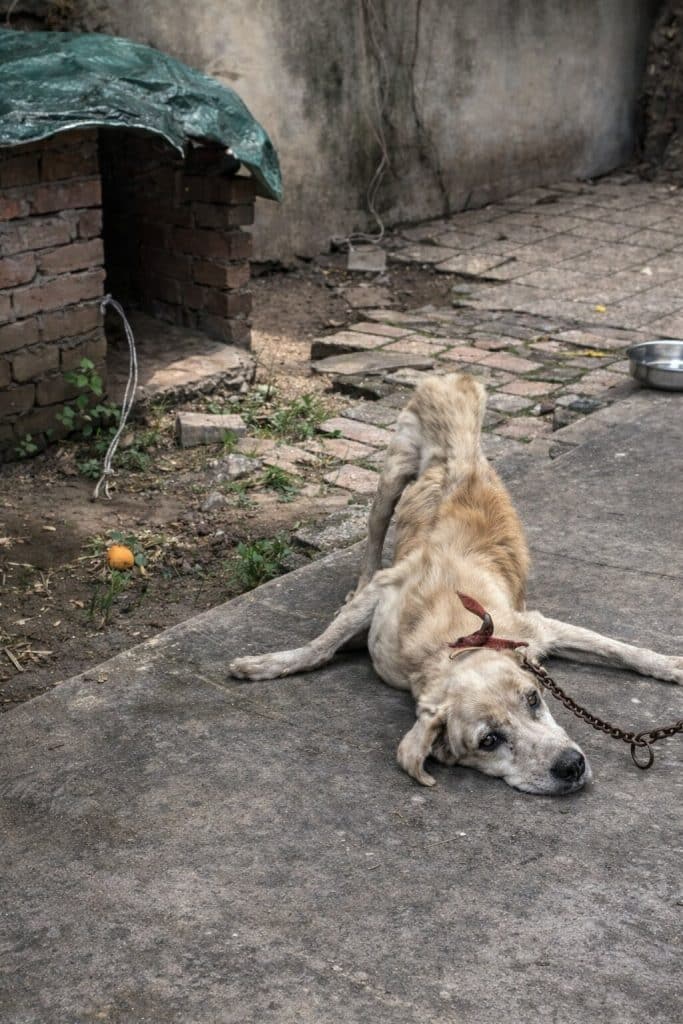
Caesar was trembling when rescuers found him.
His aging body had grown painfully thin. One of his eyes was badly injured, and even remaining on his feet appeared to require more strength than he could comfortably spare.
He did not bark for attention.
He did not struggle against the people approaching him.
He simply stood there, quiet and exhausted.
For an elderly dog who had once belonged to a family, it was a deeply troubling sight. Caesar had reached the stage of life when he needed more care, not less. Yet the attention and protection he depended on had disappeared as his health deteriorated.
What the rescuers could not have known was that helping this one forgotten dog would eventually lead them to another animal in desperate need.
And then to many more.
An Old Dog Who Needed Someone to Choose Him
Caesar had not always been without a home.
He had lived with a family, but as he grew older and his needs increased, he was no longer receiving the attention necessary to keep him comfortable and healthy.
By the time the rescue team learned about his circumstances, the effects of that neglect were impossible to overlook.
His body was underweight and frail. Persistent trembling revealed just how physically weakened he had become.
The injury affecting one of his eyes was especially concerning. He needed veterinary attention, yet his condition suggested that proper treatment had been delayed.
There was something equally upsetting about his behavior.
Caesar showed little reaction to the people around him.
For a dog who should have been enjoying the quieter years of life with familiar companionship, he appeared remarkably withdrawn.
The rescuers recognized that remaining where he was could only prolong his suffering.
But bringing him to safety presented an unexpected difficulty.
His owner would not simply surrender him.
Although Caesar was clearly struggling, the team had to pay money before they could take him away.
It was a painful compromise, particularly when the priority should have been the elderly dog's welfare.
Still, the rescuers made their decision.
They would not leave Caesar behind.
Once he was finally in their care, the focus shifted from the circumstances of his release to something far more important.
Helping him feel comfortable again.
Helping his body recover.
And giving him the chance to experience the care he had been missing.
When Safety Finally Replaced Neglect
Caesar's first destination was a veterinary clinic.
There, the medical team began assessing his condition and providing treatment.
His fur was shaved to allow a more thorough examination. His injured eye received careful attention, and the team began addressing the physical problems associated with his prolonged neglect.
He was given medication, nourishment, warmth, and a protected place to rest.
These were ordinary parts of responsible animal care.
For Caesar, they represented an enormous change.
He no longer had to remain in the circumstances that had allowed his condition to worsen.
There were now people monitoring his needs and responding when he required help.
Yet removing him from that environment did not produce an immediate transformation.
During the first days, Caesar remained subdued.
His body was still depleted, and his reactions were limited. Even with medical care underway, his recovery would require patience.
The rescuers could not erase the time he had spent without adequate attention.
They could only begin giving him what he needed now.
Regular food.
A comfortable resting place.
Careful treatment.
And a steady routine built around his well-being.
For a senior dog recovering from such hardship, those simple things mattered.
There was no dramatic change in a single afternoon.
Instead, the team began looking for quieter signs that his condition was improving.
The Small Victories That Brought Caesar Back
Recovery came gradually.
At first, resting was one of the most important things Caesar could do.
His weakened body needed nourishment and time, while his injuries required ongoing attention.
The people caring for him understood that improvement might appear in ways that were easy to miss.
A little more interest in food.
A calmer expression.
Less trembling.
A greater awareness of someone approaching.
None of these changes would have seemed extraordinary in a healthy dog.
For Caesar, each suggested that the care he was receiving was beginning to make a difference.
As the days passed, his physical condition slowly improved.
His trembling became less pronounced, and he began responding more positively to his surroundings.
Then came a moment that captured the significance of his progress.
Caesar tried to stand.
His legs were still unsteady, and supporting his own weight remained difficult.
But he pushed himself upward.
For a brief moment, the elderly dog managed to steady his body.
It was not a long walk or an energetic display.
It was a fragile, determined movement from an animal who had once appeared almost overwhelmed by weakness.
And it gave the rescuers reason to believe that more improvement was possible.
The work continued.
Caesar received the time and support he needed rather than being pushed to recover faster than his body allowed.
Little by little, he began taking careful steps.
His appetite improved, his strength increased, and his once-fragile frame gradually became healthier.
The most meaningful change was not merely that he could move more comfortably.
He was beginning to participate in the world around him again.
A Loving Home Was Not the End of This Story
As Caesar regained strength, his gentle personality became more apparent.
He was calm and affectionate in an understated way.
He did not require constant excitement or attention. Regular meals, a peaceful place to sleep, and considerate companionship offered the comfort that had been missing from his later years.
Eventually, Caesar was adopted into a loving home.
For a senior dog who had previously been treated as an unwanted responsibility, that outcome carried particular meaning.
His age had not prevented someone from choosing him.
His medical needs had not made him undeserving of affection.
And his difficult past had not eliminated the possibility of a better future.
Caesar finally had a place where he belonged.
But while his own circumstances were improving, another dog connected to his former home was about to need the rescuers' help.
Only two weeks after Caesar's rescue, his previous owner contacted the team again.
This time, the animal in need was much younger.
His name was Volga.
And unlike Caesar, whose main challenges involved age, weakness, and prolonged neglect, Volga faced a serious disability that affected his ability to walk.
VIDEO: Caesar Found Safety in His Final Years — Then Another Dog Needed the Same Compassion
Volga's Future Changed When He Lost the Use of His Back Legs
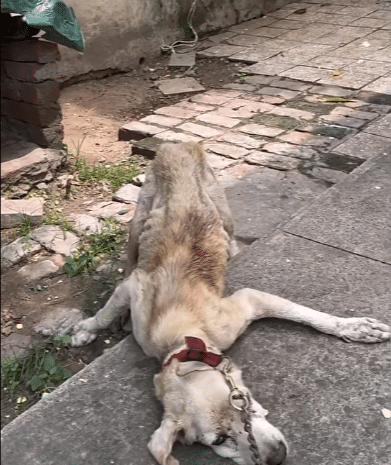
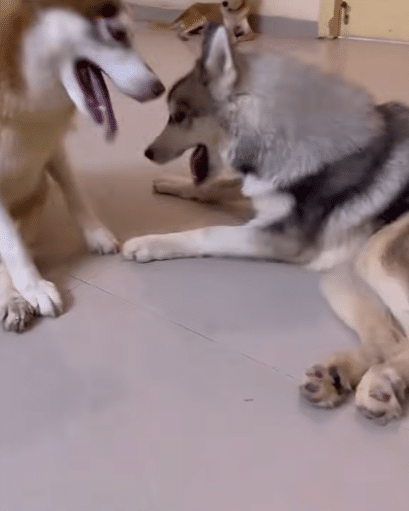
Volga was a young Siberian Husky.
At an age when a dog might ordinarily be running, exploring, and playing with enthusiasm, his movement had been severely limited.
He had suffered a serious spinal injury that appeared to be associated with physical trauma.
His hind legs no longer functioned properly.
The consequences were profound.
Volga could not move around in the ordinary way, and his condition required veterinary evaluation and specialized support.
The rescue team had already experienced the difficulty of helping Caesar out of his previous circumstances.
Now they faced another urgent decision involving an animal from the same owner.
They chose to intervene again.
Volga was brought to a veterinary clinic, where doctors examined his injuries and considered the treatment he needed.
His situation was complicated.
A spinal injury can leave lasting limitations, and at that stage there was no certainty about how much function he might regain.
The rescuers could not promise that he would walk normally again.
What they could offer was proper medical attention and a safer environment.
That distinction mattered.
A good future for Volga did not necessarily depend on restoring every ability he had lost.
It depended on finding ways to support the life he could still enjoy.
The Handmade Wheelchair That Gave Volga His Freedom
Volga later underwent surgery intended to stabilize his injured spine.
Rehabilitation remained important, but his hind legs still could not support him adequately.
The volunteers began looking for a practical way to help him move.
Their solution was simple and thoughtful.
They constructed a wheelchair from wood.
The handmade device supported the rear portion of Volga's body while allowing him to move forward using his front legs.
It did not undo his spinal injury.
It did not make his disability disappear.
But it provided something that treatment alone had not yet restored.
Independent movement.
When Volga first began using the wheelchair, the team could not be sure how easily he would adjust.
A mobility aid can feel unfamiliar to an animal, particularly one already dealing with physical limitations.
Volga, however, adapted with remarkable ease.
Soon he was moving around the yard with the other rescue dogs.
He was no longer restricted to remaining in one place or relying entirely on someone else to help him get around.
He could explore the space around him.
He could keep up with activity.
And he could participate in the ordinary enjoyment of being a young dog.
Watching him move across the grass offered a striking contrast to the condition in which he had arrived.
His hind legs still needed support.
His recovery remained different from that of a dog without a spinal injury.
Yet his ability to enjoy life had clearly not disappeared.
The wooden wheelchair was more than a piece of equipment.
It demonstrated what can happen when caregivers adapt their approach to an animal's actual needs instead of measuring the animal only by what it can no longer do.
Volga did not need to move exactly like the other dogs to share their happiness.
He needed a way to join them.
And the volunteers had found one.
From Two Rescues to a Place Filled With Second Chances
Caesar and Volga had very different experiences.
One was an elderly dog whose body had become frail after inadequate care.
The other was a young Husky whose spinal injury had permanently changed the way he moved.
But both received help from people willing to look beyond their immediate difficulties.
Their stories also became part of something larger.
Over time, the rescue center continued welcoming other animals that needed protection and care.
Some arrived physically injured.
Others were severely underweight or frightened.
There were also young puppies who had already experienced hardship early in life.
Each animal brought different needs.
Some required medical treatment. Others needed nourishment, rest, and the gradual reassurance that they were no longer in an unsafe situation.
There was no single solution that could serve every dog.
The caregivers had to respond to the individual circumstances of the animals entering their care.
A soft bed could offer comfort to one who had been sleeping on hard surfaces.
A regular feeding routine could help another begin recovering its strength.
For a frightened dog, patient handling and predictable companionship could make the difference between remaining withdrawn and gradually becoming more comfortable around people.
These changes often happened without dramatic moments.
Progress might be visible in a dog lifting its head with interest.
In an animal relaxing while someone sat nearby.
Or in the simple freedom of resting peacefully without appearing constantly unsettled.
The rescue center's grassy yard gradually became a place where those changes could be seen.
Dogs played together.
Others rested in the sunshine.
Some approached people for affection after previously struggling to feel comfortable around them.
Their circumstances were not identical, and neither were their recoveries.
What they shared was the opportunity to receive care suited to their needs.
Caesar had shown what patient treatment could accomplish for a neglected senior dog.
Volga had demonstrated how a practical mobility aid could help an injured animal regain independence.
The other dogs carried their own stories forward, supported by the same commitment to their well-being.
What Caesar and Volga Taught the People Around Them
There is an important difference between removing an animal from danger and helping it build a better life.
Rescue is the beginning.
What follows may involve repeated veterinary appointments, careful feeding, rehabilitation, specialized equipment, and weeks of patient observation.
For some animals, improvement is measured by renewed strength.
For others, it is measured by greater comfort, reduced fear, or the ability to move with assistance.
Caesar's recovery showed the value of refusing to dismiss an elderly dog because his health had declined.
His age did not make treatment pointless.
And it certainly did not make affection unnecessary.
When rescuers met him, his physical weakness was unmistakable.
He needed professional care and time.
He received both.
Eventually, he regained enough strength to enjoy a more comfortable life and was welcomed into a loving home.
Volga's experience revealed another side of compassionate care.
His recovery was not about returning completely to the way he had been before his injury.
Instead, the volunteers found a way to accommodate his lasting limitations.
The wheelchair allowed him to participate in activities he still wanted to enjoy.
It helped turn his remaining physical abilities into a source of freedom.
Neither story required an impossible outcome to be meaningful.
Caesar did not become young again.
Volga did not need to regain normal use of his hind legs to enjoy running around the yard.
Their lives improved because someone recognized what each dog needed and took action.
That same principle continued guiding the care of other animals at the center.
The Old Dog Whose Rescue Became the Beginning of Something Bigger
It is easy to understand why Caesar's story stayed with the people who followed his journey.
He had reached old age with serious unmet needs.
His body was weakened, his eye required medical attention, and his quiet behavior suggested how little energy he had left.
There was no assurance that recovery would be quick or easy.
Even getting him out of his previous home required the rescue team to overcome an obstacle.
But once Caesar reached safety, his circumstances began to change.
He received the care he needed.
His strength gradually returned.
He stood, walked, and became healthier.
And eventually, someone offered him a loving home.
That alone would have made his rescue worthwhile.
Yet the story continued.
Two weeks later, Volga needed help.
The same rescuers responded, and the young Husky eventually discovered a new kind of freedom through his handmade wheelchair.
Other vulnerable dogs subsequently found care at the rescue center as well.
Each animal had its own challenges and its own path forward.
Their experiences cannot be reduced to one simple promise that every rescue will end perfectly.
Some recover more fully than others.
Some continue living with disabilities.
Others need ongoing assistance simply to remain comfortable.
But Caesar and Volga demonstrate why those differences should never determine whether an animal deserves help.
A senior dog can still find a home.
A disabled dog can still experience joy.
And an animal that once seemed frightened or withdrawn can gradually become comfortable when given consistent care.
Caesar was once an elderly dog whose needs had been overlooked.
His rescue did not only change the remainder of his own life.
It became part of a wider effort to give other animals the safety, attention, and opportunities they deserved.
Sometimes compassion begins with one difficult decision.
To notice an animal who is struggling.
To act rather than turn away.
And to continue caring long after the immediate rescue is over.
For Caesar, that decision meant finally being chosen.
For Volga, it meant discovering how to move freely again.
And for the animals who followed them, it meant that another chance was waiting.


