
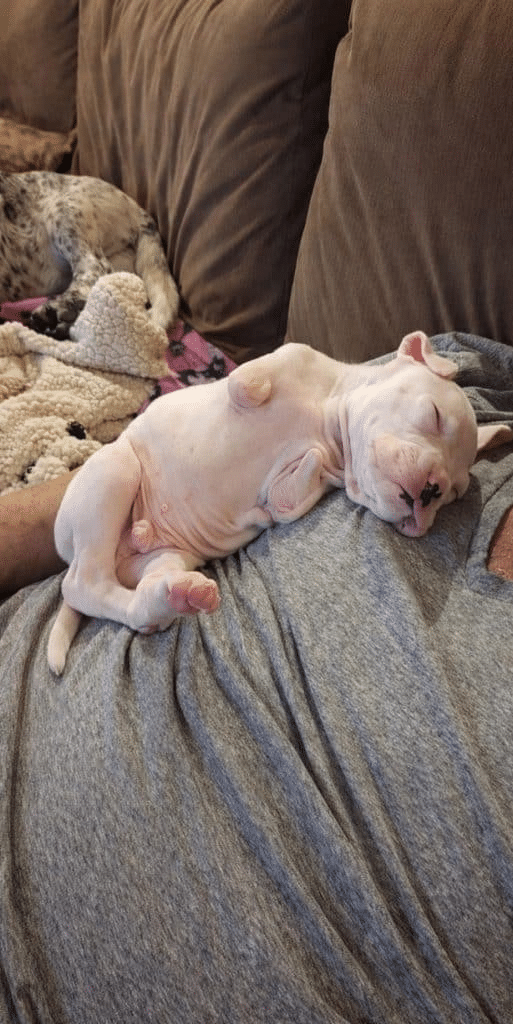
Nubby entered the world with two back legs, no front legs, and a future that seemed painfully uncertain.
He was so small and vulnerable that even feeding presented a challenge. While other newborn puppies could nurse naturally, Nubby struggled to get the nourishment he needed.
His unusual condition immediately raised concerns about whether he could survive.
For such a fragile puppy, the difficulties were not limited to learning how to move without front legs. He first needed to make it through the earliest, most delicate stage of life.
And there were no guarantees.
Yet the little puppy was alive. He was still growing, still responding to the world around him, and still deserving of care.
That simple truth would become the foundation of everything that followed.
Because two people were about to make a decision that would give Nubby something his circumstances had nearly taken away.
A chance.
A Tiny Puppy Facing an Enormous Challenge
Being born without front legs meant Nubby faced obstacles most puppies would never experience.
For a newborn, feeding is one of the most essential parts of survival. Puppies depend on regular nourishment, warmth, and close attention during their earliest days.
Nubby needed all of those things, but his physical differences made an already vulnerable stage of life even more difficult.
His inability to nurse properly was especially concerning.
He could not simply be left to manage on his own.
Someone would need to help him feed, monitor his condition, and respond whenever he showed signs of trouble.
It was a demanding responsibility, particularly because no one could be certain that the effort would succeed.
The people around Nubby understood how serious his situation was. His chances of surviving were considered extremely low.
For some, that uncertainty seemed like a reason to accept that his life might be brief.
But Nubby's circumstances looked different to Lou and Mark Robinson.
They saw a living puppy who needed help.
And rather than allowing an uncertain prognosis to determine his future, they decided to give him the care he needed.
The Couple Who Refused to Walk Away
Lou and Mark Robinson were no strangers to animals requiring special attention.
They had already spent years helping vulnerable animals, gaining experience with the demanding realities of rescue and caregiving.
They knew that compassion alone could not solve every problem.
Caring for an animal with serious needs often required patience, persistence, and a willingness to continue even when progress was difficult to see.
Nubby would need all of that.
When the couple encountered the little puppy, they understood that bringing him home would mean accepting considerable uncertainty.
There was no promise that he would grow stronger.
No assurance that careful feeding would be enough.
And no way to predict what additional complications might appear as his body developed.
Still, they chose to take him home.
Their decision was not based on confidence that everything would turn out perfectly. It was based on the belief that Nubby deserved an opportunity to live.
For the first time in his short life, the tiny puppy had people prepared to organize their days around his needs.
It was an important turning point.
Nubby's physical condition had not changed. He still had no front legs, and feeding remained a challenge.
But the circumstances surrounding him had changed completely.
Instead of facing those difficulties without specialized care, he now had two people committed to helping him through them.
The Small Victories That Made Every Feeding Worthwhile
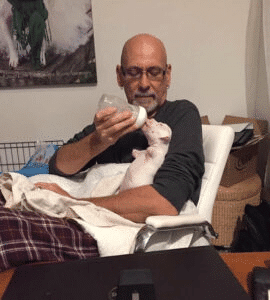
The Robinsons' early days with Nubby revolved around a simple but demanding routine.
He needed bottle feeding throughout the day and night.
He needed warmth.
He needed careful observation to make sure he was receiving the attention required to support his fragile condition.
There was little room for complacency.
For a newborn puppy struggling to feed, even ordinary routines demanded extraordinary consistency.
Lou and Mark devoted themselves to meeting those needs.
The effort was not defined by one dramatic breakthrough. Instead, progress arrived through the gradual changes that accompany a puppy's earliest development.
Nubby began opening his eyes.
His ears continued developing.
He started responding to sounds and voices around him.
Each development was modest when viewed on its own.
But together, they showed that Nubby was continuing to grow.
For his caregivers, those signs were deeply encouraging.
The puppy whose future had seemed so uncertain was reaching milestones that once could not be taken for granted.
He was experiencing more of the world.
And each new response gave Lou and Mark another reason to continue.
Their care did not eliminate the risks associated with his condition. It did, however, give him the support he needed to keep developing.
For a time, those gradual improvements offered hope that the most difficult period might be behind him.
Then his health took another worrying turn.
VIDEO: Born Without Front Legs, Nubby Faced an Uncertain Future — See How His Fight for Life Began
When Breathing Became Another Battle
Just as Nubby appeared to be making encouraging progress, new symptoms began causing concern.
He developed frequent sneezing.
He struggled to breathe normally.
Feeding, which had already required special attention, became difficult again.
These were not changes his caregivers could ignore.
Nubby had survived a challenging beginning, but he was still a young puppy whose health required close monitoring.
The breathing difficulties suggested that something more serious might be happening.
Medical examinations revealed a problem involving his esophagus.
It was another significant complication for a puppy who had already faced so many obstacles.
The exact course of his recovery remained uncertain.
For Lou and Mark, the situation brought them back to the same difficult reality they had faced when they first brought Nubby home.
They could provide care.
They could seek treatment.
They could remain attentive to his needs.
But they could not guarantee the outcome.
Nubby required medical treatment, medication, and continued supervision.
His recovery would depend on more than the progress he had already made.
What had begun as an effort to help a newborn puppy survive without front legs had become a broader struggle to support his health through an unexpected complication.
And once again, the Robinsons remained beside him.
The Patient Work of Helping Nubby Grow Stronger
Recovery was not a single event.
There was no immediate moment when every concern disappeared and Nubby could simply return to life without supervision.
Instead, his caregivers continued the steady work that had supported him from the beginning.
They followed his treatment needs.
They monitored his condition.
They gave him the attention required as he worked through another difficult period.
The process demanded consistency.
Nubby had already demonstrated encouraging development before his breathing problems appeared. Now the hope was that he could regain his strength and continue growing.
Gradually, that hope began to take shape.
His condition improved.
His strength returned.
The puppy who had once been considered unlikely to survive was moving through another stage of recovery.
There was something particularly meaningful about this progress.
Nubby had not suddenly become an ordinary puppy in a physical sense. His missing front legs remained part of his life, and his early medical struggles could not be erased.
But those circumstances no longer told the whole story.
He was growing.
He was becoming stronger.
And he was beginning to show more of his personality.
For Lou and Mark, the reward for their demanding caregiving routine was visible in the life unfolding before them.
The small puppy they had brought home under such uncertain circumstances was continuing to develop into an active, curious companion.
A Playful Spirit Emerged Beyond His Limitations
As Nubby grew older, the differences between his difficult beginning and his developing personality became increasingly striking.
He was no longer simply the fragile newborn who needed help with every feeding.
He had energy.
He showed curiosity about his surroundings.
And he developed a playful personality that brought a new dimension to his story.
The changes mattered because they revealed something that had been difficult to imagine during his earliest days.
Nubby was not merely surviving.
He was beginning to enjoy his life.
His missing front legs still created practical challenges, particularly when it came to moving around.
For a dog with his physical condition, ordinary movement requires a different approach.
But his eagerness to explore had become unmistakable.
Nubby wanted to participate in the world around him.
He wanted to move, investigate, and experience the same kinds of everyday moments that other dogs enjoy.
His growing confidence also showed why the Robinsons' early commitment had been so important.
They had not known what kind of life would be possible for him.
They had simply given him the opportunity to reach this point.
Now, as his personality emerged, a new question became important.
How could Nubby move more freely?
Two Wheels Opened Up a Bigger World
One of the most meaningful developments in Nubby's journey came when he received a specially designed wheelchair.
The mobility aid was created to accommodate his missing front legs and provide him with additional support while moving.
For a dog whose front limbs had never developed, the wheelchair offered a new way to explore his surroundings.
And Nubby's response was filled with enthusiasm.
Rather than appearing hesitant about the unfamiliar equipment, he quickly began moving forward with excitement.
He did not seem interested in taking everything slowly.
He wanted to go.
The playful puppy who had already shown such determination now had a way to express his energy through greater movement.
It was a significant change in his everyday life.
The wheelchair did not alter the fact that Nubby was born without front legs.
It did not erase the challenges that had shaped his early development.
But it helped him work around a physical limitation that otherwise restricted his mobility.
The distinction is important.
Nubby did not need to become physically identical to other dogs to enjoy being active.
He needed support suited to the body he had.
With that support, his curiosity and enthusiasm had more room to flourish.
Watching him move energetically also brought a different perspective to his earliest struggles.
The newborn who once required constant assistance just to receive enough nourishment had grown into a dog eager to explore.
The journey between those two stages had required patience, medical attention, and the dedication of people who refused to dismiss his chances too soon.
The Joy That Made Nubby's Story Reach Beyond His Home
Nubby's experiences eventually began touching people far beyond the Robinson household.
His story drew attention not only because of his unusual physical condition, but because of the contrast between his uncertain beginning and his lively personality.
People learned about a puppy born without front legs.
They learned about the difficulty he experienced feeding.
They learned that Lou and Mark had taken him home despite serious doubts about his survival.
And they learned about the frightening medical complication that threatened his progress.
Yet the most memorable part of his journey was not simply the number of challenges he had faced.
It was the dog he had become.
Nubby was playful, curious, and eager to move through his surroundings.
His mobility aid allowed him to participate in activities that would otherwise have been more difficult.
His personality showed that disability and enjoyment of life are not mutually exclusive.
That message resonated beyond the specific circumstances of his rescue.
Animals with disabilities may require different kinds of support. Some need specialized feeding, closer supervision, mobility equipment, or long-term adjustments to everyday care.
Those needs are real and should never be minimized.
But they do not automatically prevent an animal from experiencing comfort, companionship, play, or meaningful relationships.
Nubby's life offered a visible example of that distinction.
He had faced serious limitations.
With appropriate care, he had also discovered new possibilities.
The Promise Lou and Mark Kept Through Every Difficult Day
Looking back at Nubby's journey, it is easy to focus on the joyful image of a dog moving excitedly with the help of his wheelchair.
But that freedom was connected to everything that came before it.
The bottle feedings.
The careful monitoring.
The early developmental milestones.
The frightening breathing difficulties.
The medical treatment and gradual return of strength.
None of those stages could be skipped.
The Robinsons had to address Nubby's immediate needs before anyone could know what his later life might look like.
Their decision to care for him was meaningful precisely because the outcome was unknown.
They did not take him home with certainty that he would survive.
They took him home because his life mattered enough to try.
That choice required more than affection.
It called for sustained responsibility, a willingness to seek medical help, and the patience to recognize progress even when it appeared in very small ways.
Nubby's recovery also illustrates something important about caring for animals born with disabilities.
Compassion is essential, but practical support matters just as much.
For Nubby, that support included assisted feeding, medical treatment, attentive caregivers, and eventually a wheelchair designed around his mobility needs.
Each element played a different role in helping him move forward.
And together, they helped create the conditions in which his personality could emerge.
A Life Worth Fighting for From the Very Beginning
Nubby's story began with a puppy whose physical condition made survival uncertain.
He could not nurse properly.
He needed extraordinary attention during his earliest days.
And even after he began developing, a serious esophageal problem created another threat to his health.
There were many reasons for Lou and Mark to feel uncertain.
But they continued caring for him.
Over time, the tiny puppy grew stronger, became increasingly playful, and gained greater freedom of movement with the help of a custom wheelchair.
His journey did not make the challenges of disability disappear.
Instead, it showed how much thoughtful care can change the opportunities available to an animal living with those challenges.
Not every rescue story has the same outcome. Not every medical condition can be overcome through determination alone.
Nubby's progress depended on the support he received and the treatment available to him, as well as his ability to keep developing despite a difficult start.
That makes his story no less moving.
If anything, it gives greater meaning to the decision made when he was still a vulnerable newborn.
Lou and Mark could not promise Nubby a particular future.
They could only promise to give him a chance.
And because they did, the puppy once considered unlikely to survive grew into an energetic dog discovering the world in his own way.
Nubby never needed front legs to make his life valuable.
He needed someone willing to recognize that value from the very beginning.


