
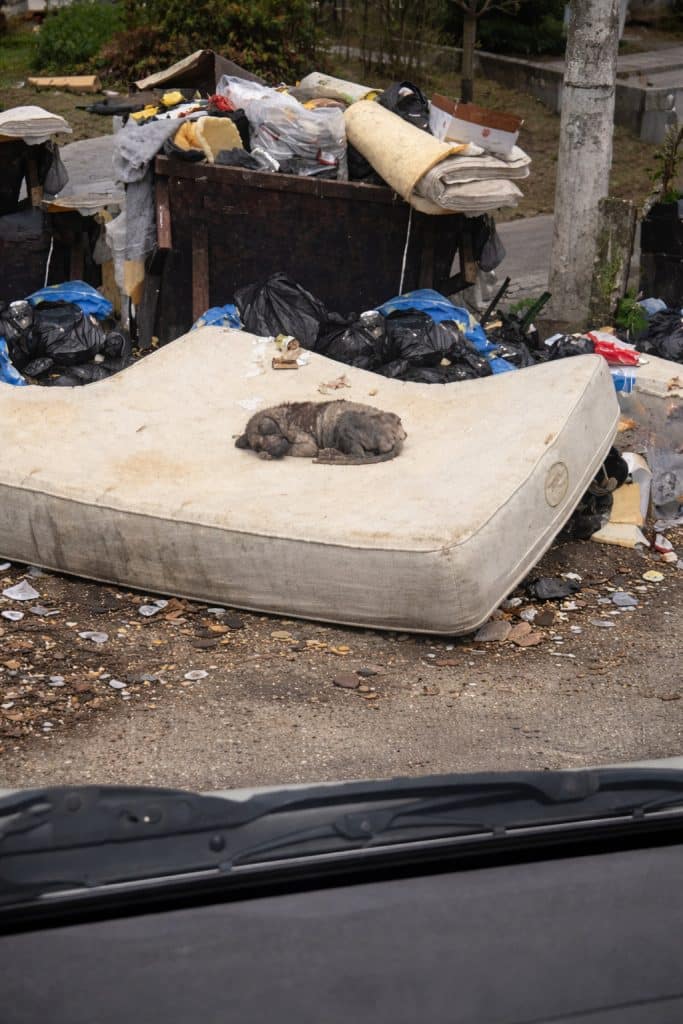
Cars continued along the busy street, and pedestrians passed a discarded mattress beside a pile of rubbish.
On that mattress lay a dog who could barely move.
His body was painfully thin. Much of his fur had disappeared, leaving his skin irritated and exposed. He seemed to have little strength left, yet occasionally, he managed to raise his head.
It was a small movement.
Easy to miss in the constant activity of an ordinary street.
But it was enough to show that he was still holding on.
People had been passing the spot without stopping. The dog made no attempt to follow anyone, and he did not bark for attention.
Then one woman noticed him.
Where others had seen a suffering stray, she recognized an animal who urgently needed help.
That decision to stop would change the course of his life.
The dog would eventually be known as Tilin.
And although his condition was far more serious than anyone could understand from the roadside, his journey was only beginning.
The Dog on the Mattress Finally Had Someone Beside Him
By the time help reached Tilin, his weakness was immediately apparent.
The mattress offered somewhere to lie, but it could do nothing to relieve the conditions that had left him so fragile.
His thin body and damaged skin suggested that his health had been deteriorating for some time. The full extent of his suffering, however, remained unknown.
There was no way to tell from that first encounter how long he had been living like this.
Or how long he had been unable to get up comfortably.
What mattered was what the rescuers could see.
Tilin needed urgent attention.
They approached slowly, taking care not to frighten him or cause unnecessary discomfort. With an animal in such a weakened state, even ordinary handling required patience.
Tilin did not struggle against their presence.
He allowed them to get close.
That quiet response became one of the first meaningful moments of his rescue.
An animal who had been lying almost motionless beside a road was finally receiving individual attention.
There was now someone watching his condition, thinking about his comfort, and making decisions intended to protect his life.
The rescuers gave him a name.
Tilin.
It was a simple gesture, but it marked an important change.
He was no longer just an unidentified dog lying on an abandoned mattress.
He was a patient whose life deserved the same consideration as any other.
And the next step would reveal how urgently he needed that care.
A Medical Examination Revealed How Serious His Condition Was
At the veterinary clinic, the initial assessment showed that Tilin was dealing with far more than exhaustion or a neglected coat.
His skin was severely inflamed and sensitive. Areas of irritation and scabbing made even gentle handling uncomfortable.
His physical weakness was equally concerning.
Tilin could not stand normally, and eating was difficult. When food was offered, he sometimes had to remain curled on the floor while trying to eat.
For a dog, something as ordinary as standing over a food bowl had become a significant challenge.
The veterinary team needed to understand why his body was struggling so badly.
Blood tests provided some troubling answers.
Tilin's platelet count was critically low, and his hemoglobin level had dropped to a dangerous point. The findings helped explain his extreme weakness and the bleeding that had been observed from his nose.
Other results suggested serious infection, while indicators associated with his liver and kidneys also raised concerns.
Additional testing confirmed that he was suffering from multiple tick-borne infections, including Ehrlichia and Anaplasma.
There was no single problem to solve.
His recovery would require the medical team to address several serious health concerns while carefully supporting a body that had become remarkably fragile.
The dog who had barely lifted his head beside the road was facing a difficult period of treatment.
And no one could promise that progress would come quickly.
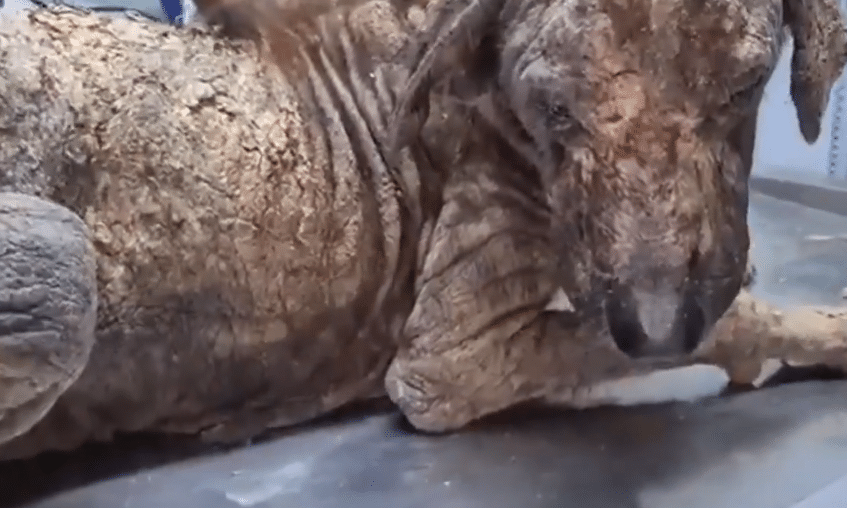
The results made something clear.
Tilin's condition could not be reversed through food and rest alone.
He needed medical treatment, continued observation, and the kind of patient daily care that could respond to even the smallest change in his health.
What followed would not be a sudden transformation.
It would be a gradual effort to help him regain the strength that illness had taken away.
VIDEO: Tilin Was Too Weak to Leave His Roadside Mattress — Watch His Journey From Rescue to Recovery
Healing Began With the Smallest Acts of Care
Treatment started with fluids to support Tilin's condition and antibiotics to address infection.
His progress had to be monitored closely.
With such serious abnormalities in his bloodwork, the veterinary team could not judge his recovery simply by whether he appeared a little more comfortable.
Every aspect of his health mattered.
His appetite.
His ability to move.
The condition of his skin.
And whether his body was responding to the treatment being provided.
Even bathing required special attention.
Tilin's irritated skin was too sensitive for rough or hurried handling. Medicated solutions had to be applied gently, with care taken to avoid causing additional discomfort.
It was the kind of work that rarely produces a dramatic moment.
There were no instant results.
Just repeated acts of care, carried out because the dog needed them.
During the early stages, Tilin remained physically weak. His body still bore the visible signs of prolonged illness, and his ability to perform ordinary movements was limited.
Yet the people caring for him continued.
A little more food eaten was worth noticing.
A more attentive expression was encouraging.
Any improvement in his strength offered another reason to continue the careful routine.
Recovery was not only about treating infections or helping damaged skin heal.
Tilin also needed time to become comfortable with the people responsible for his care.
The dog who had once lain alone beside the road was now surrounded by hands that approached gently.
There were examinations, treatments, and repeated moments of close contact.
Through them, Tilin remained remarkably cooperative.
His willingness to accept care made the difficult process easier, but it also revealed something touching about his nature.
Even after everything his body had endured, he could still respond calmly to human kindness.
The Day Tilin Found the Strength to Stand
For a while, the changes were subtle.
Tilin began eating more regularly.
He appeared increasingly alert to the people around him.
His eyes, once associated with overwhelming fatigue, became noticeably brighter.
These improvements mattered, but his mobility remained an important concern.
A dog who cannot stand comfortably cannot move freely to explore, seek attention, or enjoy the everyday activities that make up a normal life.
Then Tilin reached a milestone.
He stood up.
His legs were still unsteady, and he was not suddenly restored to full strength.
But he had managed to support his own weight.
For the dog who had previously been unable to leave his mattress, that achievement represented an enormous change.
It meant his body was beginning to recover some of its basic abilities.
The progress did not stop there.
As Tilin became stronger, he started taking steps outside.
He experienced the grass beneath his paws and began moving through his surroundings rather than remaining confined by weakness.
Those early steps were not proof that all his medical problems had disappeared.
He still needed treatment and time.
But they showed how far he had come.
A short walk, something many healthy dogs take for granted, was becoming possible again.
And with improved movement came another change.
Tilin began showing greater interest in the world around him.
He was no longer defined entirely by the effort required to survive each day.
He could begin experiencing life beyond illness.
Forty Days That Changed the Way Tilin Looked and Lived
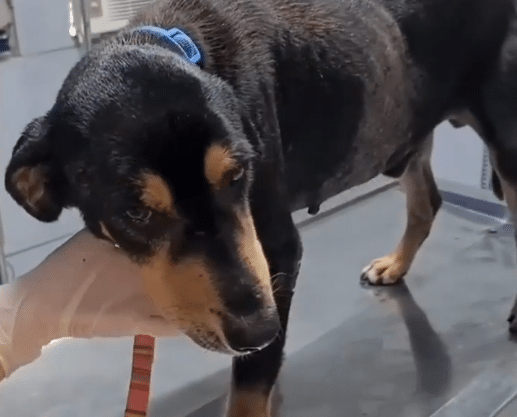
As the weeks passed, the results of Tilin's treatment became increasingly visible.
His inflamed skin began recovering.
The redness gradually diminished.
His body gained weight, replacing some of the extreme thinness that had been so apparent when rescuers first found him.
Then his coat began returning.
New black and golden fur appeared across areas that had previously been bare and irritated.
The change was more than cosmetic.
The condition of his skin had been one of the clearest outward signs of his suffering. Watching it improve was a visible reminder that treatment and consistent care were making a difference.
Tilin also became stronger and more engaged with his surroundings.
Where he had once barely moved, he could now stand, walk, and show curiosity.
Where eating had once required him to remain lying down, his improved condition allowed him to participate more normally in daily life.
After approximately 40 days of dedicated care, his appearance had changed dramatically.
The difference between the dog on the roadside mattress and the dog recovering under veterinary supervision was difficult to overlook.
Yet his treatment involved more than addressing the original infections and skin problems.
During his recovery, veterinarians also removed two small masses.
His health continued to receive attention as his caregivers worked toward a more stable, comfortable future for him.
Throughout the process, Tilin maintained the gentle temperament that had been evident during his rescue.
He accepted human contact.
He showed an increasingly relaxed interest in his surroundings.
And he continued making progress.
What made the transformation especially meaningful was that it had not happened all at once.
There had been a time when standing was beyond his strength.
A time when his skin required exceptionally careful attention.
A time when concerning medical results made his future uncertain.
Each of those difficulties had required its own response.
Gradually, the accumulation of small improvements became a much larger change.
The dog who once appeared to have almost nothing left was now experiencing a life that had seemed far beyond his reach.
A Gentle Personality Emerged as His Health Returned
Physical recovery gave Tilin the opportunity to show more of his personality.
As he became healthier, his caregivers saw a sweet, curious dog who enjoyed being near people.
He showed interest in exploring new spaces and seemed increasingly comfortable with everyday experiences.
These were simple behaviors, but they represented something important.
Tilin was no longer spending all his energy coping with serious illness.
He had strength available for the ordinary pleasures of being a dog.
Moving around.
Noticing people.
Exploring his environment.
Enjoying the attention of those who cared for him.
His story also reached an audience beyond the people involved in his treatment.
At one point, Tilin appeared on television alongside the woman who had helped rescue him.
It was a remarkable contrast to where his journey had started.
The dog who had once gone unnoticed beside a busy road was now being seen by viewers who could learn about his recovery.
His appearance reflected not only how much his health had improved, but also how completely his circumstances had changed.
He had gone from an overlooked animal in need of emergency help to a dog whose recovery could encourage others to pay attention to vulnerable animals.
And despite everything he had experienced, his gentle character remained one of his most endearing qualities.
One Final Wish for the Dog Who Refused to Give Up
Today, Tilin is described as healthy, active, and full of life.
He is eight years old.
His body has recovered from the severe condition that once made even standing difficult. His coat has returned, his strength has improved, and his curiosity has become part of his everyday life.
The immediate crisis that brought him into rescue is behind him.
But there is still one part of his future waiting to be settled.
Tilin needs a permanent family.
Someone who will offer the security and companionship that every dog deserves.
Someone who will appreciate his gentle nature without seeing his age or medical history as reasons to overlook him.
Because Tilin has already demonstrated that his past does not define everything he can become.
When he was found, his appearance could easily have led people to assume there was little hope.
His body was exhausted.
His skin needed extensive care.
His medical results raised serious concerns.
Yet one person saw a reason to act rather than continue walking.
That decision led to veterinary treatment, weeks of attentive rehabilitation, and the steady return of the dog Tilin could be when his health was no longer holding him back.
His journey is also a reminder that rescue does not always end when an animal is medically well.
For many dogs, recovery is only one part of finding a lasting home.
Tilin now has the opportunity to enjoy a very different future from the one that seemed possible on that discarded mattress.
What he still needs is someone willing to share that future with him.
A home where his presence is welcomed.
A family who values the quiet companionship of an older dog.
And the chance to spend the years ahead surrounded by consistent love and care.
There is no confirmed adoption in Tilin's story yet.
That chapter remains unwritten.
But there is already something extraordinary about the distance he has traveled.
A dog who could barely raise his head now has the strength to explore the world around him.
A dog whose illness once demanded constant attention can now enjoy the ordinary rhythms of a healthier life.
And a dog who was passed by on the street has become someone whose story deserves to be remembered.
Sometimes, compassion begins with a decision that takes only a moment.
Someone notices.
Someone stops.
Someone chooses to help.
For Tilin, that moment opened the door to recovery.
Now, all that remains is the hope that another person will see him with the same kindness—and finally give him a place to call home.


