
Some dogs spend their lives giving loyalty without asking for anything in return.
Ball was one of those dogs.
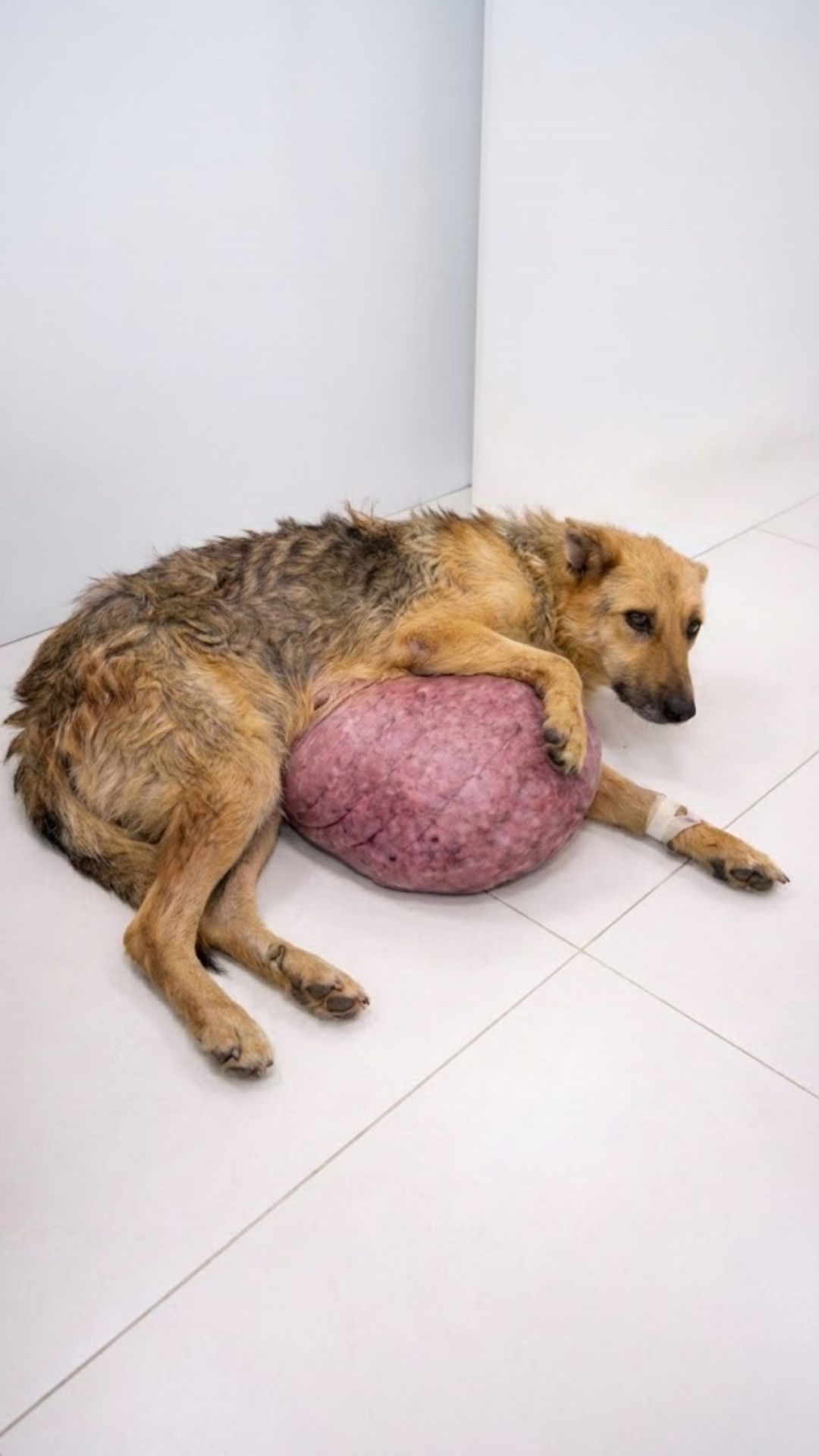
By the time rescuers discovered him lying in a filthy ditch, his aging body had almost nothing left to give. His ribs stood out beneath his thin frame, and an enormous growth hanging from his abdomen made even the simplest movement a struggle.
He could not stand.
He could not sit comfortably.
All he could do was remain where he had been left, carrying a burden no animal should have to endure alone.
The dog had reportedly spent years protecting a home. Yet when his health deteriorated, he was abandoned instead of receiving the care he desperately needed.
His rescuers did not know how much longer he could survive in that condition.
But they were about to discover something important.
Beneath all that exhaustion, there was still a dog willing to fight for another chance.
The Weight He Had Been Carrying for Years
At first, Ball's extreme thinness was impossible to overlook.
His body showed the unmistakable effects of prolonged hardship. His bones were clearly visible, his strength was severely depleted, and his age was evident in the worn condition of his teeth.
One ear had also suffered a serious injury.
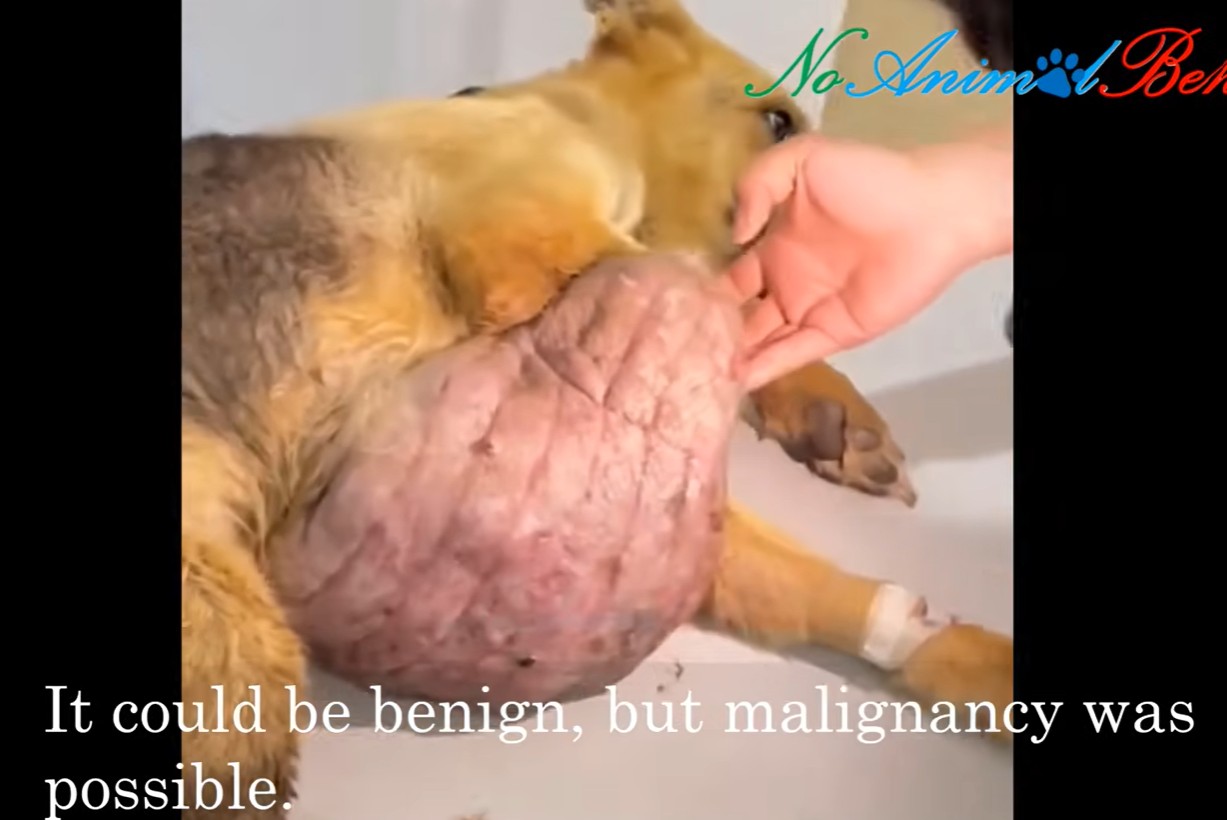
But the greatest concern was the enormous tumor extending from his abdomen.
The growth weighed approximately 10 kilograms, or 22 pounds.
For a healthy dog, carrying such a weight would have been difficult. For an elderly animal already weakened by malnutrition and neglect, it had become an overwhelming physical burden.
Every attempt to change position required effort.
The tumor restricted his movement so severely that standing or sitting was no longer possible when rescuers found him.
It was difficult to imagine how he had managed before help arrived.
What made his situation even more troubling was that the growth had not developed suddenly.
Veterinary examinations would later reveal that it had been growing over a period of years.
Ball had been living with that increasing weight for a very long time.
The people who found him could not undo those years.
They could only decide what happened next.
And rather than allowing his condition to define the end of his story, they chose to get him medical help.
A Rescue That Led to a Difficult Decision
Moving Ball required exceptional care.
His body was fragile, and the tumor made handling him more complicated than an ordinary rescue. Any unnecessary strain could add to the discomfort he was already experiencing.
Rescuers carefully transported him to a veterinary hospital, where his condition could be properly assessed.
There was reason to hope that removing the tumor might eventually give him a much better quality of life.
But there was also a serious obstacle.
Ball was not strong enough for surgery.
Blood tests revealed severe anemia, meaning his body was already struggling with a dangerously low level of healthy red blood cells.
His overall weakness made anesthesia especially risky.
Even if surgeons could successfully remove the growth, his body might not tolerate the procedure in its current state.
The veterinary team faced a difficult balance.
The tumor needed to be removed, but operating too soon could cost Ball his life.
Waiting without providing supportive care was not an acceptable solution either.
So the team decided to focus on stabilization first.
Before Ball could face surgery, he needed a better chance of surviving it.
This meant approaching his treatment patiently rather than rushing toward the most dramatic intervention.
It also meant accepting that his recovery would have to begin with very small steps.
The First Signs That He Still Had Strength
Ball remained under intensive veterinary care as the medical team worked to improve his condition.
Fluids helped address his dehydration.
Nutrition was introduced carefully to support his weakened body.
His caregivers watched his progress, knowing that the improvement they needed might come gradually.
There was no immediate transformation.
The tumor was still there.
His body was still thin.
And the operation he needed remained too dangerous until his condition improved.
Then came a moment that offered a different kind of encouragement.
Someone brought him warm roasted chicken.
For a dog who had been lying almost motionless, his response was remarkable.
He lifted his head.
Then, gathering what strength he had, Ball managed to rise.
He began eating eagerly, finishing the food within minutes.
It was a simple event, but its meaning was difficult to miss.
The same dog who had been unable to stand when rescuers found him was now responding to food with a determination that his earlier condition had almost hidden.
A meal could not cure his anemia.
It could not remove a tumor that had developed over years.
But it revealed that Ball still had energy to draw upon.
And for everyone involved in his care, that mattered.
VIDEO: Abandoned With a 22-Pound Tumor, This Elderly Dog Found the Strength to Stand Again
Four Hours That Could Change Everything
As the days passed, Ball's condition began to improve.
The supportive treatment was helping him regain enough strength for the veterinary team to reconsider surgery.
The decision was not simple.
Removing such a large tumor required a complex operation. Its long-established connections with surrounding tissue made the procedure especially delicate.
Ball's anemia remained an important concern.
Any significant blood loss could place additional strain on a body that had only recently begun recovering from severe weakness.
Yet leaving the growth in place meant allowing the physical burden to continue.
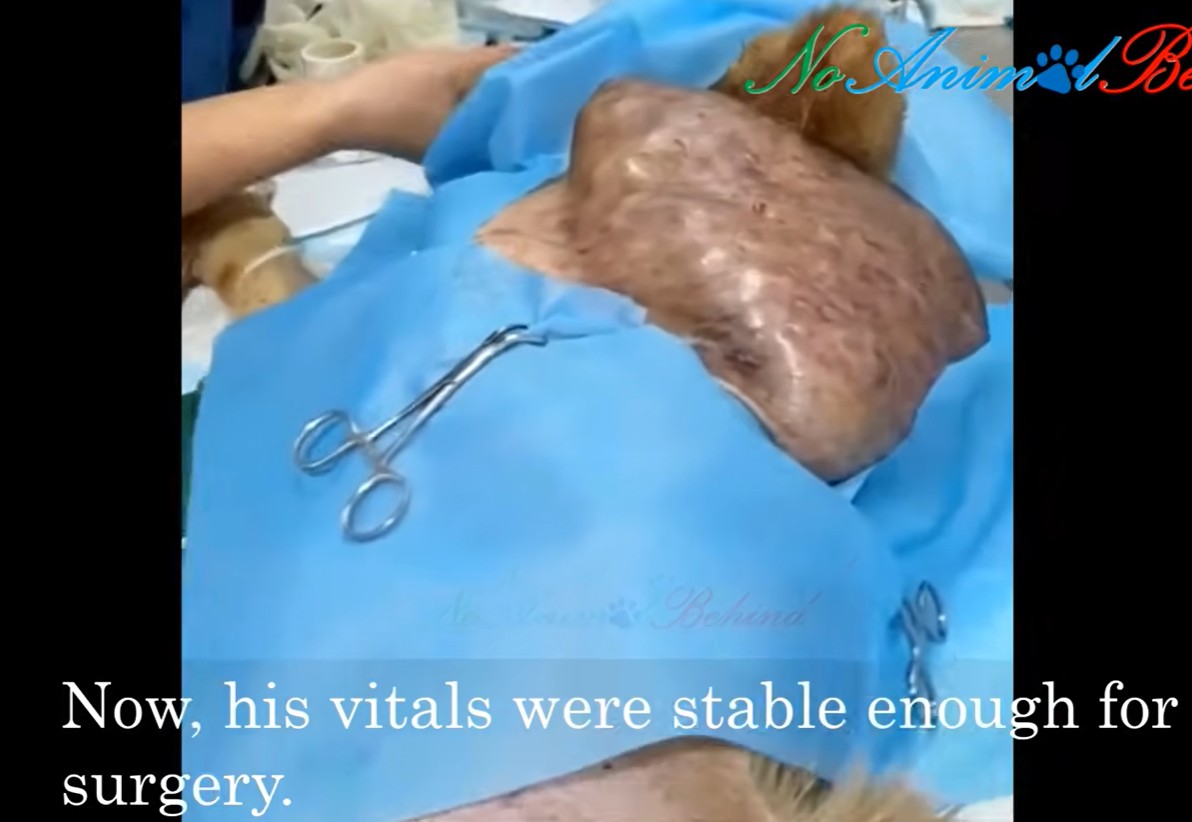
After evaluating his progress, the veterinary team determined that the time had come to operate.
For Ball, it was the most important medical challenge of his rescue.
The surgery lasted approximately four hours.
During that time, surgeons carefully worked to separate the mass from the surrounding tissue.
The size and extent of the growth demanded precision.
There was little room for unnecessary injury, particularly given Ball's fragile condition.
The operation required the team to address a problem that had been developing for years, while protecting the elderly dog's limited reserves of strength.
Eventually, the tumor was successfully removed.
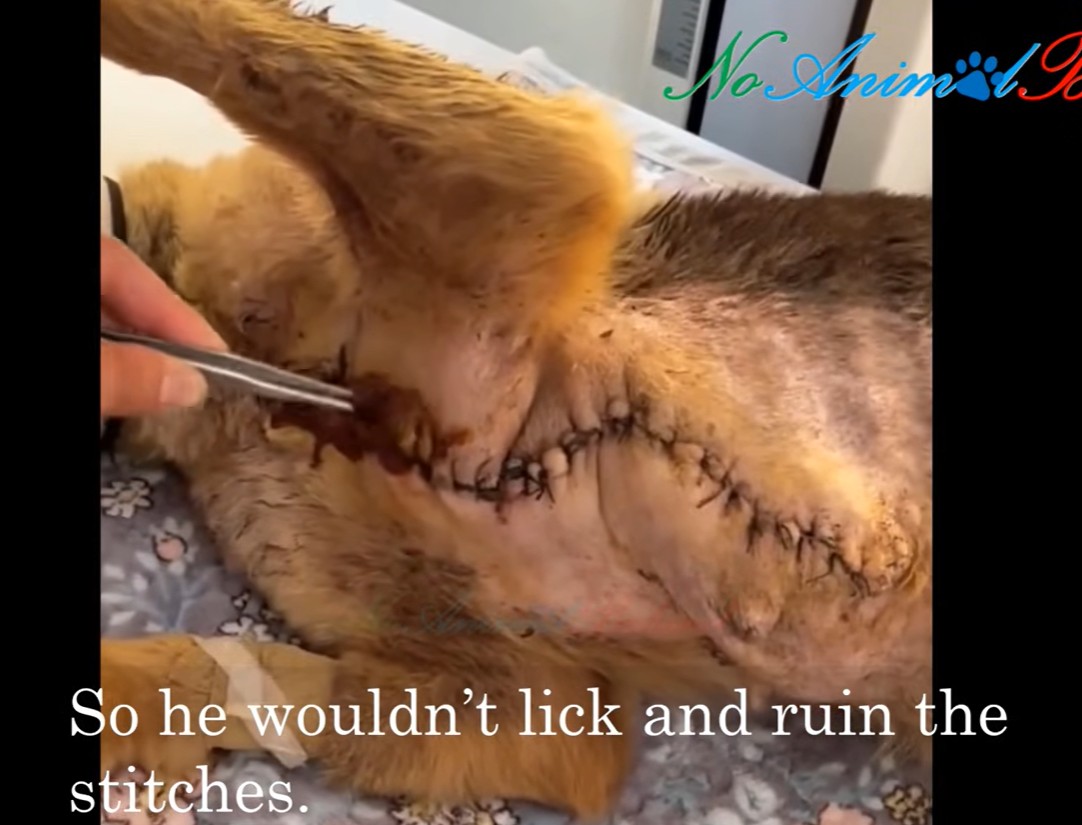
The surgical incision measured more than 30 centimeters and required over 50 stitches to close.
For the first time in years, the enormous weight that had restricted Ball's movement was no longer attached to his body.
It was a major achievement.
But the operation itself was only one part of the challenge.
Ball still needed to recover from anesthesia.
And until he opened his eyes, his caregivers could not fully relax.
The Moment Ball Opened His Eyes
Approximately half an hour after the operation, Ball began to wake.
His eyes slowly opened.
His body was exhausted from the lengthy procedure, and he showed signs of discomfort as he regained consciousness.
But he was alive.
For the people who had cared for him through his most vulnerable days, that was an enormous relief.
The tumor was gone, and Ball had made it through an operation that had initially seemed too dangerous to attempt.
Caregivers stayed close, offering gentle comfort as he recovered.
One of them quietly reassured him that he had made it.
Then they noticed moisture gathering in his eyes.
The original account described what appeared to be tears.
There was no way to know whether the moisture was connected to physical discomfort, the effects of treatment, or another natural response.
Still, the image of Ball opening his eyes after everything he had endured carried a powerful emotional meaning.
Here was an elderly dog who had been found unable to move beneath the weight of a massive tumor.
Now he was waking up without it.
The next stage would require continued medical attention, careful monitoring, and time for his body to heal.
His rescuers had never expected such a serious condition to be corrected overnight.
And even after a successful operation, there was no reason to rush his recovery.
For Ball, simply waking up was enough of a victory for that moment.
Ten Days Later, a Different Dog Began to Emerge
The days following Ball's surgery brought the kind of progress his rescuers had been hoping to see.
Ten days after the operation, his surgical wound was healing well.
The swelling associated with the enormous growth was gone.
His body no longer had to support the weight that had made movement nearly impossible.
And slowly, the changes became visible in the way he carried himself.
Ball could stand independently.
Then he began walking.
His steps were careful at first, as might be expected from an elderly dog recovering from such a serious medical ordeal.
But the important difference was unmistakable.
He was moving under his own strength.
There was no longer a massive tumor pulling against his abdomen with every attempt to walk.
His eyes appeared brighter.
His tail, once almost motionless, began moving gently again.
Those changes might seem modest when compared with the scale of his surgery.
But for a dog who had once been unable to sit or stand, they represented an extraordinary improvement in daily life.
He could change position more comfortably.
He could walk without carrying the enormous mass that had dominated his body for years.
He could rest without that same weight pressing against him.
His recovery was not simply about removing a tumor.
It was about restoring ordinary abilities that his condition had taken away.
Standing.
Walking.
Eating.
Resting.
The simplest parts of a dog's day had become meaningful achievements.
A New Name for the Life Ahead
During his rescue and recovery, the caregivers gave the elderly dog a name.
Ball.
It was a small gesture, but one that marked a very different chapter in his life.
When rescuers first encountered him, he had been abandoned in a ditch with an advanced medical condition and almost no strength remaining.
Now he was receiving the attention, treatment, and compassion that he had needed for so long.
The name did not erase his past.
His age had not changed.
Neither had the fact that he had endured years of discomfort before anyone intervened.
But his circumstances had changed profoundly.
Ball was no longer lying helpless beneath a growth that weighed almost as much as a small dog.
He was recovering.
He was walking.
And he was surrounded by people who cared about his well-being.
There is something especially moving about watching an older animal regain a little of the freedom that illness has taken away.
For a young, healthy dog, walking across a room may be an ordinary moment.
For Ball, those first steps after surgery were the result of several extraordinary things coming together.
Someone had found him.
Someone had taken him to a veterinary hospital.
A medical team had recognized that immediate surgery would be too dangerous and had taken the time to stabilize him.
And when his body was ready, surgeons had carried out a difficult operation that gave him the possibility of a more comfortable life.
His improvement was not the result of one dramatic moment alone.
It came from a series of careful decisions, each building upon the last.
What Ball's Second Chance Teaches Us
It is easy to focus on the enormous tumor when hearing Ball's story.
Its size was extraordinary.
The surgery was complicated.
And the physical improvement after its removal was striking.
Yet perhaps the most meaningful part of his journey was something much quieter.
He was an old dog who still deserved care.
That remained true when he was lying in the ditch.
It remained true when he was too weak to undergo surgery.
And it remained true during the days when recovery depended on fluids, food, medical attention, and patience.
Ball could not explain how long he had been suffering.
He could not tell his rescuers what his life had been like before they found him.
His physical condition offered evidence of prolonged hardship, but the full history of those years remained beyond his ability to communicate.
What mattered was that his caregivers responded to the needs in front of them.
They saw an animal in distress and treated his life as worth protecting.
The result was a transformation that could be seen in the smallest movements.
A lifted head when food was offered.
The ability to rise.
Eyes opening after surgery.
A few careful steps during recovery.
And finally, a gentle movement of his tail.
Each one represented a little more comfort and a little more freedom than he had known when his rescuers first arrived.
Ball's story is also a reminder that elderly dogs should never be considered less deserving of help because their bodies have become weak.
Age can make treatment more complicated.
Recovery can require additional patience.
And serious medical conditions do not always have the outcomes everyone hopes for.
But those challenges do not diminish the value of an animal's life.
For Ball, compassionate care created an opportunity that abandonment had nearly taken away.
His reported progress after surgery showed how much difference that opportunity could make.
Today, the account of his recovery describes a dog walking more comfortably, surrounded by the affection of those caring for him.
The elderly dog who once lay helpless in a ditch is no longer carrying the enormous weight that had confined him.
He has a name.
He has people looking after him.
And he has the chance to experience daily life with far less physical burden.
There is no need to make Ball's story more dramatic than it already is.
His journey from immobility to walking again speaks for itself.
Sometimes, a second chance does not arrive as one grand moment.
Sometimes, it begins when someone sees an animal who can no longer stand and decides that he is still worth saving.
For Ball, that decision changed everything.


