
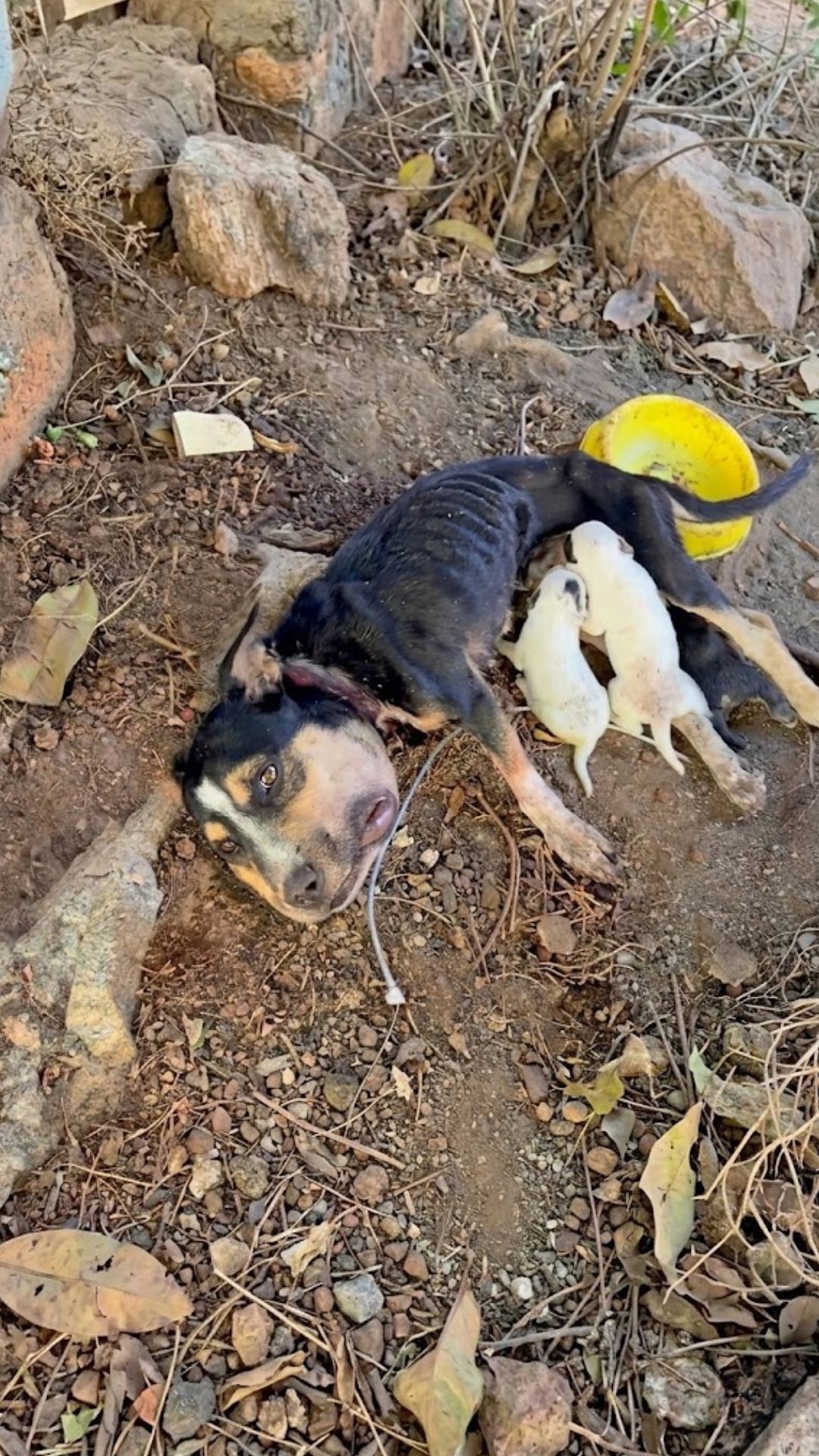
The mother dog stood beside a tree, held in place by a heavy chain that had caused her pain for far too long.
Close to her were tiny puppies, barely ten days old, searching for warmth and nourishment from the only source of comfort they had ever known.
Their mother was exhausted.
Her body showed the consequences of prolonged neglect, and the chain around her neck had caused serious injuries. Yet even in that condition, she continued to allow her puppies to stay close.
She had almost nothing left to offer them.
But she was still there.
When rescuers eventually reached the property, they would discover a mother whose determination to care for her newborns had outlasted almost everything else.
They would give her a name.
Khaleesi.
And although her time in safety would be painfully short, the impact of her rescue would reach far beyond the place where she was found.
A Neighbor's Concern Revealed a Life of Neglect
The rescue began with a message from a concerned neighbor.
Along with the message came several blurry photographs showing a dog tied to a tree on a neglected-looking property.
The images were troubling enough to prompt a response.
At first, the rescuers expected to find an animal that had been left without proper attention. They knew the situation might be serious, but the photographs had not revealed the full extent of what was happening.
When they arrived, they found a mother dog in desperate need of help.
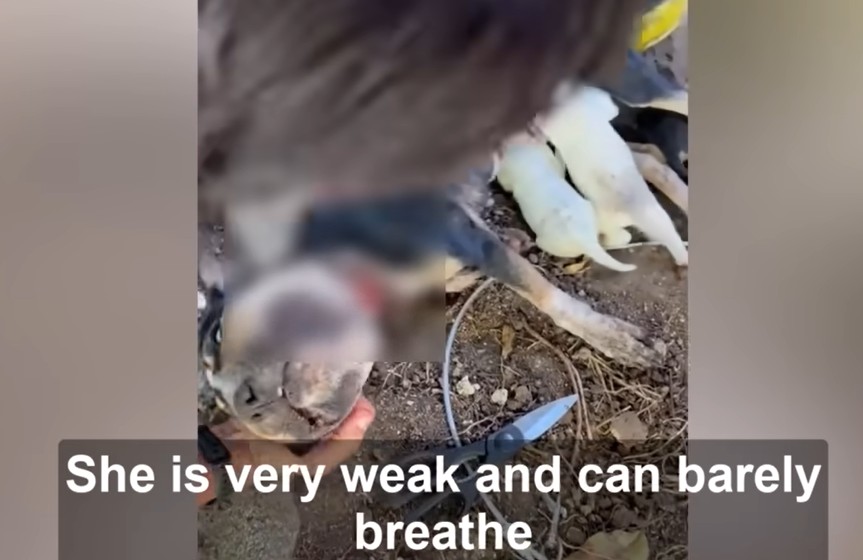
She had been restrained by a heavy chain for an extended period. The metal around her neck had tightened and caused significant damage, leaving the surrounding area swollen and painful.
Her head also appeared unusually enlarged, a condition the rescuers associated with the pressure around her neck.
She was severely weakened.
What made the discovery even more difficult was her lack of reaction.
She did not greet the approaching people with excited barking. Nor did she appear to have the strength to resist.
She simply remained where she was.
The rescuers could see that her condition required urgent attention.
Then they noticed the puppies.
The Small Lives Depending on Her
Beside the exhausted mother was a litter of newborn puppies.
They were no more than ten days old.
At that age, puppies depend almost entirely on their mother for nourishment, warmth, and protection. They cannot understand why she may be unable to provide what they need.
They only know to move toward her.
And that was exactly what these little ones were doing.
The puppies continued searching for milk, even though their mother's weakened condition had left her unable to produce enough to feed them.
For the rescuers, the sight added another layer of urgency.
The mother needed immediate medical care.
The puppies needed reliable nourishment and close attention.
Neither could safely remain in those conditions.
Yet the mother had continued allowing her babies to nurse despite the discomfort it caused her.
Her behavior revealed something deeply moving about maternal instinct.
She could not escape the chain.
She could not find food or a safer place for her newborns.
But she had continued giving them whatever comfort she could.
The rescuers now faced two responsibilities at once: freeing the mother without worsening her injuries and making sure her puppies received the care they urgently needed.
There was no time to ignore either.
The Difficult Moment the Chain Finally Came Off
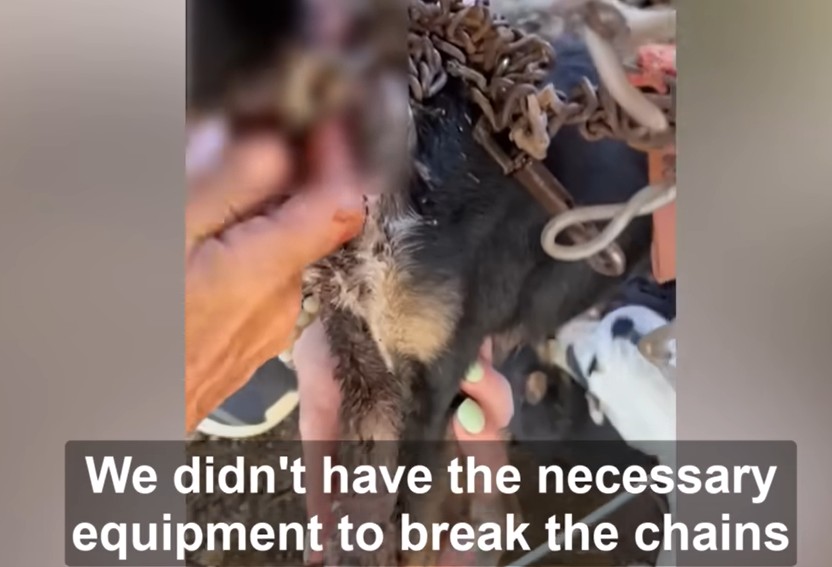
Releasing the mother dog proved much harder than anyone had hoped.
The chain was thick and rusted, and the rescuers initially lacked the proper equipment to remove it easily.
Because the metal had remained tightly positioned around her injured neck, even small movements could cause discomfort.
The rescuers needed to work carefully.
They could not simply pull the chain away.
Each attempt required patience, with the team trying to avoid placing additional pressure on an already vulnerable area.
Throughout the process, the dog remained remarkably quiet.
She made occasional low sounds that reflected her distress, but she did not struggle violently against the people trying to help her.
Those assisting her were visibly affected by her condition.
Some cried as they worked.
The longer they looked at the damaged chain and her weakened body, the harder it became to imagine how she had managed to care for her newborns under such circumstances.
Eventually, the rescuers succeeded.
The chain was removed.
For the first time since they had found her, the mother was no longer physically bound to the tree.
It was an important moment.
But freedom from the chain did not mean freedom from the damage it had already caused.
She was too weak to walk normally, so the rescuers lifted her carefully and transported her to a veterinary clinic.
Her puppies were also taken away from the property, this time to a caregiver who could provide the specialized feeding they needed.
The family was finally receiving help.
VIDEO: Chained and Exhausted, Khaleesi Kept Caring for Her Newborn Puppies Until Rescuers Arrived
Two Different Paths Toward Safety
At the veterinary clinic, the mother dog's immediate needs became the priority.
She had arrived in extremely poor physical condition, with serious injuries associated with the chain and a body weakened by prolonged neglect.
Her recovery was uncertain.
The rescuers had been able to remove the restraint, but they could not undo the effects of everything she had experienced simply by bringing her to safety.
She needed professional care and time.
Meanwhile, her puppies were placed with Martina, a foster caregiver experienced in bottle-feeding newborn dogs.
The little ones were dehydrated and fragile.
Without their mother's milk, they needed human assistance to receive enough nourishment during this vulnerable stage of life.
Martina's experience gave them an opportunity they might not otherwise have had.
While their mother received veterinary attention, the puppies began receiving the feeding support necessary for their survival.
It was not the reunion anyone would have wished for.
Ideally, the family would have been together in a comfortable home, with their mother healthy enough to nurse and protect them.
But their situation had made separate care necessary.
Both the mother and her puppies were now in the hands of people determined to give them a chance.
During this period, the rescuers chose a name for the mother.
Khaleesi.
To them, it represented the strength of a warrior.
After witnessing her condition and the way she had continued caring for her newborns, the name felt fitting.
She had endured extraordinary hardship.
Now, for the first time in the rescuers' presence, she could rest without the weight of the chain holding her in place.
A Small Step That Made Everyone Hope
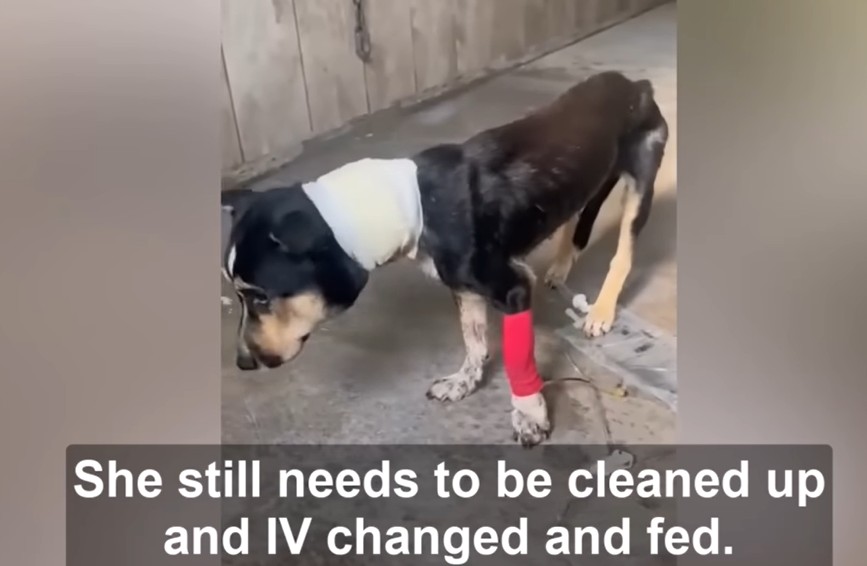
Khaleesi survived her first night at the clinic.
Considering how weak she had been when rescuers found her, making it through those initial hours was encouraging.
The following morning brought another hopeful development.
She stood up.
Her movements were slow and uncertain, and her body remained fragile. Nevertheless, she managed to support herself.
Then she began taking steps.
The significance of that moment was difficult to overlook.
Only a short time earlier, she had been restrained beside a tree, unable to move freely and struggling to provide for her puppies.
Now she could move without the chain.
She also began eating small amounts of food.
Her appetite was limited, but the fact that she was willing and able to eat offered another reason for cautious optimism.
For the people caring for her, these were meaningful signs.
Not dramatic transformations.
Not proof that everything would be all right.
Just small changes that suggested her body might still have enough strength to respond to care.
The rescuers allowed themselves to hope.
Perhaps Khaleesi would continue eating.
Perhaps she would slowly regain enough strength to walk comfortably.
Perhaps, after enduring so much, she might experience the kind of ordinary life that every companion animal deserves.
A place to rest.
Food provided regularly.
Gentle human attention.
Freedom to move without pain from a restraint.
None of those hopes were extravagant.
They were simple things that should never have been absent from her life.
But after seeing her stand and eat, the possibility of a different future no longer felt entirely out of reach.
For a brief period, Khaleesi's progress gave everyone something to hold on to.
Unfortunately, her condition remained far more serious than those small improvements could reveal.
When Her Body Could No Longer Recover
Three days after the rescue, Khaleesi's condition deteriorated.
The early signs of progress had created hope, but they had not erased the physical consequences of her prolonged suffering.
Despite the care she received, her strength began to fade.
Those looking after her had already seen how severe her condition was when she arrived.
Now they were confronted with the possibility they had feared from the beginning.
Khaleesi might not survive.
The veterinary efforts continued, but her body could no longer sustain the struggle.
She passed away.
Her death came only three days after the chain had been removed.
It was a deeply painful outcome for the people who had worked so hard to save her.
They had imagined a future in which she could recover, experience comfort, and perhaps enjoy the freedom she had been denied.
Instead, their time with her was measured in days.
Yet those days were not meaningless.
Khaleesi had received medical attention.
She had been released from the restraint that had caused her so much suffering.
She had experienced gentle care from people who wanted her to live.
Most importantly, she had not spent her final moments abandoned beside the tree.
She was surrounded by people who cared about her.
The rescuers had known her for only a short time, but they would remember her long afterward.
Her passing was a reminder that rescue does not always end in recovery.
Sometimes help arrives after an animal has already experienced too much physical damage.
Compassion cannot guarantee survival.
But it can still offer comfort, dignity, and the assurance that an animal's suffering has finally been recognized.
For Khaleesi, those final days mattered.
Hundreds Walked in Memory of One Mother
Khaleesi's death did not bring an end to the attention surrounding her story.
As people learned about the mother dog and the circumstances of her rescue, her experience began to move others who had never met her.
What had started with a concerned neighbor and a few photographs grew into a wider expression of compassion.
People wanted to remember her.
They also wanted to draw attention to the suffering that can remain hidden when animals are neglected or left restrained without appropriate care.
Eventually, hundreds of people gathered for a silent walk in Khaleesi's honor.
Participants dressed in white.
Rather than turning the gathering into a loud demonstration, they chose a quiet tribute.
The shared purpose was clear.
They wanted Khaleesi's experience to mean something beyond the sadness of her loss.
The gathering reflected a belief that no animal should be left to endure prolonged suffering without someone noticing and taking action.
Khaleesi could not tell anyone what she needed.
She could not explain how long she had been chained to that tree.
Her condition, however, had communicated the urgency of her situation once people finally reached her.
And the neighbor who first raised the alarm had shown how important a single act of concern can be.
Without that message, the rescuers might not have known she was there.
Without the rescue, her puppies might never have reached Martina's care.
Those connections gave the story a meaning that extended beyond one heartbreaking outcome.
The silent walk honored a mother whose life had been difficult, but whose final days had brought people together.
The Puppies Who Carry Her Story Forward
Although Khaleesi did not survive, her puppies were given an opportunity to continue growing.
According to the rescue account, the little ones survived their vulnerable early period and were growing stronger.
Their progress was an important part of the story.
When they were first discovered, they were tiny, dehydrated, and dependent on a mother who was herself struggling to survive.
They needed specialized feeding.
They needed protection.
And they needed someone capable of meeting their needs while they were too young to care for themselves.
Martina's involvement helped provide that support.
Khaleesi had done what she could for them before the rescue.
Afterward, human caregivers took over the responsibility of keeping them safe.
Their survival does not erase the loss of their mother.
Nor does it make the circumstances of her life any less serious.
But it does mean that the effort to help this family was not in vain.
The puppies have the chance to grow beyond the hardship into which they were born.
That opportunity is part of Khaleesi's legacy.
A Life Remembered for More Than Its Suffering
There are several moments from Khaleesi's story that deserve to be remembered.
A neighbor noticed something wrong and chose to speak up.
Rescuers arrived at a neglected property and found an exhausted mother still caring for her newborns.
People worked patiently to remove a chain that had caused serious harm.
A foster caregiver accepted responsibility for the puppies who urgently needed nourishment.
And in a veterinary clinic, Khaleesi experienced a few precious days without the restraint that had defined so much of her suffering.
None of those moments changed the final outcome for her.
But each reflected the difference that human compassion can make.
Her story also carries a difficult lesson about the importance of responding early to signs of animal neglect.
A dog tied to a tree may not always bark or struggle.
Silence does not mean an animal is comfortable or safe.
Sometimes the most vulnerable animals are the ones least able to make their distress obvious.
Recognizing that vulnerability, reporting concerns through appropriate channels, and supporting responsible rescue efforts can make a meaningful difference.
Khaleesi's life deserved far more comfort and security than she received.
She should have been able to care for her puppies in safety.
She should have had proper nourishment, freedom of movement, and medical attention before her condition became critical.
Those things came too late to save her.
But they were not too late to help her babies.
And they were not too late to inspire others to notice animals whose suffering might otherwise remain unseen.
Khaleesi will be remembered not only as a dog who endured neglect, but as a mother whose final chapter brought strangers together in compassion.
Her chain was eventually removed.
Her puppies survived.
And the people who came to know her made sure her life would not simply be forgotten.
Rest peacefully, Khaleesi.
Your time in safety was short, but your story continues through the little lives you helped bring into the world—and through the people who learned why every animal deserves to be seen.


