
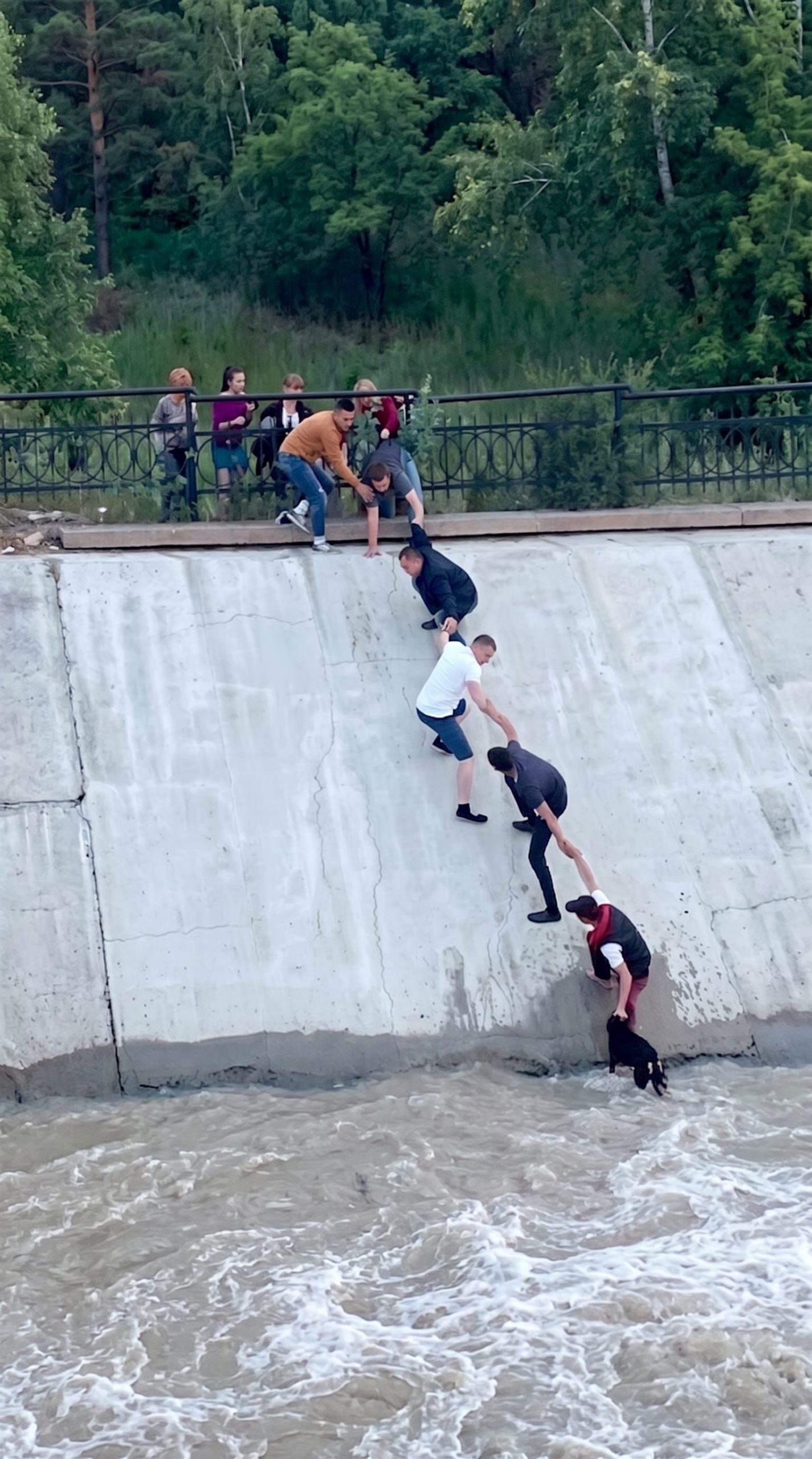
The dog was struggling against the current, its paws scraping desperately against a concrete wall too steep to climb.
Above the water, there was safety. Below it, an exhausted animal was running out of ways to escape.
At the Sayran Reservoir in Almaty, Kazakhstan, the sloping concrete banks created a frightening obstacle. The same structure that held the water in place made climbing out extraordinarily difficult.
One passerby saw the struggling dog and decided to help.
He made his way down toward the water, reached the animal, and held it close.
But saving the dog was only half the challenge.
Now the man was trapped, too.
Neither could easily climb the slippery embankment. The water continued to pull against them, and the distance to safety suddenly seemed much greater than it had from above.
What happened next would eventually become more than a rescue.
It would become a permanent reminder of what ordinary people can accomplish when they refuse to leave someone behind.
A Frightened Dog With No Way Back to Safety
The Sayran Reservoir is surrounded by imposing concrete slopes.
From a distance, those banks might appear manageable. But their steep surfaces can become dangerous for anyone trying to climb out of the water.
For a dog caught near the bottom, there was little to hold on to.
The animal struggled against the moving water, its paws unable to find a secure grip on the concrete.
Every attempt to climb ended against the same unforgiving surface.
The dog was visibly exhausted.
Its movements showed the strain of trying to remain above the water while searching for an escape that simply wasn't there.
There was no indication in the account of how the dog had entered the reservoir or how long it had been struggling before someone noticed.
What mattered in that moment was the danger directly in front of the witnesses.
A living animal needed help.
And someone was willing to take a risk to provide it.
One Man Reached the Dog, but the Water Held Them Both
The first rescuer was a passerby who saw the situation unfolding.
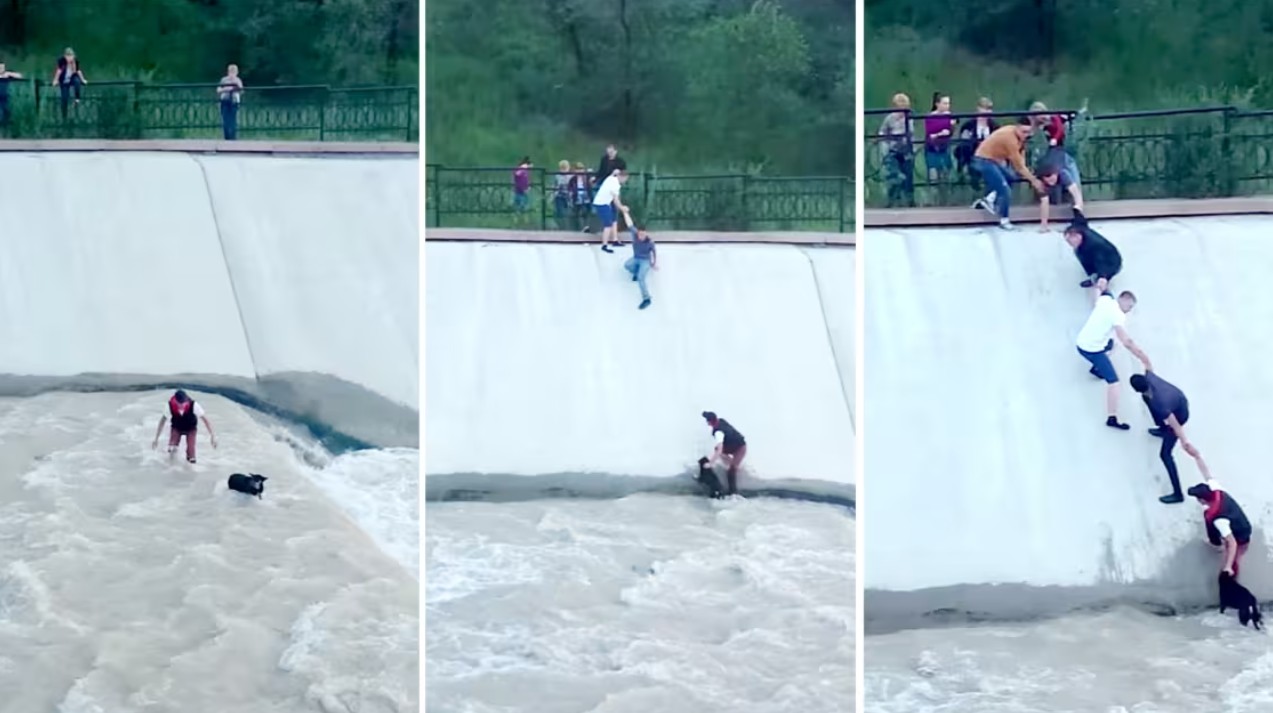
Rather than remaining at the top of the embankment, he descended the steep concrete slope toward the water.
His decision brought him close enough to reach the frightened dog.
He gathered the animal into his arms and held on, trying to keep it secure against the current.
For a moment, the most important part of the rescue had happened.
The dog was no longer struggling alone.
But the man quickly faced a serious problem.
Going down had been possible. Getting back up while holding an exhausted animal was another matter entirely.
The concrete offered little traction.
The slope was steep.
And the current continued to work against him.
The rescuer could protect the dog in his arms, but he could not easily lift both of them to safety.
His willingness to help had carried him into the danger.
Now he needed help himself.
Four Strangers Turned a Dangerous Situation Into a Shared Rescue
From above, four other people saw what was happening.
They understood that the man could not manage the climb while holding the dog.
Instead of leaving him to struggle, they moved toward the edge.
One person reached for another.
Hands closed around wrists and arms.
Carefully, the strangers lowered themselves down the embankment, using one another for support.
Together, they formed a human chain stretching from the safer ground above toward the rescuer below.
It was a simple idea.
But carrying it out demanded trust.
Each person depended on the strength and grip of the others. If someone lost their hold, the entire effort could be affected.
There was no complicated equipment described in the rescue.
No elaborate preparation.
Only people using their own bodies to bridge the distance that one person could not overcome.
At the lower end of the chain, the original rescuer continued holding the dog.
At the upper end, the others worked to keep everyone connected.
The water pulled.
Their footing remained uncertain.
But the chain stayed together.
VIDEO: Strangers Form a Human Chain to Pull a Trapped Dog and His Rescuer From the Reservoir
For approximately four minutes, the group worked against the difficult conditions.
Four minutes can pass almost unnoticed during an ordinary day.
Beside a steep reservoir, with a frightened animal in the water and several people depending on one another, those minutes carried a different weight.
There was no room for an individual to solve the entire problem.
The man holding the dog needed the people above him.
Those people needed one another.
Every link mattered.
Then came the decisive effort.
Working together, the strangers pulled the rescuer upward, bringing the soaked dog with him.
The human chain had done what one person alone could not.
Both the man and the animal made it back onto solid ground.
The immediate danger was over.
The Moment They Finally Reached Solid Ground
The rescue succeeded because the strangers remained connected until everyone was out of the water.
The dog, exhausted and wet, had been carried away from a situation it could not escape independently.
The original rescuer had also reached safety.
The source does not describe a veterinary examination, the dog's later recovery, or whether it eventually returned to an owner or found a permanent home.
Those details remain unknown.
But the outcome of the rescue itself was clear.
The dog was no longer trapped at the bottom of the reservoir.
And the man who had gone down to save it had not been left behind.
There is something especially moving about the way the rescue unfolded.
The first man did not know that four strangers would come to his aid when he went down the slope.
The people above did not begin as an organized rescue team.
They were simply individuals who recognized that another person and an animal needed assistance.
Their actions turned separate people into a single coordinated effort.
That is what made the footage so memorable.
The rescue was recorded on camera, allowing people far beyond Almaty to witness the moment.
As the video circulated internationally, viewers saw the frightening conditions, the improvised human chain, and the coordinated effort that finally brought both lives out of danger.
The footage did not need an elaborate explanation.
The importance of the moment was visible in the way each person held on to the next.
For many viewers, the rescue represented something reassuring about human nature.
A stranger saw a dog in distress and responded.
When that stranger needed help, others responded in turn.
Compassion spread from one person to another.
And the outcome changed because of it.
A Rescue Remembered Long After the Water Settled
Many widely shared rescue videos eventually disappear from public attention.
People watch, feel relief, and move on to the next story.
But this rescue left a lasting impression in Almaty.
Approximately a decade after the event, the moment that had brought strangers together became the inspiration for a permanent public artwork.
ForteBank JSC collaborated with creative agency Progression to commemorate the extraordinary act of cooperation.
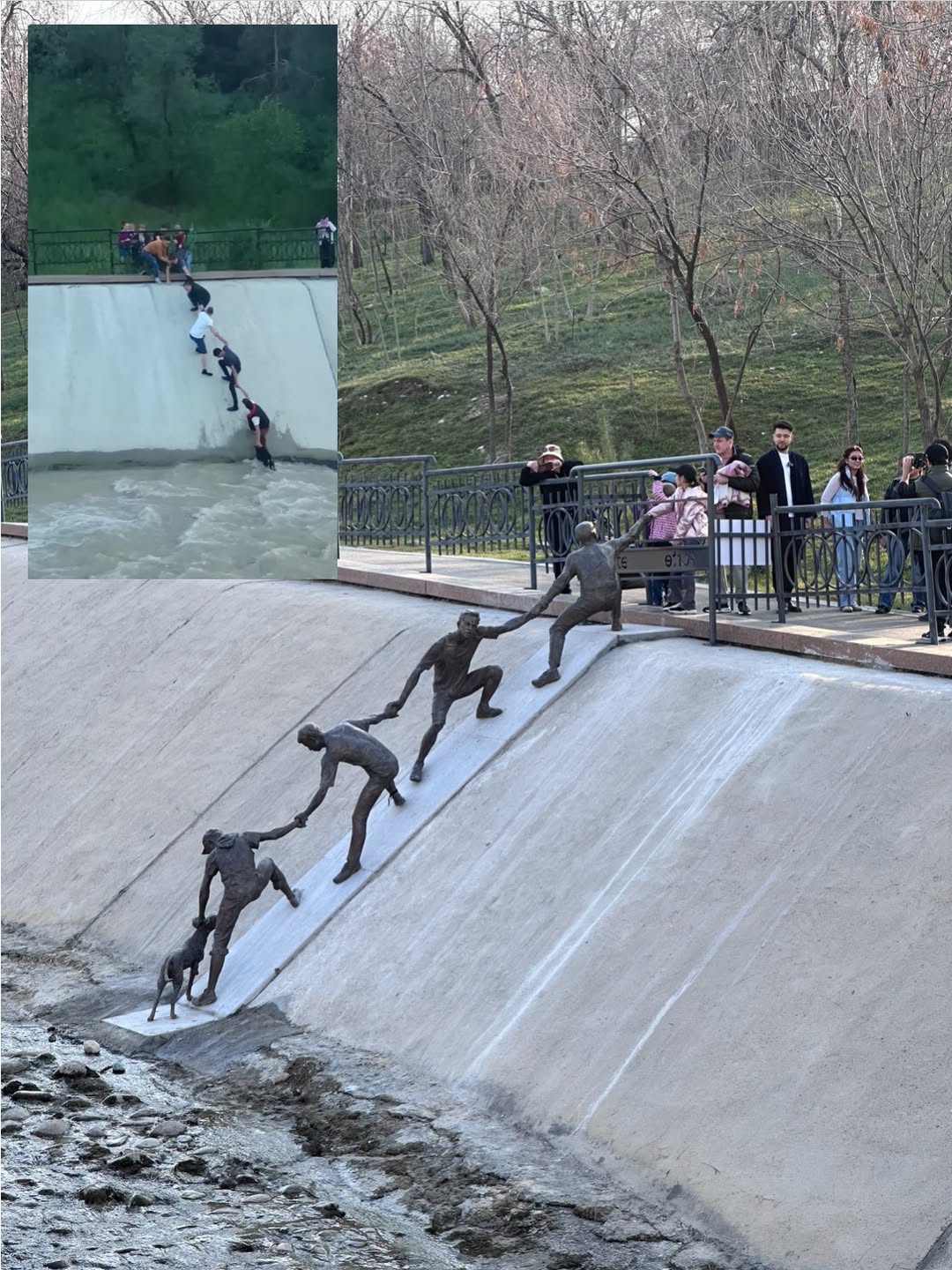
The project brought in artist Yerbosyn Meldibekov, who transformed the central image of the rescue into a bronze sculpture.
The installation was titled "Unity."
Rather than presenting the dog rescue as an isolated act of individual bravery, the artwork focused on the connection between the people involved.
The figures were arranged in a chain.
Their bodies stretched toward one another.
Their arms reached across the distance, recalling the physical effort required to bring the rescuer and the dog out of the reservoir.
The sculpture was installed at the same reservoir where the original rescue had taken place.
That location gave the work a special meaning.
Visitors could stand near the place where the real event happened and see a permanent representation of the cooperation that saved two lives.
The artwork did not simply preserve the memory of danger.
It preserved the moment when people overcame that danger together.
One Bronze Hand Invites Everyone to Become Part of the Story
Perhaps the most meaningful part of the installation is its final outstretched hand.
At the upper end of the sculpture, a bronze hand extends beyond the railing.
It reaches outward toward anyone standing nearby.
Unlike the other figures, whose positions are fixed within the artwork, this hand is deliberately waiting for someone.
A visitor can approach it.
Reach out.
And take hold.
By doing so, that visitor visually completes the human chain.
It is a small interaction, but it changes the experience of viewing the sculpture.
Instead of merely observing a rescue that happened years earlier, people can place themselves within its central message.
They become the next person willing to hold on.
The artistic idea is powerful because it asks so little of the visitor.
There is no need to understand a complicated explanation.
A hand is reaching out.
Another hand can meet it.
The gesture reflects exactly what made the original rescue possible.
No single person could overcome the reservoir's steep concrete walls while protecting the exhausted dog.
But when people connected, the seemingly impossible task became achievable.
The sculpture turns that lesson into something visitors can physically experience.
And it gives the rescue a new life beyond the original footage.
A Small Act of Compassion Became a Message for the World
The "Unity" installation attracted widespread attention online, with the project reportedly drawing hundreds of millions of views.
Its appeal reached beyond Kazakhstan.
The story was understandable to people from different countries and backgrounds because its central action required no translation.
Someone was in trouble.
Another person reached out.
Others joined.
And everyone held on until the rescue was complete.
That message is especially meaningful when looking back at the dog whose struggle began the entire sequence.
The animal did not know that its rescue would eventually inspire a public sculpture.
It did not know that people around the world would watch the footage.
It only faced the immediate difficulty of remaining safe in water from which it could not escape.
The first passerby responded to that immediate need.
The four strangers responded to his.
Everything that followed grew out of those decisions.
The rescue illustrates an important difference between individual courage and collective strength.
The man who entered the reservoir showed courage by approaching an animal in danger.
The strangers above showed courage by joining the effort despite the difficult conditions.
But the successful outcome depended on more than bravery.
It depended on cooperation.
Each person accepted that their own safety and success were connected to those of the others.
They did not need to know one another beforehand.
They only needed to recognize a shared responsibility in that moment.
A representative of ForteBank later reflected on the project with a message about how tasks that seem impossible for one person can become possible when people support one another.
That idea lives on in the bronze figures at Sayran Reservoir.
And it lives on in the final hand reaching beyond the railing.
Years after the dog and its rescuer returned to safety, visitors can still complete the chain that once made their escape possible.
The sculpture reminds us that kindness is not always a grand gesture.
Sometimes it begins with noticing a frightened animal.
Sometimes it means reaching toward a stranger who cannot climb back up.
And sometimes the most important thing one person can do is simply refuse to let go.
At Sayran Reservoir, five people proved how much can change when compassion becomes a shared action.
A dog was saved.
A rescuer was brought home safely.
And a moment of human connection became a lasting symbol of hope.
The water eventually settled.
But the meaning of those outstretched hands remained.


