
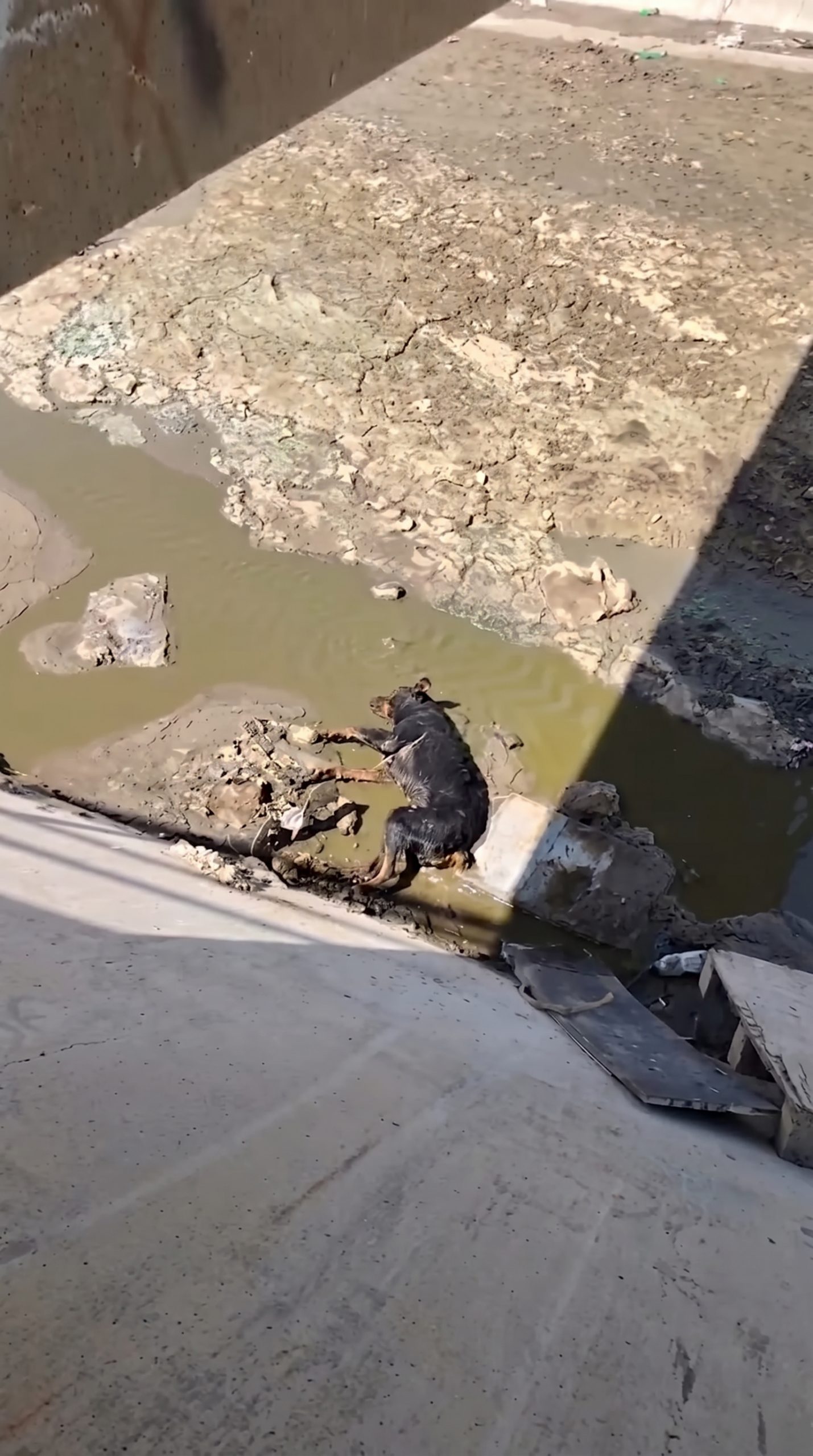
The cry came from the bottom of a concrete canal, rising through the hot, still air of Baja California.
Far below the edge, a Rottweiler lay almost completely motionless. She was too weak to stand, too exhausted to find her own way out, and surrounded by steep concrete walls that offered no easy escape.
For a brief moment, she managed to make a sound.
Then everything became quiet again.
It was a difficult sight for the people who eventually noticed her. From above, the large dog looked terribly small against the enormous drainage structure.
She needed help.
And reaching her would require far more than simply walking down and carrying her away.
What nobody watching from the canal's edge could have known was how much this dog had already endured before arriving there.
Her rescue would reveal a long period of neglect, a body weakened by hunger, and a surprising ability to trust people despite everything that had happened.
But first, someone had to get her out.
A Lonely Figure at the Bottom of the Canal
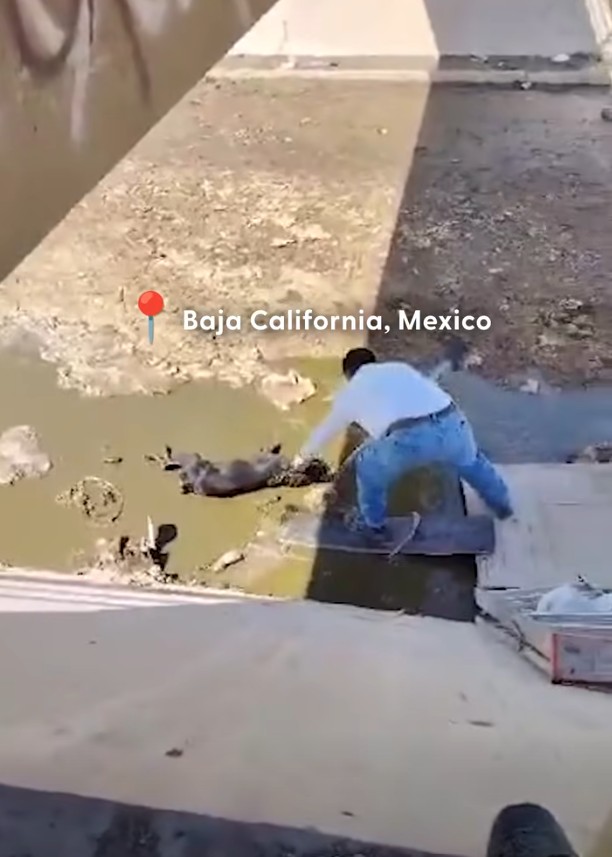
The drainage canal stretched across a dry landscape in Baja California, Mexico. Its steep concrete sides were designed to direct water, not to provide a safe passage for a frightened animal.
At the bottom lay the Rottweiler.
Her body was pressed against the hard surface. She could barely move, and even lifting her head appeared beyond her remaining strength.
A few men passing nearby happened to look down into the canal.
What they spotted immediately raised concern.
There was a large dog below them, seemingly unable to move. The distance between her and the top of the canal made it clear that she could not simply walk out.
The men recognized that the situation was serious, and news of the stranded dog began to spread.
Eventually, the incident reached The Cantu Foundation, an animal rescue organization whose team would become central to her survival.
A video of the dog also began circulating, drawing attention to the helpless animal lying on the concrete.
The footage showed a situation that was difficult to ignore.
There was no comfortable place for the Rottweiler to rest. No shelter from the exposed surroundings. Most importantly, there was no obvious way for her to escape without assistance.
She remained at the bottom, waiting in the only way her exhausted body allowed.
For the people who saw her, one question mattered more than anything else.
Could rescuers reach her in time?
The Fall That Left Her Stranded
When Fatima Guevara and the rescue team arrived, they began learning more about the circumstances that had brought the Rottweiler to the canal.
According to witnesses, a truck had stopped near the edge.
A cardboard box containing the dog had been left in a precarious position.
When the dog shifted, the box lost its balance.
She fell down the steep concrete slope.
The account explained how she had ended up in such an inaccessible place, but it did not fully explain her physical condition.
Even after the fall, there was something particularly concerning about how little she could move.
She was a large dog, yet she showed almost none of the strength normally associated with her breed.
Her body seemed completely drained.
Fatima and her team could see that helping her would require patience, coordination, and careful handling.
The rescuers were facing two immediate problems.
First, the dog was trapped at the bottom of a steep canal.
Second, she was in no condition to assist with her own rescue.
She could not climb toward them.
She could not support her own weight.
Every part of the effort would depend on the people who had come to help.
And because her condition was so fragile, moving her carelessly was not an option.
The Careful Climb Back to Safety
Volunteers descended into the canal to reach the Rottweiler.
Once beside her, the rescuers were confronted with the full extent of her weakness. She could not even raise her head as they approached.
The team needed to secure her without placing unnecessary strain on her body.
They worked carefully, arranging soft ropes to support her during the lift.
It was a delicate operation.
The dog was heavy, and the height of the concrete walls made the extraction challenging. Every movement had to be coordinated with the people helping from above.
There was little room for haste.
The rescuers began lifting her gradually, keeping her supported as she moved upward.
Inch by inch, the distance between the dog and the top of the canal grew smaller.
For an animal who had been unable to move from the ground, being lifted out was an enormous change.
She was no longer alone at the bottom.
Human hands were supporting her.
People were working together to bring her somewhere safe.
Eventually, the team completed the difficult extraction.
The Rottweiler reached the top of the canal.
She was finally out of the place where she had been trapped.
VIDEO: Too Weak to Stand at the Bottom of a Concrete Canal — Watch Flor's Rescue and Her First Steps Toward Recovery
The rescue was an essential first step, but it did not mean the danger had passed.
The dog still needed veterinary attention.
Her severe weakness remained unexplained, and rescuers had to determine what kind of medical care would give her the best chance of recovery.
The team took her directly to a veterinary clinic.
There, an unexpected discovery began to change the way everyone understood her situation.
The Medical Findings Revealed a Longer Struggle
Given the reported fall down the concrete slope, there was understandable concern that the Rottweiler might have suffered broken bones.
But the veterinary examination brought surprising news.
No fractures were found.
That was encouraging, especially after such a frightening incident.
However, the absence of broken bones did not mean the dog was healthy.
The examination indicated severe exhaustion, prolonged starvation, and deep neglect.
Her weakness had not begun with the fall.
She had already been struggling before she ended up in the canal.
That distinction mattered.
The rescue had removed her from immediate physical danger, but her body still needed time and consistent care to recover from a much longer period of deprivation.
She did not simply need a way out of the drainage canal.
She needed nourishment.
She needed rest.
She needed a safe environment where recovery could happen without another struggle for survival.
Under the care of The Cantu Foundation, the dog was given a name.
Flor.
It was a small but meaningful change.
Until then, much of her story had been defined by the place where she was found and the condition she was in.
Now she had an identity beyond those circumstances.
Flor was no longer merely the Rottweiler from the concrete canal.
She was a dog being cared for, with people paying attention to her progress.
And although her recovery would take time, the first encouraging changes eventually began to appear.
From Lying Motionless to Taking Her First Steps
Flor's progress did not happen all at once.
At the beginning, she remained extremely weak.
Her body had endured a long period without adequate nourishment, and the rescue team could not expect her strength to return immediately.
Instead, recovery unfolded through small but important improvements.
The first changes were quiet.
With regular care, warmth, and nourishment, Flor began showing signs that her body was responding.
Then came an achievement that might seem ordinary for a healthy dog but meant something very different for her.
She managed to sit.
For a Rottweiler who had been unable to lift her head at the bottom of the canal, sitting upright represented meaningful progress.
It showed that some of her lost strength was beginning to return.
There was still a distance between sitting and walking, but it was a start.
As her condition improved, Flor reached another milestone.
She stood.
Her first attempts at moving were hesitant. She was not yet the energetic dog she would later become.
But she was supporting herself again.
And eventually, she took her first steps.
Those steps mattered because of what had come before them.
The dog who once lay helpless on a hard concrete surface was now able to move under her own power.
Her recovery was not simply a dramatic moment captured in a video.
It was the result of continued care and the gradual return of strength.
The Cantu Foundation had helped her escape the canal.
Now the people looking after her were helping her regain the ability to live comfortably.
And as Flor became physically stronger, something else started to emerge.
Her personality.
A Gentle Personality Behind a Powerful Appearance
Rottweilers are large, powerful dogs, and their appearance can sometimes make them seem more intimidating than they really are.
Flor offered a wonderful reminder that appearance does not tell the whole story.
As she recovered, her caregivers began noticing a gentler, more playful side.
The dog who had once been too weak to move was becoming increasingly interested in the world around her.
She could enjoy attention.
She could play.
She could interact with people without the exhaustion that had defined her earliest days in rescue.
Her growing confidence was visible in the way she behaved.
There was an affectionate, almost silly quality to her personality.
For those who had seen her initial condition, the transformation was especially meaningful.
Flor had gone from struggling to survive to discovering the simple pleasures that a dog should be able to enjoy.
And she was not finished changing.
Once she was healthy enough to travel, arrangements were made for her to cross the border into the United States.
Her destination was San Diego, California.
There, a foster home was waiting.
It would become the next important chapter in her recovery.
A Foster Home That Revealed the Real Flor
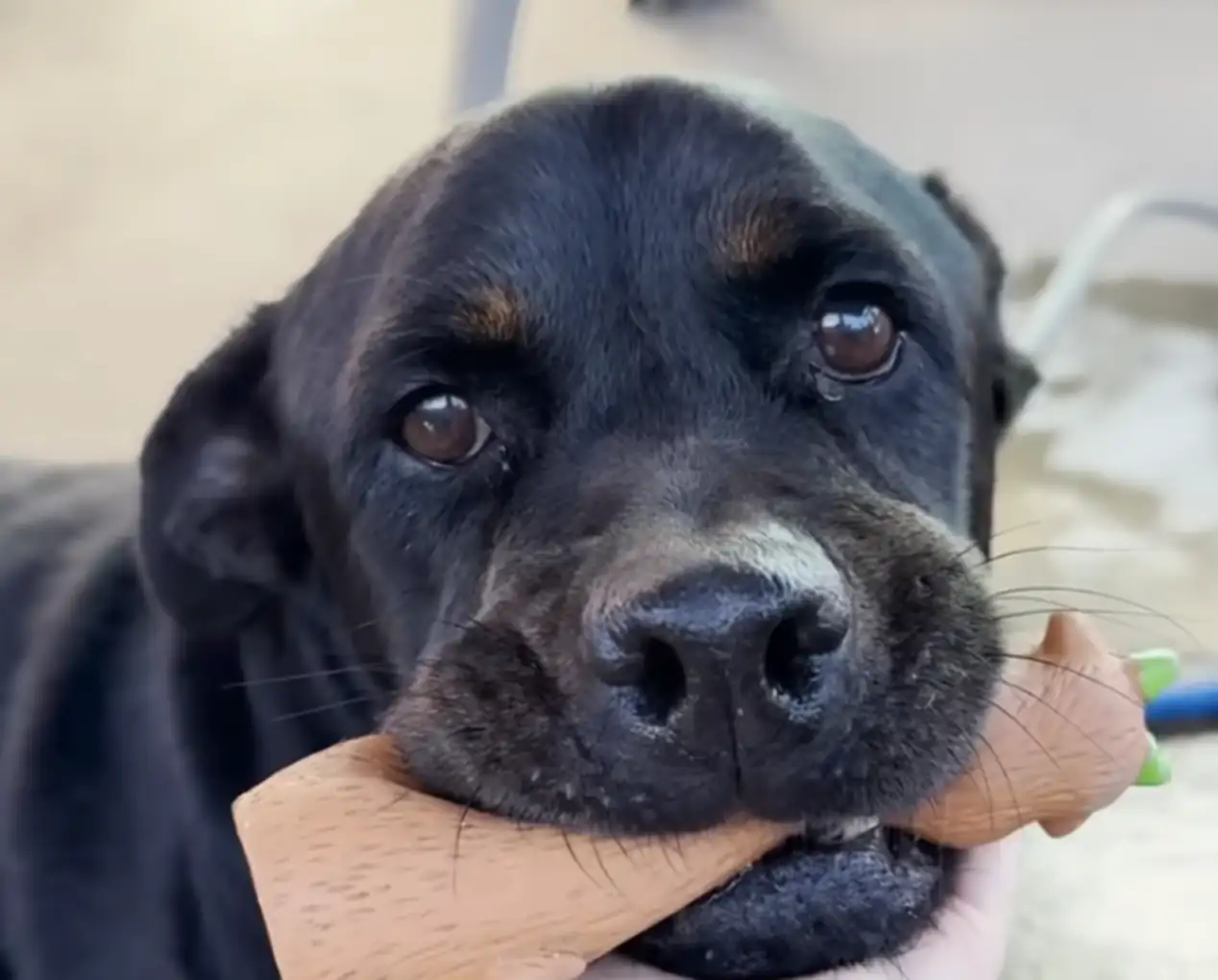
Flor's foster mother, Kajsa, quickly discovered that the large Rottweiler had an unexpectedly soft personality.
Despite her imposing size, Flor behaved like an affectionate, oversized puppy.
She enjoyed companionship and had a playful nature that could be easy to overlook if someone judged her only by her appearance.
Her favorite activities were wonderfully ordinary.
She loved chasing soccer balls.
The sight of a ball was enough to bring out her enthusiasm, turning playtime into one of the highlights of her day.
For a dog who had previously been unable to stand, running after a ball was a remarkable contrast.
It showed just how far she had come.
Flor also enjoyed running through sprinklers and spending time outdoors in the California sunshine.
These were not extraordinary activities for a healthy dog.
That was precisely what made them special in her case.
She was finally experiencing the ordinary happiness that had been missing from her earlier life.
She could run because she had regained her strength.
She could play because she was no longer focused entirely on enduring physical hardship.
She could enjoy the company of people because she was living in an environment where kindness and care were part of her daily routine.
The transformation was visible not only in her movement but also in her behavior.
Flor was gentle.
She was playful.
And she continued to show affection toward the people she met.
Her foster mother was particularly struck by that willingness to trust.
Considering the circumstances of her abandonment and the neglect identified during her medical evaluation, Flor had every reason to be cautious around people.
Yet she continued to respond warmly to human companionship.
Whatever her earlier experiences had been, they had not prevented her from forming positive connections in her new environment.
It was one of the most touching parts of her recovery.
Flor had regained her physical strength.
But she had also retained something that no medical examination could measure.
Her affectionate spirit.
Waiting for the Home She Deserves
By the latest stage described in her story, Flor had recovered enough to enjoy an active life in foster care.
She could chase soccer balls, run through sprinklers, and spend her days surrounded by attention.
But her journey had not yet reached its final destination.
Flor was ready to find a permanent family.
Her foster home had given her a safe place to recover and experience the happiness of being cared for.
Now she needed the stability of a forever home.
A place where her large size would be welcomed along with her affectionate personality.
A place where her playful habits would bring smiles rather than surprise.
A place where the care she had come to know would continue for the rest of her life.
The contrast between Flor's past and present is difficult to forget.
In Baja California, she had been found lying at the bottom of a drainage canal, unable to lift her head.
Rescuers had to support her entire body to bring her to safety.
Her veterinary examination revealed that her weakness had developed through prolonged hunger and neglect.
At that point, even standing was beyond her ability.
Now she could run.
She could play.
She could enjoy the warmth of a foster home and the companionship of people who appreciated her.
The distance between those two versions of Flor was far greater than the height of the canal walls.
It represented the patient work of recovery and the difference that compassionate intervention can make.
The Trust That Survived Everything
Perhaps the most memorable part of Flor's story is not the difficult extraction from the canal or even her return to physical health.
It is her continued openness toward people.
Kajsa described a dog who had been through enough to make trust difficult, yet still showed affection to everyone she encountered.
That gentle nature became one of Flor's defining qualities.
Her story does not erase what happened to her.
The neglect was real.
The exhaustion was real.
And the frightening situation at the bottom of the canal was something no animal should have been forced to experience.
But those events are no longer the only things that define her life.
There is also the moment someone noticed her.
The effort of rescuers who carefully lifted her to safety.
The veterinary care that helped reveal what her body needed.
The gradual achievement of sitting, standing, and walking again.
And finally, the simple sight of a large Rottweiler happily chasing a soccer ball.
Flor's future permanent home had not yet been confirmed in the original account.
But she had already been given something important: a chance to recover, feel safe, and show the world who she really was.
Her journey is a reminder that saving an animal is often only the beginning.
Recovery takes time.
Trust deserves patience.
And sometimes, the most meaningful evidence of a second chance is wonderfully simple.
A dog who once could not move is running through the sunshine.
And this time, she is running because she is happy.


