
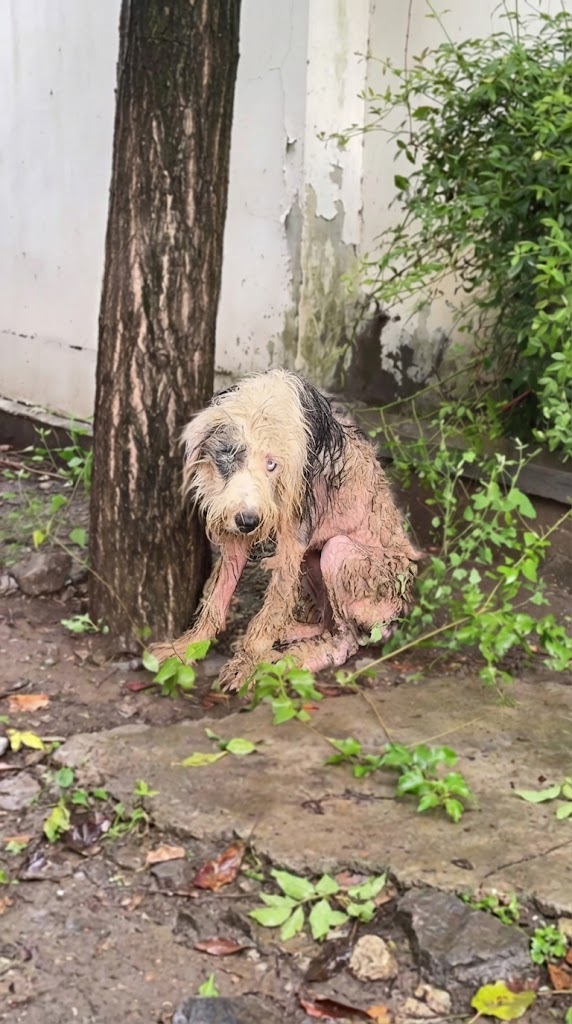
The rain had become part of Shitou's everyday life.
It fell across the damp yard where he was kept, soaking the ground beneath his paws. Nearby stood a rusted post, with a heavy chain that restricted how far he could move.
There was little shelter from the discomfort around him.
For this frightened dog, the world had gradually become smaller. His days were shaped by the length of his chain, the changing weather, and the uncertainty of how the person responsible for him would react.
But the most troubling part of Shitou's situation was not the rain.
It was what happened when he tried to make himself heard.
According to the rescue account, his cries were met with anger rather than reassurance. The person keeping him claimed that harsh treatment was necessary because Shitou was dangerous.
Yet when someone finally approached him with kindness, his behavior suggested something very different.
Shitou did not attack.
He did not even growl.
Instead, he pressed his frightened body against the person who had come to help, trying to hide beneath a coat.
That quiet movement revealed something his rescuer would not forget.
The dog described as dangerous appeared to be desperately searching for safety.
A Life Reduced to the Length of a Chain
Before his rescue, Shitou's surroundings offered little of the comfort a dog should be able to expect.
The yard was damp. The post was rusted. The chain kept him confined to a limited space, regardless of the weather.
He had experienced hunger, cold, and prolonged neglect.
And there was something even more concerning about the way he responded to people.
Shitou had learned to be afraid of the very presence that should have offered protection.
Dogs communicate discomfort in many ways. They may bark, withdraw, hesitate, or seek reassurance when something feels wrong.
For Shitou, vocalizing had apparently brought punishment rather than help.
Over time, fear seemed to become his most familiar response.
What made his condition especially distressing was the damage to his vision. The rescue account described an owner who had deliberately harmed his ability to see, leaving Shitou with lasting consequences.
The full circumstances of that harm were not detailed, but the condition later observed by a veterinarian was serious.
One eye was completely gone.
The other retained very limited vision.
Imagine navigating an unfamiliar world while struggling to see clearly, with little confidence that the people around you will treat you gently.
That was the situation from which Shitou needed to escape.
He needed more than freedom from a chain.
He needed an opportunity to learn that human hands could offer comfort instead of fear.
The Moment Shitou Finally Found Someone Safe
When his rescuer first encountered him, Shitou's response was striking.
There was no aggressive display.
No attempt to intimidate the unfamiliar person.
Instead, he moved closer and pressed himself into the person's body, seeking the shelter of a coat.
For an animal whose history had been marked by frightening human interactions, this was an important moment.
He was still scared.
He still seemed uncertain about what would happen next.
But he had found someone who was willing to respond to his fear with care.
The owner offered an explanation for Shitou's condition, describing his treatment as discipline and insisting that the dog was dangerous.
Those claims did not match the behavior the rescuers observed.
Around unfamiliar people, Shitou appeared fearful rather than threatening.
Whatever difficulties may have existed in caring for him, they could not justify the neglect and harm described in his story.
The people helping Shitou faced a difficult practical decision.
They offered the owner money so the dog could be released.
It was not an acknowledgment that Shitou's life had a price. It was a way to bring an immediate end to his confinement.
The owner accepted the offer quickly.
And with that agreement, Shitou's circumstances changed.
He was no longer required to remain in the same yard, attached to the same chain, dependent on someone whose treatment had left him terrified.
His rescuers also notified the authorities about the situation.
That decision mattered because removing one animal from danger does not erase the responsibility associated with what happened to him.
Shitou was finally out of the place where he had suffered.
But freedom was only the beginning of his recovery.
VIDEO: Chained in the Rain and Nearly Blind, Shitou Finally Finds Someone Willing to Save Him
The First Steps Away From Neglect
The changes began with something ordinary.
A bath.
For many dogs, bathing is simply part of routine care. For Shitou, even this familiar activity required patience.
His fur was thick, severely tangled, and weighed down by neglect.
The rescuers first removed the damaged, matted coat so his body could be cleaned more comfortably.
It was a necessary step toward giving him relief.
Then came the warm water.
At first, Shitou trembled.
After spending so much time exposed to cold, wet conditions, the sensation of water could hardly have been reassuring.
The difference was in the way he was treated.
There was no harsh reaction to his fear.
No punishment for being uncomfortable.
Only careful handling and warmth.
Gradually, his trembling began to subside.
It was a small change, but an important one.
The same dog who had tried to disappear beneath his rescuer's coat was beginning to experience ordinary care without the threatening consequences he had previously known.
A bath could not undo his past.
It could not restore his sight.
But it could offer him something he had been missing for a long time: a moment of physical comfort in the presence of people.
For Shitou, that was a meaningful beginning.
What the Veterinary Examination Revealed
Once Shitou was in safer hands, his physical condition needed professional attention.
The veterinary examination confirmed the seriousness of his vision problems.
One of his eyes was completely missing, while the remaining eye had very limited vision.
These were not minor difficulties that could simply be washed away with the dirt from his coat.
They represented lasting physical challenges that would affect how he experienced his surroundings.
His skin also showed signs of prolonged neglect and exposure.
The irritation and damage made it clear that his discomfort extended beyond his vision problems.
The full treatment plan was not described in the rescue account, and there was no indication that his lost sight could be restored.
What was clear was that Shitou had finally reached people who recognized his condition and were willing to provide care.
That distinction mattered.
For a dog with severe visual impairment, familiar surroundings, gentle handling, and predictable interactions can be particularly valuable.
Shitou would need time to become comfortable in a world he could not see clearly.
His recovery could not be measured only by improvements in physical condition.
There was also the matter of trust.
After everything he had experienced, how would he respond when someone reached toward him?
Would he continue hiding whenever a person came close?
Would he ever feel comfortable enough to explore without being overwhelmed by fear?
Those questions could not be answered in a single veterinary visit.
They would be answered gradually, through the way Shitou lived after his rescue.
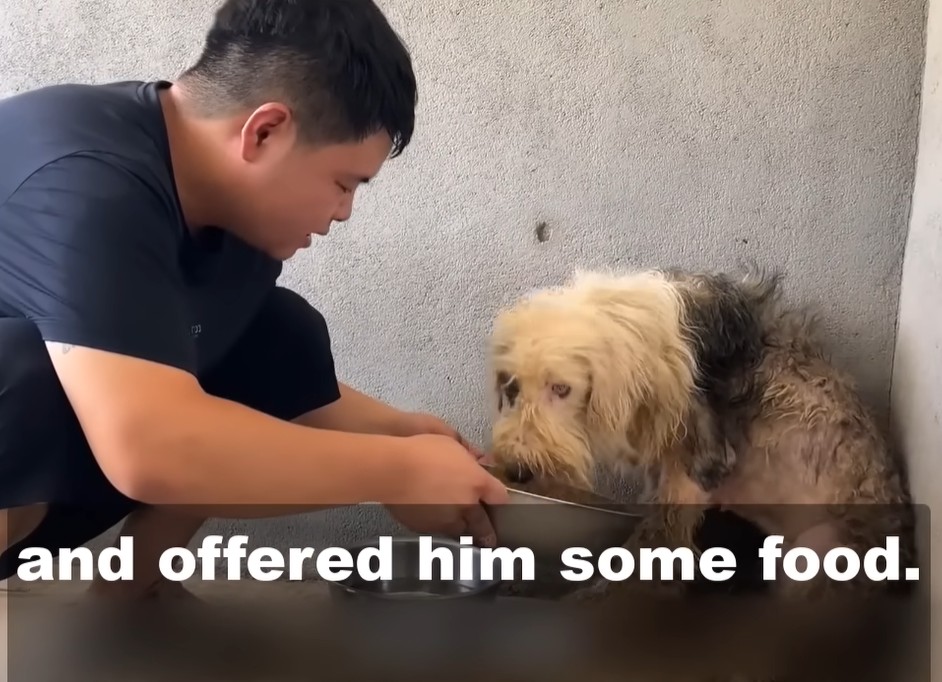
Learning That the World Could Be Gentle
Shitou's emotional recovery did not happen all at once.
The rescue account describes a gradual change, shaped by ordinary experiences that had once been missing from his life.
He began taking quiet walks.
Instead of spending his days restricted to a wet patch of ground, he could feel soft grass beneath his paws.
It was a simple experience, but it represented a profound change in his circumstances.
He could move beyond the reach of the chain.
He could explore.
He could encounter the world without the same constant restrictions.
And he was not required to navigate those experiences alone.
Gentle human companionship became part of his new routine.
There were also opportunities to spend time around other dogs.
For Shitou, these encounters introduced another side of life.
Dogs were no longer simply distant sounds or unfamiliar presences. They could be companions in moments of play and curiosity.
The account does not describe every stage of these interactions, but it does make one change clear.
Shitou gradually became more comfortable.
The frightened dog who initially tried to hide was beginning to engage with his surroundings.
There was no single dramatic event that transformed him.
Instead, reassurance accumulated through repeated experiences.
A walk without punishment.
A gentle touch.
A chance to move freely.
Time near other dogs without feeling threatened.
Each experience offered another reason for Shitou to approach life with a little less hesitation.
That kind of recovery is not always visible in photographs.
Sometimes it appears in the smallest movements.
A body that no longer pulls away.
A dog willing to explore.
A tail beginning to move when something pleasant happens.
For Shitou, those little changes would eventually become impossible to overlook.
The Tail That Started Wagging Again
One of the most encouraging developments in Shitou's story was the return of his playful energy.
At the time of his rescue, he had seemed almost determined to make himself smaller.
He pressed against his rescuer, seeking somewhere to hide.
Later, as he became more comfortable in his new surroundings, that withdrawn behavior began to change.
His tail started wagging again.
He showed greater enthusiasm.
His personality became more visible.
The dog who had once reacted to human attention with intense fear was now able to participate in moments of joy.
That change did not mean his physical limitations had disappeared.
Shitou still lived with severe visual impairment.
He still carried the consequences of what had happened before his rescue.
But those challenges no longer defined every moment of his life.
His world had expanded beyond the small area surrounding a rusted post.
He had room to move, opportunities to explore, and people who wanted him to feel secure.
Perhaps the most beautiful part of his recovery was that he did not need to become a different dog to deserve those things.
He did not need perfect vision.
He did not need to prove that he was fearless.
He only needed a safe environment in which his natural curiosity and affection could return.
And slowly, that was exactly what happened.
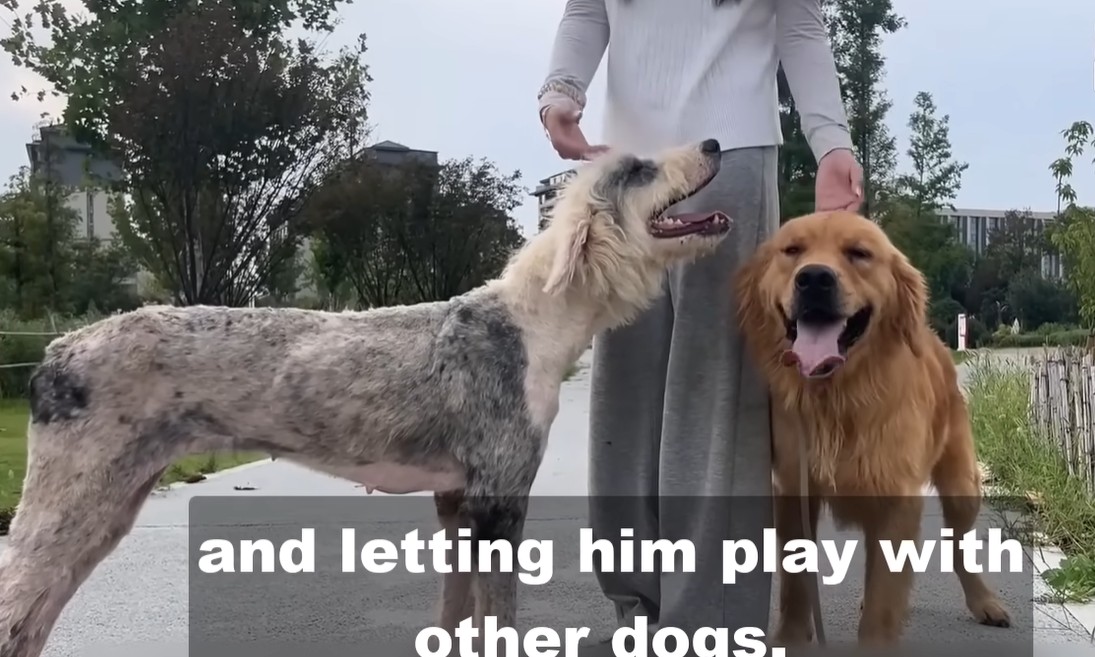
A Different Life, Even Without Perfect Sight
Shitou's transformation is especially meaningful because his recovery was not defined by a complete reversal of his injuries.
His missing eye did not return.
The original account does not suggest that his remaining vision became normal.
Instead, his progress was reflected in the way he learned to live with greater confidence despite those limitations.
For someone meeting Shitou only after his recovery, his playful behavior might make it difficult to imagine how withdrawn he had once been.
But his journey had begun with a dog who was frightened of human attention and uncertain whether approaching a stranger would bring relief or more suffering.
The contrast is remarkable.
Before, the presence of people had been associated with fear.
After his rescue, compassionate human care helped him discover a different experience.
Before, the chain determined where he could go.
Now, he could enjoy walks and time outdoors.
Before, discomfort shaped his daily existence.
Now, he could experience warmth, gentleness, and companionship.
His story also highlights an important distinction between physical healing and emotional recovery.
Medical care can identify injuries and address physical needs.
But rebuilding confidence often depends on repeated moments of kindness.
Shitou's progress was not the result of a single gesture.
It came from being given a different way to live.
That was the second chance he needed.
What Shitou's Journey Leaves Behind
There is something unforgettable about the image of Shitou pressing himself beneath a stranger's coat.
It was the behavior of a dog who seemed desperate for protection.
At that moment, nobody could promise that his fear would disappear or that his vision could be restored.
His future was uncertain.
But someone had recognized that he needed help and was willing to act.
That decision allowed everything else to follow.
The release from his chain.
The careful grooming and warm bath.
The veterinary examination.
The quiet walks.
The companionship of other dogs.
And eventually, the return of a wagging tail and an energetic personality.
Each part of that journey mattered because each represented something Shitou had been missing.
Safety.
Comfort.
Freedom.
Trust.
His story is also a reminder that dogs living with disabilities can still enjoy meaningful, fulfilling lives.
Shitou's limited sight did not prevent him from responding to kindness or finding pleasure in his new surroundings.
What had restricted him most was not simply his physical condition.
It was the environment in which he had been forced to live.
Once that environment changed, his behavior began to change as well.
Today, according to the rescue account, Shitou is safe and approaching life with a confidence that once seemed far beyond his reach.
His journey does not erase the suffering that came before.
Nor does it make the harm he experienced any less serious.
But it shows what becomes possible when an animal who has known neglect is finally treated with patience and respect.
Shitou may never see the world clearly again.
Yet he can feel the grass beneath his paws, enjoy the company of other dogs, and recognize the comfort of gentle human care.
For the dog who once stood chained in the rain, those ordinary moments mean something extraordinary.
He did not get his old life back.
He was given the chance to have a better one.
And this time, when Shitou reaches toward a person for comfort, there is someone there to welcome him.


