
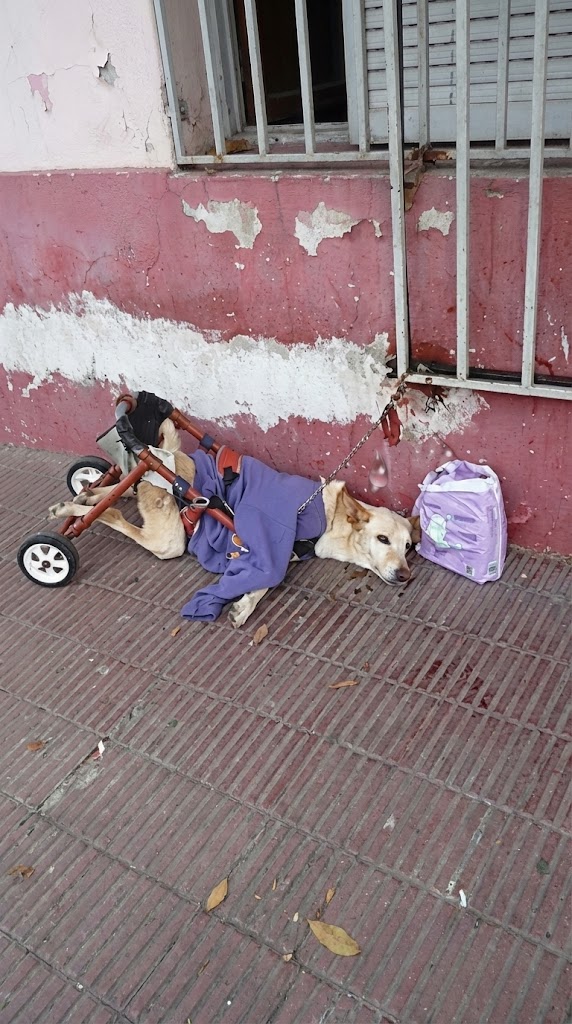
A wheelchair stood beside a railing outside a grooming shop in Salta, Argentina. Next to it were a bag of diapers, a handwritten note, and a dog who could not walk away.
Her name was Lunita.
She was paralyzed from the waist down, and the people who had been responsible for her care had left her there.
The note explained that they could no longer look after her.
For Lunita, however, those few words could not change the reality of her situation. She was alone on the sidewalk, unable to use her back legs, with no food or water beside her.
Her wheelchair was there, but the person who might have helped her into it was gone.
It was a painful beginning to a story that would eventually reach far beyond the streets of Argentina.
Because Lunita's life would not be defined only by the day she was abandoned.
It would also be remembered for the extraordinary happiness she discovered when people finally gave her the care she needed.
The Little Dog Left Waiting Beside a Railing
Lunita's physical condition made her especially vulnerable.
Unlike a dog who could simply walk away from an uncomfortable situation, she depended on assistance and specialized equipment to move around.
Being left outdoors was more than frightening. It placed her in a position where even meeting her most basic needs would have been difficult without help.
The wheelchair and diapers beside her suggested that her previous caregivers understood something about her disability.
But caring for a paralyzed dog requires more than equipment.
It requires time, attention, patience, and an understanding of the animal's daily needs.
The explanation in the note indicated that those responsibilities had become too much for the people who left her.
Whatever difficulties had led to that decision, Lunita was the one left waiting.
She had no way to explain what she needed.
She could not ask someone to bring her water or help her move into a safer place.
Her situation depended entirely on whether someone would recognize that she needed assistance.
And eventually, someone did.
The rescue organization LUBA Salta became involved in Lunita's case, giving her a chance to leave the sidewalk behind.
It was the first major turning point in her life.
But rescue would prove to be only the beginning of a much longer journey.
A Rescue That Opened the Door to Another Chance
With help from LUBA Salta, Lunita was no longer abandoned outside the grooming shop.
She received a new wheelchair, an important step toward giving her more independence.
For a dog living with paralysis, suitable mobility equipment can make an enormous difference.
It does not remove the disability, but it can allow movement that would otherwise be difficult or impossible.
For Lunita, the possibility of moving freely mattered deeply.
Her rescue story eventually attracted the attention of a family in the United States.
An opportunity for a new home appeared to offer the stability she needed.
There was reason to hope that the hardest part of her journey might finally be over.
But caring for Lunita required a level of commitment that her new home was not prepared to provide.
The placement did not give her the lasting security everyone had hoped for.
When rescuers became involved again, Lunita's condition was alarming.
The dog who had already endured abandonment was facing another serious struggle.
Her body needed extensive care, and the road back would demand patience from everyone involved.
This time, the challenge was not simply finding her somewhere to live.
It was helping her recover enough to enjoy that life.
VIDEO: Abandoned With Her Wheelchair, Lunita Faced a Difficult Road Before Finding Her Second Chance
When a Second Chance Was Almost Lost
By the time Lunita returned to rescue care, she weighed only 35 pounds.
Her health had deteriorated badly.
She was suffering from serious infections, mange had affected her coat, and her skin was irritated by prolonged exposure to urine.
Her discomfort was so severe that even gentle handling could cause her pain.
These were not difficulties that could be resolved simply by giving her a comfortable bed and a meal.
Lunita needed careful, consistent attention to several problems at once.
Her disability also meant that the people caring for her had to consider how her limited mobility affected her daily comfort.
For dogs with paralysis, even ordinary routines can require additional help.
Keeping the skin clean, maintaining suitable hygiene, supporting mobility, and monitoring physical condition all become essential parts of care.
Lunita's situation showed why these responsibilities could not be overlooked.
Her second rescue was not an instant transformation.
There was no single treatment that could erase everything she had experienced.
Instead, recovery would have to happen through many repeated acts of care.
A dedicated foster mother became an important part of that process.
And for Lunita, the difference would be profound.
Healing Began With the Smallest Acts of Care
Lunita's recovery involved medical baths, physical therapy, and a carefully nourishing diet.
Each part of the routine addressed something important.
The baths helped soothe her irritated skin.
Physical therapy supported her strength and movement.
Fresh chicken and turkey provided nutrition as she worked toward regaining lost weight and energy.
None of these measures offered an immediate solution.
Healing demanded consistency.
For a dog who had experienced such serious health problems, progress could not reasonably be measured by dramatic changes from one day to the next.
It had to be recognized in smaller improvements.
A body becoming stronger.
Skin gradually recovering.
More energy available for ordinary activities.
The ability to tolerate care more comfortably.
These changes might seem modest when viewed individually.
Together, they represented a remarkable shift in Lunita's quality of life.
Her foster mother was not simply helping her survive another difficult period.
She was helping create the conditions in which Lunita could begin enjoying life again.
That distinction mattered.
Rescuing a disabled animal does not end when the animal reaches a safe home.
Real care continues through the routines that follow.
It is found in preparing appropriate meals, providing necessary treatment, and making sure the animal's physical limitations are understood rather than ignored.
For Lunita, that dependable care made her recovery possible.
She slowly regained strength.
Her health improved.
And beneath the difficulties that had once dominated her days, her lively personality began to emerge.
The Purple Tutu That Became a Symbol of Joy
As Lunita recovered, the people around her began seeing more of the dog she was beyond her medical needs.
She was energetic, playful, and eager to participate in life.
Her paralysis was still part of her reality.
But it was no longer the only thing that stood out about her.
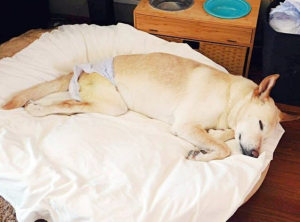
One of her most recognizable accessories was a purple tutu.
It gave Lunita a distinctive appearance and became part of the joyful image that people came to associate with her.
Combined with her wheelchair, the little outfit made her difficult to forget.
Yet the clothing was only a small part of what made her remarkable.
What truly captured attention was her enthusiasm.
Lunita received a custom wheelchair suited to her needs.
With the right equipment, she could move in ways that had once been unavailable to her.
And she made the most of that freedom.
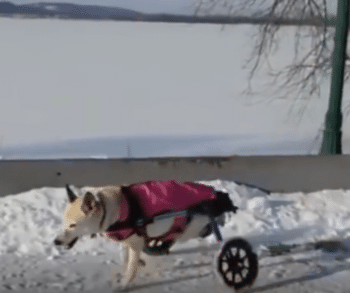
She ran.
Not in the conventional way of a dog using all four legs, but with the assistance of wheels that supported her body.
The result was movement filled with energy and excitement.
A dog who had once been unable to leave a sidewalk on her own was now exploring the world.
Her wheelchair did not make her life identical to that of every other dog.
It gave her an opportunity to experience activities that brought her happiness.
That was enough to change so much.
Bridges, Snow, and the Freedom to Enjoy Life
Lunita's new life included experiences far removed from the railing where she had once been abandoned.
She explored bridges.
She played in the snow.
She joined her canine siblings in shared howling sessions.
These were not extraordinary adventures by themselves.
Many loved dogs enjoy similar activities.
What made them meaningful for Lunita was how different they were from the helplessness she had experienced earlier.
The world was no longer something she had to observe from one fixed position.
She could move through it.
She could take part in family activities.
She could share moments of excitement with other dogs.
Her wheelchair made those experiences accessible, while the people caring for her made them possible.
And in photographs and videos, Lunita's personality was unmistakable.
The purple tutu, the wheels, and her obvious enjoyment of movement formed an image of a dog who had gained far more than mobility.
She had gained the opportunity to live fully within the possibilities of her own body.
Her story also offered an important perspective on disability.
A dog does not need to move perfectly to enjoy a meaningful life.
Physical limitations may require accommodation, but they do not eliminate the desire for companionship, stimulation, and play.
Lunita's happiness came from being given those opportunities.
She still needed special care.
She still depended on people who understood her condition.
But dependence did not prevent her from having an active, affectionate life.
In fact, the right support allowed the qualities that made her special to shine through.
The dog once left beside an unused wheelchair had become a dog who could hardly contain her enthusiasm for moving.
An Eleventh Birthday Worth Celebrating
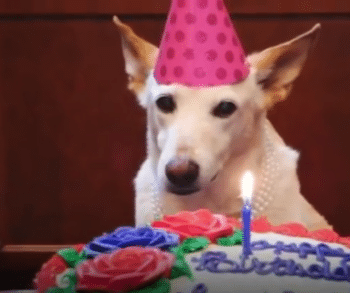
In June 2018, Lunita reached her eleventh birthday.
For any beloved dog, a birthday can be a happy occasion.
For Lunita, it carried additional meaning.
Her life had included abandonment, unsuccessful placement, severe health problems, and a demanding recovery.
Yet she had reached another year surrounded by people who cared for her.
There were special treats.
There was affection.
And most importantly, there was a home in which her needs were understood.
The celebration was not about pretending the hardships of her past had never happened.
Those experiences remained part of her story.
But they no longer described the entirety of her life.
Lunita had known what it meant to be left without the assistance she needed.
She had also experienced the difference that committed care could make.
Her eleventh birthday represented everything that had changed.
She was no longer waiting on a sidewalk for someone to notice her.
She belonged to a family.
For a dog whose disability required ongoing attention, that sense of belonging was especially valuable.
Her caregivers had accepted the responsibilities that came with loving her.
They had also discovered the joy that she could bring into their lives.
The relationship was not simply one of a helpless animal receiving care.
It was a bond built through shared experiences, affection, and trust.
Lunita had become a deeply loved member of her family.
And her birthday offered an opportunity to celebrate that bond.
A Goodbye That Came Too Soon
Only one month after her eleventh birthday, Lunita became ill.
The happiness of her birthday celebration was followed by another difficult period for the family who loved her.
Her condition became serious enough that she required intensive care.
Despite the efforts to help her, Lunita passed away in the ICU.
It was a painful ending to a life that had already included so many challenges.
Her family had worked to give her comfort, mobility, and happiness.
They had watched her recover from a condition that once made even gentle contact difficult.
They had seen her explore the outdoors in her wheelchair, play in the snow, and share everyday moments with the other dogs in her home.
Now they had to say goodbye.
There is no simple way to measure the importance of the time Lunita spent with her family.
It was shorter than they would have wished.
But it contained the security, affection, and companionship that she had been missing when her story first became known.
Her mother later expressed the depth of their connection in a few words:
"She changed my life forever. I loved her so much."
Those words revealed something essential about Lunita's journey.
She had received care from people who were willing to meet her needs.
But she had also given something meaningful in return.
Her presence had changed the life of the person who loved her.
And that love did not disappear simply because their time together had ended.
What Lunita Taught the People Who Loved Her
It would be easy to remember Lunita only through the most painful details of her past.
The railing.
The wheelchair left beside her.
The note explaining that her caregivers could no longer continue.
The serious health problems that followed an unsuccessful placement.
Those events mattered because they showed how vulnerable she had been.
But they were not the whole story.
Lunita also left behind images of happiness.
A little dog dressed in purple, moving enthusiastically in a wheelchair designed for her.
A companion enjoying the snow.
A family member joining the familiar chorus of other dogs.
A beloved pet celebrating an eleventh birthday surrounded by affection.
These moments deserve to be remembered just as clearly as the suffering that came before them.
Her story illustrates how important appropriate care can be for animals living with disabilities.
Equipment alone is not enough.
A wheelchair can support mobility, but it cannot provide affection, hygiene, nutrition, medical attention, or companionship.
Those things require people who are willing to remain involved.
Lunita was fortunate to eventually find that commitment.
Her experience also reminds us that rescue is not always a straight path from hardship to happiness.
Sometimes an animal needs more than one intervention.
Sometimes a placement does not succeed.
Sometimes recovery takes time, and sometimes even a deeply loved animal cannot be given as many years as a family hopes for.
These realities do not make the effort less worthwhile.
They make every period of genuine comfort and happiness more meaningful.
More Than a Wheelchair, More Than a Rescue Story
Lunita's life began its most widely known chapter in a place where she had almost no control over what happened next.
She could not untie herself from the railing.
She could not find food or water.
She could not choose the people who would eventually care for her.
But once the right support became available, she showed just how much life she still had to enjoy.
Her paralysis did not disappear.
Her needs did not suddenly become simple.
Instead, her circumstances changed because people took those needs seriously.
They helped her heal.
They gave her suitable equipment.
They welcomed her into a family.
And they made room for the lively, affectionate dog she had always been capable of becoming.
Lunita's story does not have the ending everyone hoped for.
She did not live forever, and her recovery could not protect her from every illness.
Yet her final chapter was very different from the moment when she had been left outside that grooming shop.
She spent her later life knowing companionship, activity, and love.
For those who remember her, the image that remains is not only of a helpless dog waiting beside a railing.
It is also of Lunita in her purple tutu, moving forward with extraordinary enthusiasm.
Her wheelchair was never a symbol of a life without possibilities.
With the right care, it became part of the freedom she had been missing.
And perhaps that is what makes her legacy so lasting.
Lunita did not need to be free of her disability to be happy.
She needed a chance to live with it, surrounded by people who loved her.
For a little dog who had once been left behind, that chance changed everything.


