
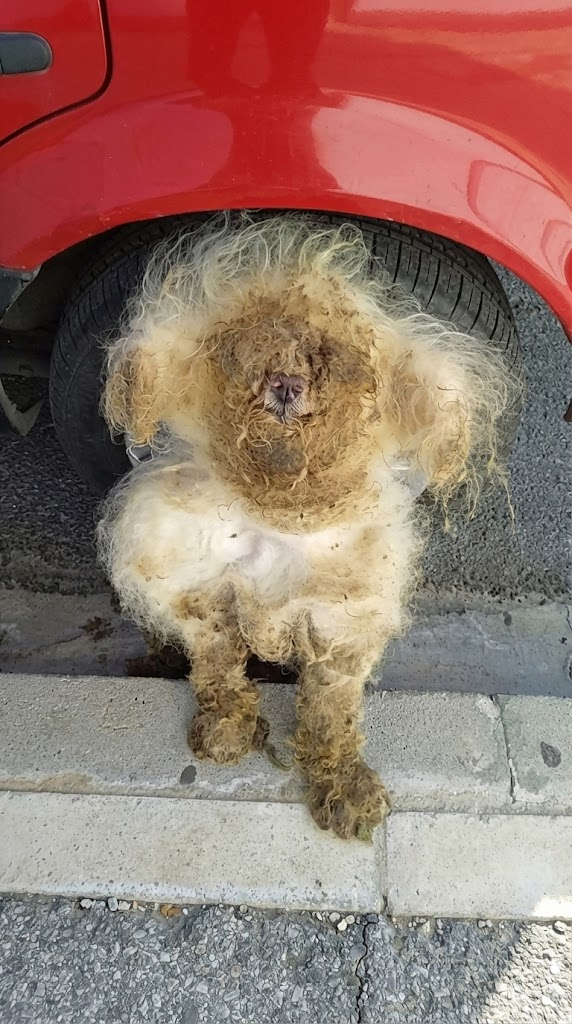
The small bundle resting on a pavement in Athens hardly looked like a living animal.
There was no visible face. No recognizable tail. No clear outline of a body beneath the thick, hardened layers covering it.
To anyone passing by, the strange shape might have seemed like something that had been thrown away.
But beneath that tangled mass was a dog.
An elderly Poodle who had once belonged to someone. A dog who had known a home, yet had somehow ended up sitting outside, almost completely hidden beneath his own neglected coat.
His name would eventually be Julian.
And the story of how he became recognizable again would reveal something far more meaningful than a physical transformation.
It would show what can happen when a forgotten animal is finally treated as a life worth caring for.
The Forgotten Shape on an Athens Pavement
It began on a quiet Sunday in Athens, Greece.
An unusual photograph started circulating on Facebook, drawing attention to a shapeless bundle lying on a pavement only a short distance from the city center.
Something about the image was troubling.
The object appeared dirty and heavily tangled, with no obvious features that would identify it as an animal.
A volunteer from a local animal rescue group went to investigate.
What the volunteer discovered was a dog whose coat had become so severely matted that his body was almost impossible to distinguish.
His fur was thick with accumulated dirt and waste. The tangles had hardened into an enormous covering, hiding even the basic shape of his head and tail.
It was no longer simply a grooming problem.
Julian had been living inside a layer of fur that had become a physical burden.
Every part of his appearance suggested that ordinary care had been absent for a long time.
And as people nearby began sharing what they knew, a sadder picture of his circumstances emerged.
According to local accounts, the dog had belonged to an elderly woman who lived in the area.
When she passed away, the people clearing her home apparently made no arrangements for the animal she left behind.
Instead, they carried him downstairs and left him outside.
The dog who had once been part of someone's household had suddenly become an overlooked responsibility.
There was no explanation in the account of exactly how long his coat had been neglected or what his daily life had looked like before his rescue.
But the condition in which he was found spoke clearly enough about his need for help.
He was alive.
And he needed someone willing to look beyond the tangled fur.
A Tiny Pink Tongue Broke the Silence
Being taken into rescue care did not immediately bring a visible change.
For nearly 20 hours afterward, Julian remained remarkably still.
He made no sound and showed almost no movement.
The odor from his neglected coat was so strong that even other animals at the shelter reportedly avoided approaching him.
For the people caring for him, it was difficult to know how much of the dog beneath those heavy layers was responding to his surroundings.
His face remained concealed.
His mouth was difficult to locate.
The thick covering of fur separated him from even the simplest forms of contact.
Then came one small moment that changed the way his rescuers could connect with him.
A caregiver carefully reached toward the place where they believed his mouth was hidden.
From somewhere inside the tangled coat, a tiny pink tongue appeared.
It gently touched the person's hand.
The movement was almost nothing.
Yet after so many hours of stillness, it was an unmistakable sign of life and response.
Julian was not just an anonymous bundle rescued from the street.
There was a living, feeling animal inside, capable of reaching back toward the person trying to help him.
That small contact did not solve everything.
His fur still covered him. His body still carried the burden of severe neglect. The careful work of freeing him had yet to be completed.
But for the first time, there was a simple connection between Julian and the people who had come to care for him.
A hand reached in.
A little tongue answered.
And the dog hidden beneath the mats was beginning to be seen.
VIDEO: Five Hours to Freedom — Watch Julian Emerge From His Severely Matted Fur
Five Hours to Reveal the Dog Beneath
Removing Julian's coat was not a quick grooming session.
The hardened fur had built up into layers measuring nearly 10 centimeters thick in places.
The people helping him had to work slowly, cutting through the dense tangles a little at a time.
There was no easy way to rush such a delicate task.
The fur had become so tightly packed that separating it required patience and close attention.
Minute by minute, the covering that had hidden his body began to disappear.
It was a striking contrast.
On one side was the heavy mass that had made him look almost unrecognizable.
Beneath it was an ordinary dog who had been there all along.
As the rescuers continued, familiar features gradually emerged.
The shape of a head.
The outline of a small body.
And finally, a face.
Julian was a Poodle.
The transformation took approximately five hours.
Throughout the process, he remained quiet and did not struggle against the hands working to free him.
It is impossible to know exactly what he understood or felt during those hours.
But his stillness allowed the careful work to continue.
For the people caring for him, the result was profound.
A dog who had arrived hidden inside a shapeless mass could now be recognized as an individual.
He had a face.
He had a body no longer concealed by that enormous covering.
And he had a name.
Julian.
It was the beginning of a different kind of life, although the effects of his previous condition would not disappear as quickly as the fur itself.
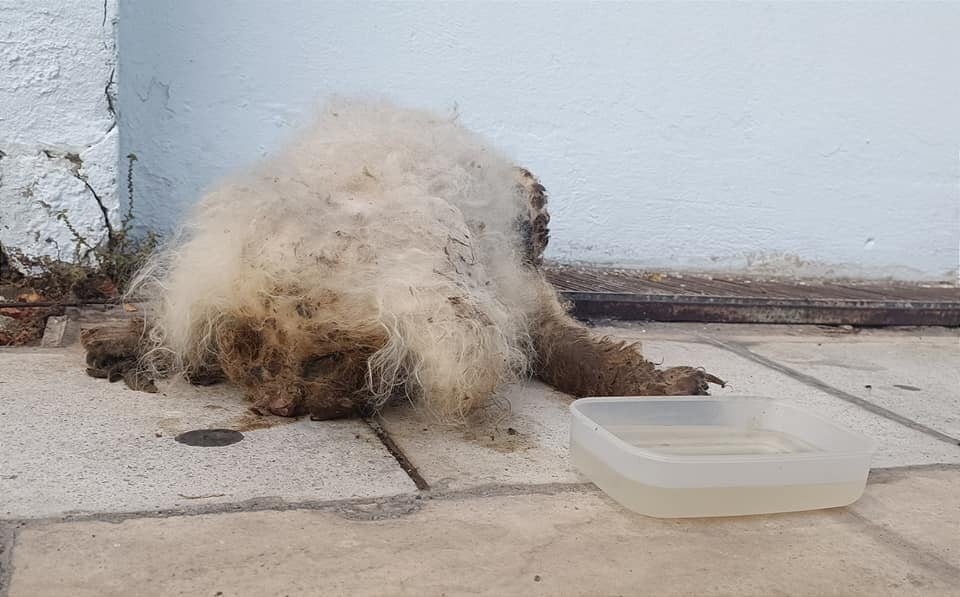
His Body Still Remembered the Weight
Removing Julian's severely matted coat freed him from a visible burden.
But it did not mean that his movements immediately returned to normal.
One of the most unusual details of his recovery was the way he walked after the grooming was finished.
He continued lifting his legs unusually high, as though he still needed to step over the thick layers that had previously surrounded them.
The obstacle was gone.
Yet his movements still seemed shaped by its former presence.
Watching such a small adjustment carried a larger emotional meaning.
For Julian, freedom was not simply the moment the final piece of tangled fur fell away.
It also involved becoming accustomed to moving without that weight.
His body had spent an unknown amount of time working around the restrictions of his coat.
Now those restrictions had disappeared, but his habits remained.
The change offered a quiet reminder that the consequences of prolonged neglect may continue even after the most visible signs have been removed.
A clean coat could be achieved in hours.
Adjusting to a changed body was a slower process.
Julian's unusual steps showed that clearly.
There was something both tender and sad about seeing him lift his paws over obstacles that no longer existed.
He was no longer trapped beneath that mass of fur.
But he was still learning what it meant to move without it.
And his rescuers were beginning to understand that helping Julian would require accepting more than the difficulties visible on the day he was found.
An Older Dog With His Own Ways
Julian's transformation made an extraordinary visual difference.
But it did not turn him into a young or perfectly healthy dog.
He was already elderly.
His eyesight was affected by cataracts. His heart was weak, and his hearing was inconsistent.
These were important parts of his condition, not details that could simply be brushed aside because he now looked different.
Julian also had a personality that did not fit the image of an endlessly gentle, grateful rescue animal.
He liked sleeping wherever he pleased.
When an opportunity appeared, he sometimes helped himself to food.
And when he was in the wrong mood, he could snap.
His caregivers did not treat these habits as proof that the rescue had somehow failed.
Instead, they accepted that Julian was an individual with preferences, limitations, and a temperament of his own.
That approach gave his story a special meaning.
A dog does not have to become perfectly behaved to deserve care.
An elderly animal does not have to regain youthful energy to have a worthwhile life.
And an animal rescued from neglect does not owe anyone an idealized version of gratitude.
Julian could be stubborn.
He could be inconvenient.
He could want rest when someone else wanted interaction.
None of those things diminished his value.
His rescuers expressed a simple belief: Julian should be allowed to be Julian.
The goal was not to transform him into a different dog.
It was to let the dog they had saved live with the dignity of being himself.
That distinction matters.
Rescue is often associated with dramatic changes in appearance.
A neglected coat becomes clean. A hidden face becomes visible. An animal who once seemed helpless begins to move more freely.
Those moments are important, but they are only part of the picture.
For Julian, the deeper change was that his needs and individuality were finally being acknowledged.
He did not have to earn that attention by behaving perfectly.
He had already deserved it.
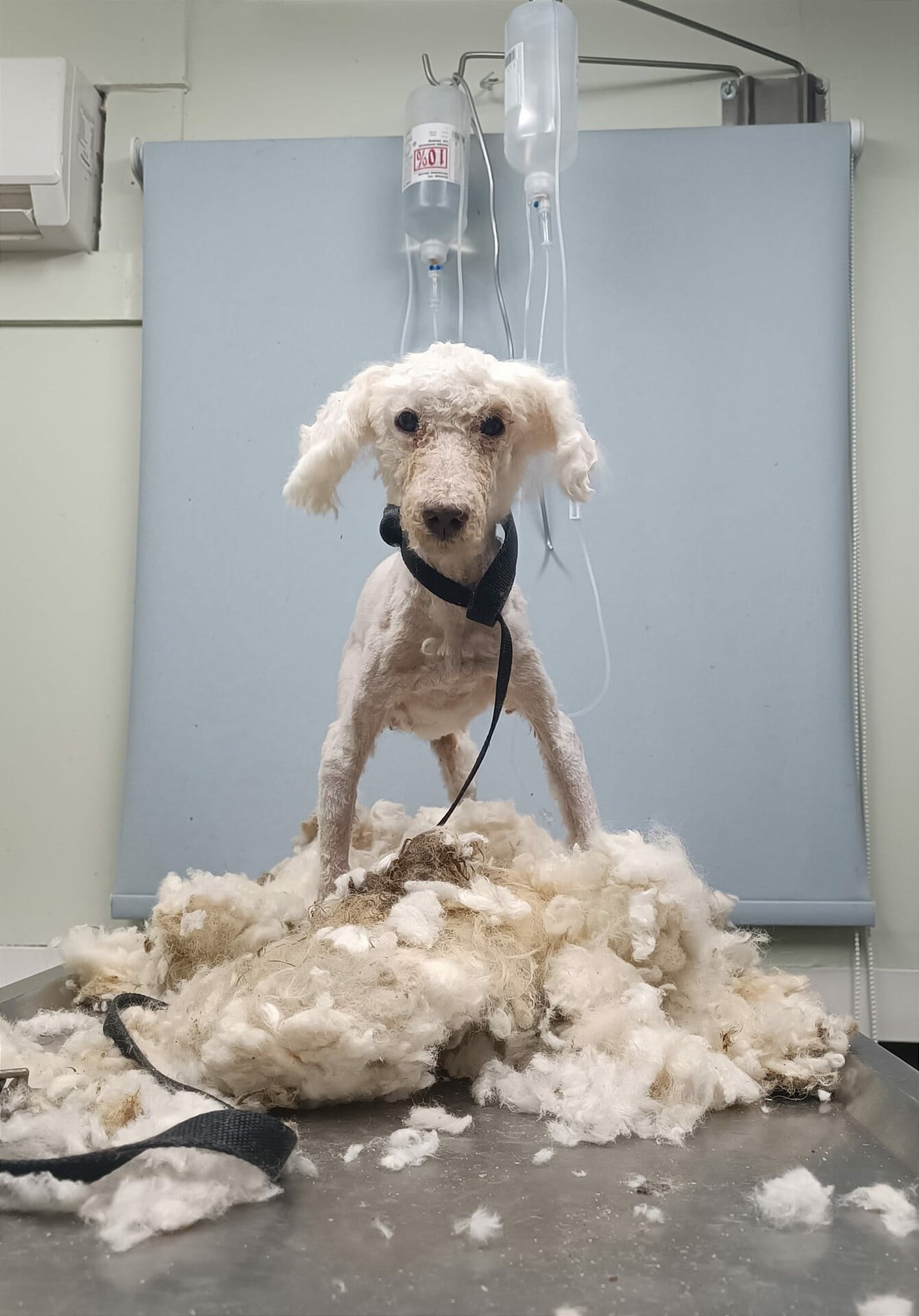
The White Curls That Returned
Over time, Julian's appearance continued to change.
His coat grew back.
Where there had once been an enormous, hardened tangle, soft white curls now covered his body.
The difference was remarkable.
The dog found on the Athens pavement had looked almost impossible to identify.
Now Julian looked unmistakably like a Poodle.
But his new appearance was not the most important part of his progress.
What mattered was the way his life had changed.
He was no longer an unidentified animal hidden beneath layers of neglected fur.
He was Julian, an elderly dog whose caregivers understood that his age, health concerns, and sometimes difficult personality were all part of who he was.
His story did not erase the loss of his former owner.
It did not explain every unanswered question about the period before he was found.
Nor did it mean that the challenges of growing old had disappeared.
His cataracts remained part of his reality.
His heart and hearing still required consideration.
And he still had his own ideas about when to rest, where to sleep, and whether to cooperate.
But none of that prevented him from enjoying a life in which he was recognized and cared for.
That is what made the change so meaningful.
The five-hour grooming revealed his face.
The care that followed allowed his individuality to remain visible.
More Than a Transformation
There is a reason Julian's rescue stays in the mind.
At first, he was so completely hidden that someone looking at him might not even have realized a dog was there.
His suffering had become part of his appearance.
He was not asking loudly for attention.
For many hours after his rescue, he hardly moved at all.
The moment that revealed his presence most clearly was not dramatic.
It was a tiny tongue touching a hand.
Later, there was the slow emergence of his face from beneath the hardened fur.
Then came the unusual steps of a dog whose body still behaved as though the weight remained.
And finally, there was the sight of an elderly Poodle with soft white curls and a personality nobody needed to change.
Each part of Julian's experience reveals something different about compassion.
Sometimes care begins by recognizing a life that has been overlooked.
Sometimes it means spending hours doing careful, uncomfortable work because an animal cannot free himself.
And sometimes it means understanding that the animal you have helped will still be old, imperfect, and entirely himself.
Julian did not need to become a different dog to make his rescue worthwhile.
He only needed the chance to be seen and cared for.
The forgotten bundle on the pavement had always been a living creature.
Beneath the dirt and tangled coat was an individual with his own needs, habits, and place in the world.
Today, the soft white curls are easy to notice.
But the most beautiful part of Julian's transformation cannot be measured by how much fur was removed or how different he looks.
It is the simple fact that he is no longer invisible.
He is Julian.
And that is enough.


