
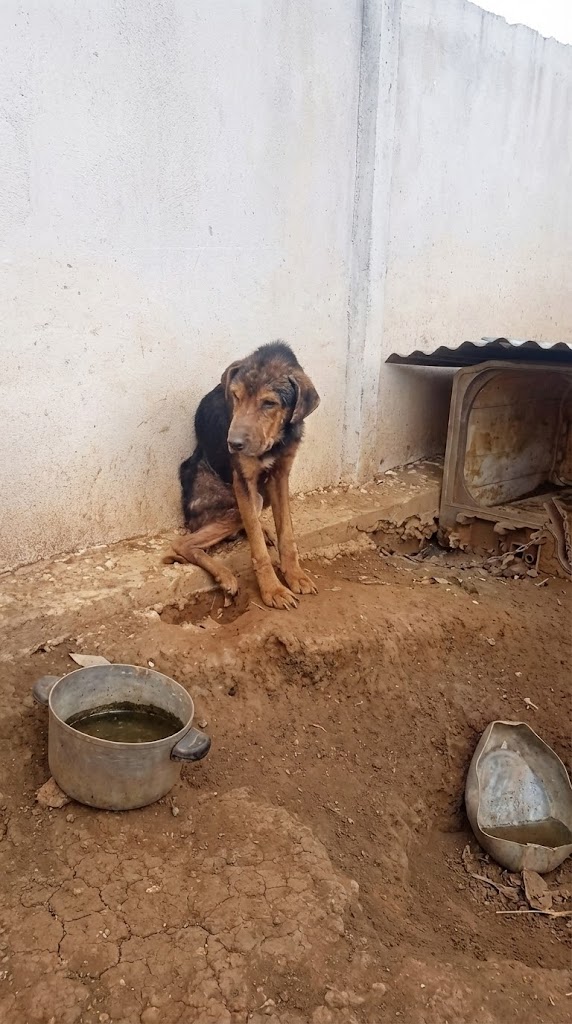
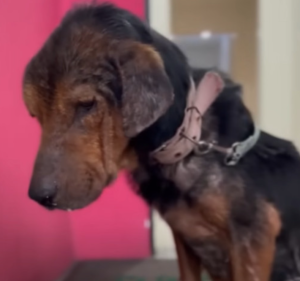
Max lay on the soft bed without moving.
For a dog who had spent so much of his life in fear, even this simple comfort seemed unfamiliar. The bed was warm. No one was asking him to leave. Yet he remained perfectly still, as though he wasn't sure what would happen next.
It was a quiet moment.
But for the people helping him recover, it revealed just how much this frightened dog still needed to learn about safety.
Only a short time earlier, Max had been struggling to survive in a condition that left rescuers deeply concerned. His body was severely underweight, his movements were stiff, and his behavior suggested that he had learned to avoid attention whenever possible.
Now, for the first time in a long while, his future was beginning to look different.
Getting him to that point, however, had been far from easy.
The Dog Who Seemed Afraid to Be Seen
When Max first appeared in the footage that brought attention to his situation, his eyes were difficult to forget.
He looked exhausted.
His thin body and worn coat spoke of prolonged neglect. Even his movements seemed careful, as if taking an ordinary step required more effort than it should.
But it wasn't only his physical appearance that stood out.
Max seemed deeply uncertain around the world beyond him.
He moved cautiously, keeping himself small and avoiding attention. His manner suggested that he had spent a long time without the security and reassurance that every companion animal deserves.
There was no way to understand every experience that had shaped his behavior simply by looking at him.
What was visible, however, was troubling enough.
This was a dog who needed help.
And he needed it urgently.
Long-term neglect can affect more than an animal's physical condition. When a dog has lived without consistent care or positive human interaction, the process of learning to trust again may be just as important as medical recovery.
For Max, both challenges lay ahead.
He needed food, treatment, rest, and a chance to regain his strength.
He also needed time to discover that human attention did not always have to be frightening.
That second kind of healing could not be rushed.
A Difficult Rescue Became His First Chance
Removing Max from his previous circumstances required cooperation between rescuers and the authorities.
It was not a simple matter of noticing a vulnerable dog and immediately carrying him to safety.
The people involved had to coordinate their efforts to make sure he could be removed from the environment where his needs had gone unmet.
Eventually, that effort succeeded.
Max was taken to a veterinary clinic, where the seriousness of his condition became impossible to overlook.
He was dangerously weak.
His weight was far below what it should have been, and his body had very little strength remaining.
The fact that he had reached professional care was encouraging, but it was only the first step.
Being rescued did not mean that Max was suddenly healthy.
He still faced a difficult period of treatment, and there was no reason to assume that his recovery would happen quickly.
For the people caring for him, the immediate priority was clear: give his weakened body the support it needed and allow him the time to respond.
Every part of that process mattered.
There would be medical decisions, close observation, and many small moments when progress might be difficult to recognize.
Yet Max had finally reached a place where his condition was being taken seriously.
He was no longer facing those challenges without help.
That difference would become the foundation of everything that followed.
VIDEO: Max Arrived Frightened and Dangerously Weak — Watch His Journey From Rescue to a Loving Home
The Soft Bed That Revealed So Much
Among the many moments in Max's recovery, one stood out for its simplicity.
He was given a soft, warm bed.
For most dogs living in comfortable homes, a bed is an ordinary part of daily life. They climb onto it, turn in a circle, settle down, and fall asleep without giving the experience much thought.
Max reacted differently.
He lay still.
There was no immediate burst of excitement or visible eagerness to enjoy his new resting place.
Instead, he seemed unsure how to respond.
It was as though this unfamiliar comfort required time to understand.
No one could know exactly what Max was thinking. But his hesitation offered a glimpse of the uncertainty that had become part of his behavior.
He had already endured enough hardship to make even a gentle experience seem unfamiliar.
And now he was being offered something different.
A comfortable place to rest.
A chance to recover without being hurried.
Care from people whose purpose was to help him rather than ignore his needs.
The significance of that moment was not in anything dramatic that Max did.
It was in what he didn't do.
He didn't immediately behave like a relaxed, confident dog.
He simply remained where he was.
For his caregivers, that quiet response was another reminder that healing involved more than restoring his weight and strength.
Max also had to become comfortable with a life that no longer revolved around uncertainty.
There was no shortcut for that process.
Kindness could be offered immediately.
Trust would have to develop gradually.
A Month of Care, One Small Step at a Time
Max's medical recovery required intensive support.
According to his rescue account, he received blood transfusions, ongoing fluid therapy, and continuous care while his condition remained fragile.
These were not minor interventions.
His weakened body needed significant assistance, and the team looking after him faced a period in which progress could not be taken for granted.
Some days offered encouraging changes.
Others brought uncertainty.
Recovery from such a serious state of neglect is rarely a straight line. Even when treatment is appropriate and carefully managed, a badly weakened animal may need considerable time before improvement becomes clear.
For Max, the work continued day after day.
There was no sudden transformation that erased everything he had endured.
Instead, his condition began to improve in small but meaningful ways.
His appetite gradually returned.
That change mattered because eating was an important part of rebuilding his depleted strength.
As time passed, his body also began responding.
He became stronger than he had been when he first arrived.
The improvements were gradual, but together they pointed toward something the people caring for him had hoped to see from the beginning.
Max was recovering.
Still, one of the most memorable signs of progress had little to do with medical equipment or clinical measurements.
It was a movement so small that someone unfamiliar with his history might barely have noticed it.
Max wagged his tail.
Just a little.
After everything he had experienced, that simple gesture carried enormous meaning.
For a dog who had once seemed afraid to draw attention to himself, even a small expression of comfort was encouraging.
It suggested that something might be changing beyond his physical health.
Perhaps he was beginning to feel more at ease.
Perhaps the people and surroundings that had once seemed unfamiliar were becoming less frightening.
Whatever Max was feeling, his caregivers had reason to celebrate.
The little dog who had arrived with so little strength was beginning to show signs of a very different future.
When Survival Slowly Made Room for Happiness
After approximately one month of intensive veterinary care, Max had improved enough to take another important step.
He was transferred into a safe, welcoming environment where he could continue adjusting to life beyond the clinic.
This transition marked a new stage of his recovery.
The earliest days had been focused on urgent medical needs.
Now Max had an opportunity to experience ordinary things that had once seemed out of reach.
He could explore his surroundings.
He could play.
And he could begin building more positive associations with the humans caring for him.
For a dog who had previously moved with such caution, these changes were significant.
Exploration requires a degree of confidence.
Play allows a dog to express curiosity and enjoyment.
Accepting gentle human contact can become a meaningful sign of growing trust, especially after a history of fearful behavior.
Max began experiencing all three.
The dog who had once seemed determined to remain unnoticed was gradually becoming more comfortable participating in the world around him.
He was no longer defined only by his need for treatment.
He was learning how to enjoy being a dog.
That change did not make his earlier suffering disappear.
Nor did it mean every uncertainty had vanished.
But it showed how much could change when an animal received consistent care and the opportunity to recover at a manageable pace.
His physical strength had improved.
His confidence was growing.
And the possibility of a permanent home was becoming real.
The Home Where Max Could Finally Belong
The next turning point in Max's journey was one that every rescue worker hopes a vulnerable animal will have the chance to experience.
Max found a forever home.
After being removed from neglectful circumstances, receiving intensive medical treatment, and gradually learning to trust, he was finally given the opportunity to settle into a permanent family environment.
His connection with his new owner was described as immediate.
It was a fitting development for a dog whose recovery had required so much patience.
For Max, a permanent home meant more than reaching the end of a rescue process.
It represented the possibility of a stable daily life built around companionship, care, and security.
The things that many dogs take for granted had become especially meaningful in his journey.
A place to rest.
People he could grow comfortable around.
Room to explore.
The freedom to play without the fear that had once shaped his movements.
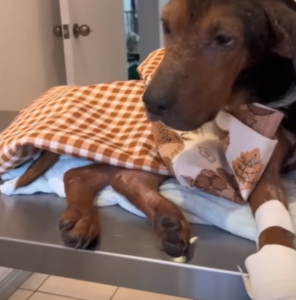
The contrast with his earliest condition was remarkable.
At the beginning, Max had been painfully thin, physically weak, and hesitant around attention.
By the time he entered his new home, he had gained enough strength and confidence to begin a different kind of life.
His story had moved beyond emergency intervention.
It had become a story about belonging.
And perhaps the most encouraging part was that his transformation had not depended on one dramatic moment.
It had been built through repeated acts of care.
From the people who helped arrange his rescue to those who supported his medical recovery, each stage gave him another opportunity to move forward.
His new home became the place where those efforts could lead to something lasting.
The Light That Returned to Max's Eyes
Today, Max is described as a much more confident and curious dog.
The fearful behavior that once dominated his movements has given way to a greater sense of ease.
He can enjoy experiences that were unfamiliar when he first entered care.
His life now bears little resemblance to the one reflected in those early images.
And yet the most moving part of his journey may still be that first small tail wag.
It was not an extraordinary physical achievement.
It did not mean his recovery was complete.
But it gave the people helping him a reason to believe that their patience and effort were making a difference.
Sometimes progress looks like a dog beginning to eat again.
Sometimes it looks like a little more strength in unsteady legs.
Sometimes it is a frightened animal discovering the comfort of a soft bed.
And sometimes it is a tail moving gently for the first time in a long while.
Max's recovery reminds us why rescuing an animal requires more than removing it from immediate danger.
Safety matters.
Medical treatment matters.
But so do patience, gentleness, and the opportunity to rebuild trust without pressure.
Not every rescued dog follows the same path, and not every recovery has the outcome people hope for.
Max, however, was given the support he needed to move from a critically weakened state into a safer and happier life.
His journey shows what sustained care can make possible.
The dog who once seemed afraid to be noticed now has a home where he belongs.
And the eyes that first drew attention to his suffering are now associated with something very different.
Confidence.
Curiosity.
And the quiet happiness of a dog who finally has the chance to live, rather than simply survive.


