
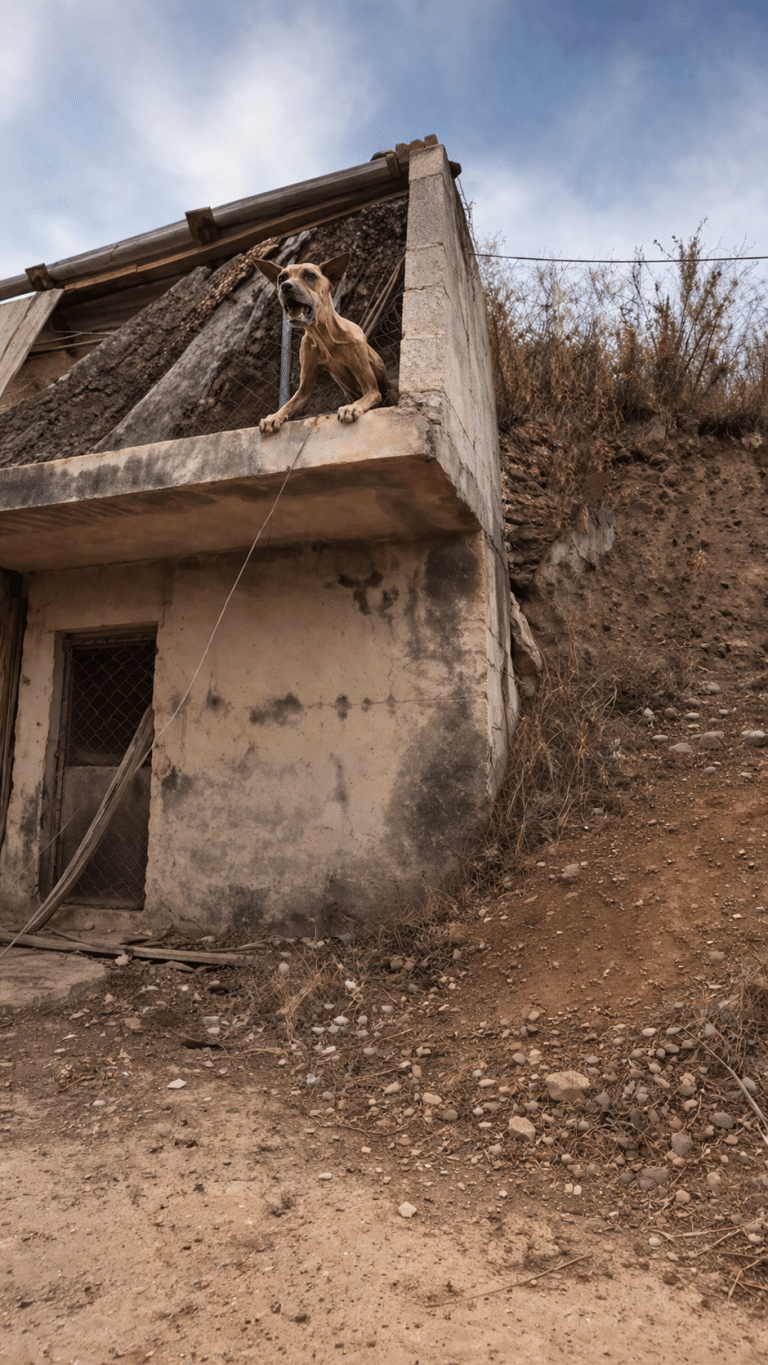
For years, Chata's entire world was a rooftop surrounded by a mesh barrier.
Below him, life continued. People went about their days, unaware of the suffering taking place above them. Yet Chata remained in the same confined space, surviving on whatever scraps of food reached him.
He had no comfortable place to call home. No reliable source of nourishment. No ordinary companionship.
And as the years passed, his body became a quiet record of everything he had endured.
By the time help finally arrived, Chata was so thin that his ribs were clearly visible. Even moving appeared to require tremendous effort.
But what happened when the rescuers approached him revealed something remarkable.
After more than eight years of isolation and neglect, Chata still found the strength to wag his tail.
Just a little.
It was a small movement from a terribly weakened dog, but it marked the beginning of a very different life.
The Rooftop That Became His Entire World
Chata had not always lived above the ground, separated from everyday life.
According to his rescue story, he had previously been used repeatedly for breeding. When he was no longer considered useful for that purpose, he was discarded.
What followed was an extraordinary period of isolation.
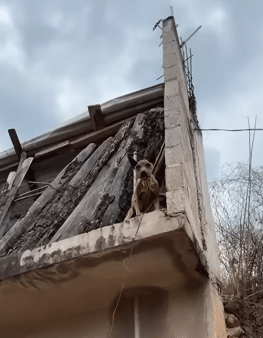
For more than eight years, Chata remained confined on a rooftop behind a mesh barrier.
The rooftop was not a place where he could freely explore or find the things a dog needs to stay healthy. His access to food depended on scraps thrown to him by strangers.
There was no dependable routine of proper meals and care described during those years.
For an animal that relies on people for protection and nourishment, such circumstances carry serious consequences.
And Chata's condition eventually reflected that prolonged deprivation.
His body had become painfully thin. His strength had faded. Ordinary movements, the simple actions that healthy dogs perform without hesitation, appeared exhausting.
It is difficult to imagine how slowly those years must have passed.
A dog needs more than the occasional food scrap to live well. He needs appropriate nutrition, veterinary attention, a safe environment, and human interaction.
Chata had been deprived of the stability that makes those basic needs possible.
What makes his story particularly moving is that his suffering had continued in a place that was physically above the world around him.
He was there all along.
Yet meaningful help had not reached him.
When the Signs of Neglect Could No Longer Be Ignored
The rescuers did not need a detailed explanation to recognize that Chata was in serious trouble.
His appearance communicated the urgency immediately.
His ribs stood out beneath his skin. His body was extremely underweight, and the weakness affecting his movements suggested that he needed medical attention without delay.
He was not simply a dog who had missed a few meals.
The condition described by his rescuers was consistent with prolonged deprivation.
For years, his survival had depended on inadequate food rather than consistent, balanced nourishment.
His physical deterioration was one concern. The length of time he had spent in isolation was another.
Dogs are social animals, and regular human care provides more than food and shelter. It offers familiarity, security, and opportunities for healthy interaction.
Chata had spent an enormous portion of his life without those ordinary comforts.
No one could immediately undo those missing years.
No single meal could restore his strength.
And no act of kindness, however meaningful, could instantly resolve the medical problems that had developed.
Still, one thing could change.
Someone could finally bring him down from that rooftop.
A Ladder, a Rescue Team, and One Small Wagging Tail
The turning point came when Dublin Shelter received information about Chata's situation.
The team responded immediately.
Reaching him required more than simply opening a door. Chata was confined high above the ground, so rescuers brought a ladder and climbed toward the rooftop.
For a dog who had been isolated for so long, the arrival of unfamiliar people might have been a frightening experience.
His physical condition also made the situation delicate.
He was extremely weak, and the rescuers needed to get him into proper care.
Yet Chata's reaction was not what someone might expect from an animal who had spent years without consistent human kindness.
He did not attempt to escape.
He did not retreat into hiding.
Instead, he wagged his tail.
It was not a dramatic burst of excitement. The movement was slight, almost understated.
But there was something deeply affecting about it.
Even after years of deprivation, Chata was still willing to respond to the people approaching him.
That small gesture did not erase his suffering. It did not mean he was healthy or that his long isolation had left no emotional effects.
It simply offered a glimpse of the gentle personality that remained beneath his fragile appearance.
And now, for the first time in years, his situation was changing.
VIDEO: Forgotten on a Rooftop for Years, Chata Greeted His Rescuers With a Tiny Wag of His Tail
Getting Chata off the rooftop was only the first part of his rescue.
The next challenge would be much harder.
His body was in urgent need of treatment, and the people caring for him were about to discover that malnutrition was not his only medical concern.
The Medical Examination Revealed How Much Help He Needed
After his rescue, Chata was taken directly to a veterinary clinic.
There, the seriousness of his physical condition became clear.
He was suffering from severe malnutrition, dehydration, and profound weakness.
These were not minor problems that could be addressed by simply offering him a large meal.
His body had spent a long time without the consistent nourishment and hydration it needed.
Even basic activities were difficult.
Standing required effort. Moving was exhausting. Making a sound could be a struggle.
For a dog in such a vulnerable condition, recovery needed to be approached carefully.
The medical team also discovered another serious concern.
Chata had a large tumor.
That finding added another layer of uncertainty to an already complicated situation.
The source does not establish the tumor's exact diagnosis or whether it could be completely treated. What is clear is that Chata required medical attention and continued monitoring.
His rescuers were now facing two connected responsibilities.
They needed to help his weakened body recover from prolonged neglect while also addressing a separate medical problem that could not be ignored.
There was no reason to expect an instant transformation.
After so many years without proper care, Chata needed patience as much as he needed treatment.
The important difference was that he no longer had to face his condition alone.
Healing Began With the Smallest Steps
For Chata, recovery was not about doing everything at once.
It was about giving his body what it needed, gradually and consistently.
His care included small meals introduced carefully, along with fluids, vitamins, and ongoing medical supervision.
Each part of that routine mattered.
Providing nourishment was essential, but his weakened condition meant that the process could not be rushed.
Restoring hydration was another priority.
So was watching his response to treatment and making sure his body was able to tolerate the care being provided.
These may sound like ordinary parts of veterinary treatment.
For Chata, however, they represented a profound change from his previous circumstances.
For years, food had been something uncertain.
Now, nourishment was part of a deliberate plan to help him recover.
For years, his physical deterioration had gone without adequate attention.
Now, his condition was being monitored.
And instead of remaining behind a barrier on the rooftop, he was receiving care from people focused on improving his health.
Recovery from prolonged deprivation is not measured only by appearance.
It also involves rebuilding enough strength to perform ordinary movements comfortably and helping the body regain more stable function.
Chata's progress was gradual.
There was no sudden moment when every problem disappeared.
His tumor remained an important medical concern, and his physical weakness required continued attention.
But the rescuers began to see encouraging signs.
He was responding to care.
Little by little, the dog who had been struggling simply to survive was beginning to regain some of the strength he had lost.
The Gentle Dog Beneath the Fragile Body
One of the most touching aspects of Chata's recovery was the way his personality emerged as his condition improved.
His first response to rescuers had already shown his willingness to engage with people.
As time passed, that gentle nature became even more apparent.
He began accepting affection and leaning into the care he received.
His eyes appeared more alert.
His movements reflected improving strength.
These changes were modest compared with the scale of what he had endured, but they were meaningful.
For an animal recovering from years of neglect, progress does not always arrive through dramatic milestones.
Sometimes, it is visible in a little more energy.
Sometimes, it appears in the way a dog responds to someone offering comfort.
And sometimes, it is simply the difference between struggling through every movement and beginning to move with greater ease.
Chata's caregivers were seeing signs that the work of recovery was making a difference.
He was becoming healthier.
More importantly, he was finally experiencing consistent attention and kindness.
It is tempting to imagine that he understood exactly how much his circumstances had changed.
Of course, no one can know precisely what Chata thought or felt.
What could be observed was enough.
He continued to respond gently to people, accepted affection, and showed increasing signs of physical improvement.
The dog who had spent years separated from human companionship was now participating in the care being offered to him.
His recovery was not complete.
But his days no longer revolved around surviving on scraps behind a rooftop barrier.
A Different Life, With Challenges Still Ahead
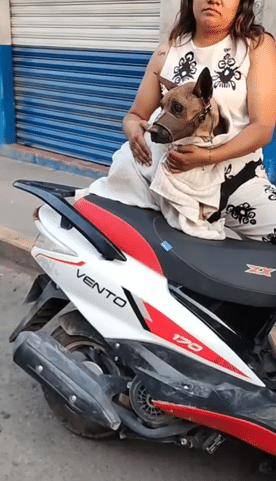
Chata's condition today is very different from what rescuers encountered on the rooftop.
He looks healthier, and his body has begun rebuilding the strength lost through years of inadequate nourishment.
His eyes appear brighter and more engaged.
He continues to receive the attention and care he needs.
But his story has not reached a perfect ending.
The medical challenges identified after his rescue still matter. His recovery requires continued treatment, patience, and careful attention to his health.
The tumor discovered during his examination remains a significant part of his medical history, and the available account does not confirm a final outcome for that condition.
It would be misleading to describe him as completely healed.
What is confirmed is that he has made encouraging progress.
The difference is substantial.
A dog once confined to a rooftop, physically depleted and surviving on discarded food, is now being cared for with compassion.
That alone represents an enormous change.
Yet there is one more important part of his future that remains unresolved.
Chata is still waiting for a home.
Not merely another place to stay, but a stable environment where he can continue receiving appropriate care and companionship.
A home where his needs are taken seriously.
A place where his well-being is part of someone's everyday responsibility.
After more than eight years of isolation, that possibility carries special meaning.
His rescue provided a chance to recover.
A permanent home could offer the long-term stability he has been missing.
The Years Cannot Be Returned, but His Future Can Be Different
There is something especially difficult about Chata's story.
His suffering was not the result of a single brief emergency.
It continued for years.
During that time, his body grew weaker, his access to proper nourishment remained inadequate, and he lived confined to a rooftop away from ordinary companionship.
By the time Dublin Shelter reached him, his condition was critical.
And yet, when people finally approached with the intention of helping, he offered that small wag of his tail.
It is the kind of detail that stays with you long after the rescue itself.
Not because it proves that Chata had forgotten everything he endured.
And not because kindness instantly repaired the damage.
But because it showed that even in his weakened state, he could still respond to a gentle human presence.
His recovery has required careful nutrition, medical supervision, and ongoing support.
There are still unanswered questions about his health and his eventual home.
Those uncertainties deserve to be acknowledged rather than covered with a convenient happy ending.
Chata has already survived an extraordinary period of hardship.
He has also demonstrated that meaningful improvement is possible when a neglected animal finally receives appropriate care.
His story reminds us that rescue is not a single dramatic moment.
It is the beginning of a responsibility.
It means recognizing suffering, responding to urgent needs, continuing treatment, and making room for an animal's future.
For Chata, that responsibility began when a team climbed a ladder to reach a forgotten dog.
Years of loneliness could not be taken away.
But the days ahead no longer had to look like the days behind him.
And somewhere beyond the medical treatment and gradual recovery, there is still hope for the simple thing he has waited so long to receive.
A safe home.
People who care.
And a life in which he is never forgotten on a rooftop again.


