
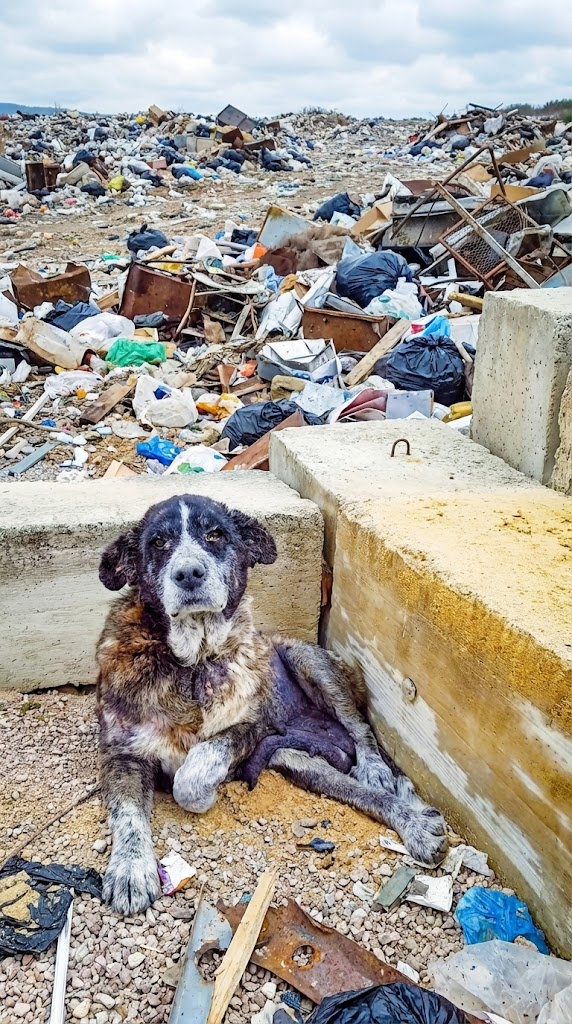
At the edge of a landfill filled with rusted metal, discarded objects, and piles of debris, one large dog stood quietly among the things the world had thrown away.
Her name was Maya.
She was not running through the landfill looking for an escape. She was not wandering from place to place in search of something better.
She was simply there.
Day after day, Maya remained exposed to the harsh conditions around her with no proper shelter, no dependable source of clean water, and no certainty about what the next day would bring.
She was physically impressive, a large dog with enough strength to endure far more than anyone should have expected from her.
But strength alone could not protect her forever.
A Dog Almost Hidden by the Place Around Her
A landfill is designed for things people no longer want.
That made Maya painfully easy to overlook.
Against the broken metal and discarded materials, she could have become just another shape in the distance. Someone passing nearby might have noticed her and continued on.
The volunteers who eventually saw her did something different.
They paid attention.
Once they understood that Maya was living there, they began returning to help her. The situation was complicated because the landfill was private property, limiting what they could safely and legally do.
So at first, the volunteers worked with what was possible.
They brought food.
They brought water.
They created a small improvised shelter near the place where Maya stayed, offering at least some protection from the environment around her.
Most importantly, they kept returning.
There was no instant solution. The rescuers could not simply walk onto the property and carry Maya away.
For a time, helping her meant showing up again and again while searching for a way to get her out.
A Promise That Could Not Wait Forever
Each visit carried the same unanswered question.
How much longer could Maya continue living there?
The volunteers knew that leaving her in the landfill indefinitely was not a real solution. Food and water could help her survive another day, but they could not give her the safety she needed.
Eventually, waiting became its own risk.
The rescuers decided that Maya had spent enough time surrounded by abandonment.
They would return after dark and bring her out.
When that moment finally came, Maya did not turn the rescue into a struggle.
She did not flee from the people approaching her.
She did not resist.
Instead, the enormous dog remained remarkably still, allowing the people who had been visiting her to lead her away from the place she had been surviving in.
For the volunteers, it must have seemed that the hardest part was over.
Maya was out.
She was safe from the landfill.
But once she reached veterinary care, the next part of her fight began.
VIDEO: Maya Waited Among the Landfill Debris Until Rescuers Finally Brought Her to Safety
Safety Revealed a Much Deeper Problem
Leaving the landfill did not bring the immediate improvement everyone hoped to see.
Instead, Maya's condition became increasingly concerning.
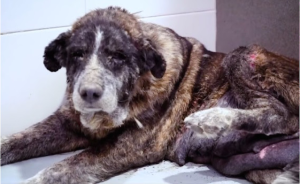
Her skin problems worsened, and uncomfortable lesions continued to appear. Veterinary examinations and testing were needed to understand what was happening.
Eventually, the diagnosis became clear.
Maya had pemphigus, an aggressive autoimmune condition in which the immune system attacks the skin.
The discovery changed everything.
This was not simply a matter of giving an underfed or neglected dog a few good meals and a quiet place to sleep.
Maya needed sustained medical care.
Her treatment involved powerful medication, careful monitoring, and patience. The condition could not be expected to disappear overnight, and the treatment itself required close attention because of possible side effects.
There were periods when the people caring for Maya feared they might lose her.
Her future was uncertain.
But the same dog who had endured life in the landfill continued moving forward through treatment.
Progress came gradually rather than dramatically.
There was no single morning when everything suddenly became easy.
Instead, recovery appeared in small changes.
Her skin began to improve.
Her appetite returned.
Her strength started coming back.
Each improvement was modest on its own, but together they told a different story from the one that had begun among the landfill debris.
Maya was no longer simply surviving one more day.
She was recovering.
Healing Was More Than a Medical Result
Physical recovery mattered, but Maya's transformation could not be measured only by her skin or her appetite.
There was another change taking place.
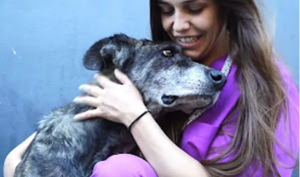
She was learning what life could feel like when the people around her were not temporary.
For so long, Maya's world had been defined by uncertainty. A makeshift shelter and regular visits from volunteers had offered her the first signs of security, but everything was still fragile.
Now she had consistent care.
She had people watching closely for what she needed.
She had time.
That time mattered.
Rescue stories are often remembered for one dramatic moment—the instant a dog is lifted into a vehicle or carried away from danger.
But Maya's experience showed why rescue rarely ends there.
Getting her out of the landfill was only the door opening.
Walking through that door required treatment, persistence, and people willing to stay involved long after the most visible rescue moment had passed.
Eventually, Maya became well enough to leave veterinary care.
And then came another important question.
Where would she go next?
She Was Not Simply Rescued — She Was Chosen
Maya's next chapter began with a family whose lives had already crossed several countries, including Venezuela, Italy, and Spain.
They did not look at Maya and see only her medical history.
They did not see a difficult case defined by the condition she had survived.
They saw the dog in front of them.
Maya had a calm presence and an unmistakable sense of composure. Despite everything that had happened, she entered her new life without seeming overwhelmed by it.
Her family came to see her as something of a queen.
The nickname fit.
Maya did not need to push the other dogs aside or demand attention. She simply carried herself with a quiet confidence.
She joined a home that already included three other dogs, and gradually became a steady presence among them.
It was a remarkable contrast.
The dog who had once stood alone among discarded objects now belonged to a family.
The dog whose future had once depended on volunteers quietly bringing food and water now had a permanent place to return to.
Adoption did not erase what Maya had endured.
But it changed what came next.
From a Landfill to the Spanish Countryside
Today, Maya's surroundings could hardly look more different from the place where rescuers first found her.
Instead of piles of debris, she walks through the Spanish countryside.
Instead of waiting alone for the next volunteer visit, she appears in family photographs.
During the holidays, she has even tolerated wearing festive antlers, maintaining the same composed expression that helped inspire her royal nickname.
These everyday moments may seem ordinary.
For Maya, ordinary is part of the victory.
A peaceful walk.
A photograph with family.
A home shared with other dogs.
The security of knowing where she belongs.
Months after her adoption, the people who had helped rescue Maya visited her again.
They were no longer looking at a dog standing in a landfill or a patient facing a difficult medical diagnosis.
They saw a dog who had settled into her life.
The uncertainty that once surrounded her had been replaced by stability.
The frightened, vulnerable chapter of her story had not disappeared, but it was no longer the chapter defining every day.
What Maya's Journey Leaves Behind
Maya's story is powerful precisely because there was no instant transformation.
Her life changed through a chain of choices.
Someone noticed her.
Volunteers returned with food and water.
They built her a small shelter.
They decided waiting was no longer enough.
Veterinary professionals worked through a difficult diagnosis.
Care continued when progress was slow.
And finally, a family chose to make her part of their own lives.
Each step mattered.
Her journey is also a reminder that the place where an animal is found does not determine what that animal deserves.
Maya was discovered in a landscape built around discarded things.
She was never disposable.
Her illness made recovery complicated.
It did not make her less worthy of care.
And the time, expense, and patience required to help her did not reduce the value of saving her.
True rescue is not only about removing an animal from immediate danger.
Sometimes it means staying through the difficult medical days.
Sometimes it means returning again when progress is barely visible.
And sometimes the most meaningful ending is not dramatic at all.
It is simply a dog walking calmly through the countryside, surrounded by family, living a life that once seemed almost impossible from the edge of a landfill.
Maya did not need a throne to become the queen her family saw in her.
She needed safety.
She needed care.
And finally, she needed a place where she was no longer waiting to be noticed.
She had found it.


