
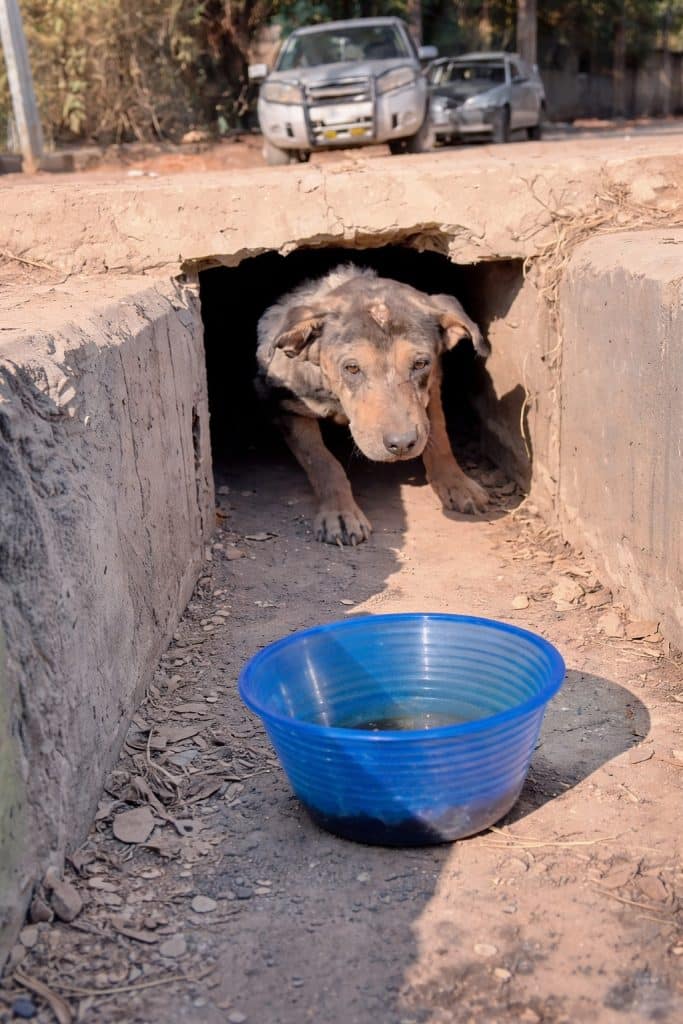
By the time someone finally noticed Buddy, the elderly dog had already learned how to make himself almost invisible.
He was tucked deep inside a narrow drainage pipe beside a quiet road, curled into the darkness where most people would never think to look.
It was not a home.
There was no soft place to sleep, no dependable meal waiting for him, and little protection beyond the concrete walls surrounding his tired body.
Yet somehow, that small space had become the place where he survived.
A Dark Pipe Had Become His Only Refuge
Buddy’s condition showed how difficult life had become.
He was painfully thin, and his coat had grown sparse and uneven. His skin was irritated, reflecting the discomfort of spending so much time in a cramped environment that offered little more than a place to hide.
Inside the drain, even the simplest necessities were uncertain.
Food was scarce.
Fresh water was difficult to find.
There was nowhere comfortable to stretch out and rest.
And there was no person nearby checking whether the elderly dog was eating, drinking, or growing weaker.
For Buddy, each day seemed to be about getting through the hours ahead.
The drain protected him from the outside world, but it could not give him the things an aging dog truly needed.
Still, he remained there.
Quiet.
Watchful.
Waiting without knowing whether anyone would ever notice him.
The Small Movement That Made Someone Stop
The turning point came when rescuers were passing through the area and noticed something near the roadside.
It was only a small movement.
The kind of detail that could easily disappear into the background.
But instead of continuing on, they stopped and looked more carefully.
Inside the dark opening of the drainage pipe, they saw him.
Buddy did not rush toward them.
He remained cautious, watching from the place that had become his shelter. He did not disappear farther into the pipe, but he was clearly uncertain about the people standing outside.
After spending so long alone, there was no reason for trust to come immediately.
So the rescuers did not force him out.
They stayed patient.
A bowl of clean water was placed near the entrance, close enough for Buddy to reach without anyone crowding him.
Then they gave him time.
Buddy stared toward the water.
For a while, nothing happened.
The rescuers waited rather than turning the moment into a struggle.
Eventually, thirst and curiosity seemed to overcome some of his hesitation.
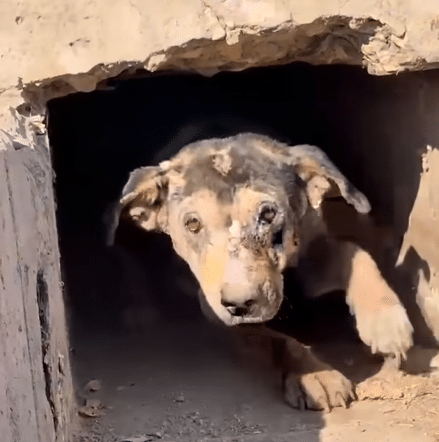
Slowly, Buddy began to move.
One Careful Step Out of the Darkness
As Buddy emerged from the drain, his physical condition became even clearer.
His body was thin and weak, and every movement seemed careful.
He did not bound toward his rescuers or suddenly become comfortable around them.
His progress was quieter than that.
One movement at a time, he left the darkness behind.
The rescuers approached him calmly and gave him room to adjust. Buddy allowed them to come closer without retreating into the pipe again.
That alone mattered.
For an elderly dog who had depended on hiding for safety, leaving his shelter meant entering a world he could not yet understand.
But this time, the people waiting outside were there to help.
Buddy was gently lifted and taken away from the roadside.
The drainage pipe that had sheltered him through hunger and isolation was finally behind him.
He no longer had to depend on a strip of concrete beside the road simply to have somewhere to survive.
Healing Started With Ordinary Things
At the rescue center, Buddy was given the basic care that had been missing from his life.
He received a thorough checkup.
His irritated skin was treated.
He was given a much-needed bath, helping remove the dirt and discomfort that had accumulated during his time outside.
And there was food.
Not a meal that might disappear tomorrow.
Not scraps he had to search for.
Regular nourishment was finally available as caregivers began helping his weakened body regain what it had lost.
There was also clean water whenever he needed it.
For a dog who had lived with uncertainty, these ordinary things represented a profound change.
A bowl remained available.
Meals arrived reliably.
There was a safe place to lie down.
He no longer had to conserve every bit of energy while wondering where the next basic necessity would come from.
Recovery could not happen instantly.
Buddy was elderly, underweight, and had spent too much time living without consistent care.
There was no reason to expect years of hardship to disappear after a single bath or meal.
But healing did not need to happen all at once.
It could begin with something much smaller.
A full stomach.
A clean place to rest.
Fresh water nearby.
And the absence of danger.
Learning That He No Longer Had to Hide
Physical care was only one part of Buddy’s new life.
He also had to adjust to something that may have felt unfamiliar: people paying attention to him.
For so long, surviving had required him to stay unnoticed.
Inside the drain, silence had been part of his protection.
Now there were caregivers nearby who noticed when he ate, when he rested, and whether he seemed comfortable.
Their presence did not demand anything from him.
It simply remained.
That kind of consistency can matter deeply for a dog whose recent life had been defined by uncertainty.
Buddy did not need to suddenly become energetic or completely trusting.
He only needed time.
Each quiet day in a protected environment gave him another opportunity to understand that the roadside drain was no longer his only option.
He could sleep without keeping himself tucked into a narrow concrete space.
He could drink without searching for water.
He could eat without wondering when another meal might appear.
And when he looked around, he was no longer completely alone.
A Second Chance Built Slowly
There was no dramatic overnight transformation.
Buddy’s body still needed care, nourishment, and rest.
His past could not simply be erased.
But his circumstances had changed completely.
The elderly dog who had once survived inside a roadside drain now had people responsible for his wellbeing.
That difference was visible in the smallest routines.
Someone could notice whether his bowl was empty.
Someone could make sure fresh water was available.
Someone could provide a quiet place where his tired body could settle comfortably.
Someone was finally paying attention.
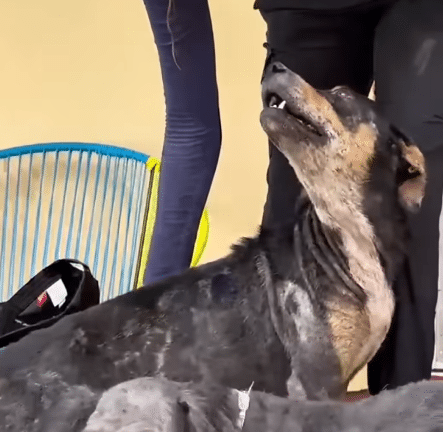
For Buddy, recovery would be measured through those small moments rather than one dramatic event.
A little more strength.
A little more comfort.
Another peaceful rest.
Another meal.
Each ordinary day offered something his former life had rarely provided: predictability.
And sometimes, safety begins exactly that way.
Not with a grand gesture, but with the repeated proof that care will still be there tomorrow.
The Life Hidden Beside the Road
Buddy’s story is a reminder that suffering is not always easy to see.
Sometimes it exists in places people pass every day without noticing.
Under roadside edges.
Behind barriers.
Inside narrow spaces where frightened or exhausted animals learn to stay hidden.
Buddy had been only a few feet away from the ordinary world moving around him.
Yet until someone noticed that small movement near the drain, his struggle remained almost completely unseen.
The people who stopped that day could not change what had already happened to him.
They could not give back the time he had spent alone.
But they could change what happened next.
They looked closer.
They waited patiently.
They offered water instead of forcing him forward.
And when Buddy was ready to leave his hiding place, they were there to carry him toward safety.
Sometimes rescue begins with specialized equipment or urgent intervention.
Other times, it begins much more quietly.
Someone notices something unusual.
Someone chooses not to keep walking.
Someone looks into a dark place that everyone else has passed.
For Buddy, that simple decision meant the difference between continuing to survive alone and finally having people beside him.
The roadside drain had once been the safest place he knew.
Now he has something better.
Care.
Food.
Rest.
And, perhaps most importantly, the comfort of no longer having to face each day by himself.


