
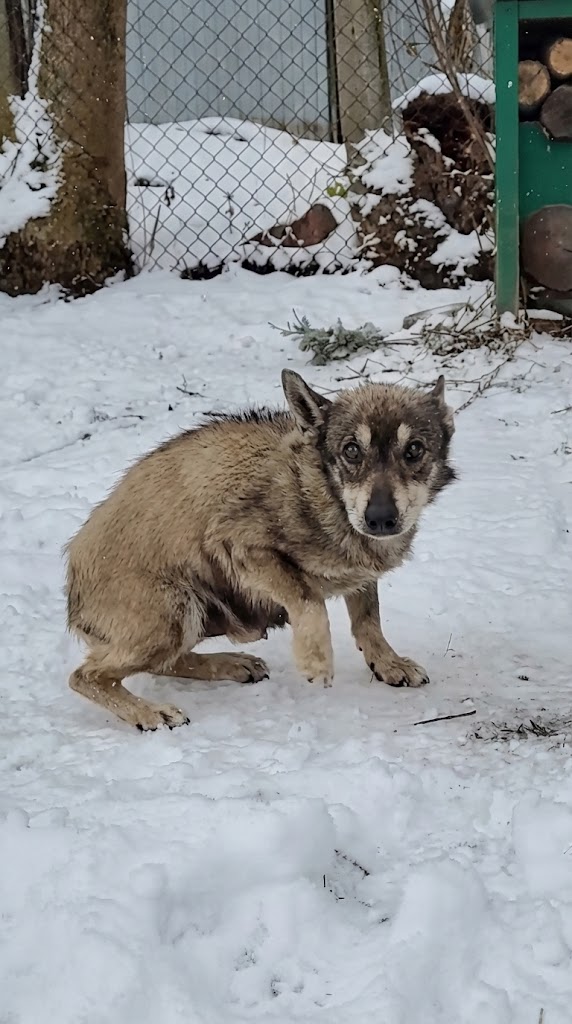
A small dog stood almost motionless against the frozen ground, his body trembling as the cold moved through him.
There was no warm place to retreat to.
No blanket beneath him.
Only a chain connecting him to a post and an owner who seemed to believe that surviving the cold meant he was somehow fine.
The rescue team had not even been heading there that morning. They were traveling toward another call when a faint movement in the landscape made them slow down.
For a moment, they hoped they had mistaken what they were seeing.
Then they looked again.
The Dog They Almost Passed By
The dog was standing outside with nowhere to escape the freezing air.
His small body shook continuously as he remained tethered in place. The ground beneath him offered no comfort, and there was nothing nearby that could truly protect him from the conditions.
When the owner came outside, the rescuers asked about the dog.
According to the source, the response was simple.
The dog was supposedly accustomed to living that way.
But the rescuers saw something different.
They saw an animal whose body was struggling to stay warm.
They saw a dog who could not choose to move somewhere safer.
And they understood that being accustomed to hardship does not make hardship acceptable.
So they asked the question that mattered most.
Could they take him?
The answer came quickly.
They could have the dog.
But the chain had to stay.
It was a brief exchange, yet it said more than a long argument ever could.
The rescuers carefully separated the dog from the restraint that had kept him there.
For the first time that morning, the small animal was no longer tied to the frozen place where they had found him.
VIDEO: He Was Left Trembling in the Cold — Then Rescuers Were Told to Take the Dog but Leave the Chain
Another Dog Was Still Waiting
The team still had another call to reach.
They continued to the place they had originally been traveling toward, carrying with them the memory of the first dog.
What they found there showed that the morning was far from over.
A second dog had a wooden structure that might have looked like shelter from a distance.
Up close, it offered very little protection.
Cold air could move through the gaps, leaving the dog exposed to the same freezing conditions that surrounded him.
But temperature was only part of the concern.
The dog was also extremely thin.
His ribs were clearly visible beneath his body, suggesting that he had not been receiving enough food for some time.
He did not rush toward the rescuers.
He did not bark or challenge them.
He simply watched.
Sometimes rescue begins with a dramatic moment.
Other times, it begins with a quiet animal standing still long enough for someone to realize how much help is needed.
One Dog Asked for Something Different
Another dog reacted in a completely different way.
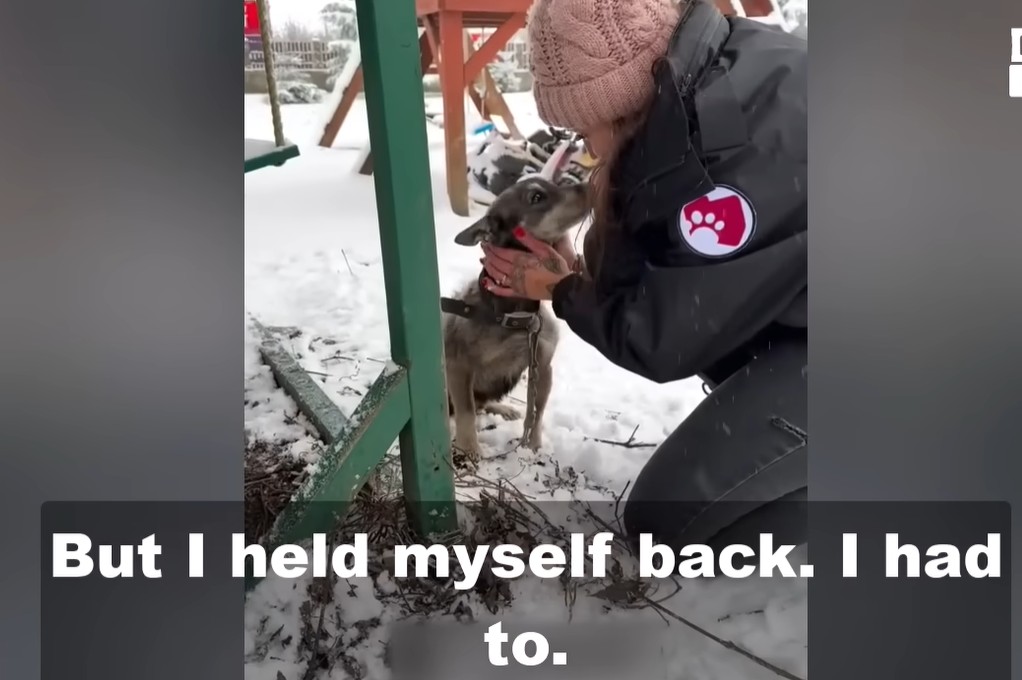
As the rescuers approached, he moved directly toward them.
There was no long period of hesitation.
No careful distance.
He pressed close to the people who had arrived, staying beside their legs as though physical contact itself offered something he had been missing.
Food and warmth were important.
But his behavior suggested another need just as clearly.
Company.
The simple reassurance that someone was there.
The freezing conditions had affected all of the dogs, but each one responded to their situation differently.
Some remained still and cautious.
This dog reached immediately for human connection.
He stayed close, trembling but unwilling to create distance between himself and the people who had stopped for him.
It was a quiet reminder that prolonged isolation can leave its own kind of wound.
The Rescue Became Larger Than Expected
What began with one dog by the roadside soon became a much larger operation.
Backup arrived to help.
By the end of the day, six dogs had been removed from the conditions in which they had been living.
Six dogs who had been tethered.
Six dogs facing cold, hunger, or both.
Six animals whose circumstances changed because someone noticed, stopped, and refused to continue driving.
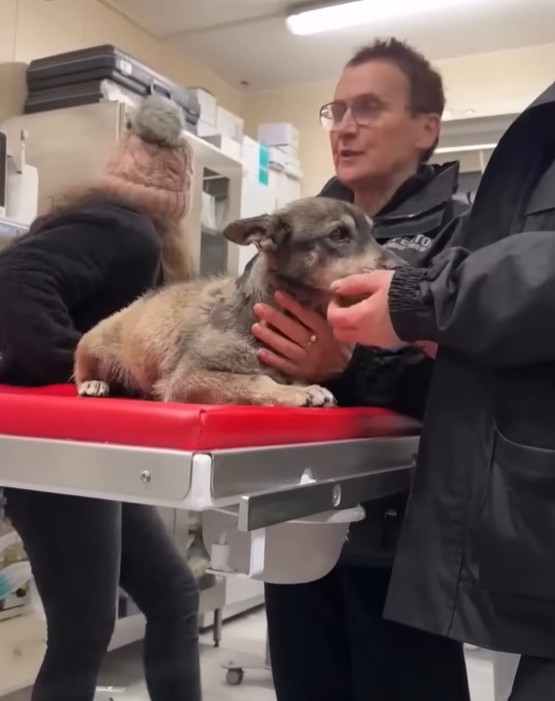
Once they were brought into care, the extent of their needs became clearer.
The dogs showed signs of malnourishment.
Some had lost fur in areas affected by long-term restraint.
And beyond the visible physical concerns were quieter signs of what they had experienced.
Trust would not return simply because the chains were gone.
Safety had to become familiar.
That takes time.
For an animal that has spent too long restrained or neglected, a warm room can feel unfamiliar.
A gentle hand may still cause hesitation.
A full bowl may be approached cautiously.
The physical rescue can happen in a moment.
Emotional recovery often moves much more slowly.
Learning What Safety Feels Like
The most important change that day was not something dramatic.
It was the absence of what had surrounded the dogs before.
No more freezing ground beneath restrained bodies.
No more waiting at the end of a chain.
No more facing hunger without the ability to search for food.
They were finally somewhere their needs could be addressed.
Their bodies now had the chance to regain strength.
Their coats could begin recovering.
And perhaps, gradually, they could learn that human presence did not always mean being left outside and forgotten.
Rescue work often looks different from the dramatic moments people imagine.
Much of it is quiet.
Providing food.
Giving an animal somewhere warm to rest.
Allowing space instead of demanding affection.
Returning the next day and offering the same kindness again.
For dogs who have experienced long periods of uncertainty, consistency can become one of the most meaningful forms of care.
Trust is rarely rebuilt in one afternoon.
It grows through repeated moments in which nothing bad happens.
A meal arrives.
A door opens gently.
A person sits nearby without asking for anything.
Little by little, fear can lose some of its hold.
Why Rescuers Continue to Stop
The people involved in this rescue knew they could not help every animal living in difficult circumstances.
No rescue team can.
There will always be another call, another dog, another situation waiting somewhere beyond the one already in front of them.
But that does not make the life directly in front of them less important.
The first dog might have remained tied in the freezing cold if the team had not noticed movement and slowed down.
The second might have remained inside a wooden shelter that did little to keep the cold away.
The dog seeking human contact might have spent another day without the companionship he so clearly wanted.
Instead, six dogs left those conditions behind.
That is why rescuers keep answering calls even when the work is difficult.
They cannot change every story.
They can change the one they reach.
When a Life Becomes More Important Than What Holds It
One sentence from that morning remained difficult to forget.
Take the dog.
Leave the chain.
The chain was only an object.
The dog attached to it was alive, trembling, and dependent on someone else to make a different choice.
That contrast became the defining image of the rescue.
Yet the story did not end with the chain.
It continued with six dogs being moved toward safety and care.
Their recovery would require patience.
Some effects of neglect are visible immediately.
Others appear through hesitation, fear, or the desperate need to stay close to the first person who offers kindness.
But every one of those dogs had crossed an important line that day.
They were no longer waiting outside for help that might never arrive.
Someone had arrived.
Someone had noticed.
And someone had chosen the life on the other end of the chain.


