
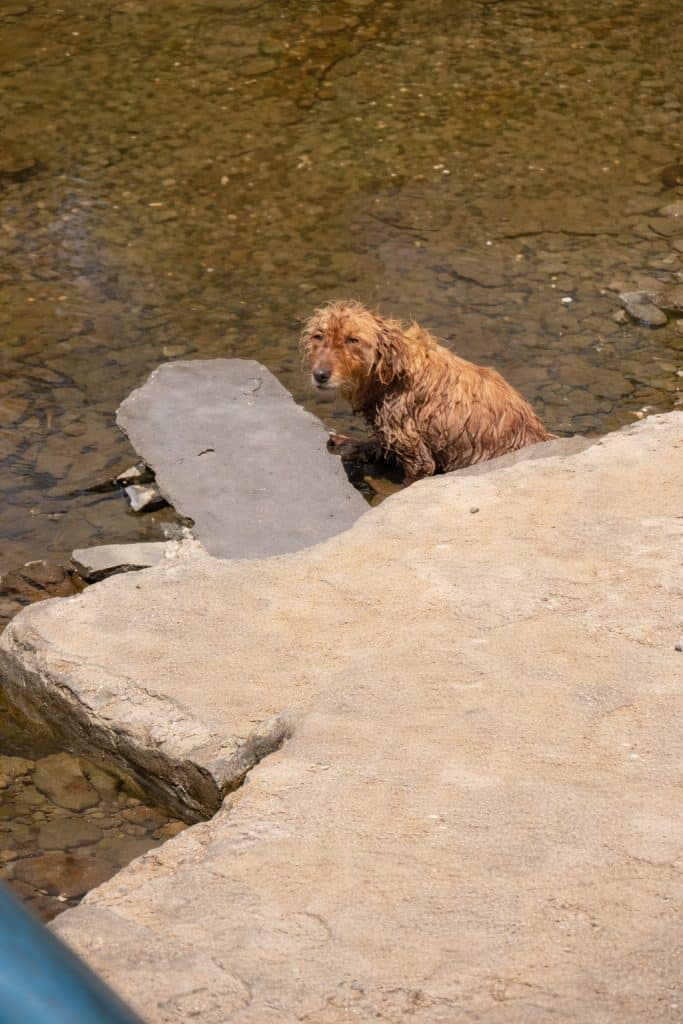
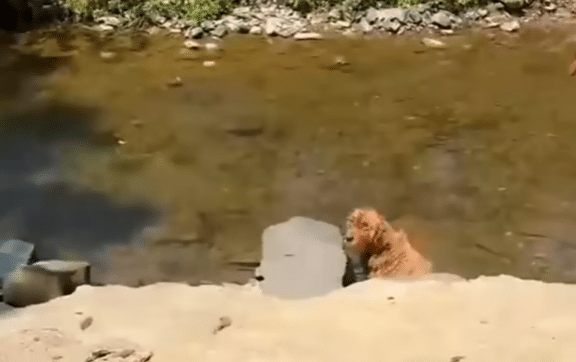
The golden-coated dog stood half-submerged in the freezing stream, surrounded by rocks and rushing water.
He was not splashing or trying to play.
He barely seemed to react to the cold at all.
Something about his stillness immediately felt wrong. When a person finally came close enough to lift him from the water and place him on the rocky bank, the reason became painfully clear.
His back legs did not move.
When His Front Legs Were All He Had
Once out of the stream, the dog tried to move forward.
His front legs pulled while the rest of his body followed heavily behind. There was no strength coming from his hindquarters and no way for him to rise normally.
Each attempt demanded effort.
The uneven rocks beneath him only made movement harder.
His earlier life was unknown. No one standing there could explain how long he had been living with this condition or exactly how he had ended up in the water.
What mattered in that moment was simpler.
Someone had noticed him.
And instead of walking away, they stayed.
Food came first—small pieces of sausage and kibble offered to a dog who clearly needed strength. Then came the decision that would change everything that followed.
He was going home with his rescuer.
A cardboard box became his first safe place for the journey away from the stream. It was simple, but for a dog who had just been struggling beside cold water and rocks, it meant protection.
For the moment, he did not have to pull himself anywhere.
Someone else was carrying him.
VIDEO: Found Unable to Use His Back Legs, Candy’s Journey Away From the Frozen River Began
The Veterinary Visit Revealed an Old Injury
The following day, the dog was brought back to the rescuer’s hometown.
There, a family welcomed him with another small act of care. They prepared boiled chicken breast so he could eat something warm and nourishing while beginning to regain his strength.
Soon afterward came the veterinary examination.
The findings explained why his back legs had failed him.
Both hind legs had suffered fractures in the past. Those injuries had already healed incorrectly, leaving damage that could not simply be corrected with surgery.
The condition, according to the veterinary assessment, was permanent.
It was difficult news.
Yet the dog himself continued to show something encouraging.
He ate eagerly.
He remained gentle with the people caring for him.
Despite everything his body had endured, he was still responsive to kindness and interested in the food placed before him.
Around this time, he received a name.
Candy.
It was a soft name for a dog whose life had suddenly begun to feel much softer too.
Wheels Gave Candy a Different Kind of Freedom
Knowing that Candy could not spend the rest of his life dragging his body forward, his rescuer began looking for another way to help him move.
The answer was a wheelchair.
It was handmade rather than sophisticated, but perfection was not the goal.
Movement was.
Once his hindquarters were supported by the wheels, Candy could begin exploring without forcing his body across the ground.
The difference was immediate.
He could move through his surroundings.
He could stop and nibble at grass.
He could lift his head and look around instead of focusing every bit of energy on pulling himself forward.
The wheelchair did not erase his condition.
It simply gave him back some independence.
And alongside that new mobility came the less visible work of daily care.
Because Candy could not relieve himself normally without assistance, his caregiver cleaned him patiently each day. His meals were prepared thoughtfully, including chicken, vegetables, and balanced nutrition to support his health.
Nothing about the routine was dramatic.
It was repetition.
Food.
Cleaning.
Movement.
Rest.
Care again the next day.
That consistency slowly began to show in Candy’s appearance.
He gained weight.
His coat looked healthier.
The strain that had once seemed fixed in his expression gradually softened.
And his behavior around people changed too.
Candy began rolling onto his back for belly rubs.
He leaned into affection rather than simply tolerating it.
The dog who had once stood almost motionless in cold water was beginning to participate in his new life.
They Kept Working Even Without a Promise
The veterinary findings had given Candy’s rescuer every reason to manage expectations.
His old fractures could not be repaired in a way that guaranteed normal use of his legs.
Still, caring for him did not stop at the wheelchair.
Each day, the wheels were removed for rehabilitation.
His back legs were gently massaged.
His muscles were stretched.
At first, there was nothing obvious to celebrate.
His hind legs remained still.
The sessions continued anyway.
There was no single dramatic moment when everything changed. Instead, progress appeared in the smallest possible form.
A reaction.
A slight reflex.
Something that had not been there before.
It would have been easy to dismiss such a tiny movement.
But for Candy, even a small response mattered.
So the routine continued.
Day after day, his caregiver worked with the body that veterinarians had warned might never function normally again.
Then, several weeks into the process, Candy did something no one had been counting on.
While eating, he rose onto all four legs.
Only briefly.
His stance was not strong or steady, and he could not remain there for long.
But his back legs were supporting him.
For a few seconds, the wheelchair was not.
Sometimes progress arrives so quietly that it can almost be missed.
Candy’s first stand was one of those moments.
The First Steps Came Slowly
About a month later, Candy returned for a follow-up visit.
The veterinary team encouraged his caregiver to continue with rehabilitation.
So that was exactly what happened.
There was no attempt to rush him into walking.
The exercises remained gentle and consistent.
Over time, those brief moments of standing began to last a little longer.
Then standing became something more.
Candy moved one leg forward.
Then another.
His steps were uncertain.
His balance was imperfect.
But he was moving under his own power.
The same dog who once depended entirely on his front legs was beginning to walk on all four.
For a dog with old fractures that had healed incorrectly, it was remarkable progress—but it did not happen through one sudden transformation.
It came through many ordinary days.
Massage.
Stretching.
Food.
Cleaning.
Encouragement.
Trying again.
Candy still did not move like a dog who had never been injured, and his history had not disappeared.
But he could walk without his wheelchair.
That alone changed what his daily life could look like.
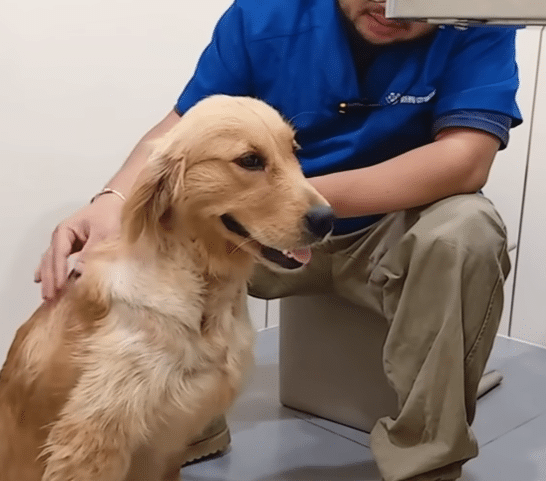
The Door Now Means Something Different
Candy’s life today bears little resemblance to the scene beside the stream.
Every evening, he waits near the door with anticipation.
There is warmth around him now.
A soft bed.
Toys.
People who expect to see him there.
The rocks and freezing water belong to an earlier chapter.
So does the exhausting way he once pulled his body forward using only his front legs.
Now Candy stands.
He takes his own steps.
He seeks affection.
Most importantly, he belongs somewhere.
That sense of belonging may be the most meaningful part of his transformation.
The wheelchair mattered.
The rehabilitation mattered.
The nourishing meals and daily cleaning mattered.
But all of those things began with one decision made beside a cold stream.
Someone saw a dog who could not walk and chose not to leave him there.
His Recovery Was Built From Small Acts
Candy’s journey is easy to describe as an extraordinary recovery, but the reality was made from very ordinary acts repeated again and again.
Someone lifted him from the water.
Someone offered him food.
A family prepared a simple meal.
A veterinarian examined old injuries and explained the limitations honestly.
A wheelchair was built when walking seemed impossible.
Hands cleaned him when he could not manage on his own.
Those same hands massaged and stretched legs that initially showed almost no response.
Then came a reflex.
A brief stand.
One uncertain step.
And eventually another.
Rescue is often imagined as the moment an animal is removed from danger.
Candy’s experience shows how much can come afterward.
Safety may happen in a single day.
Healing usually does not.
It can require patience without knowing exactly what the outcome will be.
Candy may never move exactly as he once did before his injuries. His old fractures remain part of his story.
But they are no longer the whole story.
He is no longer the dog standing silently in freezing water with nowhere obvious to go.
He is the dog waiting by the door.
The dog asking for belly rubs.
The dog taking his own imperfect steps through a home where someone chose to make room for him.
Sometimes a second chance does not begin with a dramatic promise.
Sometimes it begins when one person simply decides:
This life is worth carrying home.


