
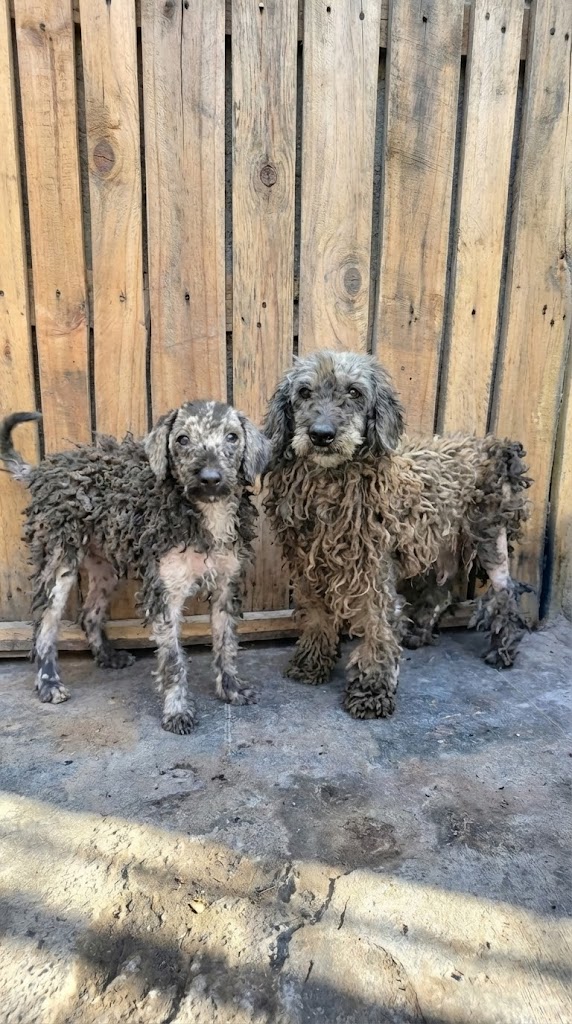
Lynch was moving slowly along a dusty roadside when help finally arrived.
His thin body and uncertain steps made it clear that something had been wrong for far too long. Nearby was Benito, the older dog who had shared the same difficult life.
They were brothers.
And although neither dog could explain what had happened, their condition told enough of the story.
A Neighbor Realized Something Was Wrong
The rescue began with a concerned neighbor who could no longer ignore what she was seeing.
She contacted rescuers and described two dogs nearby who were alive but in extremely poor condition. She did not know exactly how long they had been struggling.
She simply knew they needed help.
The rescuers responded immediately.
Reaching the dogs required a drive of more than 100 kilometers, with no certainty about what they would find at the other end.
By the time they arrived, Lynch was wandering close to a house that should have represented safety.
Instead, he looked fragile and exhausted.
His body was extremely thin. His movements lacked confidence, and there were visible signs that he had gone without the care he needed.
The rescuers spoke with the owner.
His response was simple: they could take the dogs and bring them back once they were healthy.
But after seeing their condition, returning them did not feel like a reasonable option.
Both dogs needed care immediately.
Leaving Them Behind Was No Longer an Option
The situation became more complicated when the owner realized the rescuers intended to keep Lynch and Benito away from the environment where they had deteriorated.
He asked for money.
For the rescuers, the request was difficult to accept. But arguing while two vulnerable animals waited for help would not improve their condition.
So they paid.
The priority was not winning a dispute.
It was getting Lynch and Benito somewhere safe.
Only after the rescue did more details about the brothers become clear.
Lynch was only one year old. His body showed serious signs of neglect, including skin injuries, ticks, and infection that required prompt attention.
Benito was five.
His coat had become heavily matted, forming dense layers that held dirt and parasites close to his skin. He also walked with a noticeable limp.
When the rescuers asked about Benito's difficulty walking, they were told that he had been injured in an accident the previous year.
According to the owner, no veterinary treatment had followed.
For Benito, that meant living with the problem for an entire year.
VIDEO: Two Brothers Were Barely Holding On — Then Rescuers Paid the Price to Bring Them to Safety
The First Gentle Steps Toward Relief
Once Lynch and Benito were safe, care began immediately.
Their bodies needed attention, but everything had to be approached gently.
One of the first important steps was bathing them.
For dogs accustomed to neglect, even something as ordinary as clean water could feel unfamiliar.
As dirt was washed away and Benito's badly tangled coat was carefully addressed, the extent of what he had been carrying became easier to see.
Benito trembled throughout the bath.
He did not seem to understand what was happening or whether the unfamiliar hands around him could be trusted.
The rescuer stayed close, holding him carefully and speaking in a reassuring voice.
"It's okay now. You're safe."
There was no way to erase a year of discomfort in one afternoon.
But safety could begin in one.

Healing Happened in Small Changes
Recovery was never expected to happen overnight.
Lynch and Benito had both endured prolonged neglect, and their bodies needed time.
The days that followed were about steady care rather than dramatic transformation.
Their skin began to improve.
Lynch's wounds gradually started closing.
The physical discomfort that had shaped so much of their daily lives slowly began to ease.
And then another change appeared.
Their expressions were different.
The empty, distant look that had greeted rescuers at the beginning began giving way to curiosity.
They started paying attention to their surroundings.
They seemed more comfortable with the people caring for them.
Little by little, the brothers were learning what life could feel like when every day was not defined by discomfort.
After approximately 20 days, the difference was unmistakable.
The dogs who had arrived looking exhausted and defeated were becoming more alert and engaged.
Their recovery was still ongoing, but they were moving in the right direction.
Encouraging News for Benito
Benito's limp remained an important concern.
Because the problem had reportedly begun after an accident a year earlier, a specialist later examined him to determine what kind of care he would need.
The news brought some relief.
According to the specialist, Benito could be managed with appropriate medication and joint care rather than surgery.
His mobility was expected to improve gradually.
It did not mean his recovery would be immediate.
But after so much time without treatment, having a plan was a meaningful step forward.
For the first time, his old injury was no longer something he simply had to endure alone.
He was receiving attention.
He was being observed.
And someone was finally responding when he showed discomfort.

One Thing Neglect Had Never Broken
Through every stage of the rescue, one part of Lynch and Benito's lives remained remarkably consistent.
They stayed close to each other.
The two brothers slept near one another, leaned together, and seemed to find reassurance in the familiar presence beside them.
Everything else had changed quickly.
New people.
New routines.
Baths, treatment, food, and unfamiliar surroundings.
But they still had each other.
For animals coming from an uncertain environment, that bond mattered.
When Lynch was recovering, Benito was nearby.
When Benito was adjusting to care, Lynch remained part of his world.
Their relationship had survived the hunger, discomfort, and neglect that had affected so much else.
The rescuers could improve their living conditions.
They could provide medical support.
They could offer patience and safety.
But the brothers had already been giving one another something important long before help arrived: companionship.
From Possessions to Lives Worth Protecting
Twenty days could not erase everything Lynch and Benito had experienced.
Healing takes longer than that.
Trust can take longer still.
But those first weeks showed what becomes possible when basic care is finally consistent.
Their skin improved.
Their wounds began healing.
Benito received professional guidance for his old injury.
And both dogs became noticeably more curious and engaged with the world around them.
The greatest difference was not a single dramatic moment.
It was the accumulation of small ones.
A clean place to rest.
Gentle hands instead of indifference.
Attention when something hurt.
Care that returned the next day, and the day after that.
For Lynch and Benito, those ordinary things represented an entirely different life.
They had once been regarded as animals that could simply be handed away and collected again later.
The rescuers saw something else.
Two living beings who needed protection.
Two brothers whose suffering should never have been treated as normal.
Their story did not change because everything suddenly became perfect.
It changed because someone listened when a neighbor spoke up.
Someone drove more than 100 kilometers.
Someone decided the cost of walking away would be far greater than the price demanded to take them.
And once Lynch and Benito reached safety, people kept choosing to care for them.
That consistency became the foundation of their recovery.
Today, the transformation visible in their faces tells a gentler story than the one written across their bodies when they were first found.
They are still the same two brothers.
Still side by side.
But now, they are no longer simply enduring each day.
They have been given the chance to heal together.
And sometimes, that is where the most meaningful rescue stories begin — not with a perfect ending, but with the moment someone finally refuses to leave suffering behind.


