
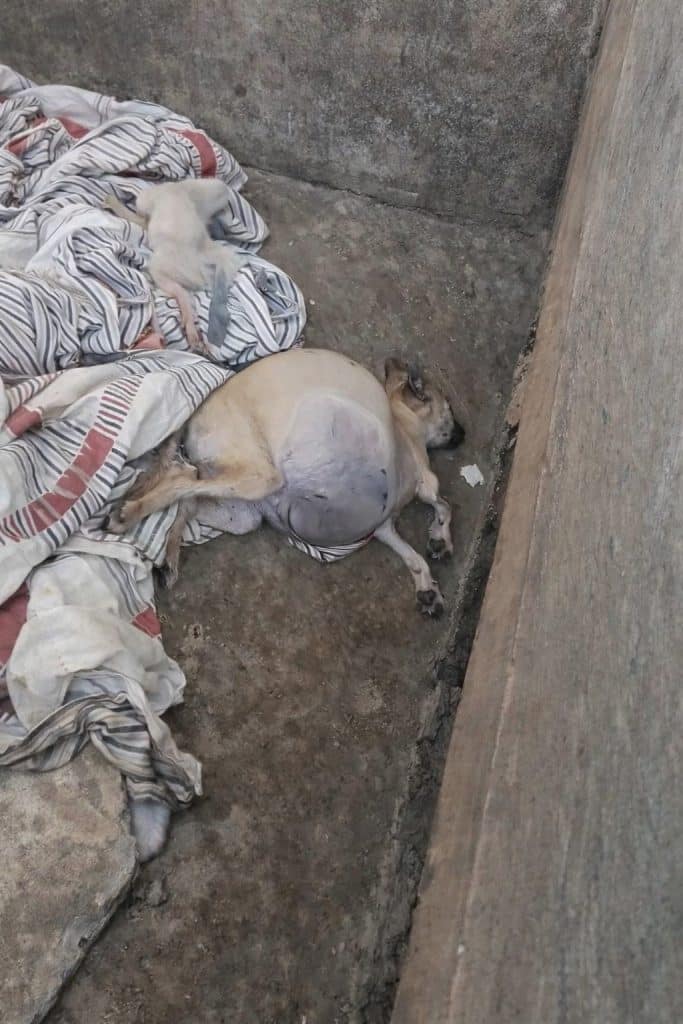
Some rescue stories begin with barking, running, or a desperate attempt to attract attention.
Jai’s began almost without a sound.
Beside a temple—a place where people came seeking peace—a small dog had been living with a body that was clearly struggling. He stayed still whenever he could, as though movement itself had become something to avoid.
His abdomen was visibly swollen.
His body trembled.
Whenever he tried to change position, soft whimpers revealed how uncomfortable even a small movement had become.
For an unknown length of time, Jai remained there, carrying his condition quietly while life continued around him.
The Small Dog Who Had Learned Not to Move
Stillness can sometimes be mistaken for calm.
In Jai’s case, it told a very different story.
He moved as little as possible. When he did try to walk, every step appeared difficult. His swollen abdomen looked tight and unnaturally enlarged, while his breathing seemed heavy and strained.
He was not demanding attention.
He was not chasing people for help.
He was simply there.
That may have been part of why his suffering was so easy to overlook.
A dog who cries loudly can be noticed quickly. A dog who has become quiet can disappear into the background, even when something is clearly wrong.
Jai had reached that point.
His body, however, could no longer hide what he was going through.
The trembling, weakness, swelling, and discomfort were visible signs that he needed more than food or a temporary place to rest.
He needed medical attention.
And first, he needed someone to truly notice him.
One Person Looked Closer
Eventually, someone stopped.
Instead of passing Jai by, that person paid attention to the small dog lying near the temple and recognized that his condition was serious.
That moment changed everything available to him.
A rescue team was contacted.
When help arrived, Jai did not try to escape. He did not struggle against the people approaching him.
He appeared drained and confused.
There was little energy left for resistance.
The rescuers were able to lift him and carry him away from the place where he had been suffering.
It was a simple action from the outside—picking up a small dog and taking him somewhere safer.
For Jai, it marked an enormous change.
For the first time in this chapter of his life, his pain was no longer something he had to endure unnoticed.
VIDEO: Jai Was Too Weak to Keep Moving — Until Someone Beside the Temple Finally Saw Him
The Swelling Had a Serious Cause
At the veterinary clinic, Jai was examined more closely.
He weighed 3.75 kilograms.
But much of what made his small body look larger was not healthy weight.
Testing revealed that Jai had ascites, a buildup of fluid inside the abdomen.
The diagnosis helped explain what rescuers had already been seeing: the severe swelling, weakness, difficulty moving, and visible discomfort.
The problem was not something that could simply be ignored while he rested.
Veterinary care was needed immediately.
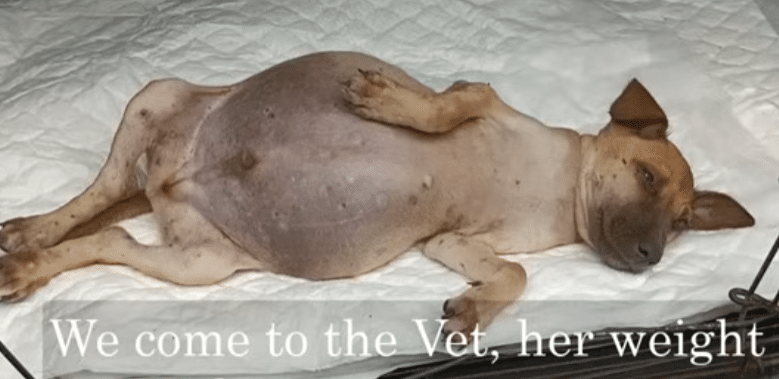
The medical team began carefully removing the accumulated fluid.
A substantial amount was drained from Jai’s abdomen—nearly two trays in total. After the procedure, his weight fell from 3.75 kilograms to approximately 3.00 kilograms.
For such a small dog, the difference was significant.
His body had been carrying a large amount of fluid while he was already weak and exhausted.
The treatment did not mean that the underlying problem had been solved.
It was an important step toward stabilizing him and reducing the burden his body had been carrying.
Jai was also given glucose and medication as the veterinary team continued supporting his fragile condition.
The Problem Went Deeper Than His Abdomen
By the second day of care, veterinarians had more information.
The fluid buildup was not the entire illness.
Jai’s heart was enlarged, and problems involving his heart valves were interfering with normal blood flow.
According to the veterinary findings described in his case, these heart problems were connected to the accumulation of fluid in his abdomen.
There was another concern as well.
Jai was severely anemic.
His pale gums reflected how compromised his condition had become, and his lack of strength was consistent with everything his caregivers were observing.
What had first appeared to be one dramatic symptom—a swollen abdomen—was actually part of a much more complicated medical situation.
There would be no quick recovery to celebrate.
No single procedure could erase everything his body was facing.
From that point forward, his care had to be cautious and closely monitored.
Every Step Had to Be Taken Carefully
Jai remained under veterinary supervision.
His treatment included medication for his heart, support related to his blood levels, fluids to help keep him stable, and continued testing so the medical team could better understand his condition.
Nothing about the situation encouraged rushing.
His small body had already been under considerable strain.
Care now meant watching closely, responding carefully, and giving him the medical support he needed without pretending that the outcome was certain.
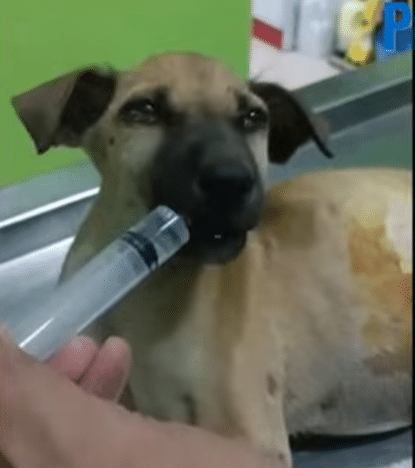
There is a particular kind of patience required when helping an animal whose condition remains delicate.
Progress cannot always be measured by dramatic changes.
Sometimes the important thing is simply that the animal has made it through another period of treatment safely.
That he can rest.
That professionals are monitoring him.
That someone is there to notice if his condition changes.
For Jai, those things now existed.
They had not existed while he lay beside the temple.
Quiet Strength in a Fragile Body
Throughout his care, Jai remained remarkably still and accepting.
He did not fight the hands treating him.
He did not pull away from the people trying to stabilize him.
He rested and allowed the care to continue.
It would be easy to turn that behavior into a dramatic story about what he understood or felt, but no one can know exactly what was happening inside his mind.
What can be seen is simpler.
Jai was exhausted.
He was medically fragile.
And when people finally stepped in to help, he allowed them to do so.
That quiet cooperation became part of his story.
Not because he suddenly became strong, and not because his medical problems disappeared, but because he continued through each examination and treatment while his caregivers worked around him.
His strength was not loud.
It was the strength of simply continuing.
His Future Was Still Uncertain, but He Was No Longer Alone
Jai’s story did not end with a confirmed recovery.
His heart condition remained serious.
His anemia required attention.
His future was still uncertain.
Those facts matter because rescue stories are not always neat journeys from suffering to perfect health.
Sometimes rescue means something more immediate and just as important.
It means being found before suffering continues unnoticed.
It means reaching a clinic.
It means receiving a diagnosis.
It means having people willing to provide treatment even when there are no guarantees.
Jai had all of those things now.
The dog who once lay quietly near a temple, trembling and struggling beneath the weight of his swollen abdomen, was finally surrounded by people paying attention to every change in his condition.
For perhaps the first time in a long while, he did not have to carry everything by himself.
Sometimes Rescue Begins With Simply Stopping
There is nothing complicated about the moment that changed Jai’s path.
Someone saw a dog.
Then they looked again.
They noticed that his stillness was not ordinary rest and that his swollen abdomen was not something that could wait.
That decision led to rescuers.
The rescuers brought him to veterinary care.
Veterinary care revealed the serious problems hidden beneath the most obvious symptom.
One moment of attention opened the door to everything that followed.
Jai’s outcome remained uncertain, but uncertainty is very different from being forgotten.
He was being treated.
He was being watched.
He was being cared for.
And sometimes, before healing can even become possible, that is where rescue truly begins:
with one person deciding that a quiet life in the corner is worth noticing.


