
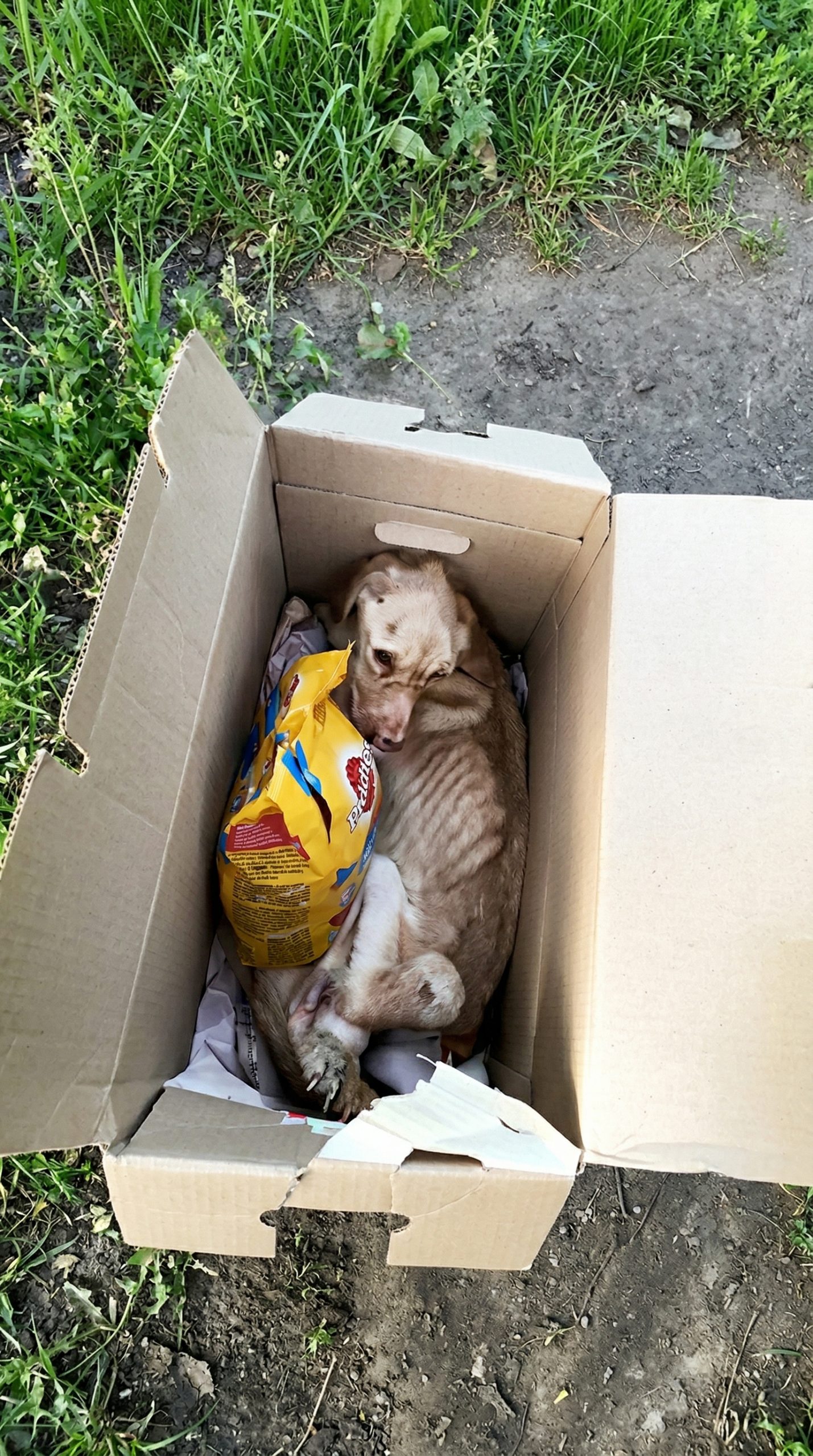
At 5:00 in the morning, the park was still quiet when a woman noticed a worn cardboard box tucked into the shadows.
It was easy to imagine someone walking past without giving it another thought.
But she stopped.
Something about the box made her look closer. When she finally opened it, she found a tiny dog curled tightly inside, almost as though she were trying to make herself disappear.
The little dog was painfully thin. Her ribs were visible beneath her fragile body, and she barely moved.
Yet her eyes were open.
They were gentle, watchful, and strangely calm.
She did not bark or struggle. She simply looked toward the woman who had found her.
That quiet encounter before sunrise became the beginning of everything that followed.
The Dog Hidden Inside the Box
There was no way to know from that first glance exactly how much the little dog had endured.
What was immediately clear was that she needed help.
She was taken for veterinary care as quickly as possible and given a name: Nika.
The examination soon revealed that her condition was far more serious than simple hunger or exhaustion.
Nika, believed to be a young Labrador mix, weighed only 9.7 kilograms. Her body showed signs of prolonged confinement and severe physical decline.
Her muscles had wasted dramatically.
According to the veterinary assessment described in the source, she appeared to have spent an extended period confined in a space so restrictive that she had been unable to stand normally.
Her dehydration was also severe enough to affect her kidneys and liver.
But the greatest concern involved the lower half of her body.
Her hind legs and tail had been damaged so extensively that the medical team faced an extremely difficult situation.
For Nika, reaching the clinic was only the beginning.
VIDEO: Dumped in a Box at Dawn, This 9.7kg Puppy Faced the Fight of Her Life
When Saving Her Meant Making a Painful Choice
During the first several days, Nika remained under intensive supportive care.
She received IV fluids while the veterinary team worked to stabilize her weakened body. There was little room for assumptions or celebration yet.
She was alive.
But she was still in danger.
Her rescuer remained close as the team monitored her condition and tried to understand how much treatment her body could tolerate.
By the fifth day, the infection affecting her damaged lower body had become an urgent threat.
Waiting was no longer a safe option.
Nika was transferred to a specialist, where the veterinary team reached the decision nobody wanted to face: both hind legs and her tail would need to be amputated.
It was not a procedure chosen lightly.
It meant permanently changing the way Nika would move through the world.
But the alternative offered little hope of controlling the infection that was putting her life at risk.
The surgery went ahead.

And Nika survived.
The First Signs That Her Body Was Fighting Back
After surgery, the focus shifted from emergency intervention to recovery.
There was still a long road ahead.
Nika had lost both hind legs and her tail, and her weakened body needed time to rebuild strength after everything it had endured.
But one important change had occurred.
The source of the spreading infection had been addressed.
Slowly, her condition began to improve.
Recovery did not happen in one dramatic moment. It came through medical care, rest, repeated procedures, rehabilitation, and the patient work of helping Nika adjust to a body that now moved differently.
She later underwent additional procedures, including skin grafts to protect areas that were still healing.
Physical therapy also became part of her routine.
For a dog who had once been unable even to stand properly, movement had to be learned in an entirely new way.
Balance mattered.
Strength mattered.
Confidence mattered.
There was no shortcut through that process.
Her rescuer continued to remain beside her as the weeks became months.
Sometimes recovery is measured in large medical milestones.
Other times, it is measured in much smaller things: a little more strength, a steadier posture, another attempt to move independently.
For Nika, those small steps gradually began adding up.
The News Everyone Had Been Waiting to Hear
Eventually, the veterinary team received the result they had hoped for.
The infection was gone.
Completely.
It was a major turning point for a dog whose life had once depended on urgent treatment.
Her weight also began to tell a different story.
When she first arrived, Nika weighed just 9.7 kilograms.
With continued care, nutrition, and recovery, she eventually reached approximately 18 kilograms.
The frail dog from the cardboard box was becoming stronger.
Nothing could erase what had already happened to her body, and recovery did not mean returning to the life she might have had before.
Instead, Nika was learning how to build a new life from the condition she was in now.
That distinction mattered.
Her progress was not about becoming physically perfect.
It was about becoming comfortable, stable, and capable of experiencing ordinary things that had once seemed far beyond reach.
Three Months Later, Home Finally Meant Comfort
After roughly three months of treatment and rehabilitation, Nika was ready to leave veterinary care.
For the staff who had watched her arrive in such fragile condition, saying goodbye was emotional.
They had seen her at her weakest.
They had watched her survive major surgery.
They had followed the long process of healing afterward.
Now she was leaving for a home.
The difference between those two moments was enormous.
At home, Nika was introduced to things that should have been ordinary but were completely new to her experience.
She had space.
She had toys.
She had other dogs nearby.
Most importantly, she had consistent care and affection.
But one simple comfort seemed especially meaningful.
Her bed.
After a beginning marked by confinement, rough surfaces, and a cardboard box in a park, Nika finally had somewhere soft and warm to rest.
She would curl into it peacefully and stay there, enjoying the comfort without needing anything more complicated.
There are moments in rescue stories when recovery becomes easiest to understand not through medical records, but through ordinary behavior.
A dog sleeping deeply in a safe place can say a great deal.
Learning How to Move Through the World Again
Once Nika was strong enough, training became another part of her new routine.
Losing both hind legs had changed her mobility forever, but it had not ended her ability to adapt.
Gradually, she learned how to balance.
Then how to move with greater confidence.
And eventually, according to the source, she could even run.
That progress did not make the months of treatment disappear.
It did not undo what her body had endured.
But it showed just how much could change once she was given consistent medical care, patience, and a safe environment.
Nika no longer had to survive alone inside a box.
Her days could now contain movement, companionship, rest, and the freedom to explore at her own pace.

What Nika's Second Chance Came to Mean
Nika's story began with a woman noticing something most people could easily have missed.
A cardboard box.
A quiet park.
A tiny dog waiting inside.
From there came difficult diagnoses, days of stabilization, major surgery, skin grafts, rehabilitation, and months of uncertainty.
There was nothing simple about her recovery.
And there was no way to restore what she had physically lost.
Yet Nika's life was not defined only by those losses.
She gained safety.
She gained strength.
She gained a home where she could rest without fear.
And she gained the opportunity to discover that a different kind of life was still possible.
Her journey is a reminder that rescue is often more than the moment an animal is picked up and carried to safety.
Sometimes rescue means weeks of medical decisions.
Sometimes it means learning an entirely new way to move.
Sometimes it means giving an animal enough time to discover that the soft bed beneath her is really hers.
Nika could not change what happened before that early morning in the park.
But once someone opened the box and chose not to look away, the direction of her life changed.
The dog who once weighed only 9.7 kilograms and could barely hold on became an 18-kilogram survivor surrounded by care.
Her body would always carry the consequences of her past.
Her future, however, no longer had to resemble it.
And perhaps that is the quietest, strongest part of Nika's story:
She was not given her old life back.
She was given the chance to build a new one.


