
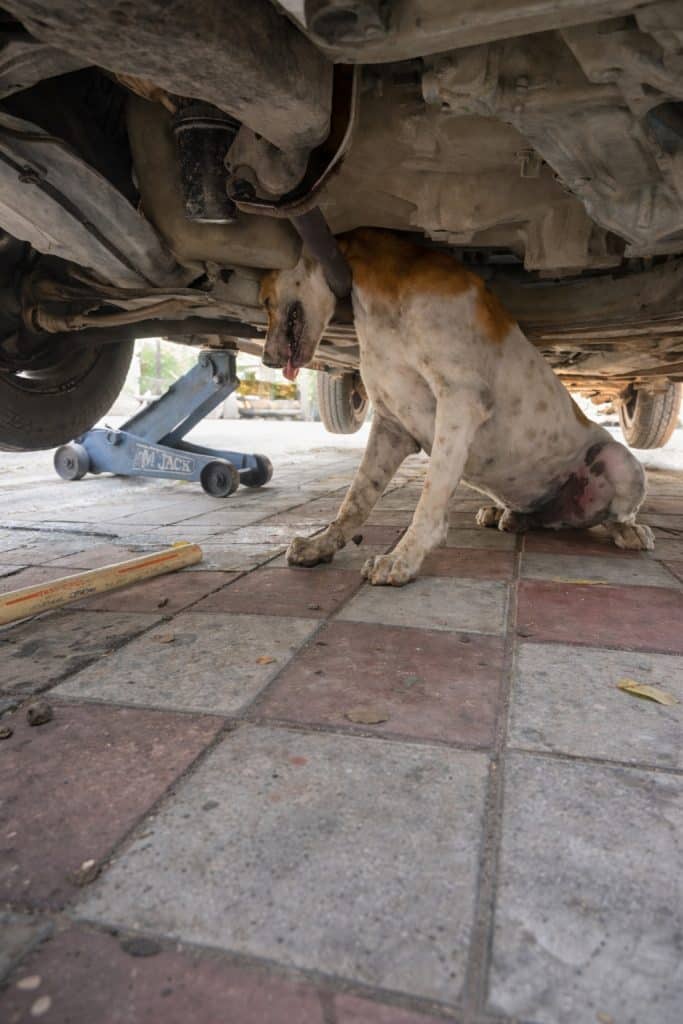
A dog was running after a cat when one sudden turn transformed an ordinary chase into an emergency.
There had been no warning and no obvious danger. One moment, the dog was focused on the animal ahead. The next, its attention shifted toward a parked car.
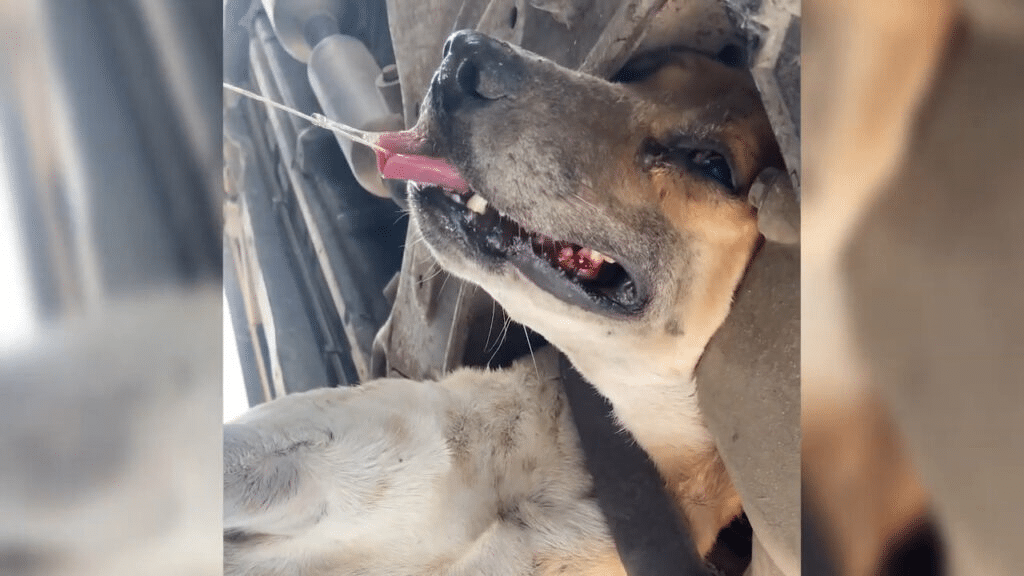
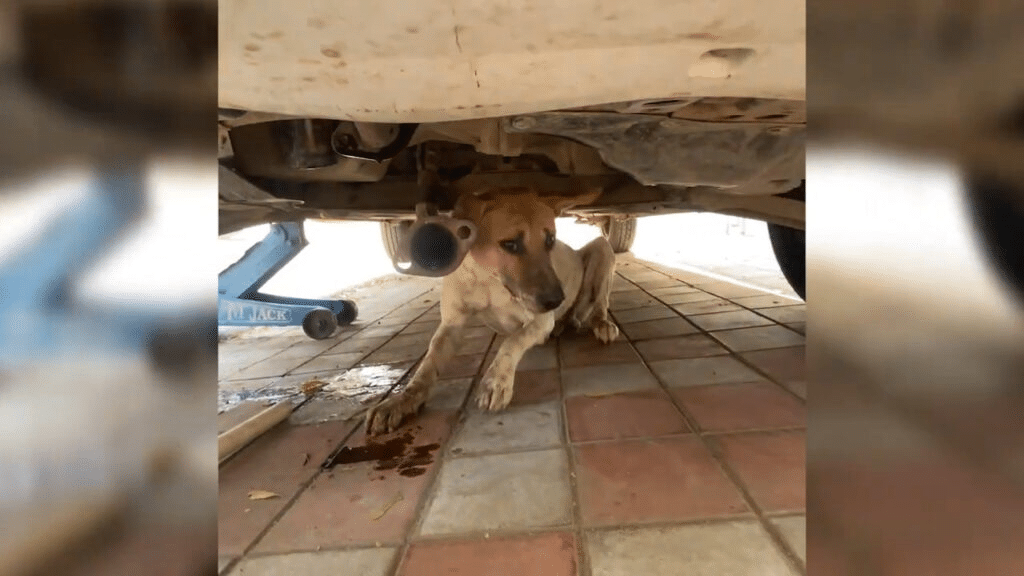
Then its head slipped into the vehicle’s exhaust pipe.
And it could not pull free.
A Chase That Changed in Seconds
At first, the dog did what frightened animals often do when they feel trapped.
It struggled.
Its body twisted as it tried to move backward, but the metal pipe remained firmly around its head. Each attempt made it increasingly clear that this was not a situation that could be solved simply by pulling harder.
That realization mattered.
A rushed attempt to drag the dog free might have caused additional harm. The people nearby understood that strength alone would not solve the problem.
What the dog needed was patience.
Help was called, and rescuers from the Nirbhay Foundation soon arrived to assess the unusual situation.
The dog remained alert, but its tense body and restless movements showed how uncomfortable the experience had become. It could not understand why it was trapped or what the people gathering around it intended to do.
The rescuers, however, understood something important from the beginning.
The dog did not need more force around it.
It needed the situation to become calmer.
When the Safest Rescue Means Slowing Down
There was no simple way to slide the dog backward from the exhaust pipe.
Instead of making repeated attempts to pull its head free, the rescuers considered the object holding it.
If the dog could not safely be removed from the pipe, perhaps the pipe itself could be removed from the vehicle.
With permission from the car’s owner, the team began working carefully around the exhaust system.
It was a rescue that depended less on dramatic action than on controlled movement.
Tools had to be handled cautiously. The frightened dog needed to remain as safe as possible while work continued nearby. Every unnecessary movement could make the situation harder.
So the rescuers kept their attention on one goal: create enough freedom without adding another problem.
Little by little, the exhaust pipe began to loosen.
For the dog, nothing had changed yet. Its head was still trapped, and the unfamiliar activity around it continued.
For the rescuers, however, the solution was finally becoming possible.
VIDEO: A Simple Chase Left This Dog Trapped in a Car Exhaust — Then Rescuers Found a Safer Way
The Moment the Metal Finally Let Go
Eventually, the pipe came loose.
The dog was free.
After being unable to escape through its own strength, freedom arrived through a completely different approach: instead of forcing the animal out, the rescuers changed the obstacle around it.
For a brief moment, the dog remained nearby.
Then its energy returned.
It shook itself and ran across the street, its tail moving as it hurried away from the strange ordeal.
The team did not have an opportunity to perform a complete medical examination before the dog left, so the source does not confirm a formal veterinary assessment.
But there was one encouraging sign immediately visible.
The dog was moving freely and energetically after the rescue.
After so much tension, watching it run again brought the first rescue to a simple ending.
No dramatic celebration was necessary.
The animal that had been trapped only moments earlier was moving on its own again.
Before the Relief Could Settle, Another Call Came
There was little time to dwell on what had just happened.
Another dog needed help.
This emergency was very different.
Instead of being caught inside an object, the second dog had been struck by a vehicle.
When the rescuers reached it, the contrast with the first case was immediate.
This dog was not twisting or trying desperately to escape.
It was lying still and appeared to be in significant discomfort. Movement was difficult, and the team could not know from appearance alone how serious the injuries might be.
The next step required medical evaluation.
A veterinarian examined the dog carefully, paying particular attention to the possibility of spinal damage.
That concern carried enormous importance. An injury involving the spine could have changed the dog’s prospects considerably.
After the assessment, there was reassuring news.
Its spine appeared to be intact.
The impact had, however, affected one of its legs, which needed appropriate treatment and time to recover.
There would be no quick sprint away from this rescue.
This dog’s journey was only beginning.
Healing Measured in Small Movements
The injured dog was taken to the rescue center, where recovery could happen gradually.
Unlike the first rescue, which ended within a relatively short period once the pipe was removed, this situation demanded continued care.
Rest came first.
Pain management and treatment followed.
Then came gentle rehabilitation intended to help the dog regain comfortable movement.
There was no single moment when everything suddenly returned to normal.
Recovery rarely works that way.
Instead, progress appeared through small physical changes.
The dog began attempting movements that had previously been difficult. Over time, it started placing weight on the affected leg again.
A change that might have looked minor to someone passing by meant much more in the context of its recovery.
One careful step could show that the body was responding.
Another could show growing stability.
The rescuers did not need an instant transformation.
They needed signs that the dog was moving in the right direction.
And gradually, those signs appeared.
Confidence Returned Along With Movement
Physical recovery was only part of what could be seen.
As the dog became steadier, its overall behavior also began to change.
The tension visible after the accident started to ease.
Movement became less uncertain.
And the playful energy interrupted by the collision slowly began to return.
Nothing about the process needed to be rushed.
The dog had experienced a sudden impact, received an examination, and entered a period of treatment and rehabilitation. Improvement came through repeated small steps rather than one dramatic breakthrough.
That made each gain meaningful.
Putting weight on the injured leg mattered.
Standing more comfortably mattered.
Moving with greater confidence mattered.
Recovery was not defined by a single perfect moment.
It was visible in the accumulation of these quiet victories.
Two Emergencies, Two Very Different Kinds of Care
The two dogs faced emergencies that had almost nothing in common.
One had followed its curiosity toward a parked car and ended up trapped in an exhaust pipe.
The other had been struck by a vehicle and needed veterinary attention followed by a slower period of recovery.
One problem was solved by carefully removing the object around the dog.
The other required examination, treatment, rest, and rehabilitation.
Yet both situations revealed the same principle.
Urgency does not always mean rushing.
When the first dog became trapped, pulling harder could have made matters worse. The rescuers instead paused, assessed the problem, and removed the exhaust pipe with the owner’s permission.
When the second dog was injured, guessing about its condition would not have been enough. A veterinarian needed to determine whether the spine had been affected before the recovery process could move forward.
Different emergencies require different responses.
What they share is the need for clear thinking.
Sometimes Rescue Is Simply the Decision to Be Careful
Animal rescue is often remembered through the final moment: the dog running free, standing again, or showing the first glimpse of its old personality.
But those moments are usually made possible by quieter decisions that happen earlier.
Someone notices that force is not working.
Someone calls for help.
Someone takes the time to examine an injury rather than assuming what happened.
Someone continues with rehabilitation even when progress arrives slowly.
Neither of these dogs needed a reckless act of bravery.
They needed people willing to respond carefully to the situation in front of them.
For the first dog, that meant dismantling part of a car rather than pulling at a frightened animal.
For the second, it meant recognizing that freedom from immediate danger was only the beginning of its recovery.
Their stories unfolded differently, but both ended with something worth remembering.
A crisis can begin in seconds.
A chase can take one unexpected turn. An accident can interrupt an ordinary moment without warning.
When that happens, the most valuable response may not be the fastest movement.
Sometimes it is the calmest one.
A careful decision.
A steady hand.
And the willingness to stay focused until an animal has a safer path forward.


