
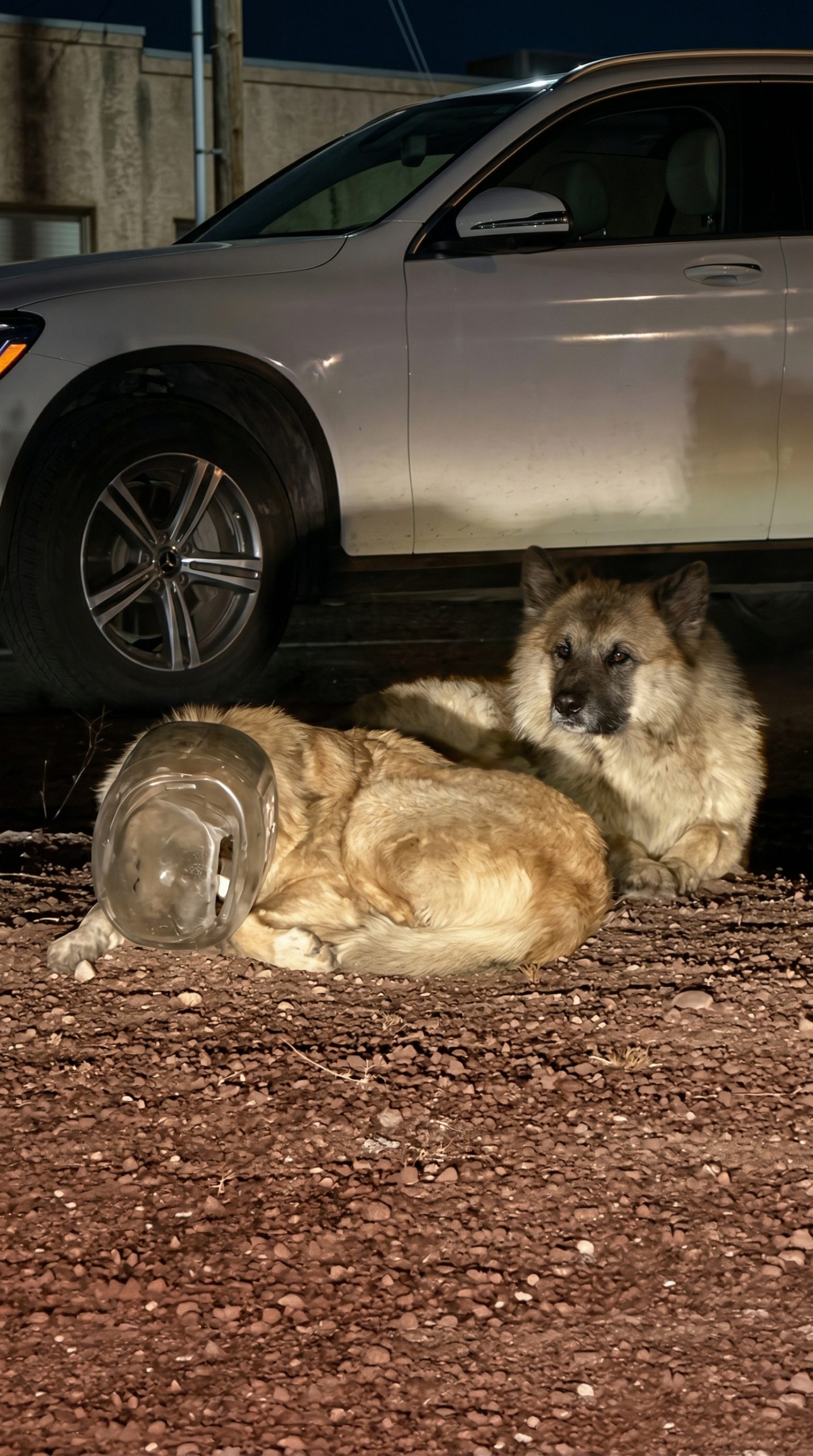
A rigid plastic container covered nearly all of the stray dog's head as he ran through the heat, unable to properly see where he was going.
For Jones, as he would later be named, even the simple act of moving forward had become dangerous.
His vision was severely limited. The opening around his head was small. Breathing was more difficult than it should have been.
And whenever someone tried to approach, fear told him to do the only thing he still understood.
Run.
A Frightened Dog Who Could Barely See
Officer Davis of Maricopa County Animal Care and Control first spotted the dog while he was still living on the streets.
At first, the situation may have seemed straightforward: reach him, remove the object, and get him somewhere safe.
But as Davis moved closer, she noticed something else.
Jones was not alone.
Another stray dog remained nearby, staying close as if unwilling to leave him completely by himself.
The moment the dogs realized a person was approaching, however, both of them fled.
For Jones, the escape was especially dangerous.
He could barely see through the plastic surrounding his head, yet instinct pushed him forward. He ran without knowing exactly what was ahead of him.
Davis followed.
But catching him was only part of the problem.
The weather made every passing minute more concerning.
The rigid container allowed only limited airflow, and under the strong sun, overheating was a serious risk. Chasing him too aggressively could make the situation worse.
So Davis changed her approach.
She would move after him, then pause.
She gave Jones brief chances to slow down, recover, and breathe before continuing.
It was not simply a chase anymore.
It became an exercise in patience—trying to stay close enough to help without pushing a terrified dog beyond what his body could manage.
Thirty Minutes Between Fear and Safety
The pursuit continued for nearly half an hour.
Jones kept running because he had no reason to understand that the person behind him was trying to save him.
To a frightened stray, an unfamiliar human can feel like another threat.
The plastic around his head only made that uncertainty greater.
He could not clearly see Davis.
He could not easily judge what was around him.
Still, he kept moving.
Then the situation finally shifted.
Jones ran into a fenced backyard.
For the first time since the pursuit began, there was nowhere else for him to disappear.
Davis was able to secure him and guide him safely into her vehicle.
The danger of the chase was over.
But the plastic was still firmly stuck.
She tried to remove it herself, only to discover that it would not slide free.
Forcing it could cause harm.
Jones needed more than a quick roadside rescue.
He needed veterinary help.
VIDEO: He Ran Blindly From the Person Trying to Save Him — Until There Was Nowhere Left to Hide
The Plastic Was Tighter Than It Looked
At the clinic, Dr. Samantha Thurman and the veterinary team examined Jones more closely.
They soon understood why Officer Davis had been unable to remove the object.
It was not an ordinary loose container.
According to the rescue account, the piece came from a dog food dispenser and had become tightly wedged around the widest part of Jones's skull.
That made the next step delicate.
Pulling too forcefully could hurt him.
Moving too quickly could also increase the fear of a dog who had already spent so much time trapped and unable to understand what was happening.
The veterinary team worked carefully.
Their goal was simple, but achieving it required patience: free Jones without causing another problem in the process.
They adjusted the plastic little by little.
Each attempt had to be controlled.
For Jones, there was little he could do except remain in the hands of people he had never met before.
Then, after several careful efforts, the plastic finally came loose.
For the first time since anyone had seen him, nothing covered his head.
He could see freely again.
He could breathe without the container surrounding his face.
The immediate physical danger was over.
Freedom Revealed Something No One Expected
The veterinary staff understood that removing the plastic did not automatically remove Jones's fear.
A stray dog who has just endured a stressful rescue may react in many ways.
Some try to create distance.
Some remain guarded.
Others simply need time before they understand that they are safe.
So after Jones was freed, the people around him gave him space.
They did not crowd him.
They waited to see what he would choose to do.
Jones looked around the room.
After everything—the blind running, the long pursuit, the unfamiliar vehicle, the clinic, and the careful effort to free his head—he finally had an opportunity to move wherever he wanted.
He could have backed away.
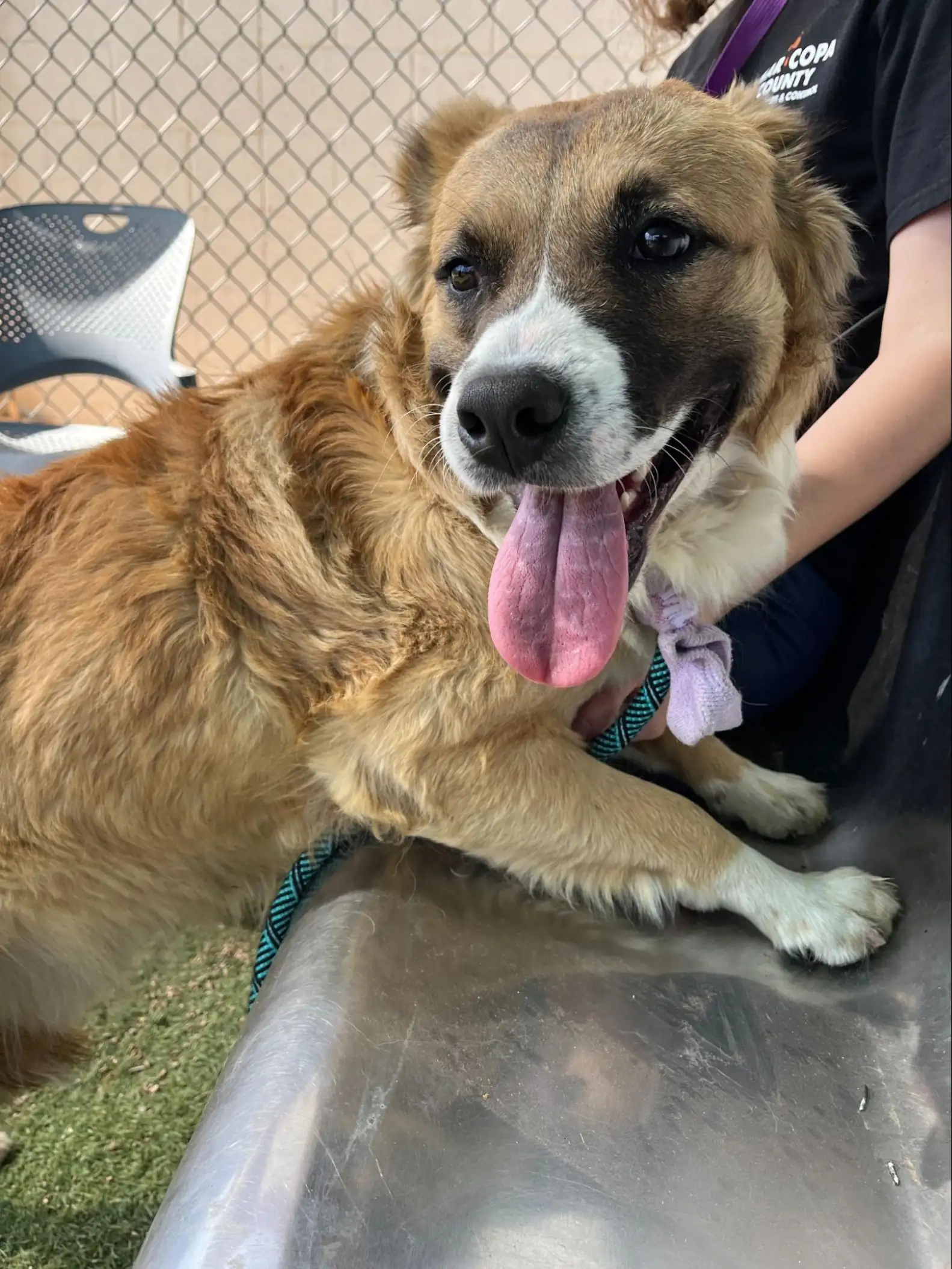
Instead, he approached one of the veterinary technicians.
Slowly and gently, Jones climbed into her lap.
There was no dramatic struggle.
No attempt to escape.
He simply settled close to the person who had helped him.
It was a small gesture, but everyone in the room understood what it meant.
The dog who had spent so long running from people was now seeking comfort from one.
Nothing about his circumstances suggested that trust should have come easily.
Yet once the frightening plastic was gone and the pressure of the rescue had passed, Jones showed the gentle nature that fear had been hiding.
From a Street Dog to Jones
The rescue team gave him a name.
Jones.
Until then, much of his life was unknown.
The team believed he may have become trapped while trying to reach food. It was an ordinary need that may have led to an extremely dangerous situation.
A rigid opening can look harmless until an animal pushes its head through and discovers that getting back out is much harder.
For a stray searching for something to eat, there may be no person nearby to notice immediately when something goes wrong.
Jones had somehow continued moving with the container stuck over his head.
How long he had been trapped was not established in the account.
What was clear was the danger he faced by the time Officer Davis found him.
He was frightened.
His sight was obstructed.
The heat was working against him.
And his instinctive response to help was to run.
That is what made Davis's patience so important.
Trying to force the rescue more quickly might have caused Jones to keep fleeing.
Instead, she adjusted to his condition, allowing moments for him to slow down while still remaining close enough to continue helping.
The rescue did not depend on one dramatic action.
It depended on refusing to give up while also understanding the limits of a frightened animal.
A Gentle Heart Hidden Behind Panic
Jones's behavior at the clinic changed the emotional tone of his story.
Only a short time earlier, he had been racing away from anyone who came near him.
Once he was safe, however, he did not continue treating every person as a threat.
His decision to climb into the technician's lap suggested something much simpler.
He wanted closeness.
He wanted reassurance.
And when kindness was finally offered without danger attached to it, he accepted it.
Moments like this are one reason rescue stories can be difficult to judge from the first encounter.
Fear can make a gentle dog run.
Fear can make an animal hide.
Fear can make help look dangerous.
Jones's frantic escape was not a measure of his personality.
It was the response of a dog trapped in a frightening situation with no way to understand what was happening.
Once that situation changed, another side of him appeared.
Quiet.
Affectionate.
Ready to trust.
One Rescue, Then the Search for a Home
Jones's journey did not end when the plastic came off.
Maricopa County Animal Care and Control began looking for a family who could give him the stable home he had been missing.
According to the original account, the organization was even willing to consider an out-of-state adoption for the right person prepared to bring him home.
That possibility represented a remarkable change in direction.
Jones had gone from running through the heat with his vision blocked to being safe, cared for, and considered for a permanent home.
There was no need to turn his rescue into something larger than it was.
The simple facts already carried enough meaning.
Someone noticed.
Someone kept following when fear made the rescue difficult.
A veterinary team worked carefully instead of rushing.
And when Jones finally had the freedom to choose what happened next, he moved toward a person rather than away.
Officer Davis expressed one straightforward hope for him:
She wanted Jones to have a good life.
After the danger he had escaped, that hope feels fitting.
Not a dramatic promise.
Not a perfect ending written in advance.
Just the chance for an ordinary life built around safety, comfort, and people willing to care for him.
What Jones Leaves Behind
Jones's rescue is also a reminder that everyday objects can become unexpected hazards for curious or hungry animals.
What appears to be a simple opening can become a trap.
For animals living outdoors without regular supervision, the danger can continue until someone happens to notice.
Jones was fortunate that Officer Davis did.
He was fortunate that she recognized the additional risk created by the heat.
And he was fortunate that when the container could not be safely removed in the field, veterinary professionals were available to finish the job carefully.
But perhaps the most memorable part came afterward.
Not during the chase.
Not when the plastic finally came free.
It came when Jones, after spending so much energy trying to escape, quietly climbed into someone's lap.
Fear had made him run.
Kindness gave him a reason to stop.
Now the frightened stray once trapped behind plastic has something he could not find on the streets:
A safe place to wait for the person who will finally choose him.


