
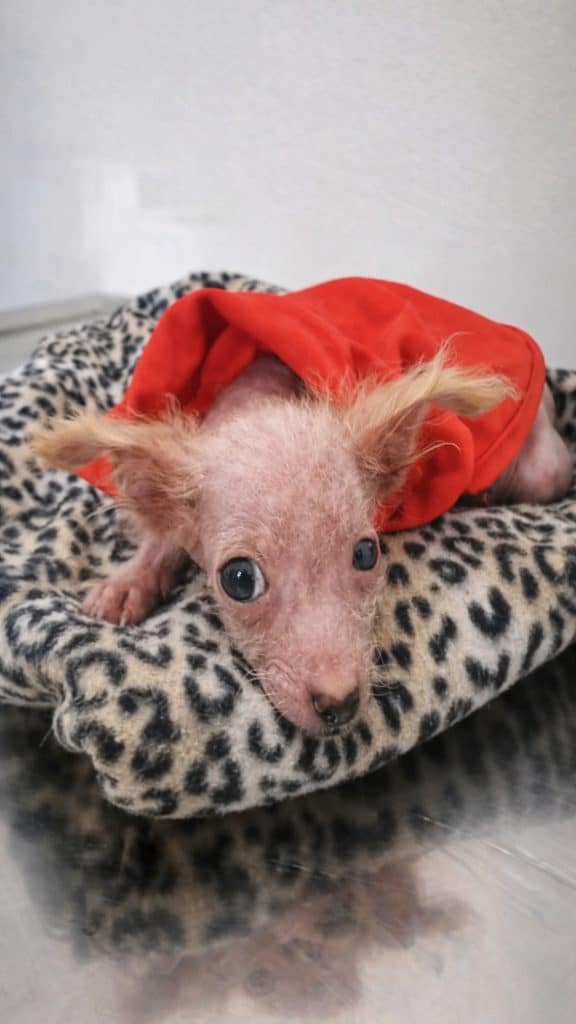
When Moka was carried out of the confined facility, the open world seemed almost too much for him.
His small body trembled in the light. Space that should have meant freedom appeared overwhelming, and even ordinary movement around him was enough to make him withdraw.
Moka was physically fragile, but there was something else that immediately stood out.
His eyes held almost no curiosity.
He did not look around like a puppy discovering a new place. He did not eagerly approach the people who had come to help him.
Instead, he remained quiet and guarded, as though staying still had become his safest way to survive.
A Puppy Who Had Learned to Disappear
Before help arrived, Moka had been living in severely inadequate conditions alongside other dogs.
Proper care had been lacking, and their health was deteriorating. Moka was among the weakest.
His body was dangerously undernourished, and even breathing had become difficult.
There was no time for a slow transition into rescue.
He needed urgent help.
Yet removing him from the facility solved only the first part of the problem. Moka had been taken away from danger, but fear still followed him.
Everything outside his old environment was unfamiliar.
Voices.
Hands.
Open rooms.
Movement.
For a puppy who had spent so much of his life surviving by becoming small and unnoticed, safety itself was something he did not yet understand.
That made his rescue different.
Saving Moka would not simply mean helping his body become stronger.
It would mean giving him enough time to discover that the people around him were no longer a threat.
The First Hours Were About Keeping Him Going
At the clinic, Moka's condition required immediate attention.
His weakened body was struggling, and he needed oxygen support to help him breathe.
A blood transfusion followed, giving him additional support during those critical early hours.
The caregivers could not know how quickly he would respond.
They could only give him what he needed and watch carefully.
For Moka, those first hours were not dramatic moments of instant recovery. They were quiet moments measured in breathing, stability, and the simple fact that he was still there.
He had finally reached a place where people were working to protect his life rather than asking anything from him.
That was only the beginning.
VIDEO: Moka Arrived Too Weak to Breathe Easily — Then His Long Journey Toward Trust Began
His Body Began Stabilizing, but Fear Remained
Once Moka was stable enough for a fuller assessment, the extent of his condition became clearer.
He was severely underweight.
His skin was inflamed and extremely sensitive.
His immune system had also been compromised.
Those physical problems required careful attention, but his response to people revealed another part of the damage.
When a hand moved toward him, Moka did not lean into it.
He pulled away.
There was no reason to force closeness.
If touch frightened him, then touch would have to wait.
The people caring for him began to understand that recovery could not be measured only through food, weight, skin, or medical stability.
Trust would need its own timeline.
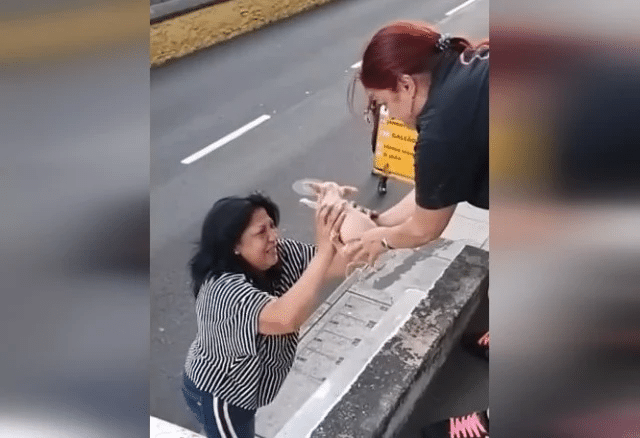
Some rescued puppies might quickly seek attention once they realize they are safe.
Moka was different.
He remained cautious.
His movements were slow and uncertain, and unfamiliar interactions could still overwhelm him.
Instead of expecting him to behave like the other recovering dogs, his caregivers adjusted themselves around him.
They lowered their voices.
They moved carefully.
They created a calm environment.
Most importantly, they stopped asking him to respond before he was ready.
For perhaps the first time, Moka was allowed to make his own choices.
He could approach or stay back.
He could watch.
He could rest.
He could simply exist without having to defend himself from what might happen next.
For a frightened puppy, that freedom mattered.
Recovery Arrived in Almost Invisible Steps
Moka's progress did not come through one dramatic breakthrough.
It arrived through tiny decisions.
One morning, he approached his food bowl and ate on his own.
No one had to persuade him.
No one needed to help him begin.
He simply walked to the bowl and chose to eat.
It could easily have looked like an ordinary moment.
For Moka, it was not.
Eating independently meant his body had enough strength to act on hunger. It also suggested that the environment around him was beginning to feel safe enough for basic routines.
The caregivers continued giving him time.
Soon, Moka began spending brief periods outside.
At first, those moments were short.
Fresh air and sunlight offered another unfamiliar world to process, so nothing was rushed.
Little by little, the time outside increased.
He began standing with more stability.
He remained present a little longer instead of immediately retreating.
There was still fear.
But fear was no longer controlling every moment.
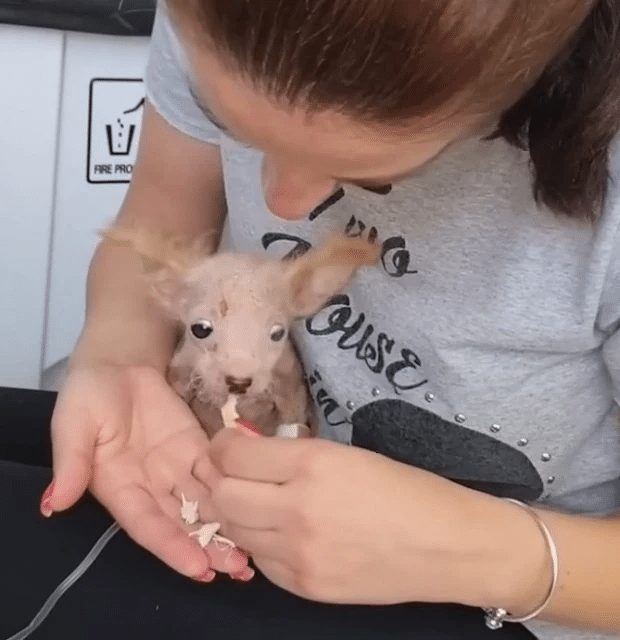
The transformation was subtle enough that someone watching only for dramatic changes might have missed it.
Those closest to Moka did not.
They saw the difference between a puppy frozen by uncertainty and one beginning to observe what was around him.
They saw the difference between surviving another minute and slowly becoming interested in life beyond fear.
Gentle Routines Became Part of His New World
Moka's recovery continued through consistent daily care.
Medicinal baths were used to soothe his irritated skin.
Regular meals helped restore his depleted body.
Around him were soft voices and predictable routines rather than pressure.
Nothing about this process could be hurried.
Healing sensitive skin takes time.
Regaining strength takes time.
And teaching a frightened animal that human presence can be gentle can take even longer.
Gradually, visible improvements appeared.
His skin began to look healthier.
His coat started returning.
But some of the most meaningful changes could not be measured through appearance.
Moka started watching people instead of immediately trying to hide.
When someone remained nearby, he was more willing to stay.
Then came another tiny sign.
His tail moved.
Only a little.
It was not a dramatic display of excitement.
It did not mean every fear had disappeared.
But it was something that had not been there before.
For a puppy who once seemed to expect nothing good from human contact, that small movement represented progress that mattered.
By Day Fifteen, Curiosity Was Beginning to Replace Fear
Around fifteen days into his recovery, Moka was clearly different from the puppy who had first arrived.
He was eating consistently.
His body was gaining stability.
Around familiar people, he could remain calmer.
And slowly, curiosity began appearing where there had once been only caution.
He still needed time.
Moka was not yet ready for adoption, and there was no reason to rush him toward the next chapter simply because he had improved.
Recovery did not need a deadline.
What mattered was that the direction of his life had changed.
He had moved from a place where basic survival consumed everything to an environment built around safety, care, and patience.
Each meal added strength.
Each calm interaction offered another experience in which nothing bad happened.
Each gentle routine gave him another reason to believe that tomorrow might feel similar to today.
Predictability can be powerful for an animal that has lived with fear.
For Moka, it became part of rebuilding the world around him.
Some Lives Are Rebuilt One Quiet Moment at a Time
Moka's story is not about a sudden transformation.
There was no single morning when all his fear vanished.
There was no instant moment when rescue erased everything that came before.
Instead, his progress came through repetition.
A meal offered every day.
A gentle voice that never demanded anything.
Hands that waited rather than reached too quickly.
Time outside that grew only when he was comfortable.
Care given again and again until safety stopped feeling completely unfamiliar.
That patience allowed Moka to change at his own pace.
His rescuers could provide medical support, food, treatment, and shelter.
But trust could not be handed to him.
Moka had to discover it himself.
And gradually, he did.
The puppy who once recoiled from human hands began remaining near familiar people.
The puppy whose body had been dangerously weak began eating regularly and standing more confidently.
The puppy who seemed almost disconnected from the world around him began showing curiosity.
Even that small movement of his tail carried meaning.
Not because it completed his recovery.
Because it showed that recovery was happening.
Moka is still healing.
His journey is not finished, and adoption will come only when he is truly ready.
But he is no longer facing that journey alone.
Sometimes rescue begins with an urgent medical intervention.
Sometimes it continues through weeks of quiet routines.
And sometimes one of the most important things anyone can give a frightened animal is something that cannot be prescribed or measured:
Time.
For Moka, kindness did not arrive as one grand gesture.
It arrived every day.
Quietly.
Patiently.
Until, little by little, he began to believe it.


