
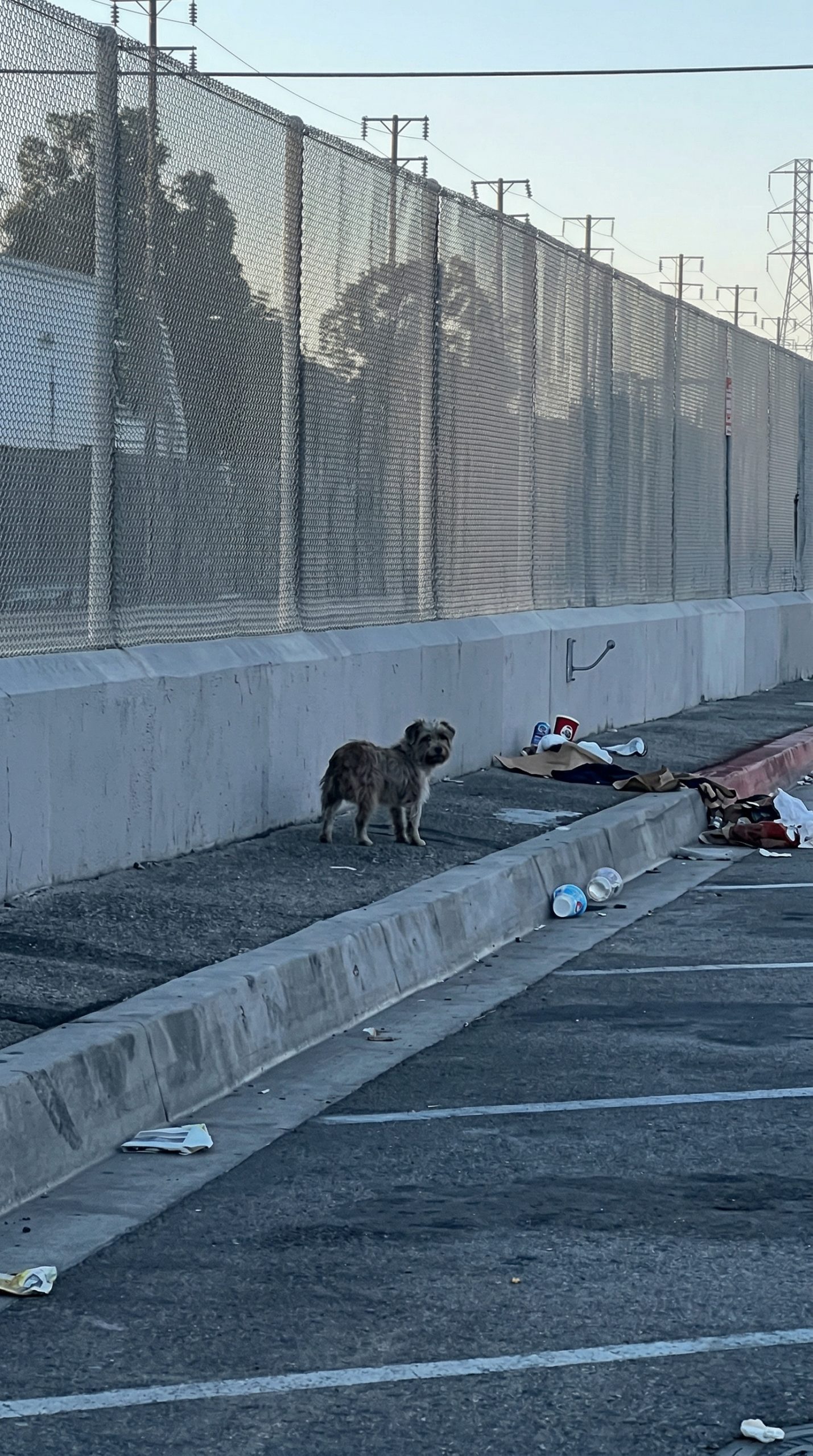
Every day, the small dog returned to the same fence beside a busy road in Los Angeles County.
Then she would rise onto her hind legs.
Her thin body stretched upward as she peered through the gaps, watching the road and the cars moving past. She was not climbing the fence or trying to disappear.
She simply kept looking.
To the people who began noticing her, the repeated gesture was difficult to forget. It looked as though she was searching the passing faces and vehicles for someone familiar.
Days went by, but no one came for her.
A Little Dog Who Would Not Stop Looking
Her light-colored coat had become so tangled that it was difficult to see the little dog beneath it. Dirt and heavy mats covered much of her body, while the California heat made carrying that neglected coat even more uncomfortable.
Still, she stayed near the area.
Each passing vehicle seemed to draw her attention. Again and again, she balanced upright against the fence and searched beyond it.
A day became several days.
Several days became weeks.
Eventually, nearly an entire month had passed.
Whatever history had brought her to that roadside remained unknown. What people could see was much simpler: a small, frightened dog was continuing to wait in a place where no one appeared to be returning for her.
Concern among people nearby continued to grow.
Eventually, they contacted rescuer Suzette Hall, founder of Logan's Legacy 29. Hall joined Rosario Ortiz in trying to bring the little dog to safety.
Finding her was one challenge.
Convincing her that people could be trusted was another.
Help Arrived, but Fear Kept Her Running
The rescuers quickly learned that approaching her directly would not work.
She had become extremely cautious around people. Even an attempt to offer water by hand frightened her. Whenever someone came too close, she ran.
She could disappear from sight with remarkable speed.
That meant the rescue could not be rushed.
Hall and Ortiz returned repeatedly, bringing food and setting humane traps while trying to understand the dog's routine. Their efforts continued for nearly two weeks.
There were unsuccessful days when they left without her.
There were also nights when they could only wonder where she had gone and whether she would appear again.
But they continued coming back.
Patience was the only path forward.
For a dog that had spent weeks avoiding human contact, one kind gesture was not enough to erase that fear. The rescuers had to keep showing up without knowing exactly when their opportunity would come.
Then the dog did something that changed the rescue.
She slipped quietly into an abandoned building nearby.
For the first time, the rescuers had a chance to prevent her from simply running away.
The Building That Finally Gave Them a Chance
Hall and Ortiz acted quickly.
Using whatever was available, including trash bins and old baby gates, they began blocking the exits from the abandoned structure.
They were not trying to frighten her into surrendering.
They were trying to create one safe opportunity to reach a dog who had spent almost two weeks escaping every attempt to help her.
Once the exits were secured, the rescuers made their way through a narrow, damaged opening.
Inside, the atmosphere was very different from the open roadside where the dog had always been able to flee.
There she was.
There was no long chase this time.
They moved carefully, spoke softly and slowly guided her toward a corner. Sudden movements could have undone everything they had worked for, so patience remained essential even in those final moments.
Then came the moment they had been waiting for.
A lead slipped gently over her neck.
After weeks of watching, searching and unsuccessful attempts, the little dog was finally secured.
The roadside waiting was over.
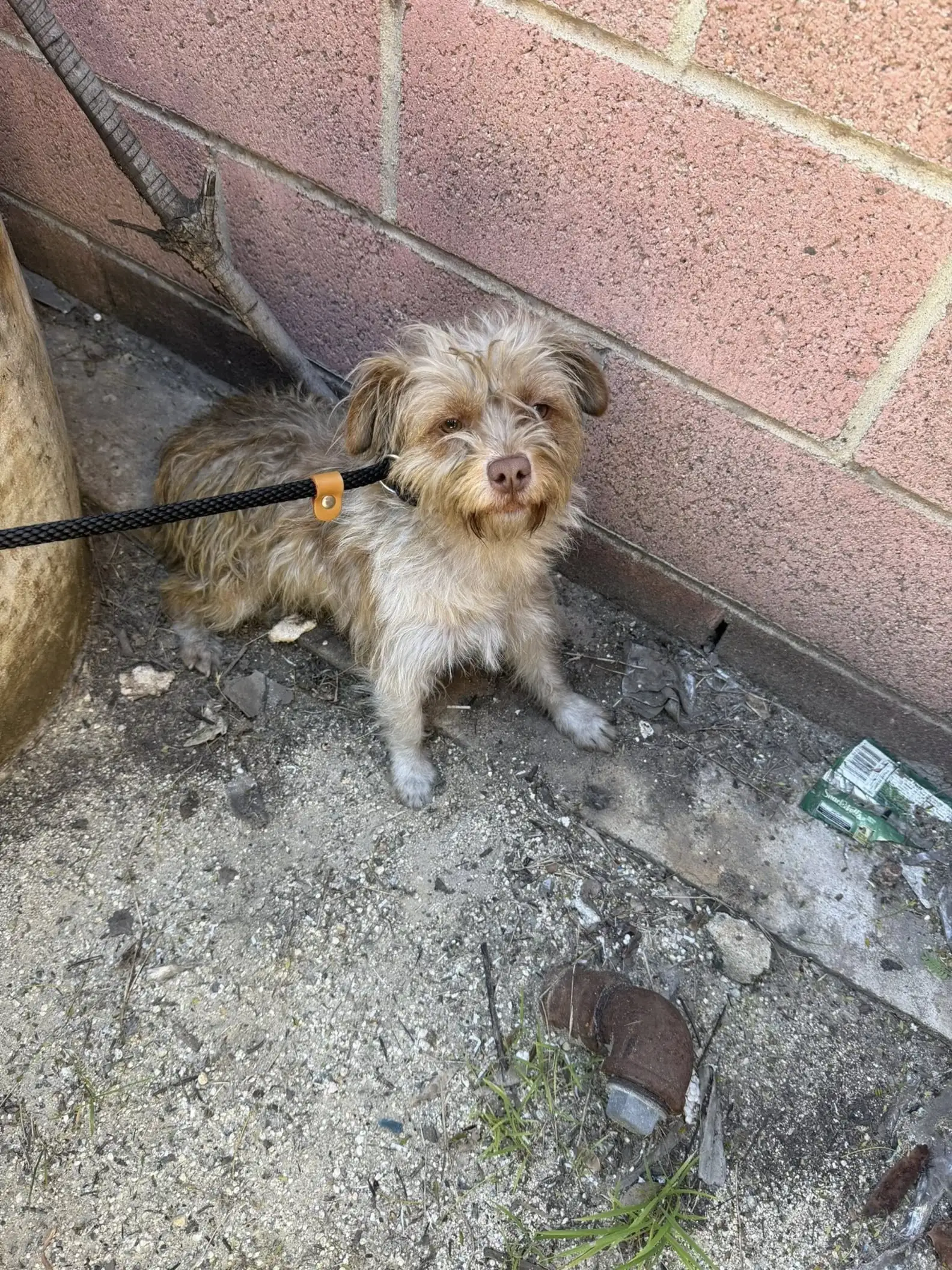
Safety did not immediately erase the fear she had carried with her.
But for the first time in weeks, she no longer had to survive alone beside that road.
The next step was to understand what was hidden beneath the neglected coat that had covered almost her entire body.
Beneath the Mats Was a Tiny Little Girl
The rescuers brought her to Camino Pet Hospital.
Her coat was so thickly matted that even identifying her clearly at first was difficult. The accumulated fur had changed the shape of her small body so much that the team initially thought she might be a male dog.
Then the clippers began their careful work.
Layer after layer of tangled fur was removed.
The transformation was gradual.
The heavy coat that had trapped dirt close to her body began to disappear, revealing the delicate dog underneath.
And eventually, something became clear.
She was a little girl.
The difference was remarkable—not because she had suddenly become a different dog, but because the neglect that had concealed her was finally being lifted away.
Each section of fur removed meant less weight clinging to her small frame.
After so much time outdoors carrying that burden, she could finally be seen more clearly.
Suzette Hall gave her a name.
Reject.
It was an unusual name, but it was not meant as an insult.
For Hall, it represented what the little dog had already endured—and the life she had managed to survive.
From Waiting Beside a Fence to Being Seen
Reject's story had begun, at least for the people who noticed her, with a repeated image.
A tiny dog standing upright beside a fence.
Cars moving past.
Her eyes searching.
Again and again, she stretched herself as high as she could, apparently hoping to recognize someone on the other side.
No explanation could tell observers exactly what she was thinking during those weeks.
But her actions were consistent enough to draw attention.
She stayed.
She watched.
She waited.
What changed her future was not one dramatic instant. It was the accumulation of people refusing to stop caring.
Neighbors noticed her.
Someone reached out for help.
Hall and Ortiz continued returning after unsuccessful attempts.
They brought food.
They set traps.
They searched when she disappeared.
And when the abandoned building finally offered an opportunity, they followed her inside rather than allowing another chance to pass.
Rescue sometimes looks like a single heroic moment.
Reject's rescue looked more like persistence.
Trust Could Not Be Forced
One of the most important parts of her rescue was also the least dramatic.
Waiting.
Reject could not understand why unfamiliar people kept approaching her. From her perspective, running was the safer choice.
That is why the rescuers could not simply decide that she should trust them.
They had to work within the limits of her fear.
When she refused water from a hand, they did not assume she would accept closer contact next time.
When she escaped an attempt, they returned another day.
When a trap failed, the effort continued.
Nearly two weeks of rescue attempts may have felt painfully slow, but the goal was not merely to catch her.
It was to get her safely away from the roadside without causing unnecessary panic or harm.
Eventually, patience created the opening that force never could.
Reject entered the building herself.
The rescuers simply recognized the moment.
A Different Kind of Life Begins
By the time Reject left the roadside, two transformations had already begun.
The first was physical.
At the hospital, the thick mats that had surrounded her body were carefully removed, revealing the small dog underneath.
The second was quieter.
She was no longer an animal whom people could only watch from a distance.
She now had people actively looking after her.
The dog who once ran whenever anyone approached was finally in a place where people could care for her without chasing her across open ground.
Her story does not need an exaggerated ending to be meaningful.
The change is already visible in the contrast.
For weeks, Reject had stood beside a fence searching beyond it.
Now she no longer has to remain there waiting.
She has people around her who notice when she needs something, who chose not to abandon the rescue when it became difficult, and who were willing to spend weeks earning the chance to bring her somewhere safe.
She No Longer Has to Search Every Passing Car
There is something especially moving about the image that first made people pay attention to Reject.
She was small enough that she had to stand on two legs just to see properly through the fence.
Again and again, she made that effort.
Whatever she hoped to find never appeared.
But something else did.
People noticed.
Then people cared.
And eventually, people acted.
Reject's story is a reminder that helping a frightened animal does not always happen quickly. Sometimes compassion means returning after the first attempt fails. Sometimes it means sitting with uncertainty, trying again and allowing trust to develop at the animal's pace.
For Reject, that patience changed everything.
She no longer needs to stretch her little body toward a roadside fence, searching every passing vehicle for someone who might stop.
Someone already did.
And this time, they stayed.


