
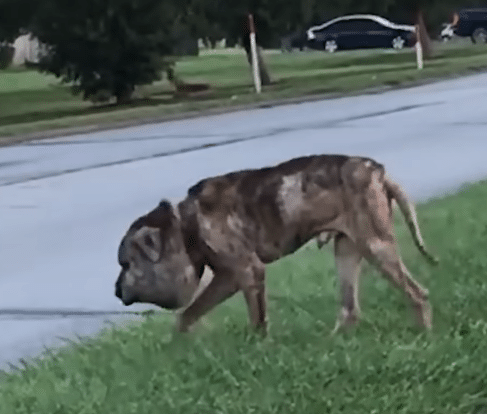
The first thing people noticed was the way the stray dog carried his head.
It hung unusually low as he moved along a Houston sidewalk, almost as though lifting it required more strength than he had left.
This was not simple tiredness.
His neck was severely swollen, and every step seemed affected by the weight and discomfort he carried.
People saw him pass.
Some stopped briefly. Others continued on.
But when rescuers learned about the dog, they could not simply forget what they had seen.
The Search for the Dog Who Kept Disappearing
Finding him was not as easy as approaching a dog resting beside the road.
The stray continued moving through the area, and rescuers had to follow scattered sightings while trying to understand where he might be hiding.
Hours passed.
Eventually, their search led them to an abandoned building.
There, away from the street and the people who had noticed him, the dog had found a place to hide.
He was frightened and unwilling to come close.
That reaction was understandable. No one knew exactly what his life had been like before that day, but his condition made one thing clear: he had been living with discomfort for a long time.
The rescuers did not rush toward him.
Instead, they carefully used a humane trap so they could bring him to safety without forcing a frightened animal into a struggle.
It was the beginning of a very different life.
But first, they needed to understand what had happened to him.
A Small String Had Caused Years of Trouble
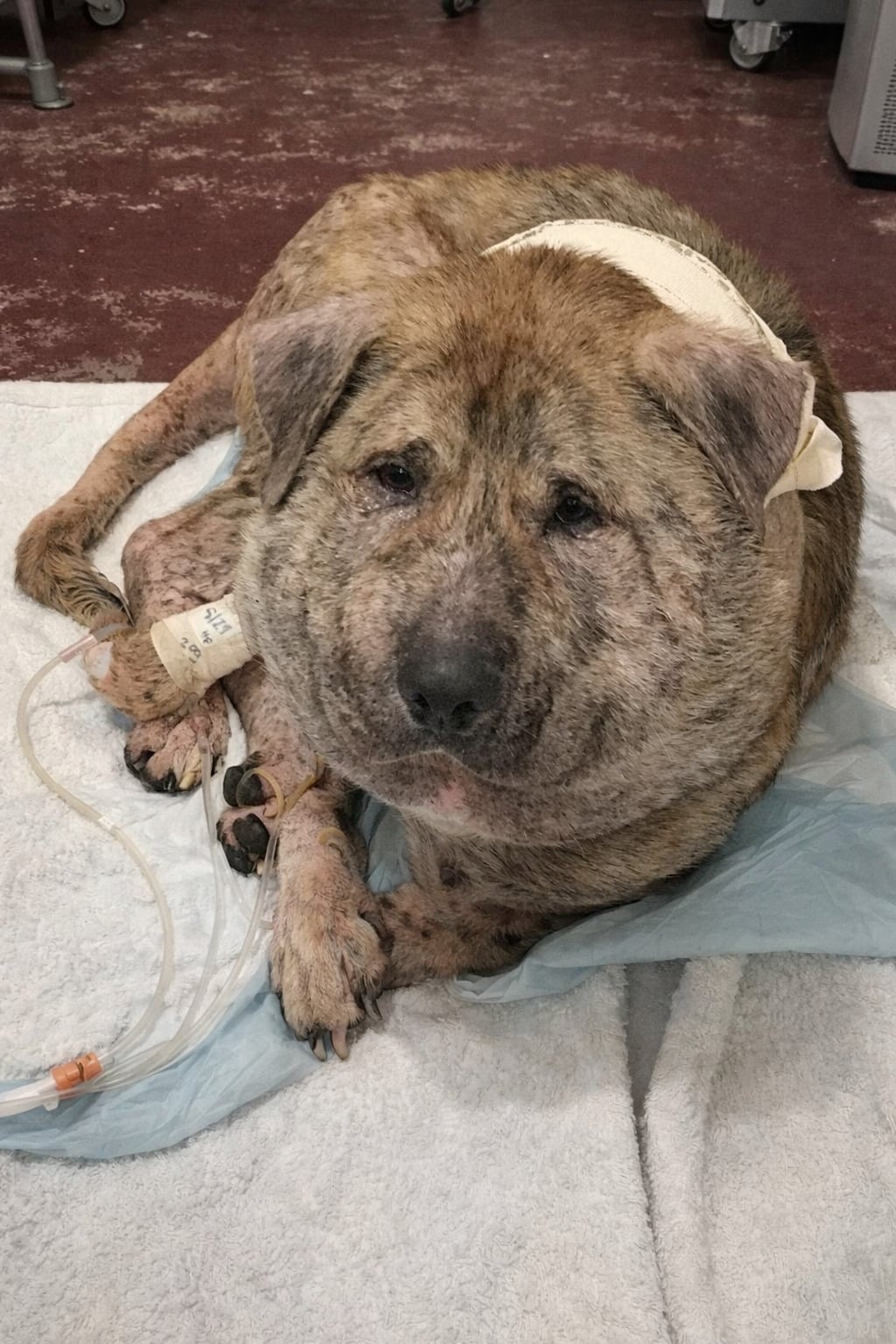
At the veterinary clinic, the seriousness of the swelling became clearer.
According to the story, a thin string had been placed tightly around his neck when he was still a puppy.
It had never been removed.
As the puppy grew into an adult dog, the string did not grow with him.
Instead, it became increasingly restrictive, pressing against his neck and contributing to the severe swelling that had eventually made ordinary movement so difficult.
The problem had clearly developed over time.
Veterinary examinations also revealed signs of older physical trauma elsewhere on his body. Some injuries had already healed externally, but they offered another glimpse of how difficult his earlier life may have been.
Even in the unfamiliar environment of the clinic, however, the dog remained remarkably calm.
He did not respond with aggression.
He simply allowed the people around him to begin helping.
Perhaps safety was still unfamiliar.
But for the first time, there were people determined to give him the care he needed.
A Name Made Him More Than Another Stray
During his care, the dog received a name.
Gus.
It was a simple change, but it marked an important moment.
He was no longer an unidentified dog wandering through Houston with his head hanging toward the pavement.
He was Gus.
There were now people watching his progress, caring about his comfort, and hoping to see what life might look like once the pressure and swelling began to ease.
Recovery would not happen quickly.
His body had been carrying the consequences of the problem for far too long.
What followed was a gradual process measured not by dramatic overnight changes, but by small improvements.
VIDEO: Gus Could Barely Raise His Head—Then His Long Road Back to Comfort Began
Small Changes Began to Add Up
Day after day, the swelling slowly decreased.
As the pressure eased, Gus's posture began to change.
Movement became more comfortable.
The dog who had once walked with his head hanging painfully low was gradually able to move in a more natural way.
Those changes may have seemed small from one day to the next, but together they represented something Gus had been missing for a long time: relief.
His recovery required patience.
There was no way to erase his past, and no reason to expect years of hardship to disappear immediately.
Care simply continued.
One day followed another.
His body was given the opportunity to heal at its own pace.
After roughly a month, Gus had improved enough to leave the clinic.
That did not mean his journey was finished.
Leaving veterinary care only opened the next chapter.
He still needed a quiet place where he could adjust to life beyond the street.
That place came through a woman named Lan, who welcomed Gus into her home as a foster dog.
Learning What a Safe Home Felt Like
For Gus, ordinary home life was something new.
The environment, the sounds, the people, and even gentle interaction required adjustment.
There was no need to hurry him.
He had already spent enough of his life dealing with pressure and uncertainty.
What surprised those around him was how quickly his gentle nature began to emerge.
Gus proved patient and calm.
Instead of withdrawing completely from people, he gradually allowed relationships to form.
Trust appeared in small ways.
He became more comfortable around the people caring for him.
He interacted with other dogs.
The unfamiliar rhythm of a household slowly became normal.
These moments did not erase what had happened before his rescue.
They simply gave him something different to build on.
Safety.
Routine.
Companionship.
And time.
The foster arrangement had originally been intended to give Gus a temporary place to recover and settle.
But something changed as the weeks passed.
Lan and Gus became increasingly attached.
The dog who had entered her home as a temporary responsibility slowly became part of everyday life.
Eventually, the answer became clear.
Gus would not need to search for another family.
His foster home had become his permanent home.
His Second Chance Began Helping Others
Gus's transformation did not end once he was safe.
As he grew stronger and more comfortable, his story began reaching people beyond the small circle that had helped him recover.
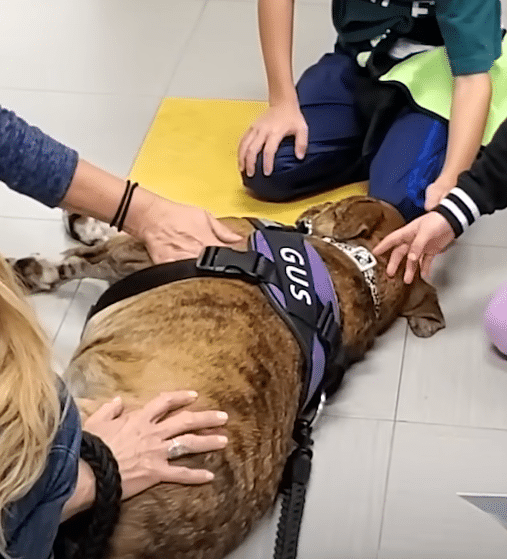
He started visiting schools, where his presence became a way to encourage children to think about kindness toward animals.
Gus did not need to explain anything.
People could see the difference for themselves.
Once, he had been a frightened stray hiding in an abandoned building, struggling to carry his swollen neck.
Now he could stand beside people as an example of what patient care could change.
His story gave children an opportunity to see rescue as more than a dramatic moment.
Saving an animal is only the beginning.
What comes afterward—the consistent care, the patience, the safe environment, and the willingness to earn trust—can be just as important.
Gus had experienced that process himself.
Now his life quietly carried that message wherever he went.
From a Houston Street to a Much Bigger Stage
Eventually, Gus's remarkable change brought him another form of recognition.
He received a Hero Dog Award.
The honor reflected more than the difficult condition in which he had been found.
It recognized the journey that followed—the recovery, the trust he developed, and the way his story was being used to encourage compassion for animals.
Gus even appeared on a red carpet in Hollywood.
It was an extraordinary contrast.
The same dog who had once moved slowly along a Houston street with his head hanging close to the ground was now walking in front of cameras, surrounded by people celebrating him.
Yet the most important part of his transformation had nothing to do with awards or public attention.
It was much quieter than that.
Gus had a home.
He had people who cared for him.
He no longer needed to hide in an abandoned building or wander the streets while carrying a condition that made each movement difficult.
That was the real change.
What Changed Gus's Life Was Someone Choosing to Act
It would have been easy for Gus to remain only a dog people noticed for a few seconds before continuing with their day.
For some time, that was exactly what happened.
His swollen neck was visible.
His unusual posture was visible.
His struggle was visible.
What finally changed his future was not simply being seen.
It was being seen by people who decided that noticing was not enough.
They searched until they found him.
They found a safe way to bring him out of hiding.
Veterinary professionals helped address the condition that had affected him for so long.
Then a foster home gave him somewhere calm to continue healing.
And eventually, temporary care turned into family.
None of those steps alone tells the whole story.
Together, they transformed the life of a dog who once could barely hold up his own head.
Gus's past could not be undone.
But his future did not have to look like his past.
His journey is a reminder that meaningful rescue often happens through a series of ordinary decisions: someone stops, someone searches, someone provides care, and someone chooses to stay.
For Gus, those decisions added up to something he had never been guaranteed.
A safe place.
A family.
And a second chance that became permanent.


