
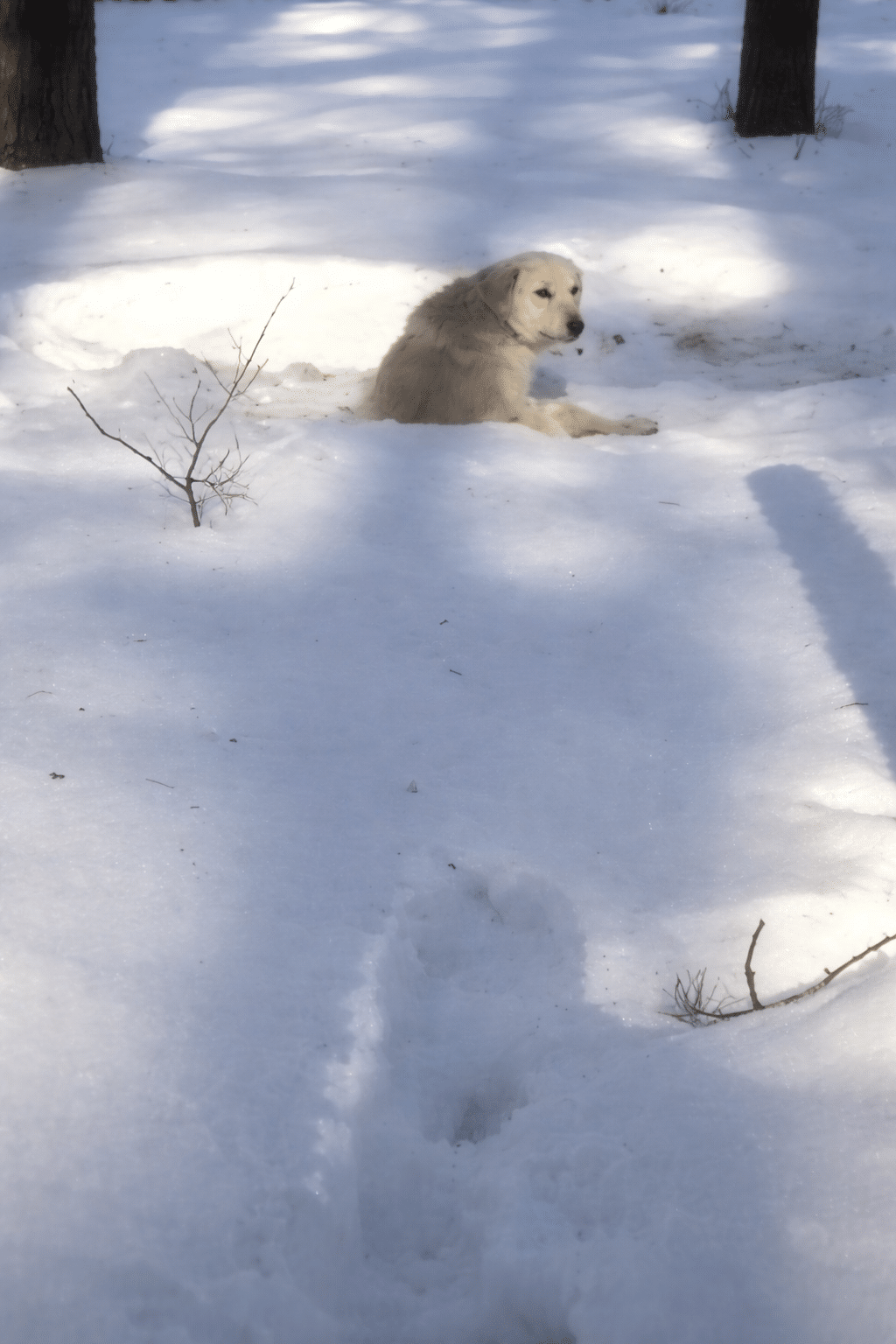
Luna lay alone in the snow, trembling against the cold and unable to move her back legs.
Her condition was serious. A severe spinal injury had left her hind legs completely paralyzed, and even the smallest attempt to change position brought discomfort.
Yet beneath the fear and physical weakness, Luna was still holding on.
There was no way to know what recovery might look like at that moment. What was clear was that she needed help quickly.
From the Cold Into Urgent Care
Once Luna was found, getting her somewhere safe became the immediate priority.
She was taken to a veterinary clinic, where the medical team began assessing the extent of her injuries and stabilizing her condition.
The tests confirmed what her inability to move had already suggested: the trauma to her spine had caused extensive nerve damage.
For Luna, this meant that the road ahead would not be measured in hours or days.
It would be measured in careful treatments, repeated rehabilitation sessions, and tiny changes that might be almost invisible to anyone who was not watching closely.
The veterinary team also discovered bone fragments pressing against her spine.
Surgeons were able to remove several of them, reducing some of the pressure around the injured area. One fragment, however, was lodged too deeply to remove safely. Attempting to reach it carried too much risk, so it had to remain in place.
The procedure could not erase everything Luna had endured.
It could only give her body a better opportunity to begin healing.
And from that point forward, the focus changed.
The question was no longer simply whether Luna had survived being found in the snow.
The question became how much strength and movement she might be able to regain.
A Recovery Built One Session at a Time
There was no single treatment that could suddenly restore Luna's mobility.
Her rehabilitation required patience.
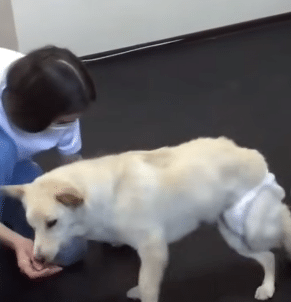
Massage was used to encourage circulation. Physical therapy helped stimulate her muscles and nerve responses. Assisted standing exercises allowed her body to experience the position of standing again while receiving the support she could not yet provide for herself.
Each exercise was gentle.
Each movement had a purpose.
The progress could not be rushed.
Some days, the most meaningful achievement might have been a small response from a muscle or a slightly steadier posture.
Those moments mattered because recovery from a serious spinal injury does not always announce itself dramatically.
Sometimes it begins almost quietly.
VIDEO: Luna Was Found Paralyzed in the Snow — Then Her Long Fight to Move Again Began
When Water Gave Her Body More Freedom
Among Luna's rehabilitation treatments, hydrotherapy became especially important.
Warm water supported much of her body weight, reducing the pressure she would otherwise have experienced while trying to move.
On land, her weakened back legs had to work against gravity while also coping with the effects of her spinal injury.
In the water, movement became different.
Her body could be supported while her legs were encouraged to move more freely.
It was not a shortcut to recovery.
It was another carefully controlled way to help her muscles work, maintain circulation, and practice movements that remained extremely difficult outside the water.
For a dog whose hind legs had once been completely unable to support her, even controlled motion was significant.
The rehabilitation team continued working with her consistently, repeating the same careful exercises again and again.
Recovery was being built through repetition.
Not through one dramatic moment.

The First Small Victories
Eventually, Luna began showing changes that offered real encouragement.
One of the most meaningful came when she managed to sit upright by herself.
At first, she could hold the position only briefly.
A few seconds might not sound like much.
For Luna, those seconds represented something very different from the dog who had first been found motionless in the snow.
Her muscles were beginning to regain strength.
Her coordination was showing signs of improvement.
Tasks that once seemed completely beyond her reach were slowly becoming possible.
There was still no reason to rush the process or expect immediate results.
Her recovery remained gradual.
But now there were visible signs that the work was having an effect.
That changed the emotional rhythm of her rehabilitation.
Instead of looking only at everything Luna still could not do, those caring for her could begin recognizing what she had already regained.
A stronger posture.
A little more control.
A few more moments of balance.
Small achievements became milestones.
Healing Became a Shared Effort
Luna's progress was not created by one person or one treatment.
Veterinary professionals handled the medical side of her condition.
Rehabilitation specialists worked repeatedly with her weakened body.
Volunteers helped provide care and encouragement.
Supporters contributed in other ways, including helping make the long rehabilitation process possible.
Together, those efforts formed the network Luna needed around her.
For an animal recovering from a serious spinal injury, long-term care can require consistency far beyond the first rescue.
The emergency may happen in a single moment.
Recovery does not.
Luna needed people willing to continue showing up after the urgency had passed.
She needed therapy even when improvement was slow.
She needed support even when a session produced no dramatic result.
And she needed time.
That steady commitment became one of the most important parts of her story.
Learning What Her Body Could Do Again
As Luna became stronger, the meaning of rehabilitation began to change.
At the beginning, much of the work centered on basic support: protecting her body, stimulating weakened muscles, and helping her experience controlled movement.
Later, each new ability became something she could build upon.
Sitting upright required balance.
Balance required strength.
Strength had to be developed repeatedly.
The process was gradual because her body had to relearn how to coordinate movements affected by the spinal trauma.
Nothing about that could be forced.
That is why the smallest signs of improvement carried so much meaning.
A movement that might appear ordinary in a healthy dog could represent weeks of effort for Luna.
Her rehabilitation became a collection of those moments.
One controlled position.
One stronger response.
One longer attempt.
Then another.
Progress did not erase the seriousness of her injury, and the remaining bone fragment meant there were still medical limitations that could not simply be removed.
But Luna was no longer exactly where she had been when she arrived.
Her body was responding.
And every response gave the people around her another reason to continue.
A Future Defined by Progress, Not the Snow
Luna's story began with an image that was difficult to forget: a dog alone in the snow, injured, shaking, and unable to move her back legs.
That moment could easily have become the only thing that defined her.
Instead, it became the beginning of a much longer story.
She received medical care.
She underwent surgery to relieve pressure around her spine where it could be done safely.
She entered long-term rehabilitation.
She experienced massage, physical therapy, assisted standing exercises, and hydrotherapy.
And eventually, she began to achieve movements that had once seemed impossible.
Her journey is still about patience.
It is still about repetition.
And it is still about accepting that meaningful recovery may happen in very small steps.
Luna did not suddenly leap from paralysis into complete independence.
Her progress came through careful care and persistence.
That makes each improvement more meaningful, not less.
The dog who once could not move her back legs began to sit upright.
The body that had been completely dependent on support began showing greater strength and coordination.
Those changes are reminders of what consistent care can make possible.
Luna continues moving forward through rehabilitation, surrounded by people committed to giving her every reasonable opportunity to improve.
Her future cannot be reduced to one dramatic promise.
It is being written through the work happening now.
Session by session.
Movement by movement.
Small victory by small victory.
And for Luna, that is already a very different future from the one that seemed possible when she was first found alone in the snow.


