
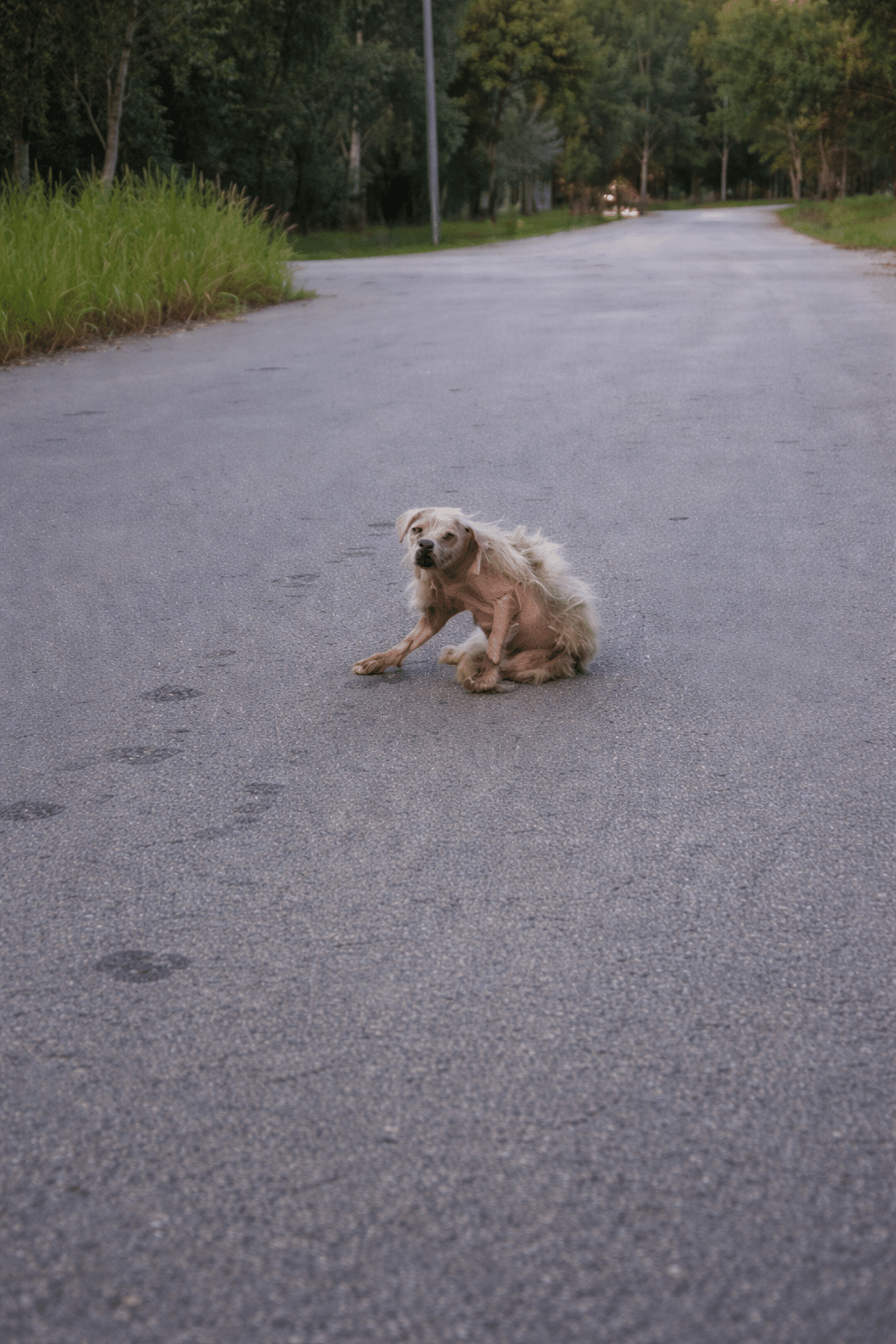
Trinity was not running when someone finally noticed her.
She was simply moving slowly through the streets, without any clear destination, as though even deciding where to go required more energy than she had left.
She was still a young dog.
Yet the condition of her body made her seem much older.
Her fur was tangled and neglected. Her skin looked irritated. Even her movements carried the heaviness of a dog who had spent too long without the care she needed.
What stood out most, however, was not panic or aggression.
It was exhaustion.
She kept moving, but there was little urgency in her steps. Nothing about her suggested that she expected something good to be waiting ahead.
Then someone chose not to pass her by.
The Day Her Wandering Finally Ended
Being rescued did not instantly erase what Trinity had been through.
There was no sudden transformation.
There was only the beginning of something she had been missing for a long time: care.
After she was taken in, Trinity was brought to a clinic, where she could be examined and treated. Her neglected coat and irritated skin needed attention, but her recovery would require more than medical help alone.
She needed rest.
She needed warmth.
Most of all, she needed time to understand that she no longer had to keep moving.
She was gently cleaned and bathed.
For a dog whose days had been defined by uncertainty, even these ordinary acts of care marked a major change.
Someone was paying attention to her comfort now.
Someone was noticing what she needed.
And when the activity around her finally became quiet, Trinity did something simple that revealed just how tired she had been.
She slept.
Not the uneasy rest of an animal forced to stay alert to everything around it.
She slept deeply.
For once, there was no street to navigate and nowhere else she had to reach.
She could simply lie down.
And for the moment, that was enough.
Healing Began in Almost Invisible Ways
The first days of Trinity's recovery were quiet.
She rested more than she explored.
Her body had been depleted, and nothing about the process could be rushed. The people caring for her gave her the space to regain strength gradually rather than expecting an immediate change.
At first, progress was easy to miss.
Then, after roughly a week, Trinity began lifting her head more often.
She watched the people around her.
That alone was different.
Instead of appearing completely withdrawn into her exhaustion, she was beginning to notice her surroundings again.
Then came an even smaller movement.
Her tail shifted.
It was only a slight wag, but it carried enormous meaning.
The dog who had once seemed almost too tired to engage with the world was beginning to respond to it.
Curiosity followed.
Toys started catching her attention.
She approached them gently, exploring them without the confidence of a carefree dog, but with enough interest to show that something inside her was returning.
Her recovery was not happening in one dramatic leap.
It was unfolding through tiny decisions.
Look up.
Watch.
Explore.
Move the tail.
Rest again.
Then try a little more the next day.
When Survival Slowly Became Something More
There is often no single moment when a rescued dog becomes "better."
The change happens quietly, through dozens of small signs that eventually become impossible to ignore.
That was true for Trinity.
As the days passed, her skin began to improve.
Her strength started returning.
Her interest in the world became more visible.
The transformation could be seen not only in how she looked, but in how she carried herself.
The hesitant dog who once drifted through the streets was gradually becoming more present.
More alert.
More willing to interact.
VIDEO: From Wandering the Streets Exhausted to Discovering Safety — Trinity’s 30-Day Transformation
Watching that change over time made one thing clear: rescue had given Trinity more than physical care.
It had given her the chance to stop living in constant survival mode.
Every safe day built upon the one before it.
Every calm interaction gave her another reason to remain curious.
Every moment of rest allowed her body to recover a little more of what exhaustion had taken away.
There was no need for a dramatic breakthrough.
Her healing could be measured in smaller things.
The way she held her head.
The way she noticed a toy.
The way she stayed near people instead of withdrawing.
And eventually, the way her movements began to look lighter.
By the Third Week, the Difference Was Clear
Around three weeks into her recovery, Trinity no longer looked like the same weary dog who had first been brought in.
Her coat was changing.
Soft fur was beginning to return where her skin had once looked fragile and neglected.
Her movements became easier and more confident.
The world around her also seemed to feel less threatening.
She was no longer reacting to every small thing with the same uncertainty.
Instead, she began leaning into the life forming around her.
Trust does not arrive all at once for an animal that has lived without stability.
It grows through repetition.
Food appears again.
A resting place remains safe.
Hands approach gently.
Nothing terrible follows.
Day after day, those experiences create something new.
For Trinity, that new feeling was beginning to look like confidence.

The physical transformation was becoming obvious, but the change in her behavior mattered just as much.
She was no longer simply enduring each day.
She was participating in it.
That distinction may seem small, but for a dog who had once looked emptied of energy, it represented an enormous step forward.
On Day 30, Someone Chose Her
Then Trinity's story reached another turning point.
A family saw her.
They learned what she had been through.
And they decided that her future should continue with them.
On the 30th day of her journey, Trinity left the clinic.
This time, she was not returning to the streets.
She was going home.
The young dog who had once wandered without direction now had people waiting for her and a place where she belonged.
Her new family also gave her a new name.
Lily.
A new name could not erase the beginning of her story.
But it marked the start of a very different chapter.

She was no longer simply the dog who had been found exhausted and neglected.
She was someone's companion.
Someone's dog.
A member of a home.
The transformation that had begun with rest, careful treatment, and one small tail wag had carried her all the way to adoption.
Months Later, the Streets Felt Like Another Life
As more time passed, Lily continued to change.
The difference became so striking that the fragile dog from the beginning of her story seemed almost unrecognizable.
Her coat grew soft and healthy-looking.
Her energy returned.
Her personality became playful and warm.
Instead of wandering alone, she now spent her days close to the people she loved.
She rested beside them.
She followed them through the house.
She became interested in the ordinary rhythms of home life, even reacting to sounds coming from the television.
These were not extraordinary moments.
And that is exactly what made them meaningful.
For Lily, ordinary life was the gift.
A room where she could sleep safely.
People she could stay close to.
Sounds that did not signal danger.
A daily routine she could trust.
The dog who once moved through the streets as though she had nowhere to go now had somewhere she could return to every day.
What Her Transformation Really Means
Lily's story is powerful because her recovery was not built around one spectacular moment.
It was built around consistency.
Someone noticed her.
Someone brought her to safety.
Someone gave her the time her body needed.
Someone stayed through the quiet days when progress was measured in little more than a lifted head or a tiny wag of the tail.
And eventually, someone chose to give her a permanent home.
That chain of simple acts changed the course of her life.
Rescue did not instantly turn Trinity into Lily.
The transformation happened gradually.
First came safety.
Then rest.
Then curiosity.
Then trust.
And finally, belonging.
Months later, the exhaustion once visible in her face had been replaced by the relaxed confidence of a dog who knew where she belonged.
She had survived the streets.
But survival was only the beginning.
The most meaningful part of her story came afterward, when she discovered what it felt like to live without constantly searching for the next safe place.
Now, she had found it.
And this time, she could stay.


