
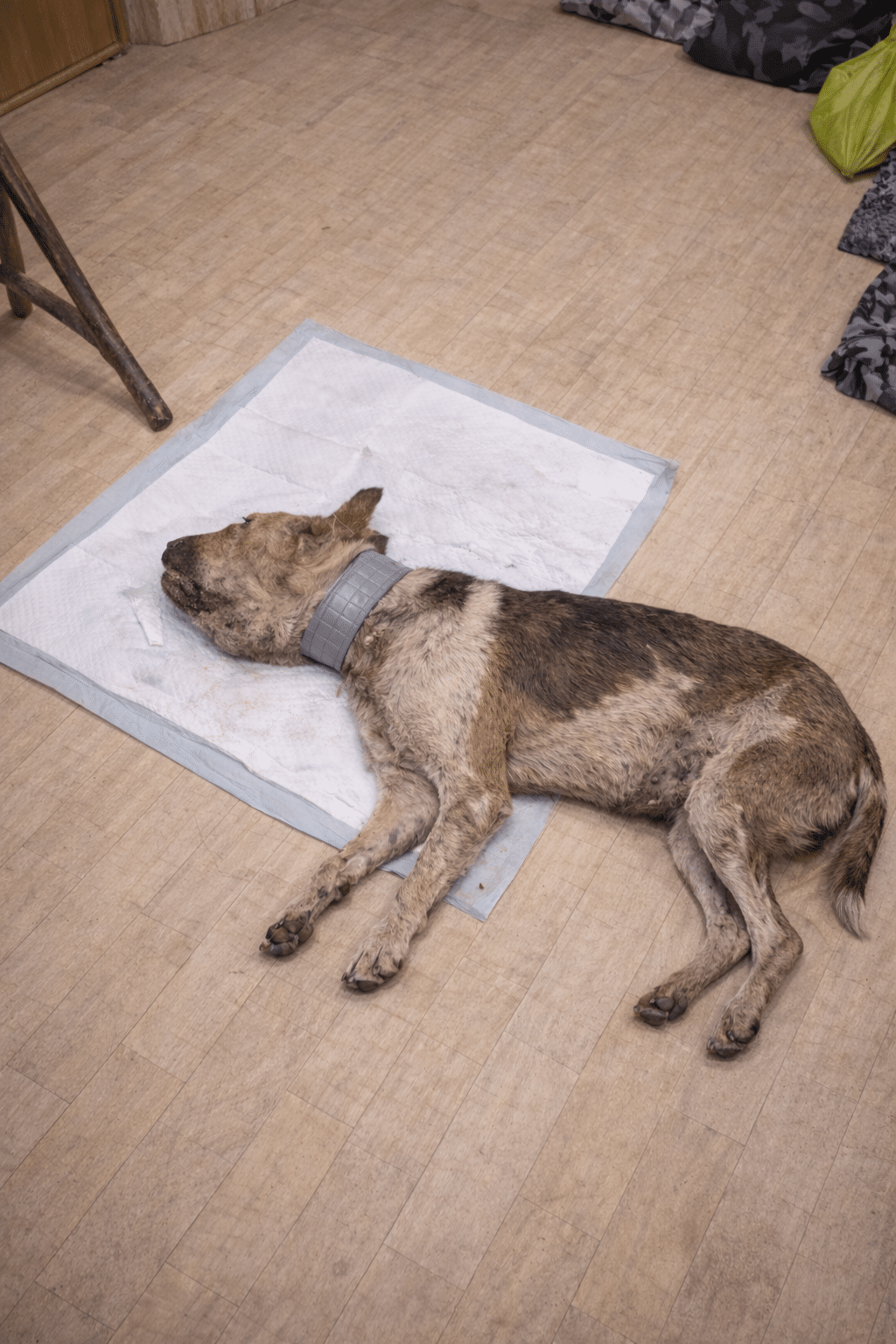
The first thing rescuers noticed was the swelling.
Moving slowly among broken bricks, metal scraps, and scattered debris, a stray dog carried his head unnaturally high. His neck remained stiff, and his head looked far larger than it should have.
Something was clearly wrong.
When the rescuers came close enough to see beneath the swelling, they discovered the source of his suffering: a thick piece of rigid plastic was locked tightly around his neck.
It was not a collar.
It appeared to be part of a drainage pipe that had somehow become trapped around him and remained there long enough to cause serious harm.
For an unknown amount of time, the dog had been surviving with that unyielding ring pressing against his neck.
He needed help quickly.
A Small Piece of Plastic Had Become a Serious Threat
No one knew how the dog had become trapped inside the plastic ring.
Perhaps he had pushed his head through an opening while searching for food or exploring the debris around him. The full history was unknown, and rescuers could only deal with what was directly in front of them.
What they could see was troubling enough.
As the dog grew or the surrounding tissue became swollen, the rigid plastic had nowhere to move. Unlike a flexible collar, it could not loosen or stretch.
The pressure around his neck had become increasingly severe.
His head was noticeably swollen, and the skin beneath the pipe had become badly irritated and injured. His condition suggested that the object had not been there for only a short time.
Still, the dog had somehow continued moving through the debris and searching for a way to survive.
By the time the rescue team from Saahas For Animals reached him, his body was already frail from hunger, exhaustion, and the strain of carrying the plastic around his neck.
Yet he remained remarkably calm as help came closer.
There was no way to explain to him what was about to happen.
The rescuers could only move gently and hope he would allow them to help.
Reaching Safety Was Only the Beginning
After bringing the dog into their care, the team was able to examine the trapped ring more closely.
The situation was more serious than it had first appeared.
The plastic had pressed firmly against the tissue around his neck. According to the rescue account, the pressure had interfered with normal circulation, contributing to the dramatic swelling in his head.
The surrounding skin also needed immediate attention.
Before attempting to remove the pipe, the team began stabilizing him.
Fluids were administered because he was weak and dehydrated. Medication was used around the affected area to help manage the irritation and infection that had developed beneath the trapped plastic.
These first steps mattered.
Removing the object was essential, but the dog was already exhausted. The rescuers had to care for his immediate condition while preparing for the most delicate part of the rescue.
And that part could not be rushed.
The pipe was thick.
It could not simply be pulled over his swollen head.
Trying to force it off could have caused more harm.
The only safe option was to cut through it carefully while protecting the dog underneath.
VIDEO: His Head Had Swollen Around a Plastic Ring — Rescuers Carefully Began Cutting Him Free
Every Movement Had to Be Controlled
The dog was positioned carefully while the rescuers prepared a handheld cutting tool.
The challenge was obvious.
The plastic ring sat directly against an already sensitive part of his neck. There was very little room for error between the hard material that needed to be cut and the dog they were trying to protect.
One team member operated the tool.
Others focused on keeping the dog steady and shielding the surrounding area as much as possible.
The work moved slowly.
There was no dramatic pulling or sudden movement. The safest approach was patience: cut a little, check the position, protect the skin, and continue.
The dog, despite everything he had experienced, remained cooperative through the procedure.
That quiet stillness gave the team the chance they needed.
Little by little, the cutting tool worked through the rigid plastic.
The ring that had refused to bend finally began to weaken.
A section opened.
Then the tension around his neck started to release.
After what had likely felt like an endless burden for the dog, the piece of plastic could finally be lifted away.

For the rescuers, it was a moment of relief.
For the dog, it was the beginning of something much more important.
For the first time since becoming trapped, there was no hard ring tightening around his neck.
The immediate danger had been removed.
Freedom Did Not Mean the Healing Was Finished
Taking off the pipe solved the most urgent problem, but it could not instantly reverse everything the dog had endured.
His head was still swollen.
The skin around his neck still required treatment.
His body was still weak.
Rescue, in moments like this, is not simply the instant an object is removed. It is also the quieter work that comes afterward — cleaning, medication, observation, hydration, and giving an exhausted animal time to recover.
The team continued caring for the damaged area around his neck while keeping him as calm and comfortable as possible.
Now, however, his body had an opportunity it had not had while the plastic remained in place.
The constant pressure was gone.
The area around his neck was finally free.
That change alone marked a major turning point.
There was still uncertainty ahead, and the source did not confirm a complete long-term recovery. But the dog had reached a level of care that had seemed impossible while he was wandering among the debris.
He was no longer trying to survive the problem alone.
A Quiet Beginning After So Much Discomfort
Recovery often begins with moments that look small from the outside.
For this dog, simply resting without the rigid ring around his neck was one of them.
There was no need for a dramatic transformation overnight.
His body needed time.
The swelling needed time to improve, and the irritated tissue around his neck needed continued care.
What had changed immediately was the direction of his story.
Before the rescue, every passing day with the pipe still trapped around him risked making his condition worse.
After its removal, each day of care offered the possibility of improvement.
The rescuers could now focus on supporting his recovery rather than fighting against the object that had been causing constant pressure.
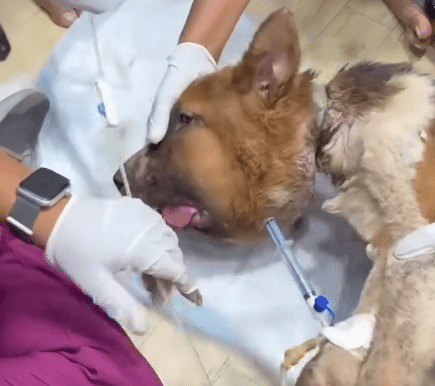
The contrast was striking.
Only a short time earlier, he had been moving through piles of debris with an oversized plastic ring pressing tightly against his neck.
Now that ring was gone.
He was still fragile, but he was safe enough to receive treatment.
Sometimes that is what the first stage of rescue looks like.
Not a perfect ending.
Not an instant recovery.
Just the removal of the danger that has made healing impossible.
No One Knows How Long He Carried It
One part of the dog's story remains unanswered.
No one knows exactly how the drainage pipe became trapped around his neck or how long he had been living with it.
There was no way to ask him where it happened.
There was no clear history explaining how many days he had spent struggling with the growing pressure.
The condition in which he was found was the only evidence rescuers had.
His swollen head, weakened body, and injured neck showed that the problem had become serious before help arrived.
It is easy to look at an ordinary piece of discarded plastic and see nothing dangerous about it.
For a stray animal searching through debris, however, that same object can become a trap.
Once the dog's head passed through the rigid opening, escaping on his own may have become increasingly difficult as swelling developed.
What began as an accident could gradually turn into an emergency.
That is why noticing animals in distress matters.
Sometimes the difference between continued suffering and the beginning of recovery is simply that someone sees what others might overlook — and chooses to act.
The Ring Was Gone, and a Chance Remained
The rescuers could not erase what had already happened to this dog.
They could not know exactly how long he had struggled.
But they could change what happened next.
By bringing him into care, stabilizing his weakened body, treating the affected area, and carefully cutting away the plastic ring, they removed the greatest immediate threat to his life.
His recovery still required patience.
The swelling would not disappear in a single moment, and the damage around his neck needed continued attention.
But the most important obstacle was finally gone.
He no longer had to carry that rigid piece of plastic everywhere he went.
He no longer had to endure its tightening pressure with every movement.
Instead, he could rest under supervision while his body began the slower work of healing.
His story does not need an exaggerated ending to matter.
A frightened, weakened stray was found with something dangerously tight around his neck.
People stopped.
They brought him to safety.
They carefully cut him free.
And because they did, a dog whose condition had been growing more dangerous finally received something he had been missing for far too long:
a real chance to recover.


