
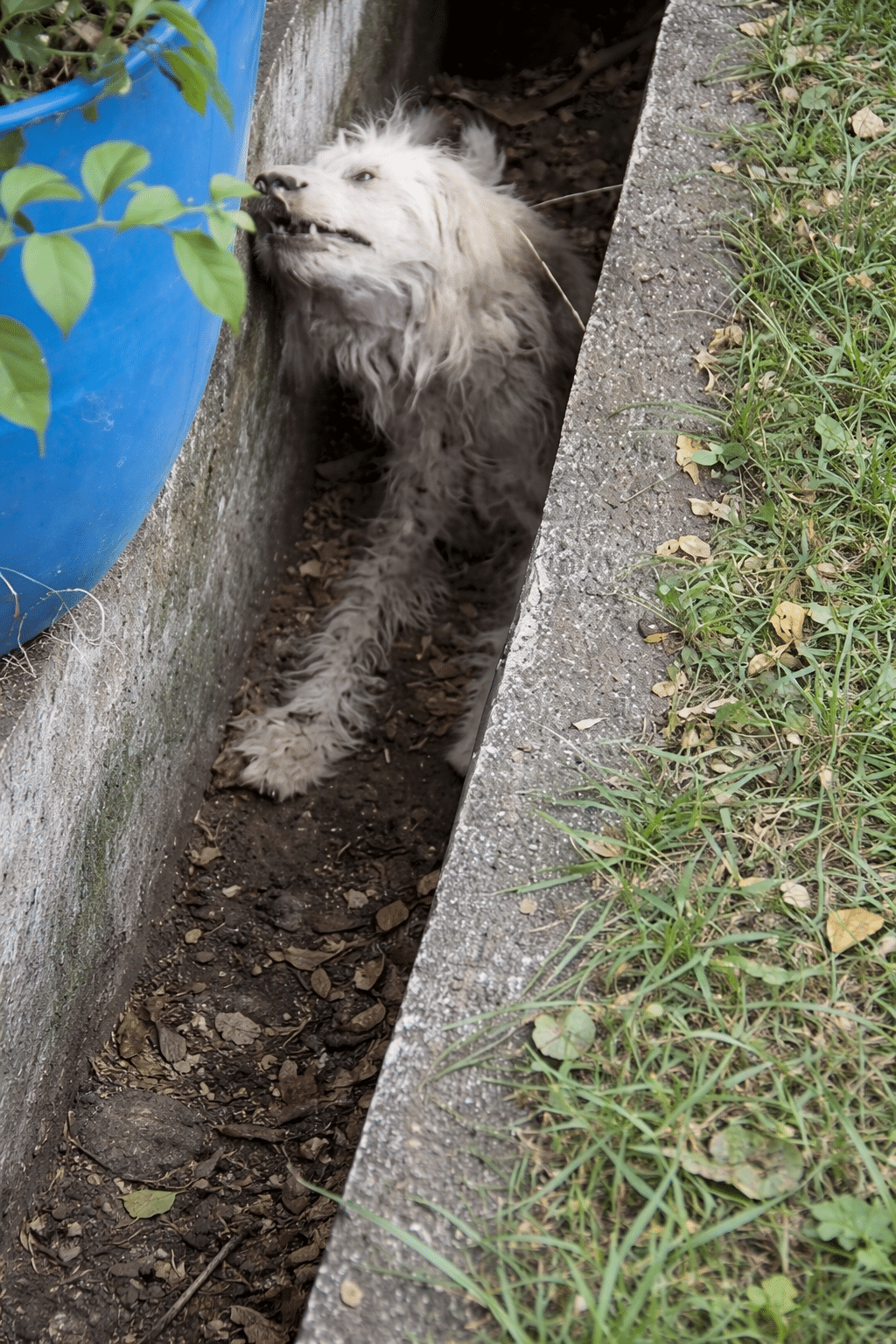
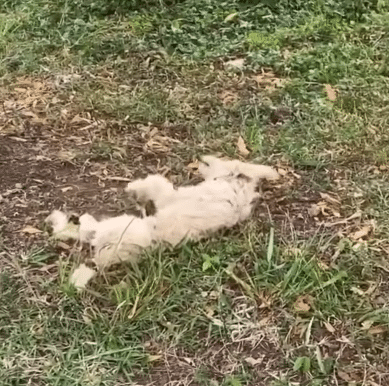
A tiny white dog moved slowly across the grass, his thin body struggling to carry him even a few more steps.
His legs seemed unsteady beneath him. Each movement looked difficult, as though simply remaining upright required nearly all the strength he had left.
Then his body gave way.
He collapsed onto the ground.
There was no dramatic struggle and no one immediately rushing toward him. There was only a small, exhausted dog who appeared to have reached the limit of what his body could manage.
What happened next made his situation even more dangerous.
When His Strength Finally Gave Out
After falling, the little dog eventually tried to move again.
But he was weak and disoriented. Beside the grassy area ran a narrow concrete drainage channel, and before he could regain his balance, he slipped down into it.
The drain offered little room for escape.
Its sides were steep and smooth, creating a barrier that a healthy dog might already have found difficult. For an animal struggling just to stand, climbing out appeared impossible.
Now the tiny dog was no longer simply exhausted.
He was trapped.
The concrete around him offered none of the comfort he needed. His fur became wet and dirty, and his body continued to tremble as he remained inside the narrow channel.
Above him, life continued.
People noticed him, but help did not immediately follow.
People Saw Him, Yet Fear Kept Them Back
According to captions shown in the video, several people nearby became aware of the stranded dog.
They were concerned that he might be sick, with some apparently fearing that he could have rabies. Because of that uncertainty, they chose not to approach closely.
Their concern may have been understandable, but for the little dog, the result remained the same.
He was still alone.
He could not climb out by himself.
He could not simply walk away.
The dog remained inside the drain as the surroundings grew darker, wet, tired, and visibly frightened.
Sometimes an animal in trouble does not need a complicated rescue.
It needs someone willing to come close enough to understand what is actually happening.
For this dog, that person would arrive later that night.
One Rescuer Finally Stepped Forward
A rescuer from Paws Rescue eventually came after learning about the trapped dog.
There was no sudden grabbing or frantic movement.
He approached slowly.
The tiny dog had already been frightened and exhausted for hours, so the rescuer allowed the first contact to be gentle. He reached down and softly stroked him rather than immediately trying to lift him from the drain.
That simple touch changed the tone of the moment.
The dog's body was still trembling, but the rescuer remained calm. Instead of treating him as something dangerous, he treated him as a frightened animal in need of help.
Little by little, the dog appeared to relax.
Only then did the rescuer carefully lift his small body from the concrete channel.
VIDEO: Too Weak to Escape the Drain, He Trembled Until a Gentle Hand Reached Down
For the first time since becoming trapped, the dog was no longer responsible for saving himself.
Someone else was carrying him.
His fur was wet and dirty, yet the rescuer held him close rather than keeping him at a distance.
After hours surrounded by cold concrete and uncertainty, the little dog finally had warmth around him.
Safety Began With the Simplest Things
The rescue did not end when he was lifted from the drain.
The dog still needed to become warm, dry, and comfortable.
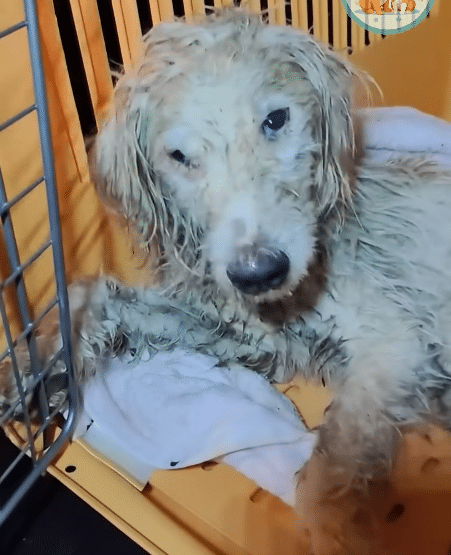
The rescuer brought him to the vehicle and began cleaning him with a soft towel. Mud and dirty water clung to his white fur, so the process was handled gently.
There was no need to rush.
For an animal that had spent the night frightened and trapped, something as ordinary as being dried with a towel could mark a major change.
A short time earlier, the dog had been trembling inside a place he could not escape.
Now a person was sitting beside him, cleaning him and keeping him warm.
His circumstances had changed completely, even if his physical strength had not yet returned.
The video does not establish the cause of his weakness or provide a medical diagnosis. What it does show clearly is that he was extremely frail when he was found and that the immediate priority became comfort and safety.
Those first moments of care were simple.
Dry fur.
Warmth.
A quiet place.
Gentle hands instead of distance.
For a frightened animal, sometimes those are the first building blocks of trust.
The Fear in His Face Slowly Began to Fade
As the dog was cleaned and settled, his expression appeared different from the one seen earlier in the drain.
He was still tired.
Nothing suggested that all of his difficulties had suddenly disappeared.
But the intense fear seemed to begin easing.
The transformation was subtle rather than dramatic.
He did not suddenly become energetic. He did not leap up and begin running around. The source does not confirm a full recovery, and there is no need to turn the moment into something larger than it was.
The meaningful change was quieter.
He no longer had to struggle against the walls of the drain.
He no longer had to wonder whether anyone would come close.
He could simply rest while someone else took responsibility for keeping him safe.
That kind of relief can be easy to overlook.
Rescue stories are often remembered for the moment an animal is physically pulled from danger. Yet the minutes afterward can matter just as much.
Being rescued means more than being removed from one difficult place.
It means reaching a place where the animal can finally stop fighting for every moment.
For this little dog, that place was waiting inside the vehicle.
A Soft Place After a Long Night
By the end of the video, the dog is resting inside a transport crate lined with soft blankets.
The contrast with the earlier scene is striking.
Before, he had been lying inside a narrow concrete drain, wet and unable to climb out.
Now he was dry, protected, and surrounded by something soft.
His body still looked tired, but the panic visible earlier had eased.
There was no indication that he needed to keep moving.
No steep wall to climb.
No cold channel trapping him.
He could finally stay still without being in danger.
The source does not confirm what happened during a longer recovery period, so his story should not be pushed beyond what is known. There is no confirmed diagnosis, treatment plan, adoption, or complete physical recovery presented here.
What is confirmed is already meaningful.
A dog who was too weak to remain on his feet became trapped.
People noticed but were afraid to approach.
Then one rescuer chose patience instead of fear.
He moved slowly.
He offered gentle contact.
He lifted the dog out.
He dried him.
And he gave him a safe place to rest.
Sometimes Rescue Begins With One Person Coming Closer
It would have been easy for the tiny dog to remain just another frightened animal seen from a distance.
The people who hesitated apparently had concerns about illness, and caution around an unfamiliar animal can be reasonable.
But eventually someone with rescue experience arrived and was willing to assess the situation directly.
That decision changed the dog's night.
The most powerful moment was not dramatic.
It was a hand reaching down slowly.
A frightened dog allowing himself to be touched.
A small body being lifted away from cold concrete.
Then a towel, a warm vehicle, and blankets waiting nearby.
Rescue does not always begin with a complicated medical procedure or an extraordinary intervention.
Sometimes it begins with attention.
With patience.
With someone recognizing that fear should not leave a vulnerable animal completely alone.
The little white dog entered that drain with almost no strength left.
He ended the night somewhere very different—dry, protected, and finally able to rest.
His future beyond those moments is not shown in detail.
But for that night, one thing had changed completely.
He was no longer alone.


