
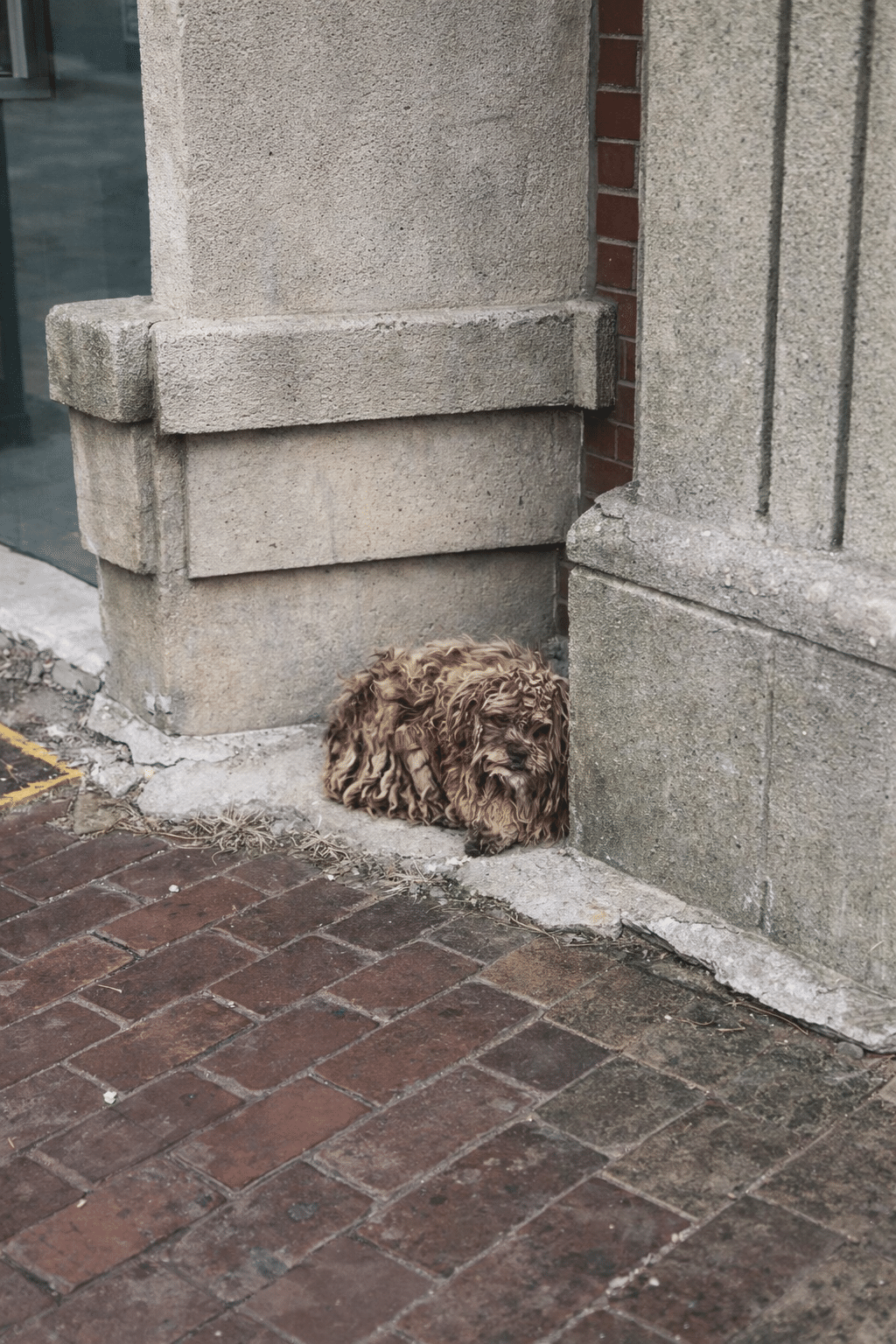
Some bonds begin without a leash, an adoption form, or even a name.
For the woman who owned a small neighborhood shop, it began with an elderly dog sitting quietly outside her door.
He did not bark for attention.
He did not scratch at the entrance or follow customers inside.
He simply arrived, settled into the same familiar place, and waited.
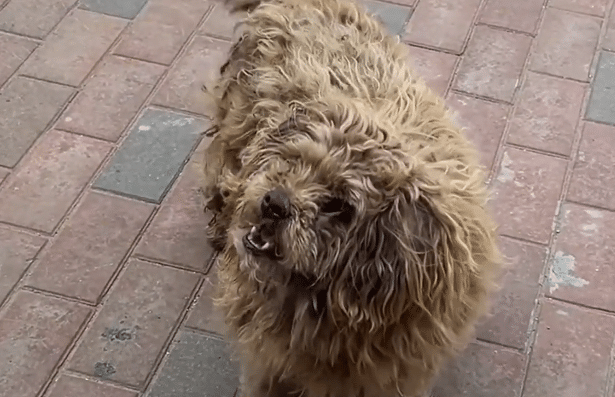
His long coat had become thick and tangled with mats. His movements were slow, carrying the unmistakable heaviness of age.
Yet nothing about him seemed demanding.
There was only a quiet patience that made him difficult to ignore.
The Visitor Who Kept Coming Back
At first, the shop owner treated his visits as something temporary.
Dogs wandered through the neighborhood. Perhaps this one was passing through too.
But the next day, he returned.
Then he came again.
Soon, his presence outside the shop became part of the rhythm of her day.
The same old dog.
The same place near the entrance.
The same calm silence.
He never seemed to be asking her for anything, which somehow made his visits even more touching.
There was no dramatic plea for help.
There was only consistency.
And eventually, the woman began to wonder whether his repeated visits meant something.
Maybe he had chosen this place for a reason.
Kindness Began With Something Small
She did not rush toward him.
She did not try to grab his collar or force him through the door.
Instead, she decided to meet him where he was.
A little food became the beginning.
Sometimes it was a piece of fish skin.
Sometimes a warm dumpling.
She would place it nearby and give him enough space to decide what to do.
At first, the old dog remained cautious.
He watched her carefully, keeping enough distance to retreat if he needed to.
The woman did not take it personally.
The next day, she tried again.
And the day after that, she greeted him with the same gentle patience.
Nothing was forced.
Nothing needed to happen quickly.
That steady routine gradually changed something between them.
The distance became a little smaller.
His hesitation became a little less visible.
Eventually, he was willing to come close enough to take food directly from her hand.
Trust Arrived in Tiny Steps
There was no single moment when the old dog suddenly decided that he trusted her.
It happened gradually.
One day, he stayed a little longer.
Another day, he allowed her to stand closer.
Later, he accepted food without immediately stepping away.
The change was easy to miss if someone only looked once.
But the shop owner was seeing him every day.
She noticed the details.
Trust was forming not through one grand gesture, but through repetition.
Food placed gently nearby.
A familiar voice.
A person who never chased him.
A place where nothing frightening happened.
Over time, the invisible boundary between them began to disappear.
VIDEO: The Old Dog Who Waited Outside Her Shop Every Day — Until She Finally Understood Him
Then the Rain Changed Everything
One evening, heavy rain swept through the neighborhood.
The shop owner found herself thinking about the elderly visitor.
She knew the place where he usually waited, and the thought of him sitting there through the storm stayed with her.
So she returned to the shop to check.
He was still there.
The old dog had tucked himself beneath the edge of the roof, using what little shelter he could find while rain fell around him.
She called him gently, inviting him inside.
For a moment, he hesitated.
It did not look like the same cautious distance he had shown in the beginning.
Instead, his pause seemed almost considerate.
His coat was wet, muddy, and heavily tangled, and he remained near the entrance rather than walking into the clean shop.
The woman did not force the issue.
If he was not ready to come inside, she would bring comfort outside.
She found a cardboard box.
Then a dry towel.
And she approached him carefully.
This time, when her hand reached toward him, he stayed.
For the first time since his visits began, the old dog allowed her to touch him.
It was a small moment.
But after so many days of patient distance, it carried enormous meaning.
The Truth About the Quiet Stranger
The woman eventually shared the old dog's story online.
Until then, she had only known him as the elderly visitor who appeared outside her shop each day.
Then someone recognized him.
The dog was not an unknown stray after all.
His name was Mao Mao.
He was 12 years old.
And he had a family and a home.
The discovery changed the story, but not in the way people might expect.
Mao Mao had spent much of his life in the countryside, where he had been accustomed to open spaces and the freedom to move around.
Later, his family relocated to an apartment.
Mao Mao never fully adjusted to spending all of his time indoors.
He still preferred wandering outside and finding places where he could settle comfortably.
His daily travels were not necessarily the movements of a lost dog searching for home.
They were part of the life he preferred.
And somewhere along those familiar walks, Mao Mao had discovered the woman's shop.
Then, for reasons only he could fully understand, he kept choosing to return.
Two Homes of Comfort Instead of One
Once the shop owner understood who Mao Mao was, she contacted his family.
There was no argument over who should keep him.
No attempt to turn his story into something it was not.
Instead, they reached a gentle arrangement centered on Mao Mao himself.
His family would continue caring for him.
And the shop owner would continue looking out for him whenever he came by.
The arrangement respected both sides of his life.
There was the home and family he already knew.
And there was the shop he had independently chosen as another place where he felt safe.
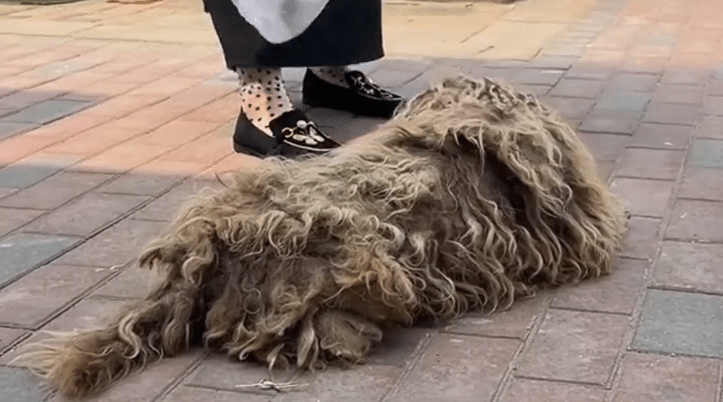
Even his heavily matted coat would be handled with patience.
Because Mao Mao was already 12, there was no reason to subject him to unnecessary stress simply to make his appearance change quickly.
Grooming could be approached gradually when the weather was warmer and the process more comfortable for him.
At his age, his well-being mattered more than appearances.
That understanding reflected the same lesson the shop owner had learned from the beginning:
Mao Mao responded best when people allowed him time.
Nothing About Him Needed to Be Forced
It would be easy to describe Mao Mao's experience as a rescue.
But that would not quite tell the truth.
He had not been abandoned without a home.
He had not been waiting for someone to adopt him.
What he needed was more subtle.
He needed someone willing to notice his routine before making assumptions about it.
The shop owner could have chased him away.
She could have tried to force him inside the first time she became concerned.
She could have decided that his tangled fur meant she already understood his entire story.
Instead, she watched.
She offered food.
She gave him space.
And when the rain came, she adjusted her actions to what he was comfortable accepting.
That patience allowed the real story to reveal itself naturally.
Mao Mao was an old dog with his own habits, preferences, and familiar world.
He had a family.
He also had a favorite shop.
The two things did not have to compete.
The Visitor Who No Longer Keeps His Distance
Mao Mao still returns.
But the atmosphere around those visits has changed.
The dog who once sat quietly at a distance now approaches the entrance with far more confidence.
When he sees the woman, his tail may begin to move gently.
There is no longer the same uncertainty about whether she can come near.
The shop has become part of his familiar world.
And the woman is no longer simply the person who leaves food beside the door.
She is someone he has learned to trust.
For a senior dog, that kind of trust can be especially meaningful.
Mao Mao had spent years developing his own way of moving through life.
The woman did not ask him to abandon that independence in exchange for kindness.
She simply made room for him.
Perhaps that is why he kept coming back.
Not because he was asking to be saved.
Not because he had nowhere else to go.
But because, in his quiet way, he had found another place where he felt welcome.
Mao Mao's story is a reminder that helping an animal does not always mean changing its entire life.
Sometimes it means paying attention long enough to understand the life already there.
A little food.
A dry towel.
A safe corner during the rain.
A familiar face waiting at the same shop.
None of those things were dramatic.
Together, they became something lasting.
And for Mao Mao, they were enough to turn a place he once visited cautiously into somewhere he could approach without fear.


