
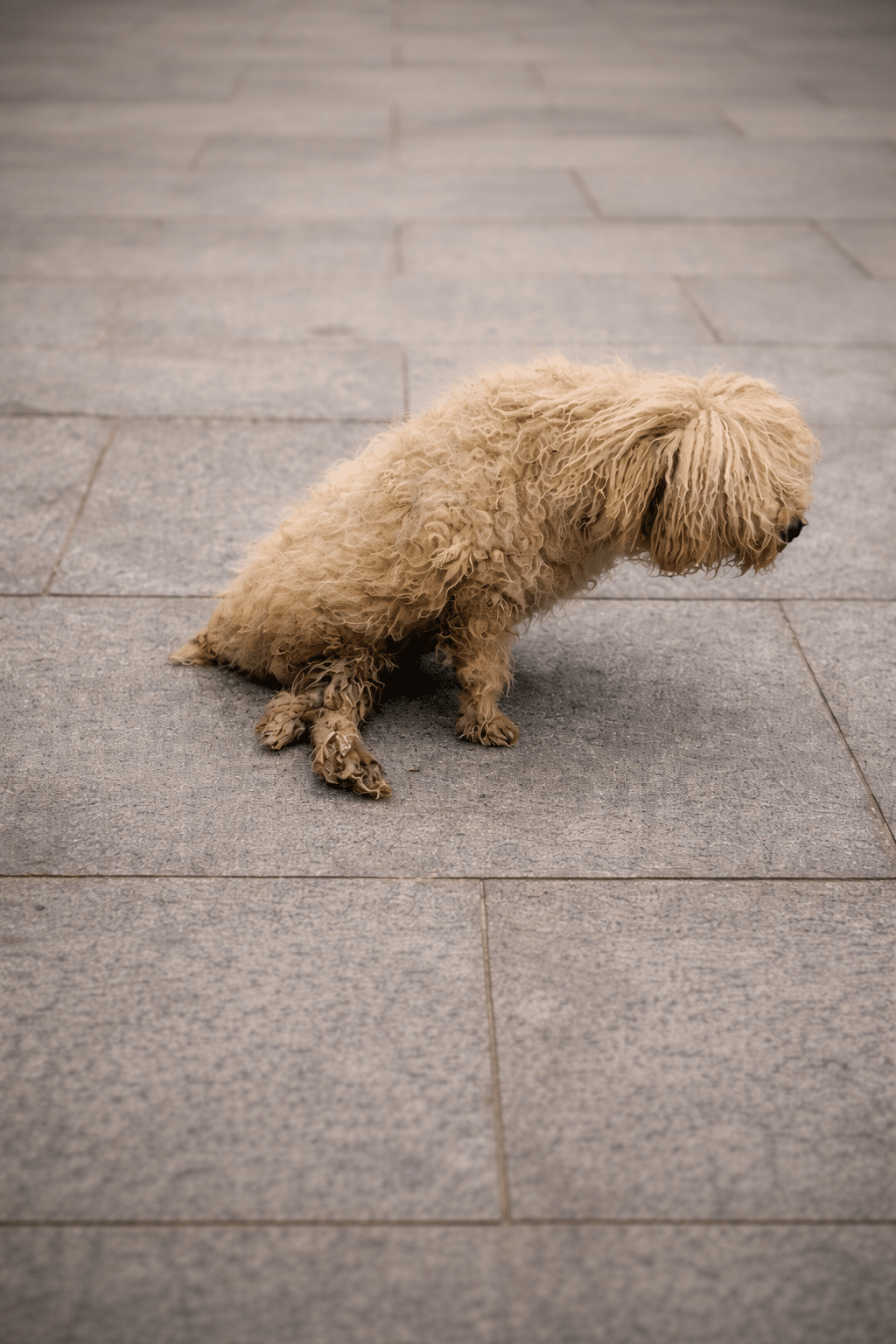
When Hai Hai tried to move, his front legs did all the work.
He pulled his small body across the ground while his back legs followed behind, unable to support him. Even a short distance demanded enormous effort.
Still, he kept going.
Beneath a thick layer of tangled fur was a fragile dog whose body had already been through more than anyone could immediately see. His coat made him look larger than he really was, hiding just how thin and vulnerable he had become.
Yet there was determination in every movement.
Hai Hai could not walk normally, but he had not stopped trying to reach whatever was ahead of him.
Every Small Movement Took Everything He Had
There was nothing graceful about the way Hai Hai moved.
He planted his front paws, pulled himself forward, rested, and tried again. His hind legs offered no help.
It was a slow rhythm built entirely around what his body could still do.
The cause of his condition was not immediately visible. What rescuers could see was a dog adapting to a serious physical limitation with the only strength still available to him.
His long coat had also become heavily tangled.
Underneath all that fur, there was no way to know at first what Hai Hai truly looked like or how much his body had weakened.
But one thing was obvious.
He needed help that could not wait.
A Rainy Night Became His Turning Point
The decision to bring Hai Hai to safety came on a rainy night.
Instead of leaving him to continue dragging himself along the ground, rescuers carefully lifted him and transported him to a veterinary clinic.
For perhaps the first time in a long while, Hai Hai no longer had to use every bit of his strength simply to move from one place to another.
At the clinic, the veterinary team began examining him.
What they discovered explained why his back legs had stopped working.
Hai Hai had suffered a serious spinal injury. The damage had affected his ability to move his hind legs, leaving him dependent on the front half of his body whenever he tried to get around.
He was also physically weak and had several health concerns that required attention.
There was no instant solution.
His recovery would depend on careful care, observation, patience, and finding a way to help him live with the mobility he still had.
But the most important change had already happened.
Hai Hai was no longer struggling by himself.
Beneath the Matted Fur Was a Tiny Bichon
As the veterinary team began cleaning him up, they carefully removed the thick, tangled fur covering his body.
With each section that came away, Hai Hai seemed to become smaller.
Then his real appearance emerged.
Underneath the neglected coat was a tiny Bichon with a soft face, bright eyes, and a gentle expression that had been almost completely hidden.
The transformation did more than change the way he looked.
It revealed the little dog underneath the hardship.
His appearance suggested that he had once experienced a very different life. Whatever had happened before rescuers found him remained outside the story they could see now.
What mattered was the dog in front of them.
Hai Hai was safe.
He was receiving attention.
And he was beginning the difficult process of adjusting to a body that no longer moved the way it once had.
VIDEO: He Dragged Himself Forward With Only His Front Legs — Then Someone Gave Him a New Way to Move
Recovery Began With the Smallest Things
Hai Hai's first days in care were not about dramatic progress.
They were about stability.
He was kept warm while the veterinary team watched his condition closely. Fluids were provided as needed, and his caregivers gave his weakened body time to respond.
There was no reason to rush him.
After living with such limited mobility, even ordinary moments of comfort mattered.
A safe place to rest meant he no longer had to pull himself across the ground simply to find somewhere better.
Hands approaching him now brought care rather than another obstacle.
Despite everything his body had endured, Hai Hai remained remarkably gentle.
He allowed the people around him to handle and care for him without resistance.
Then another encouraging sign appeared.
He started eating.
It was a small development, but small developments can mean a great deal during recovery.
Food meant energy.
Rest meant strength.
And every quiet day in safety gave Hai Hai's body another opportunity to stabilize.
His spinal injury had changed what his back legs could do, but it did not erase his curiosity or his desire to move.
That would soon become important.
Four Wheels Changed the Meaning of Moving Forward
The veterinary team could not simply ask Hai Hai's hind legs to work again.
Instead, they found another way to give him mobility.
A small wheelchair was prepared especially for him.
It supported the back of his body while allowing his front legs to provide the movement he already knew how to create.
At first, Hai Hai was unsure.
The frame around his body was unfamiliar. Moving while supported felt completely different from dragging himself along the ground.
His early attempts were hesitant.
He needed time to understand the balance.
He needed to learn how much pressure to put through his front legs and how the wheels responded when he changed direction.
Nobody expected perfection.
They simply encouraged him to try.
And gradually, he did.
One movement became another.
A few uncertain steps turned into forward motion.
For so long, Hai Hai's body had scraped behind him whenever he tried to travel anywhere. Now the wheelchair lifted and supported the part of him that could no longer carry its own weight.
He was still using his front legs.
But everything about the experience had changed.
Instead of pulling his body across the ground, Hai Hai was rolling forward.
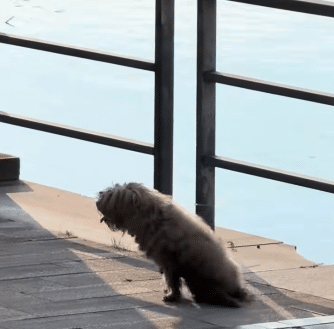
Confidence Came One Turn at a Time
Learning to use the wheelchair was its own kind of rehabilitation.
Hai Hai needed practice.
At first, even turning could require concentration. His body had developed one way of moving out of necessity, and now he had to discover another.
Day by day, the unfamiliar equipment became less strange.
He began to understand how to balance.
He learned how to change direction.
He became increasingly comfortable moving across the ground without his hindquarters dragging behind him.
The difference could be seen not only in how he traveled but also in the energy he brought to those moments.
His eyes appeared brighter.
His movements carried more confidence.
The wheelchair did not erase his injury.
It did something equally important: it allowed Hai Hai to work around it.
That distinction mattered.
His second chance was not based on becoming exactly the dog he had been before.
It was based on discovering what remained possible.
He Found a Home Among Dogs Who Understood
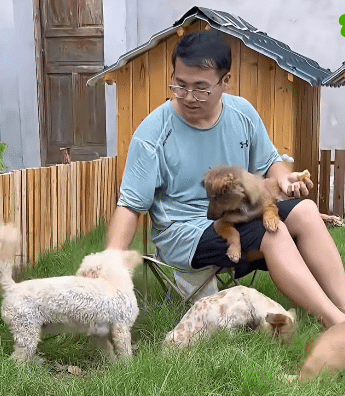
Hai Hai eventually came to live in a place where he was surrounded by other dogs facing challenges of their own.
For a dog whose movement had once been defined by isolation and physical struggle, the setting offered something simple but meaningful.
He was not alone.
There were other dogs nearby.
There were warm places to rest.
There was room to move.
And there were people who understood that a disability did not make his life less valuable.
With his wheelchair supporting him, Hai Hai could travel across the grass with a steadiness that had once seemed impossible when rescuers first saw him pulling himself forward.
The wheels became part of his everyday rhythm.
They did not hide what had happened to him.
They helped him live beyond it.
His Life Did Not Need to Return to the Past
Hai Hai may never move exactly as he once did before his spinal injury.
That is not what makes his story meaningful.
He can move now.
He can explore.
He can respond to the world around him instead of spending all his strength simply dragging himself toward the next place.
His progress came through many small acts rather than one dramatic moment.
Someone noticed that he needed help.
Someone carried him out of the rain.
Veterinary care revealed what his body was facing.
His tangled coat was removed.
He was kept warm, monitored, fed, and given time.
Then someone looked at the abilities Hai Hai still had and found a way to build around them.
A small wheelchair changed his relationship with the ground beneath him.
The dog who once had to pull his body forward can now glide across the grass alongside other dogs.
His back legs may remain limited, but his world no longer has to be.
Sometimes a second chance does not mean restoring everything that was lost.
Sometimes it means adapting with compassion, patience, and creativity until life becomes possible in a different way.
For Hai Hai, moving forward no longer means dragging himself inch by inch.
Now, he has wheels beneath him, caring people around him, and space ahead to keep going.


