
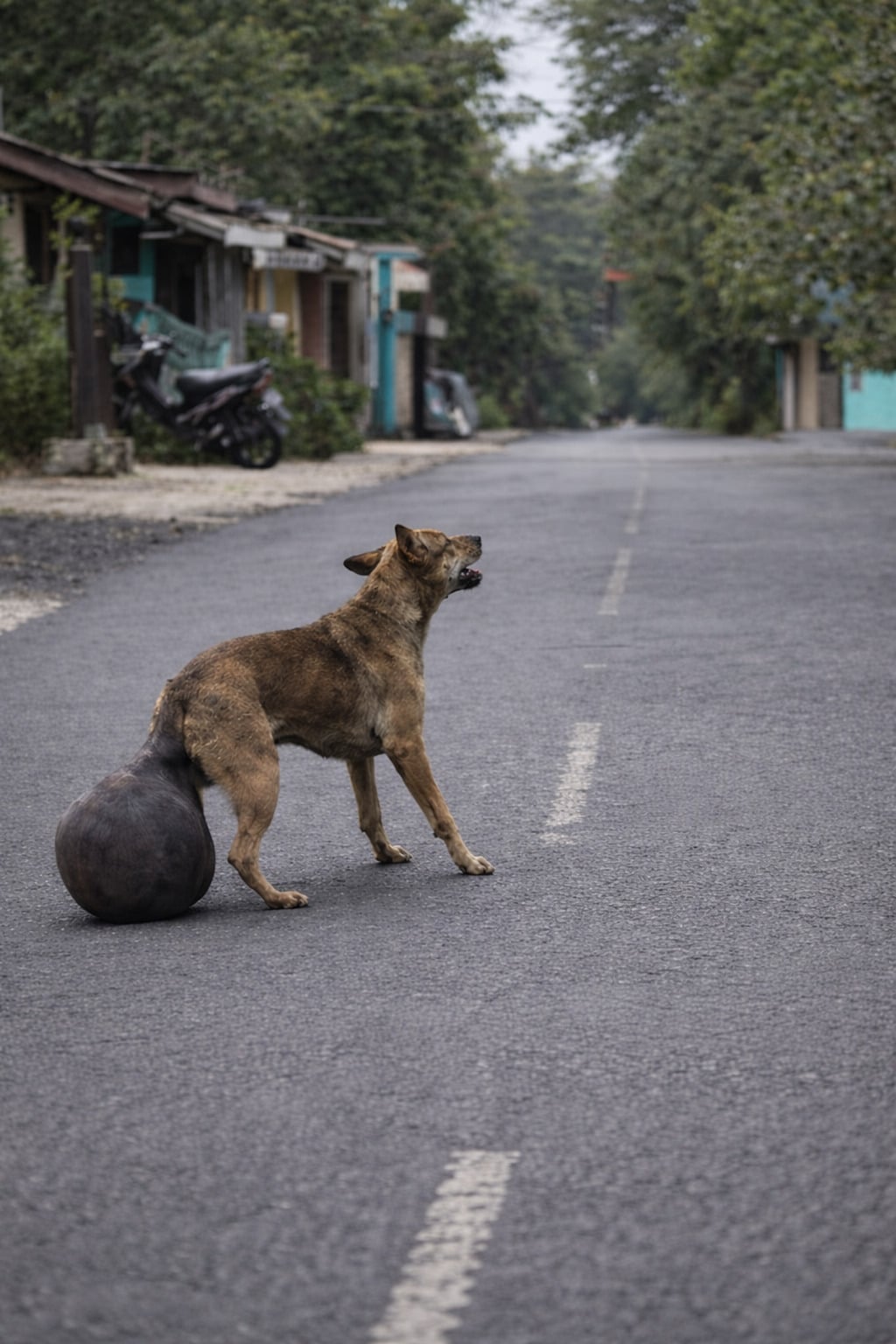
Puspita had learned to move carefully.
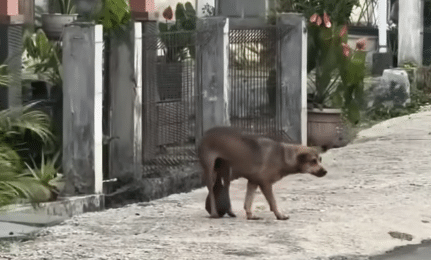
Along the edge of a quiet roadside, the thin stray dog walked with an enormous growth hanging from one of her back legs. Every step required effort, and the heavy mass moved with her as she searched for the few things that might help her survive another day.
Food.
Shelter.
And somewhere people would leave her alone.
For a dog already struggling physically, life on the streets offered very little comfort.
She Followed People Because Hunger Left Few Choices
Puspita sometimes followed workers, particularly people collecting scrap, hoping that someone might share a little food.
But kindness was never guaranteed.
Many people saw only a sick stray wandering too close and drove her away. Over time, avoiding people became part of the way she survived.
When she felt threatened, she disappeared into drainage pipes and other narrow spaces where she could hide.
One scene showed just how frightened she had become. While sheltering inside a drainage pipe, Puspita cried out as someone attempted to force her away with a stick.
She retreated deeper into the place that had become her refuge.
There were no soft beds waiting for her.
No regular meals.
No safe home to return to.
Instead, she searched through scraps and moved between the roadside and dark pipes, carrying a physical burden that made an already difficult life even harder.
Her behavior told its own story.
Whenever people came too close, she tried to escape.
Reaching Her Meant Moving at Her Pace
When rescuers learned about Puspita, approaching her proved far more difficult than simply walking over and picking her up.
She was frightened of people.
Each attempt to move closer made her retreat.
The rescuers recognized that chasing her would only increase her panic, so they changed their approach. Rather than forcing the situation, they watched quietly from a distance and began learning her routine.
Eventually, they noticed something important.
At night, Puspita regularly entered a narrow construction pipe where she rested.
That routine offered an opportunity.
The rescuers prepared carefully and waited until she entered the pipe again. Once she was inside, they quietly positioned themselves around the area and began guiding her toward a prepared purple metal cage.
There was no need for sudden movements.
Patience mattered more.
After living so long by avoiding human contact, Puspita could not understand that these strangers were trying to help her.
At first, she struggled against the unfamiliar situation.
Then the cage was secured and placed inside the rescue vehicle.
And something changed.
The frightened dog became quiet.
She lay inside the crate as the vehicle carried her away from the streets that had shaped her life for so long.
VIDEO: Puspita Hid From People for So Long — Until Patient Rescuers Finally Brought Her to Safety
Her First Night Away From the Street
That evening, one of Puspita's rescuers brought her home.
For the first time in a long while, survival no longer depended on finding scraps or hiding inside a pipe.
A meal of sausages and meat was prepared and placed near her cage. Friendly dogs belonging to the rescuer remained nearby, helping create a calm environment around the frightened newcomer.
But safety and trust are not the same thing.
Puspita stayed curled tightly in a corner.
The food was there.
No one was chasing her.
Nothing was demanding that she run.
Still, she did not eat.
After so much time relying on caution, a single quiet evening could not erase the habits that had kept her alive outdoors.
The rescuers did not force her.
For that first night, simply knowing that Puspita was no longer wandering the streets was enough.
She had shelter.
She had food available.
And she finally had people willing to give her time.
A Name, an Examination, and Unexpected Hope
The following morning brought the next important step.
Puspita was taken to a veterinary clinic for a full examination.
The veterinary team carefully checked her condition. Her heartbeat was fast and irregular during the visit, while the enormous growth attached to her back leg remained the most obvious concern.
It was also during this stage of her rescue that she received the name Puspita.
Until then, she had largely existed as an unwanted stray moving quietly through the roadside environment.
Now she had a name.
And people were paying attention to what she needed.
The size of the tumor understandably raised serious concern. It had become so large that it interfered with the way she walked and had likely been weighing on her for some time.
After examining it, however, the veterinarians were able to deliver encouraging news.
The tumor was benign.
It was extremely large and uncomfortable, but according to the examination, it was not cancerous.
For the people who had worked so patiently to bring Puspita to safety, the result offered something they had not been able to count on before.
A realistic path forward.
The Burden She Had Carried Could Finally Be Removed
With the examination completed, attention turned to removing the tumor.
Puspita underwent surgery, and the procedure went smoothly.
Afterward, the difference was impossible to miss.
The enormous mass that had once hung from her leg was gone. In its place was a carefully closed surgical area that now needed time to heal.
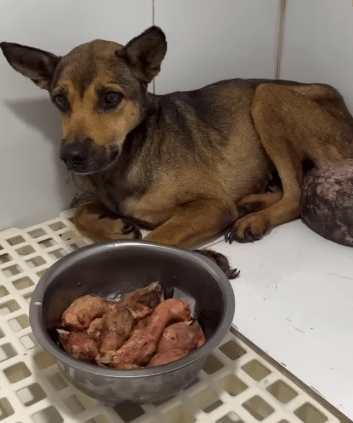
Puspita rested in a clean recovery space wearing a protective e-collar so she could not disturb the healing area.
Nearby, her rescuer continued offering food and watching over her.
Her situation had changed dramatically in a short period of time.
Only recently, she had been moving slowly beside a road, searching for scraps while carrying a growth that made every step harder.
She had hidden inside drainage and construction pipes because those narrow spaces felt safer than being near people.
Now she was resting indoors after receiving veterinary care.
The physical burden was gone.
The quieter work of recovery could begin.
Learning That Not Every Human Would Chase Her Away
Puspita's rescue was not only about removing a tumor.
Her fear had been built through repeated experiences of being driven away and having to protect herself.
That kind of caution does not disappear the moment a cage door closes or a meal is placed nearby.
Her first night in safety made that clear.
She had food but remained too uncertain to eat.
She had shelter but still curled tightly into the corner.
The rescuers could remove her from the street quickly.
Learning to feel secure would take longer.
That is why the patience shown during her rescue mattered so much.
They did not simply chase her until exhaustion made capture possible. They watched her routine, waited for the right moment, and worked around the fear she was already carrying.
That same patience would remain important after surgery.
Healing is sometimes measured in large changes.
A successful operation.
A painful burden removed.
A safe place to recover.
But for a frightened stray, it can also be measured in smaller moments: remaining calm near a person, accepting food, or slowly discovering that a nearby hand is not there to drive her away.
A Different Life Had Finally Become Possible
Puspita's story began with a lonely image: a thin dog walking beside the road while a massive tumor pulled heavily from her leg.
She had adapted to a difficult life.
She searched for food where she could find it.
She followed people when hunger outweighed caution.
She hid inside pipes when the world felt unsafe.
And when humans approached, her first instinct was to escape.
Yet the people who eventually came for her were willing to do something different.
They waited.
They observed.
They moved carefully.
And when Puspita finally entered their care, they continued helping her one step at a time.
A safe night led to a veterinary examination.
The examination brought encouraging news.
And that news opened the way for surgery that removed the enormous weight she had carried for so long.
Her recovery was still beginning in the final moments of the story.
Trust would need time.
Her body would need time as well.
But one important thing had already changed.
Puspita no longer had to face those things alone.
The drainage pipes, roadside searches, and exhausting steps beneath the weight of the tumor were behind her.
Ahead was something much simpler, but completely new:
A protected place to rest.
People willing to care for her.
And the chance to discover what life could feel like without that heavy burden following every step.


