
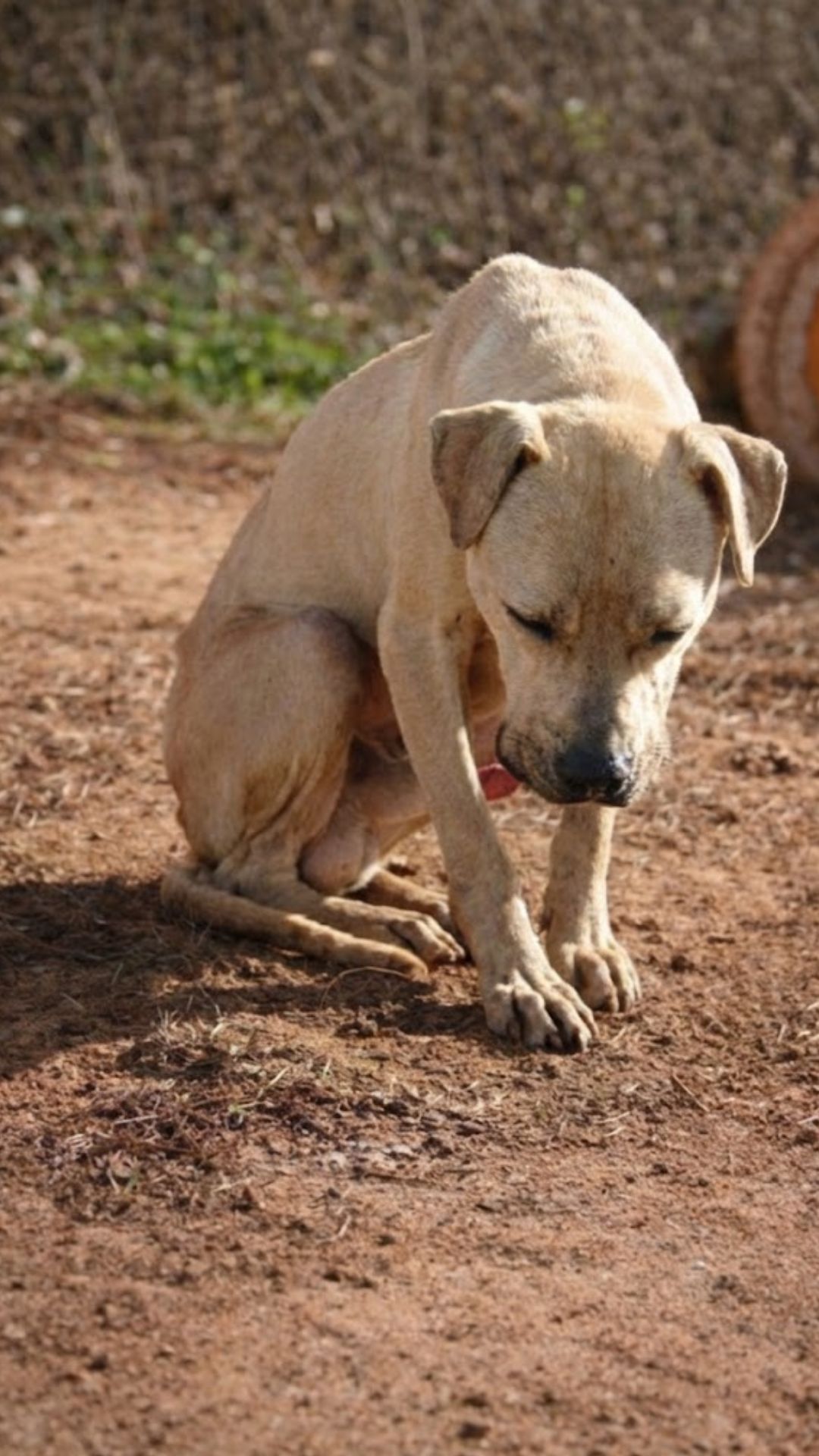
Some dogs learn to disappear because disappearing is how they survive.
For months, a dog known as Momma moved through the abandoned properties and overgrown lots of North St. Louis, always managing to stay just beyond the reach of the people trying to help her.
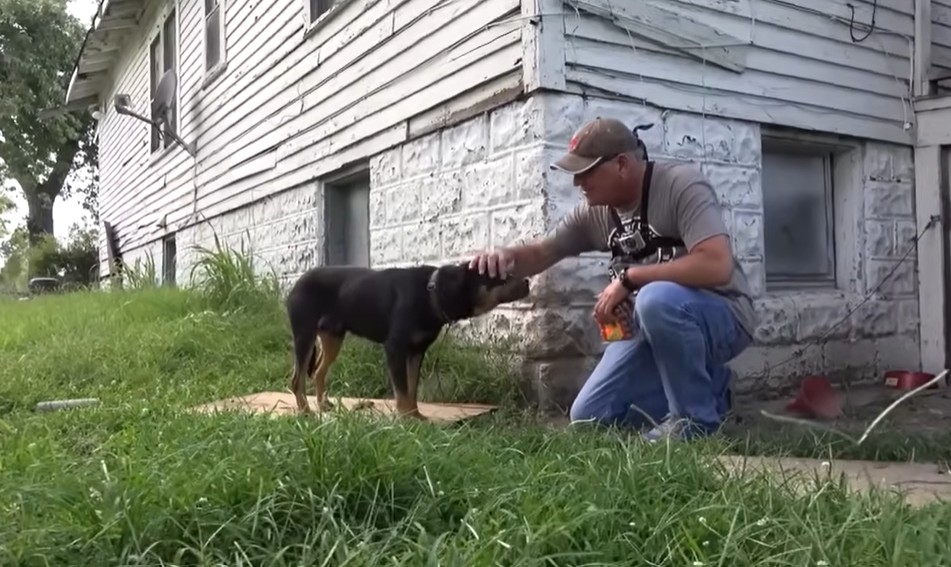
Randy Grim, founder of Stray Rescue of St. Louis, had been searching for her since November.
Again and again, rescuers came close.
Again and again, Momma vanished into the streets.
By the time they finally reached her, the long pursuit had become something much more urgent than a rescue.
Her life was in immediate danger.
Five Months of Running From Help
No one could fully explain everything Momma had experienced before she was rescued.
What rescuers could see was enough.
Her body carried numerous puncture injuries, and many of them had become seriously infected. Randy and his team believed she may have been involved in street fights or possibly used as a bait dog, although her complete history remained unknown.
What mattered most in that moment was not how the injuries had happened.
It was how little time she appeared to have left.
The infection had spread through her body to the point that septic shock had become an immediate concern.
Randy later described the situation in painfully simple terms: Momma should not have still been alive.
When they found her, he believed she was only hours away from dying.
For a dog that had spent five months avoiding capture, finally being caught may have been the one thing that saved her.
The streets had taught Momma to fear.
Now the people she had spent so long running from were the people standing between her and death.
The Rescue Was Only the First Battle
Getting Momma off the streets did not mean the danger had passed.
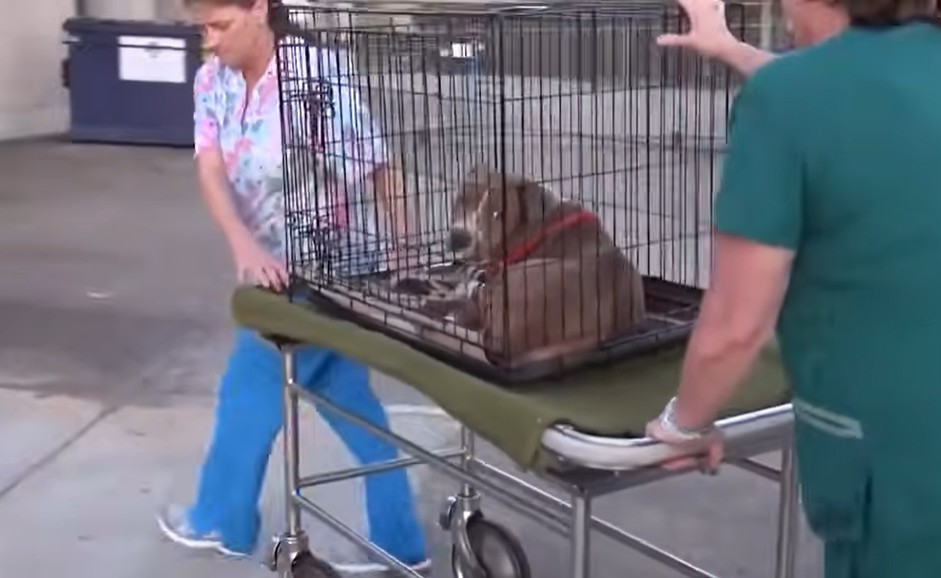
She needed intensive medical attention immediately.
Rescuers rushed her to Foster Creek, where she could receive around-the-clock care. Her condition was serious enough that even the first night in intensive care was expected to cost about $2,700.
For Randy, however, the decision was not complicated.
Momma was alive.
That was enough reason to try.
She had lost a significant amount of weight, and her body remained extremely sensitive. Even gentle contact could make her flinch.
The trauma was not only physical.
When other dogs were nearby, Momma trembled.
Whatever she had experienced before rescue had left her deeply frightened of them.
Yet there was another side of her that had somehow survived alongside the fear.
She was still gentle.
Under the exhaustion, the pain, and the instinct to protect herself, the dog rescuers had spent months pursuing had not lost her capacity for softness.
That small truth gave the people caring for her something to hold onto.
VIDEO: Five Months of Running Ended With a Race to Save Momma’s Life
Small Signs That Life Was Still Waiting
In intensive care, progress could not be measured in dramatic transformations.
Momma needed time.
Her medical team worked to stabilize her while her body fought the severe infection that had nearly overwhelmed it.
There were no guarantees.
But slowly, she began to hold on.
For everyone who had watched her arrive in such critical condition, even small moments began to matter.
One of those moments came through the clinic glass.
Momma noticed another dog nearby—one who happened to look remarkably similar to her.
Despite the fear she usually showed around dogs, she seemed unusually interested in this particular pup.
The rescuers jokingly wondered whether she had developed a little crush.
It was a light moment inside an otherwise serious situation.
But it also offered a glimpse of something larger.
Momma was no longer spending every moment simply trying to survive another day on the streets.
For the first time in a long time, she had the chance to notice the world around her from a place of safety.
The difference may sound small.
For a frightened dog recovering from severe illness, it was not.
Safety creates space for other things to return.
Curiosity.
Trust.
Interest.
The quiet behaviors that ordinary dogs experience without anyone thinking twice about them.
Momma was only beginning that journey.
The Streets Still Held Others Waiting for Help
Once Momma was receiving the care she needed, Randy and his team returned to the work that had brought them into these neighborhoods in the first place.
Their next stop was East St. Louis.
Randy has described parts of the area as an “urban jungle”—neighborhoods filled with neglected properties, abandoned houses, and animals whose needs can easily become invisible.
The problem is rarely limited to one dog.
On this visit, rescuers encountered two male dogs chained separately on a neglected property.
Trash surrounded the area.
Both dogs had signs of fly strike affecting their ears, and Randy believed they would also likely test positive for heartworm.
Their situation reflected something he had seen many times before.
People leave.
Dogs remain.
Sometimes families move from struggling neighborhoods and animals are left behind. Sometimes dogs stay chained to properties that are slowly falling apart around them.
For rescue workers, discovering them can be only the beginning.
Reaching an animal is one challenge.
Understanding the human situation around that animal can be another.
When Rescue Requires More Than a Leash
Later, the team noticed another dog wandering nearby.
The dog was beautiful, but extremely frightened and poorly socialized. Randy and the others tried to safely trap the animal.
They were nearly successful.
Then a man appeared and said the dog belonged to him.
It was the kind of situation that cannot always be solved in a single moment.
Rescue work in communities facing poverty, crime, abandoned properties, and limited resources requires more than simply identifying an animal that appears to need help.
It requires relationships.
Patience.
And often, the willingness to return later rather than force a confrontation that could close the door permanently.
Randy hoped to reconnect with the people involved and offer assistance, possibly including free supplies.
Sometimes practical support becomes the first step toward trust.
And trust can eventually create opportunities to improve an animal's life.
That approach may not provide the immediate emotional resolution people expect from a rescue story.
But real rescue work is often more complicated than a dramatic moment of taking a dog away.
Long-term change depends on people being willing to keep showing up.
The Work Continues After the Camera Leaves
For Randy and his teammate Donna, days like this are not unusual.
There are dangerous neighborhoods to navigate.
Dogs that run when help approaches.
Animals whose medical needs are far beyond what anyone can see from a distance.
Situations where ownership, poverty, fear, and limited resources make every decision more complicated.
And sometimes rescuers arrive too late.
Still, they keep returning.
Momma herself is proof of why persistence matters.
Randy had been trying to save her for roughly five months.
Five months of searching.
Five months of watching her escape.
Five months in which it might have been easy to assume that she would never allow anyone close enough to help.
Then came the day when persistence finally met opportunity.
If rescuers had stopped looking, Momma's story could have ended very differently.
Instead, she reached intensive care with only a narrow margin of time remaining.
A $2,700 Night Was Really a Chance
The estimated cost of Momma's first night in intensive care—about $2,700—was significant.
But rescue organizations regularly face choices where money and time become inseparable from survival.
For Momma, that expense represented something simple.
Another night.
Another chance for medication and monitoring to do their work.
Another opportunity for her body to stabilize.
Another morning she might live long enough to see.
Rescuers cannot save every animal they encounter.
Resources are limited, medical care is expensive, and the need never seems to stop.
But when a dog has already endured months on the streets and still reaches safety alive, sometimes the question becomes less about whether the effort is easy and more about whether there is still a chance.
Momma had one.
So they took it.
From Survival Toward Something More
According to the rescue, Momma began slowly recovering and was expected to move toward the adoption program.
That did not erase what had happened to her.
Her fear around other dogs showed that healing would involve more than treating an infection.
Trust would need time.
Confidence would need time.
The simple experience of living without constantly preparing for danger would need time too.
But she now had something she had not possessed while moving through the abandoned lots of North St. Louis.
Time itself.
She no longer had to spend every day finding a place to hide.
She no longer had to run whenever rescuers appeared.
She no longer had to survive alone while serious injuries worsened.
The dog who had once vanished whenever help came near was finally surrounded by people determined to keep her safe.
Her story also reflects the larger reality Randy and Donna encounter every time they return to these neighborhoods.
There is always another property.
Another frightened dog.
Another situation that cannot be solved in a single afternoon.
Yet every successful rescue creates one small change in that landscape.
For Momma, that change came after five difficult months.
She went from hiding in North City to receiving round-the-clock care.
From being dangerously close to septic shock to beginning the slow process of recovery.
From having no obvious path off the streets to preparing for the possibility of adoption.
Rescue did not erase her past.
It gave her a future beyond it.
And somewhere in the forgotten corners of St. Louis, Randy Grim and his team will keep driving, searching for the next animal still waiting for someone to notice—and refusing to assume that being difficult to reach means being impossible to save.


