
Some lives become so restricted that even the simplest freedom can feel unfamiliar.
For Penny, freedom began beside a busy road.
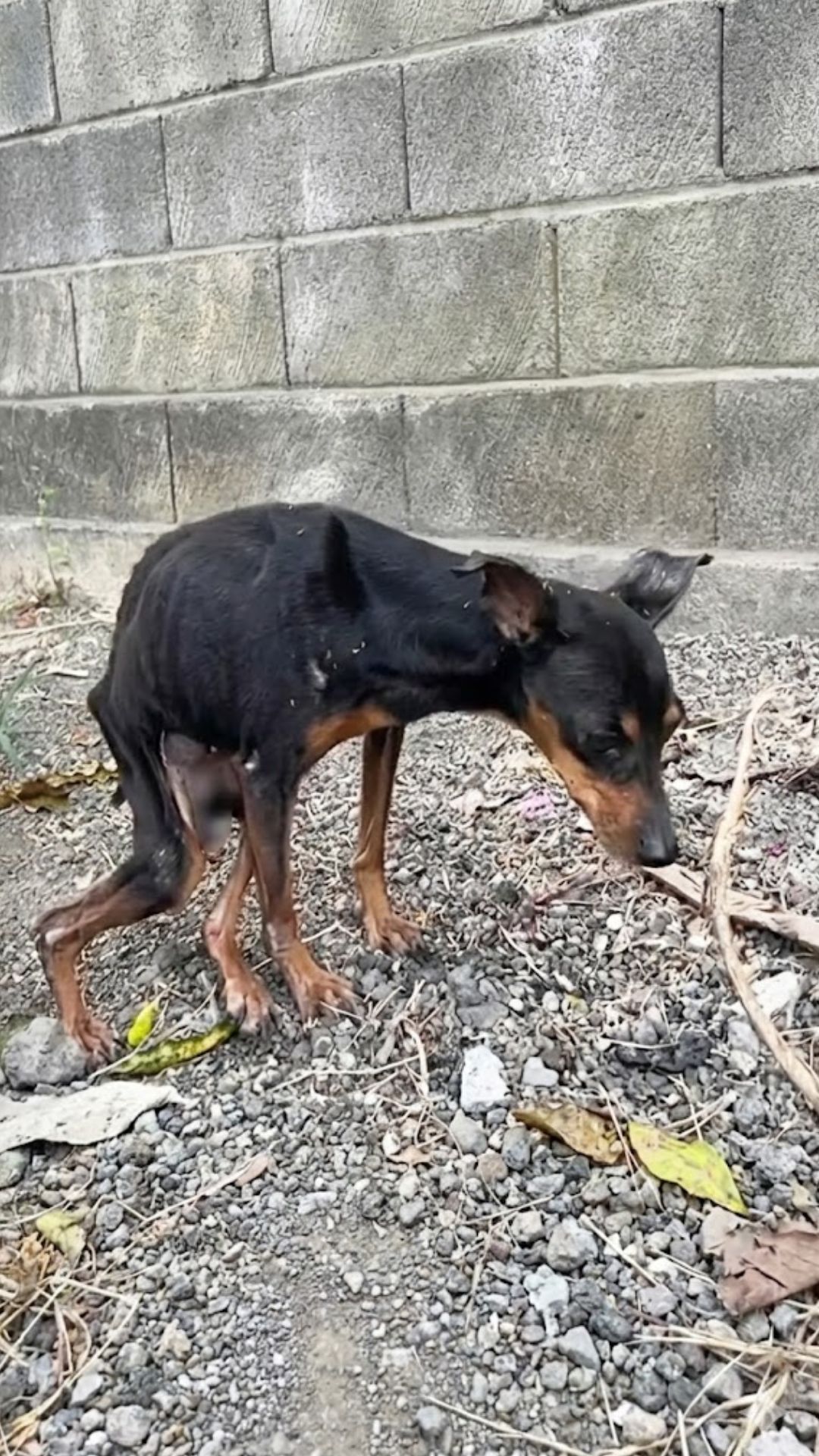
She was tiny, frightened, and trembling as cars rushed past. Her body looked painfully thin, and when someone finally approached to help, Penny tried to get away.
She could not move normally.
Her hind legs bent at unnatural angles, making every attempt to escape difficult. At only 5.7 pounds, she seemed almost impossibly fragile against the noise and movement surrounding her.
People nearby shared another troubling detail. According to the account they gave rescuers, Penny had been left beside the road after a vehicle stopped late one night and then drove away.
For more than a week, she remained close to that same roadside.
She had nowhere familiar to return to.
And she did not yet understand that the person approaching her was about to change the direction of her life.
The Little Dog Who Could Barely Get Away
Fear was Penny's first response to help.
When the rescuer came closer, she attempted to flee, but the condition of her legs prevented her from moving the way a healthy dog could. Her body told a story long before anyone knew the details behind it.
She was severely underweight.
Her ribs were visible beneath her skin, and her unusual posture made it clear that her mobility problems were not minor.
Getting Penny away from the roadside was only the beginning.
Once she reached veterinary care, the staff began seeing something else that was just as revealing as her physical condition.
Inside the clinic cage, Penny became quiet.
She did not frantically search for a way out. She did not appear unsettled by the confined metal space.
Instead, she curled up.
For a dog who had just been rescued, the reaction seemed unusual.
Soon, the medical examination would offer a painful explanation.
Her Body Carried Years of Confinement
The veterinary assessment identified several serious health concerns.
Penny had anemia and significant skin problems. Some of her teeth were missing or badly deteriorated. Both hind legs also had Grade 4 luxating patellas, a severe condition affecting the kneecaps.
But the most important discovery concerned the unusual shape of her legs.
According to the veterinarian, the deformity was not believed to have come from the recent roadside incident.
Penny's body had developed that way over time.
The explanation given was that she had spent nearly five years confined in an extremely small cage, with so little room that normal movement and physical development had been affected.
As she grew, her pelvis and legs developed abnormally.
Suddenly, her calm behavior inside the clinic cage made more sense.
A cramped enclosure was not strange to Penny.
It was familiar.
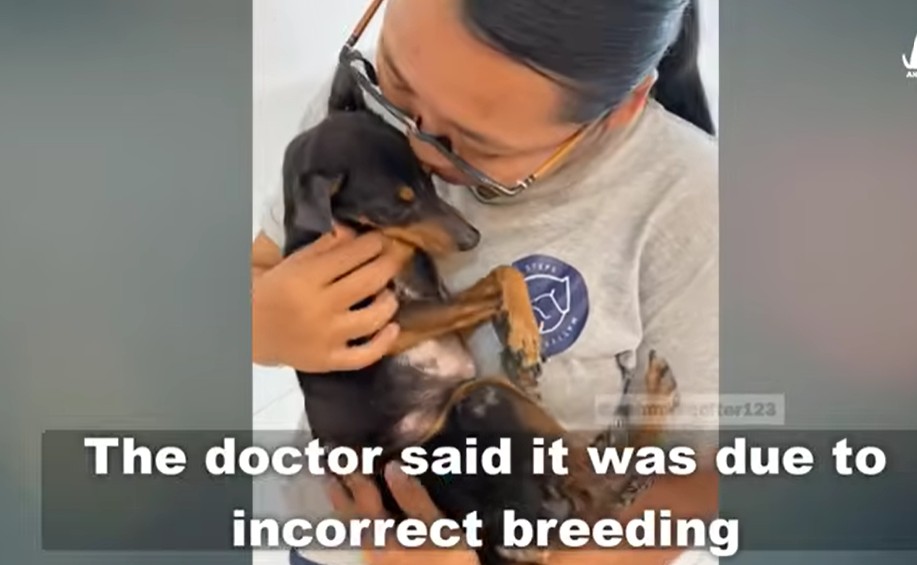
The realization changed how her rescuers understood nearly everything about her behavior.
Open space was new.
Freedom of movement was new.
Even the idea of having room to stretch was something Penny seemed to be experiencing in a completely different way.
Her body still carried the physical consequences of those years.
Yet her life was no longer limited to them.
VIDEO: Penny Could Barely Walk Beside the Road — Then Someone Finally Stopped
Healing Began With Things Most Dogs Take for Granted
Penny spent seven days being stabilized before she was ready to leave the clinic.
A complicated surgical procedure was still ahead, but the next chapter of her recovery was not defined only by medicine.
It was also about introducing her to ordinary experiences she had apparently never been free to enjoy.
One of them was a toy.
When Penny was given one, she looked at it with curiosity. She tilted her head and examined the unfamiliar object, as though she had no established idea of what she was supposed to do with it.
For many dogs, a toy is an everyday part of life.
For Penny, it represented something larger.
There was finally space for something other than survival.
Then came another experience that required no special equipment at all.
Sunlight.
Penny was allowed to lie outside in the grass, where the warmth of the sun reached her body and a breeze moved through her fur.
There were no metal bars around her.
Nothing forced her to curl into a tiny space.
She could simply rest.
Those quiet moments became an important part of her new world.
The physical problems had not disappeared. Her legs were still damaged, and surgery remained necessary.
But Penny was beginning to discover what safety could feel like beyond the walls of a cage.
Each Step Opened a Bigger World
By Day 15, Penny was joining her new family for a slow walk across open fields.
She could not move quickly or effortlessly.
Every step had to be taken with the limitations her body had carried for years.
Still, she moved forward.
The ground beneath her paws was no longer the floor of a cramped enclosure. Around her was open space, fresh air, and room to look in every direction.
For the first time, her world seemed to extend beyond whatever was immediately in front of her.
She could explore.
She could stop.
She could look around.
And she could move again when she was ready.
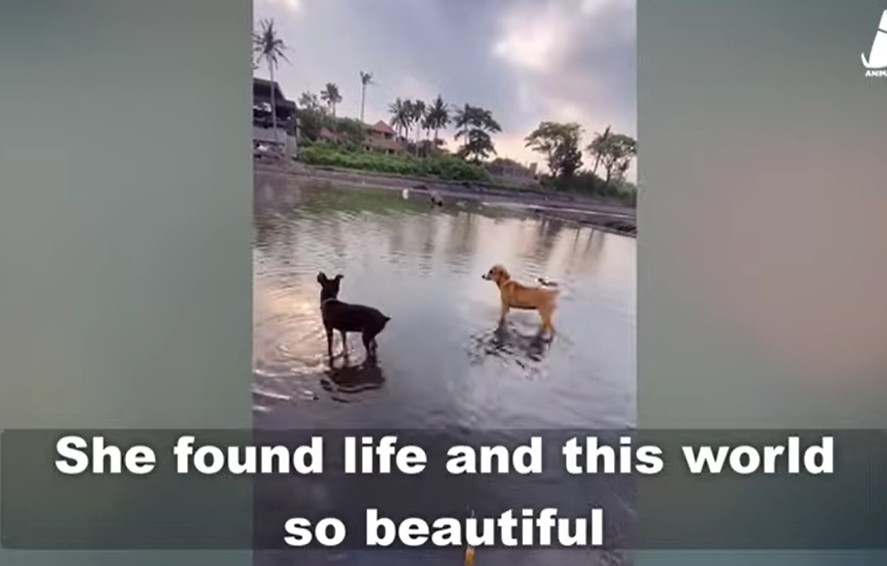
There was something especially meaningful about watching Penny experience ordinary outdoor life.
Nothing dramatic was required.
Grass beneath her paws mattered.
A breeze mattered.
The ability to choose where to step mattered.
For a dog whose movement had been restricted for so long, these small freedoms carried enormous weight.
But enjoying the outside world was only one part of Penny's recovery.
Her damaged legs still needed medical treatment if she was going to have a better chance at moving comfortably.
Surgery Gave Her Legs a New Chance
When the time came, Penny underwent a complicated operation involving her left femur and patella.
The procedure was intended to address some of the damage associated with years of abnormal development and restricted movement.
The surgery was successful.
When Penny woke afterward, she looked around for the people who had become familiar to her.
The operation, however, was not the end of the process.
Recovery required patience.
Penny still had to work through physical therapy and learn how to use her body differently after living with deformity for so long.
Progress could not be rushed.
Her muscles and joints had spent years adapting to abnormal movement. Building a new pattern required repeated effort and careful rehabilitation.
There were no instant transformations.
Instead, Penny's recovery came through small improvements.
Standing.
Balancing.
Taking controlled steps.
Trying again.
Each accomplishment represented something that once seemed far beyond the frightened dog found beside the road.
Over time, the legs that had limited her began carrying her farther.
Eventually, Penny started learning not merely how to walk more confidently, but how to run.
Her Past Shaped Her Body, Not Her Future
Penny's story is powerful partly because so much of her recovery involved things that can easily be overlooked.
A toy.
A patch of grass.
Warm sunlight.
Space to move.
Gentle care.
None of these things seem extraordinary in the life of a well-loved dog.
For Penny, they represented a completely different existence.
Her physical condition could not simply be erased. Years of confinement had left lasting effects that required veterinary treatment, surgery, rehabilitation, and patience.
But those years no longer controlled where she would spend the rest of her life.
The dog who once sat trembling beside traffic was no longer waiting alone.
She had people watching over her.
The dog who had learned that tiny enclosed spaces were normal was discovering fields and open air.
The dog whose legs had developed under severe restriction was being given the chance to move with greater strength.
And the little dog who once had almost nothing was learning what it meant to have a family.
One Brave Step After Another
Today, Penny's life looks very different from the one reflected in the condition in which she was found.
She is described as healthy, playful, and deeply loved.
The roadside where she waited is behind her.
So is the cramped cage that shaped so much of her early life.
What remains is the work of moving forward.
Penny's journey does not erase what happened to her. Her body will always carry evidence of a difficult beginning.
But scars and deformities are only part of a life.
They do not have to become the entire story.
For Penny, healing arrived through veterinary care, patient rehabilitation, simple comforts, and people willing to give her the time she needed.
Most of all, it arrived through freedom.
Freedom to stretch beneath the sun.
Freedom to feel grass beneath her paws.
Freedom to explore a field instead of staring through bars.
And freedom to keep moving toward a life that once would have been impossible for her to imagine.
One careful step became another.
Then another.
And Penny's world, once barely larger than a cage, finally began to open.


