
A Small Cry From Inside the Concrete
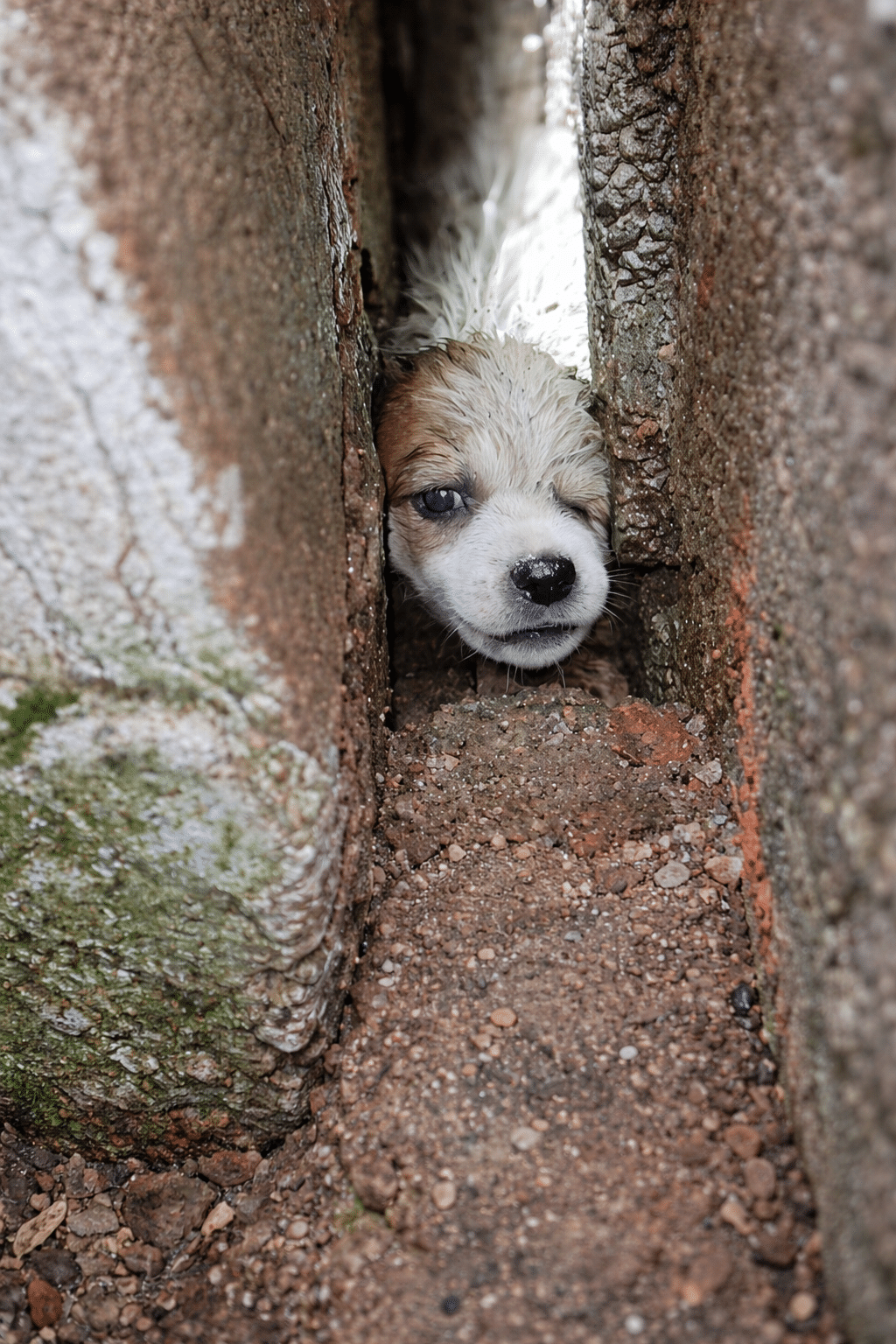
The puppy could barely move.
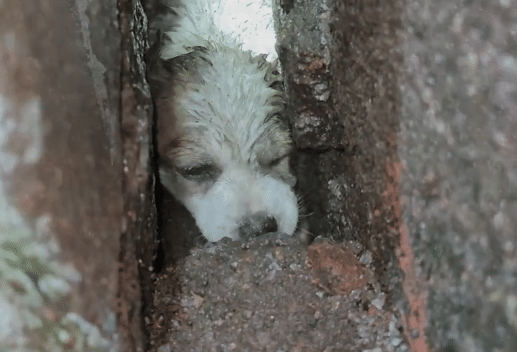
Wedged deep inside the narrow space between two concrete walls, his tiny body had nowhere to turn. There was no room to step forward, no way to back out, and no space to twist himself free.
Only his cries could escape.
Soft whimpers carried through the quiet night as the puppy remained trapped inside the cold concrete gap. He appeared frightened and confused, surrounded on both sides by walls that had accidentally become a prison.
For such a small animal, the situation was especially dangerous.
He could not reach food.
He could not reach water.
Most importantly, he could not escape without someone finding a way to reach him.
The opening was so narrow that even a human hand could not simply slide in and pull him out.
What looked like a simple rescue at first was going to require patience.
A Rescue That Could Not Be Rushed
When rescuers arrived, they quickly saw the problem.
The puppy was visible inside the gap, but the space around him was far too tight for anyone to safely grab him. Trying to pull him through the narrow opening could have caused injury.
So instead of forcing the situation, they began working on the wall itself.
Under dim nighttime lighting, rescuers brought tools to the concrete and started removing small sections around the trapped puppy.
It was slow work.
With a hammer and chisel, they carefully chipped away at the hard surface.
One strike.
Then another.
Small pieces of concrete loosened and fell away while dust collected below.
The goal was not to break open a large section of the wall. They only needed enough additional space to safely reach the puppy.
That meant every movement had to be controlled.
A careless strike too close to the animal could create another danger. Moving too aggressively could frighten him further.
So they continued little by little.
The puppy remained inside the narrow space, whimpering as unfamiliar sounds echoed around him.
But with each piece of concrete removed, more of his body became visible.
The opening was slowly getting wider.
Inch by Inch, the Gap Finally Opened
There was no dramatic shortcut.
The rescuers simply kept working.
They chipped away another small section.
Then they stopped to check the puppy.
Then they continued.
The concrete that had held him so tightly began to give way, creating the few precious inches they needed.
Eventually, the gap became wide enough for one rescuer to reach inside.
That was the moment the entire effort had been leading toward.
A hand slowly entered the opening.
The movement was gentle and deliberate, giving the frightened puppy as little additional stress as possible.
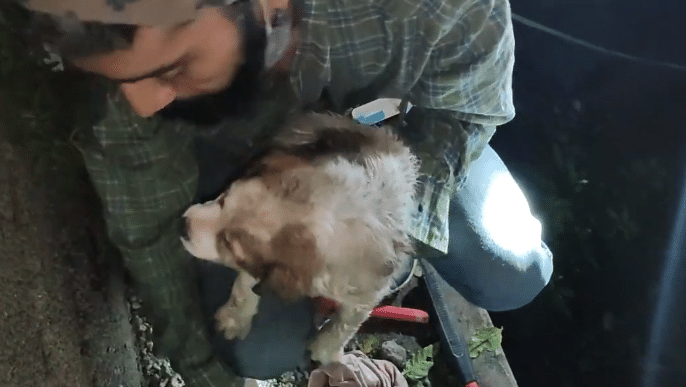
Then the rescuer carefully took hold of his small body.
For the first time since becoming trapped, the puppy began moving out of the space rather than deeper into it.
He was lifted slowly.
Past the broken edge of the concrete.
Past the narrow opening.
And finally, into the open air.
The walls no longer surrounded him.
He was free.
VIDEO: Trapped Between Two Concrete Walls, the Tiny Puppy Was Finally Lifted Into Safety
Back Where He Needed to Be
The rescue was not truly complete until the puppy was returned to someone who had been waiting nearby.
His mother.
After the ordeal, the small dog appeared safe and unharmed. The rescuers carried him toward the area where his mother had been anxiously waiting.
Her reaction was immediate.
As soon as the puppy was close enough, she moved toward him and began sniffing him carefully.
She nudged him with the kind of focused attention familiar to any mother checking her young after danger.
The puppy, meanwhile, had another urgent need.
He was hungry.
After spending so long trapped between the walls, he quickly began nursing while his mother remained close beside him.
The contrast was striking.
Only a short time earlier, he had been pressed helplessly between concrete surfaces with nowhere to go.
Now he was beside his mother again, feeding and resting in safety.
No tools.
No hammering.
No walls closing around him.
Just the comfort of being back where he belonged.
A Quiet Reunion After a Difficult Night
Some rescues end with a dramatic medical recovery.
This one ended with something much simpler.
A puppy returned to his mother.
There was no need to add anything more to the moment.
The danger had come from the physical space around him. Once rescuers widened that space and lifted him free, what he seemed to need most was the familiar presence of his mother.
Her careful sniffing and nudging offered a quiet confirmation that the ordeal was over.
For the rescuers, the result also showed why patience mattered so much.
The puppy had not been saved by pulling harder.
He had been saved because people were willing to slow down.
They assessed the space.
They chose a safer method.
They carefully removed concrete around him.
And they waited until the opening was wide enough to lift him without forcing his body through a dangerously narrow gap.
It was not a fast rescue.
But it was the kind of rescue that placed the animal's safety ahead of speed.
Why Rescues Like This Depend on Patience
Animal rescue can look very different from one emergency to another.
Sometimes the greatest challenge is distance.
Sometimes it is fear.
In this case, it was a few inches of concrete.
The puppy was close enough to see but still almost impossible to reach.
That is what made the situation so difficult.
The rescuers needed tools, careful coordination, and enough patience to keep working through the night without turning urgency into recklessness.
Every small piece of wall they removed brought the puppy closer to freedom.
That kind of effort is often invisible in the final moment.
Viewers see the instant when an animal is lifted into safety.
But before that moment can happen, there may be long periods of waiting, planning, checking, and carefully repeating the same small action.
Chip away a little concrete.
Check the puppy.
Adjust the angle.
Try again.
That persistence made the difference here.
Compassion Is Often Practical
Before the rescue video ends, the team shares a broader message about helping animals in danger.
Compassion is not always a single emotional moment.
Sometimes it means showing up with tools.
Sometimes it means staying longer than expected.
Sometimes it means working carefully through the night because an animal has no other way out.
Rescue organizations and volunteers often depend on support from people who understand that emergencies require time, equipment, and effort.
Not every rescue is complicated in the same way.
But every rescue depends on someone deciding that the trapped, frightened, or vulnerable animal is worth helping.
For this puppy, that decision changed everything.
A narrow concrete gap had left him helpless.
Then rescuers arrived and refused to rush the job.
Piece by piece, they created enough room.
Hand by hand, they brought him back into the open.
And after a frightening night between two walls, the small puppy was finally able to return to his mother.
Safe.
Close.
And no longer trapped.


