
Lost in the Bushes With No Way to See
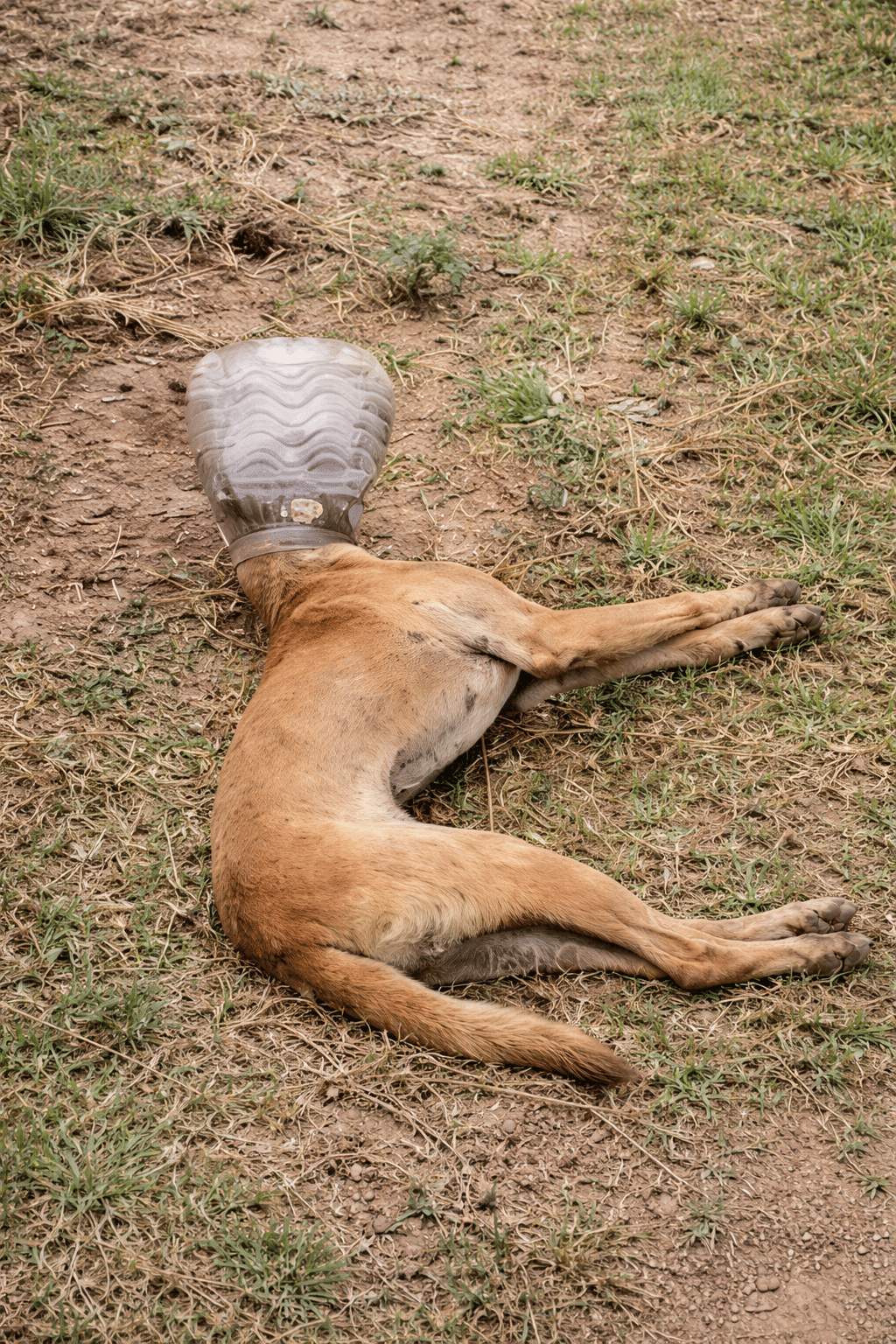
The dog moved through the thick vegetation in short, uncertain steps.
Wherever he turned, branches brushed against the hard plastic container covering his entire head. He could not properly see what was ahead of him, and even simple movement had become confusing.
A discarded plastic jar had become tightly lodged around his head.
What might have looked like ordinary trash to someone passing by had turned into a serious trap for a stray animal with no way to understand how to escape it.
The dog kept trying.
He pushed forward through the bushes, changed direction, and stumbled around the vegetation. But every attempt seemed to leave him just as trapped as before.
The container blocked his vision and prevented him from eating or drinking normally.
That made the situation increasingly urgent.
There was no way to know how long he had already been trapped, but one thing was clear: he could not solve the problem alone.
The more he moved, the more frightened and disoriented he appeared to become.
For an animal living outdoors, being unable to see the surroundings can quickly turn even a familiar area into a confusing maze. The dog could hear what was happening around him, but the rigid plastic prevented him from seeing where those sounds were coming from.
Then help arrived.
Getting Close Was the First Challenge
The rescuers immediately understood that freeing the dog would require more than simply walking up and pulling the container away.
He was frightened.
As people began approaching, he barked loudly from inside the jar. The sound echoed through the plastic, emphasizing just how completely his head was enclosed.
He could hear strangers getting closer without being able to see them.
His instinct was to escape.
The dog tried to move away through the bushes, but the rescuers remained patient. They carefully positioned themselves so that he would not disappear deeper into the vegetation, where reaching him could become much harder.
There was no need for unnecessary force.
What mattered was preventing panic from turning the rescue into another danger.
The team moved closer little by little, watching his movements and waiting for a safe opportunity to secure him.
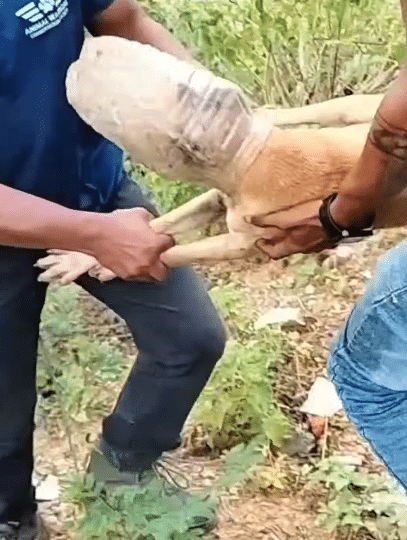
When that moment came, they gently held his body and legs.
The restraint was necessary for everyone involved. A terrified dog can struggle suddenly when it does not understand what is happening, and with his vision completely blocked, even a helping hand could feel threatening.
For the first time since the rescuers arrived, the dog was no longer running blindly through the bushes.
Now they could focus on the plastic jar.
VIDEO: Frightened and Unable to See, He Struggled Until Rescuers Finally Reached Him
The Jar Would Not Simply Pull Away
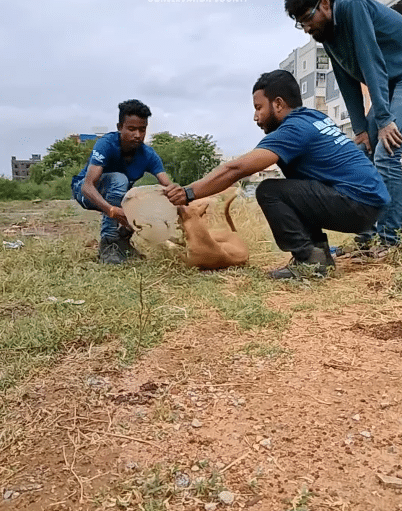
Once the dog was safely under control, the rescuers moved him into a more open area where they had enough room to work carefully.
Only then could they see how difficult the final step might be.
The jar was stuck tightly around his head and neck.
A hard pull was not the answer.
Trying to remove it too quickly could frighten the dog further or cause unnecessary discomfort, so the rescuers slowed everything down.
One person steadied him while another took hold of the container.
Then they began to twist.
A little movement.
A pause.
Then another careful rotation.
The process required patience because the plastic had become firmly wedged in place. Rather than fighting against it, the rescuers gradually worked the container loose.
The dog remained restrained while they continued.
For an animal that had spent the previous moments stumbling without sight, there was still no way for him to understand that the hands around him were trying to solve the problem.
He only had to stay still long enough for them to succeed.
Slowly, the jar began to shift.
That tiny movement was the first sign that the trap was finally giving way.
The rescuers continued rotating it, carefully creating enough space for the container to move past the dog's head.
Then came the moment everyone had been working toward.
With one final controlled pull, the plastic jar slid free.
His face was uncovered.
His vision returned.
And the object that had turned his surroundings into darkness was finally in the rescuers' hands instead of around his head.
From Confusion to Open Space in Seconds
The change was immediate.
Once the rescuers were confident that the container was completely removed, they released their hold.
The dog did not wait.
He jumped to his feet and ran.
After struggling slowly through bushes with his head trapped, he now crossed the nearby field with remarkable speed.
There was no jar blocking his view.
No rigid plastic surrounding his face.
No need to feel his way through branches without knowing what was ahead.
Within seconds, he was moving freely across the open ground before disappearing into the distance.
According to the source, he appeared unharmed after the ordeal.
There was no extended recovery scene or dramatic goodbye.
Just a dog running away under his own power after being given something he had been unable to give himself: freedom from the trap.
For the rescuers, that brief sprint was enough.
They had arrived while the situation could still be changed.
A simple intervention had separated a frightening emergency from an outcome that could have become much worse if the dog had remained trapped and unable to eat, drink, or navigate safely.
One Piece of Trash Had Nearly Become a Deadly Trap
The rescue could easily have ended when the dog ran away.
But one important thing remained on the ground.
The plastic jar.
One of the rescuers picked it up.
Instead of leaving the container behind, where another animal might eventually encounter the same danger, he placed it under his foot and crushed it.
It was a small action, but it carried the message of the entire rescue.
Discarded plastic does not disappear simply because someone no longer needs it.
Containers, rings, jars, and other pieces of waste can remain in outdoor spaces where animals investigate them without understanding the danger.
For this dog, curiosity or simple contact with one discarded container was enough to leave his entire head trapped.
Once that happened, he had no hands to pull it away.
No understanding of how to twist it loose.
No way to explain that he needed help.
He could only keep struggling until someone noticed.
A Rescue With a Message Beyond One Dog
There was no complicated equipment involved in this rescue.
No long medical procedure.
No extraordinary technology.
What changed the dog's situation was human attention, patience, and the willingness to intervene carefully.
The rescuers did not allow his barking or frightened attempts to escape to stop them. They understood that his reaction came from fear and confusion.
So they stayed calm.
They prevented him from running farther away.
They secured him without rushing.
And they worked the plastic loose until his head was finally free.
Those actions took only a short part of the dog's life, but without them, the consequences of remaining trapped could have become increasingly serious.
The incident also offers a practical reminder about waste.
Crushing or properly disposing of containers can help prevent animals from becoming stuck inside them. Recycling and reducing unnecessary plastic waste can make outdoor spaces safer not only for stray dogs, but for many animals that encounter discarded objects while searching for food or simply exploring their surroundings.
An empty container may seem harmless once it has been thrown away.
To an animal, it can become something completely different.
Sometimes Prevention Is the Next Rescue
The final image of this story is not the frightened dog stumbling blindly through the bushes.
It is the same dog running freely across an open field.
That difference came because people noticed something was wrong and chose to act.
But the crushed jar left behind carries another lesson.
Rescue begins when an animal is already in trouble.
Prevention begins earlier.
It happens when waste is disposed of responsibly, when dangerous containers are crushed or secured, and when people remember that discarded objects can remain part of an animal's environment long after humans have forgotten about them.
This dog was fortunate.
Help reached him while he still had the strength to run the moment he was released.
And once the plastic fell away, he needed no encouragement to reclaim his freedom.
One frightened animal disappeared safely into the distance.
One dangerous container was destroyed.
And one simple rescue became a reminder that compassion does not always require something extraordinary.
Sometimes it begins by noticing.
Sometimes it means stopping to help.
And sometimes it means making sure the same danger cannot happen again.


