
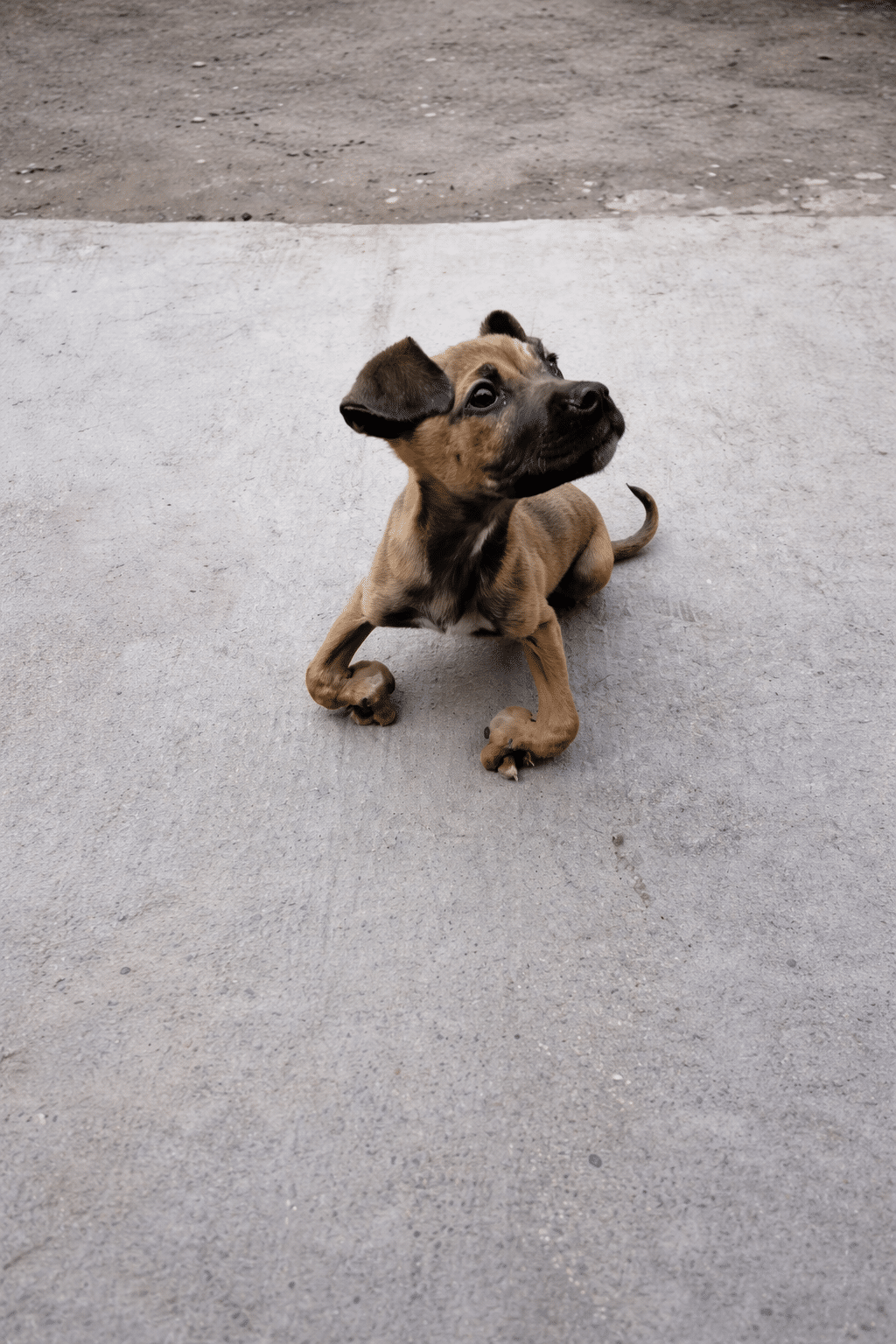
Sometimes courage appears in the smallest body.
When Tomy was first noticed on the streets, walking was already a challenge. Both of his front legs were severely bent, leaving him unsteady whenever he tried to move across the ground.
His body would wobble.
His steps were awkward and difficult.
Still, he kept going.
What made Tomy especially memorable was not only the condition of his legs. It was the way he continued to approach people.
Rather than trying to disappear whenever someone came near, the little puppy would slowly move closer with quiet curiosity. At times, he simply stayed nearby, seemingly hopeful that food, attention, or a gentle hand might come his way.
Whatever difficulties had shaped his early life, they had not taken away his willingness to trust.
A Tiny Body Already Struggling
Tomy's legs were only one part of the problem.
He was extremely thin when rescuers found him, and his condition showed clear signs that his young body had not been receiving the nutrition it needed. He was weak and dehydrated, with severe vitamin and calcium deficiencies.
For a puppy already struggling to stand and walk normally, that physical weakness made everything harder.
Yet Tomy continued trying to move.
There was something quietly moving about seeing such a fragile puppy make the effort to approach people rather than retreat from them. His body needed help urgently, but his gentle nature was still there.
Rescuers knew that simply feeding him on the street would not be enough.
Tomy needed veterinary care.
He was taken to a clinic, where the first priority was not immediately correcting his bent legs. Before anything else could happen, his weakened body had to become stable enough to handle the next stages of treatment.
At the time, Tomy weighed only about three kilograms.
The veterinary team began providing fluids, medication, and nutritional support while treating the vomiting and diarrhea that were adding to his weakness.
For the first several days, progress had to be measured carefully.
With a puppy this fragile, even a small improvement mattered.
The First Sign That Tomy Was Fighting Back
Then Tomy began to eat.
At first, it was simply encouraging to see him interested in food again. Soon, however, his appetite became noticeably stronger.
Each meal meant his body was receiving something it desperately needed.
More nutrition.
More energy.
More strength for what would come next.
For the people caring for him, his growing appetite became one of the first hopeful signs that Tomy was responding to treatment.
The puppy who had arrived weak and undernourished was beginning to participate in his own recovery in the simplest possible way: he wanted to eat.
Once his overall condition improved, attention could finally turn toward the problem that had been visible from the beginning—his severely bent front legs.
Helping Tomy move more comfortably would not happen overnight.
It would require rehabilitation, repetition, and patience.
VIDEO: Tomy Could Barely Walk on His Bent Legs — Then His Small Steps Began to Change
Learning How to Move With Confidence
Tomy's rehabilitation became a gradual process built around strengthening his body.
Special therapy equipment was introduced to help him develop muscle control and improve his coordination. One exercise involved large therapy balls, which allowed him to practice balancing and making controlled movements.
For a puppy whose front legs had made ordinary walking so difficult, exercises that might look simple were meaningful challenges.
He had to learn stability.
He had to build strength.
And he had to keep trying.
Tomy also received laser therapy as part of his care, intended to help reduce inflammation and support healing after treatment.
Through the sessions, he remained remarkably cooperative.
There was no dramatic overnight transformation. Instead, improvement appeared through small changes that gradually became impossible to miss.
Tomy could support himself better.
His movements became steadier.
He began navigating his surroundings with greater confidence.
And there was another part of therapy that seemed especially welcome: the small treats waiting for him after his work was finished.
Those moments helped turn rehabilitation into something more than a medical routine. Tomy was receiving consistent care and positive attention while his body became stronger.
Day by day, the puppy who had once struggled across the ground was discovering how much more his body could do.
When Walking Turned Into Running
Eventually, Tomy's progress became visible outside the therapy sessions.
He began moving across the grass.
Then he became quicker.
Before long, he was running around the yard and playing with other dogs.
The contrast was extraordinary.
This was the same puppy whose bent front legs had once made every step uncertain. Now there was energy in his movements and curiosity in the way he explored the space around him.
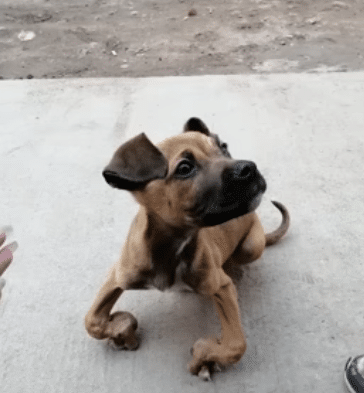
Recovery did not erase where Tomy had started.
That was what made these ordinary moments feel so meaningful.
Running through the grass might be something most healthy dogs do without a second thought. For Tomy, it represented strength that had been carefully rebuilt through treatment, nutrition, and rehabilitation.
He had arrived needing help simply to become physically stable.
Now he could play.
He could explore.
He could move with a freedom that had once seemed far beyond his reach.
Eva Found Her Own Way Forward
Tomy was not the only dog receiving help for a mobility problem during this period.
Another dog named Eva was also being cared for.
Her path toward movement looked different from Tomy's.
Rescuers fitted Eva with a specially designed wheelchair that supported her front legs. Once she had the device, she was able to move much more freely and quickly.
Watching Eva travel confidently with the wheelchair offered another reminder that recovery does not always look the same for every animal.
Sometimes progress means rebuilding strength through therapy.
Sometimes it means finding the right equipment to provide support.
What matters is giving an animal the opportunity to experience movement, comfort, and independence in whatever way works for its individual needs.
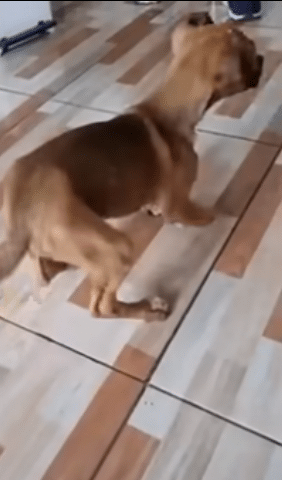
Eva's progress complemented Tomy's in a simple but powerful way.
Neither dog needed a perfect beginning in order to have a better future.
They needed care that recognized what each of them could do—and what kind of help could allow them to do more.
From a Fragile Stray to a Beloved Companion
For Tomy, the changes continued far beyond the clinic and rehabilitation equipment.
Both he and Eva eventually found loving homes.
The tiny stray puppy who had once been dangerously weak now lives as a strong, healthy dog surrounded by comfort and attention.
Tomy travels with his family.
He rests on soft beds.
He explores new places.
And the puppy whose twisted legs once made walking such a struggle can now run freely.
There is something especially touching about the ordinary details of his new life.
Playing outside.
Resting comfortably near a warm fireplace.
Sleeping without having to worry about where the next meal might come from.
Exploring simply because he can.
These are not dramatic moments.
They are better than that.
They are the quiet signs of a dog who is finally home.
The Trust Tomy Never Lost
Tomy's physical transformation is easy to see.
He went from a severely undernourished puppy struggling on bent front legs to an energetic dog able to run, play, and explore.
But one part of his story had been present from the very beginning.
Trust.
Even when he was weak on the streets, Tomy still approached people.
Even when every step required effort, he continued moving forward.
He did not know what would happen when he came closer. He could not know that those encounters would eventually lead to veterinary care, rehabilitation, and a family of his own.
He simply kept giving people a chance.
In the end, someone gave him one in return.
Tomy's journey shows what patient care can accomplish when it meets an animal still willing to keep trying. Nutrition helped rebuild his fragile body. Veterinary treatment stabilized him. Rehabilitation helped strengthen his movement. A loving home gave all that progress somewhere safe to continue.
Today, his life is no longer defined by the difficult steps he once took across the street.
It is defined by movement, curiosity, warmth, and belonging.
For a puppy who began with so little, that may be the most meaningful transformation of all.


