
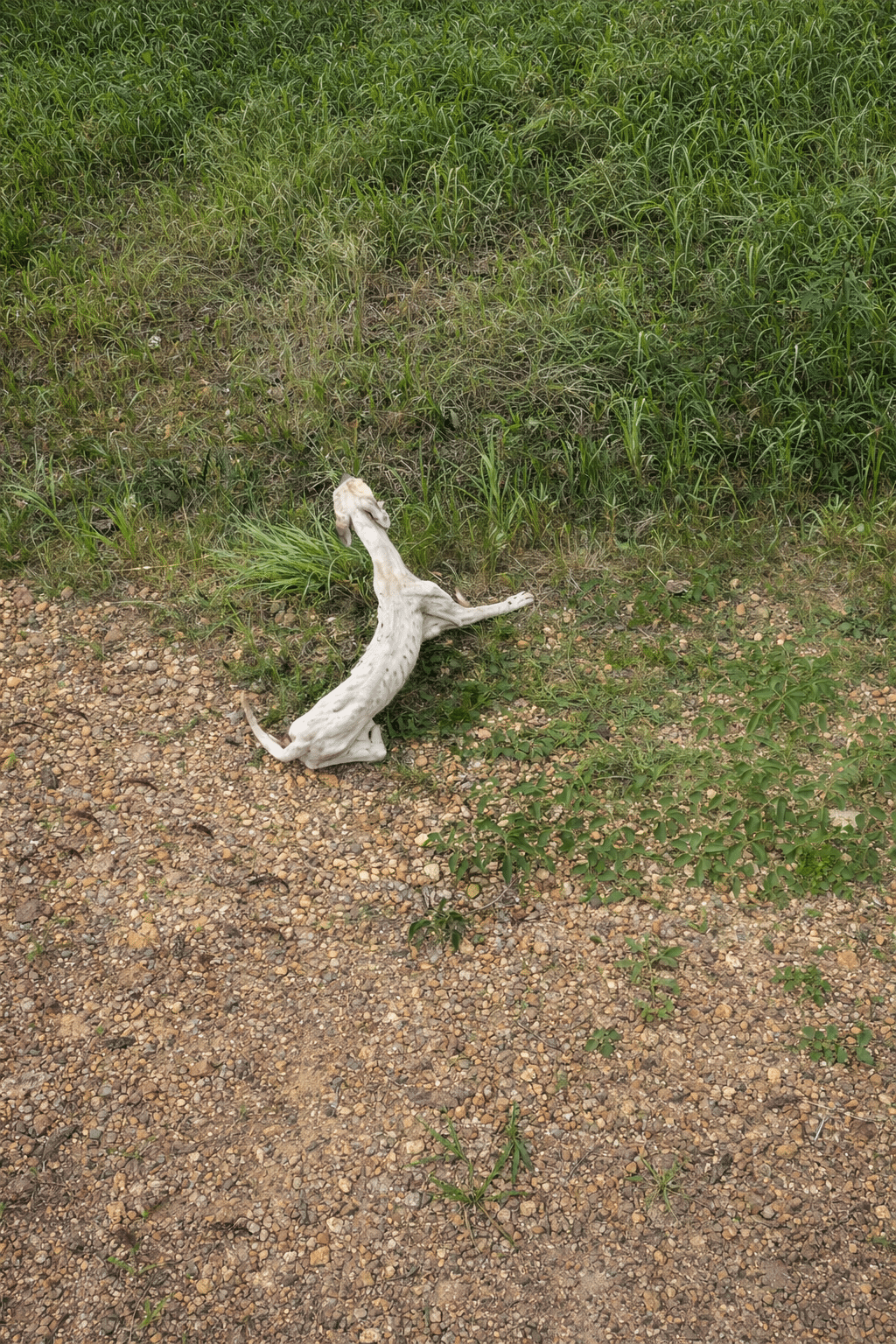
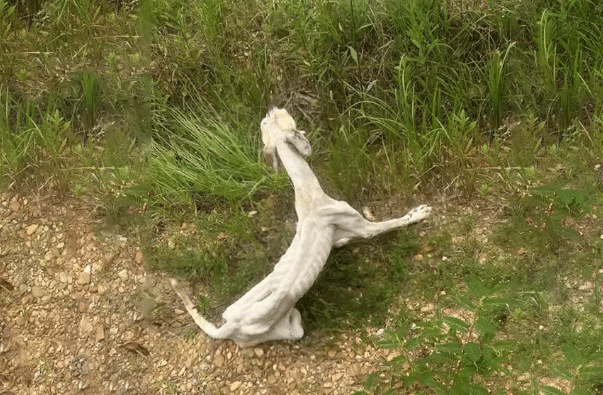
When rescuers first saw Liam, simply staying upright seemed to require nearly all the strength he had left.
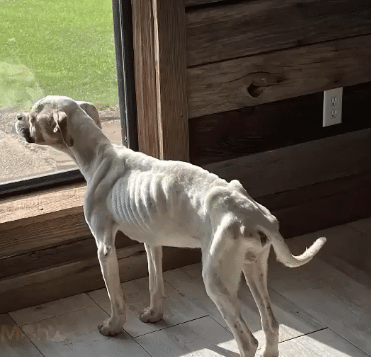
His body was painfully thin. His ribs were sharply visible beneath his skin, his coat was dirty and covered with fleas, and exhaustion made him tremble.
There was no way to know every detail of what Liam had experienced before that moment.
But his physical condition made one thing clear: he needed help immediately.
He Was Weak, Yet He Did Not Pull Away
Liam had been found in a quiet, isolated area, already in a severely weakened state.
He was dehydrated and underweight, and even small movements appeared difficult. Yet when the rescuers moved closer, Liam did not run.
He stayed still.
Instead of resisting the hands reaching toward him, he quietly accepted their touch.
For a dog in such poor condition, that simple response carried enormous meaning. Liam could not explain where he had been or how long he had struggled, but he allowed the people in front of him to help.
The rescuers carefully placed him inside a crate.
It was a small transition—from the place where he had been found to somewhere safe—but it marked the beginning of everything that followed.
Soon, Liam was on his way to receive veterinary attention.
The First Priority Was Keeping Him Stable
At the veterinary clinic, Liam's condition required immediate care.
His body temperature had fallen dangerously low, so the staff wrapped him in a warm jacket while preparing treatment.
Even then, Liam remained remarkably gentle.
As people worked around him, he softly licked the hands caring for him.
The veterinary team began IV fluids to address his dehydration. They also treated the fleas covering his coat and gave medication for internal parasites.
Further examination revealed additional problems.
Liam had hookworms, and he tested positive for heartworm disease.
Blood tests were taken so the team could monitor his weakened body closely as treatment began.
There were several concerns to manage at once, and recovery could not be rushed.
For the moment, the goal was simple: give Liam warmth, hydration, nutrition, medication, and the chance to stabilize.
Then something encouraging happened.
Liam became interested in food.
He began eating eagerly despite his weakness.
For the people watching over him, it was one of the first visible signs that his exhausted body was still willing to keep going.
VIDEO: From Too Weak to Stand Steadily to Growing Stronger — Liam's Recovery Begins
Small Steps Began to Mean Everything
Recovery did not transform Liam overnight.
At first, even standing normally was difficult.
His body had been depleted for so long that rebuilding strength required consistent nutrition, medical care, and patience.
But the changes began to appear.
Day after day, Liam became a little steadier.
Eventually, he could stand without the same struggle.
Then he began taking careful steps.
Those movements might have looked ordinary in another dog. For Liam, they represented enormous progress.
A body that had once trembled from exhaustion was slowly becoming capable of supporting itself again.
Two weeks into his recovery, another major milestone showed just how much had changed.
Liam had gained 13 pounds—about 6 kilograms—bringing his weight to approximately 36 pounds, or 16.3 kilograms.
The difference was becoming visible.
His bones no longer stood out as sharply as before. With proper food and ongoing care, his body was gradually filling out and rebuilding the strength it had been missing.
The Fragile Dog Started Discovering Ordinary Joy
Liam's story was no longer centered only on treatment.
As his strength returned, life began to offer him experiences that had once seemed far beyond reach.
He could move more comfortably.
He could explore.
He could rest without having to fight simply to get through another day.
The transformation was especially meaningful because it happened through steady, ordinary care rather than one dramatic moment.
Food.
Warmth.
Medication.
Monitoring.
Patience.
And people continuing to show up for him.
Each part mattered.
The dog who had arrived weak, cold, dehydrated, and unable to stand steadily was beginning to look and behave like a dog finally able to enjoy his surroundings.
A Warm Home Changed What His Days Looked Like
Today, Liam's life is very different from the one rescuers first encountered.
He has a warm home where he can rest comfortably.
There is a soft bed waiting for him, along with cozy blankets where he can sleep peacefully.
His new family gives him treats and plenty of belly rubs.
After everything his body had endured, these ordinary comforts became part of his everyday life.
And Liam does not enjoy that home alone.
One of his closest companions is a calm gray cat.
The two can often be found curled up together on the bed, sharing quiet naps side by side.
It is a peaceful scene that stands in striking contrast to Liam's beginning.
Once, he was struggling just to remain upright.
Now, he can stretch out in comfort beside a companion and simply rest.
There Was More Waiting for Him Than Survival
Liam also began enjoying activities outside the home.
He likes car rides and visits to farm supply stores.
He can run across open grass, using the strength that once seemed almost gone.
These may be simple pleasures, but that is part of what makes them so meaningful.
Recovery is not only about gaining weight or reaching a medical milestone.
Sometimes it can be seen in the freedom to run.
In the ability to relax on a soft bed.
In accepting affection without fear.
In spending an afternoon riding in a car or exploring somewhere new.
Liam's progress turned survival into something much larger: a life with comfort, companionship, movement, and routine.
Compassion Gave Liam the Chance to Become Strong Again
When Liam was first found, his condition offered little room for delay.
He was extremely thin, dehydrated, covered with fleas, struggling with parasites, and facing heartworm disease.
Even standing was difficult.
Yet the people who found him did not measure his value by how weak he looked.
They brought him to safety and placed him in the hands of people who could provide the care he needed.
From there, improvement came one step at a time.
A warmer body.
A meal eaten eagerly.
A steadier stance.
A few careful steps.
Thirteen pounds gained.
And eventually, the freedom to run across the grass.
Liam's journey shows what patient, compassionate care can make possible.
The vulnerable dog once struggling to maintain his balance is now surrounded by comfort, affection, and friendship.
His past cannot be rewritten.
But because someone chose to help when he was at his weakest, the life ahead of him became very different.
Sometimes a second chance begins with nothing more complicated than noticing a fragile animal, stopping, and deciding that his life is worth the effort.


