
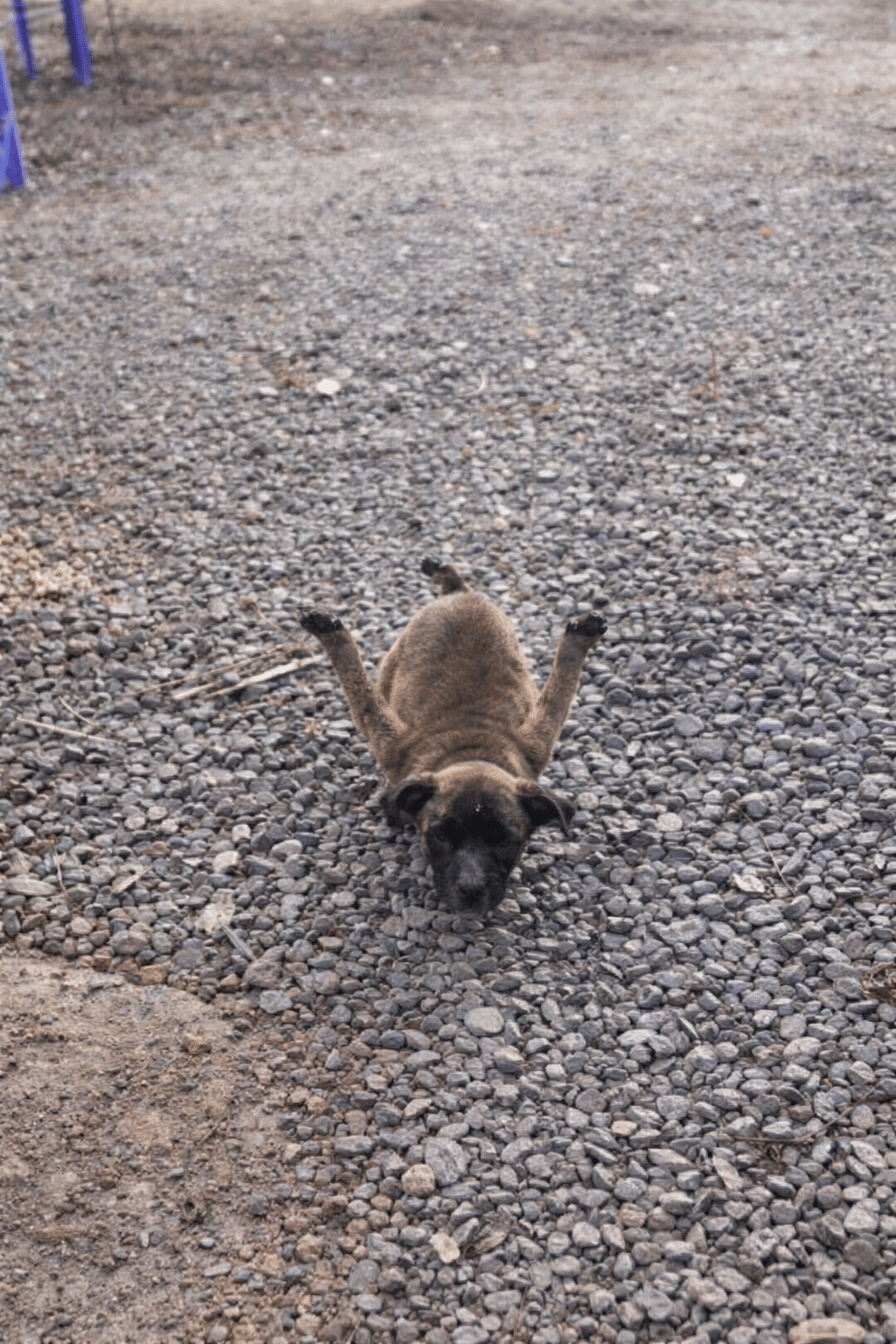
Vanilla had never known what it felt like to stand the way most dogs do.
From birth, a severe congenital deformity affected both of her front legs. Instead of supporting her weight beneath her body, the limbs extended outward, leaving her unable to balance normally.
Moving from one place to another meant pulling herself forward.
Her small body had to drag across gravel, dirt, and hard pavement while she searched for food and continued doing what she had always done: survive.
The physical challenge was only part of what she faced.
People saw that Vanilla looked different. Some simply kept their distance. Others reportedly described her as “bad luck,” turning a medical condition she never chose into another reason to reject her.
Yet Vanilla continued moving.
She searched for scraps.
She endured uncomfortable ground.
She adapted because adaptation was the only option she had ever been given.
A Life Built Around Survival
For another dog, walking might have been an ordinary movement requiring no thought at all.
For Vanilla, every bit of progress demanded effort.
Her front legs could not carry her weight properly, so she relied on the rest of her body to pull herself along. There was no comfortable bed waiting at the end of the day and no indication that she had previously received the specialized care her condition required.
Her world had been shaped around limitation.
But limitation was not the same as surrender.
Despite everything working against her, Vanilla kept searching for food and finding ways to move. Her body could not function in the conventional way, yet she continued using what strength she had.
Then someone finally looked at her differently.
A woman noticed Vanilla and did not focus only on the unusual position of her legs. She saw a dog struggling and understood that help was needed.
Instead of walking away, she contacted rescuers.
That decision changed the direction of Vanilla's life.
When help reached her, she was exhausted and clearly uncomfortable. The people approaching her were strangers, and she had every reason to be uncertain about what would happen next.
Then her tail began to move.
It wagged.
That small gesture stood in striking contrast to everything Vanilla had experienced before. After struggling for food and being avoided because of her appearance, she still responded to the people coming toward her.
For the first time, survival was beginning to make room for care.
VIDEO: Born Unable to Walk Normally, Vanilla Finally Met the People Who Chose to Help
The Examination That Changed the Plan
Once Vanilla reached veterinary care, X-rays gave the medical team a clearer picture of what her body had been dealing with since birth.
Her front legs were severely contracted and twisted because of the congenital structural deformity.
This was not simply a matter of weakness that could disappear after a few days of rest.
Her body had developed differently.
The first approach centered on stabilizing her condition and using medication, but progress was slow. As the team considered what could realistically give Vanilla a better quality of life, one possibility entered the discussion.
Amputation.
For the woman who had already refused to leave Vanilla behind, that possibility was difficult to accept without exploring every available alternative.
She sought another opinion from an orthopedic specialist.
That choice brought an important change in direction.
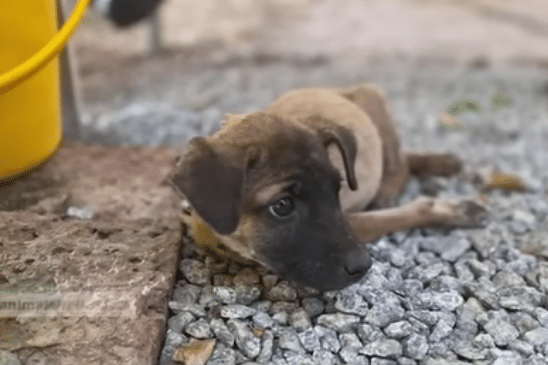
The specialist determined that Vanilla's front legs did not have to be amputated.
Instead of trying to force her body to move exactly like that of another dog, the new strategy focused on helping Vanilla make better use of the body she already had.
Her back legs needed to become stronger.
Her front limbs needed protection from unnecessary strain.
And her surroundings needed to support the way she naturally moved rather than constantly work against her.
It was a more patient path.
There would be no instant correction.
Vanilla would need time, careful support, and repeated practice.
Recovery Measured in Small Attempts
Her new environment gave Vanilla something she had rarely experienced before: comfort.
She received a warm, cushioned place where she could rest without repeatedly dragging herself across rough surfaces.
Her food was carefully balanced to support her general health and muscle development.
Gentle physical therapy became part of her routine.
None of those changes transformed her overnight.
Instead, recovery arrived through repetition.
Vanilla tried to balance.
She wobbled.
She lost her position.
Then she tried again.
As the days passed, the muscles in her back legs became stronger. Because those legs would carry more of the work of supporting her body, every improvement mattered.
Her caregivers were not waiting for her to become a conventional four-legged walker.
They were helping her discover what independence could look like on her own terms.
That distinction became increasingly important.
A body can be different without being incapable.
Vanilla was beginning to prove it.
Around three months into her recovery, all of those small efforts came together in a moment that once would have seemed impossible.
She lifted herself upright.
Her body balanced on her two back legs.
For a dog who had spent so much of her life pulling herself across the ground, simply remaining upright represented an extraordinary change.
Then she moved.
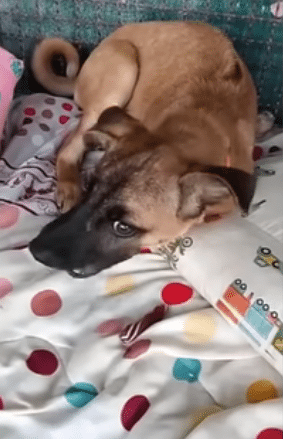
The steps were small.
They were not perfectly steady.
But they belonged entirely to her.
Vanilla had not suddenly become like every other dog.
She had learned another way forward.
A Wheelchair Opened an Even Wider World
As Vanilla's story reached more people, her resilience caught the attention of a man who wanted to give her a permanent home.
He chose to welcome her into his life.
There, Vanilla's mobility journey continued with another form of support: a wheelchair made for dogs with movement challenges.
The device allowed her to travel more comfortably while reducing the difficulty created by her front legs.
For Vanilla, it offered freedom without demanding that her body conform to a movement it had never been able to perform.
She adapted to it.
Soon, the dog who had once dragged herself across hard ground could move across grass with far greater ease.
The contrast was remarkable.
Earlier, every stretch of pavement had demanded effort from her body.
Now wheels supported her as she moved forward with confidence, sunlight catching her fur while the ground passed beneath her.
Her life was no longer defined only by what she could not do.
She had a home.
She had support.
And she had ways to move that respected the body she was born with.
Different Was Never the Same as Broken
Vanilla's journey is powerful because nobody changed the fact that she was born different.
Her congenital condition remained part of her life.
What changed was everything surrounding it.
Someone noticed her instead of avoiding her.
Rescuers brought her into care.
Veterinary professionals examined what her body actually needed.
A second opinion helped avoid an amputation that ultimately proved unnecessary.
Physical therapy strengthened the legs she could rely on most.
A supportive environment reduced the strain of daily movement.
And eventually, a wheelchair gave her another way to explore the world.
Each step came from compassion meeting patience.
Vanilla's story also challenges an assumption that special-needs animals must experience life only through limitation.
She may never move exactly like another dog.
She does not need to.
Her progress was never about becoming “normal.”
It was about gaining comfort, independence, and the chance to live without being dismissed because her body worked differently.
The same dog once labeled unwanted became a dog surrounded by care.
The dog who once pulled herself across unforgiving ground learned to balance on her back legs.
Then she learned to move with wheels beneath her.
Her world expanded because someone decided her difference was not a reason to walk away.
Rescue cannot erase every condition an animal is born with.
Sometimes the most meaningful kind of rescue does something else.
It gives that animal the resources to live fully within the body it already has.
Vanilla did not need to become a different dog to deserve a different life.
She only needed people willing to see possibility where others had seen a problem.
And once that happened, she finally had the freedom to rise in the way that had always been uniquely hers.


