
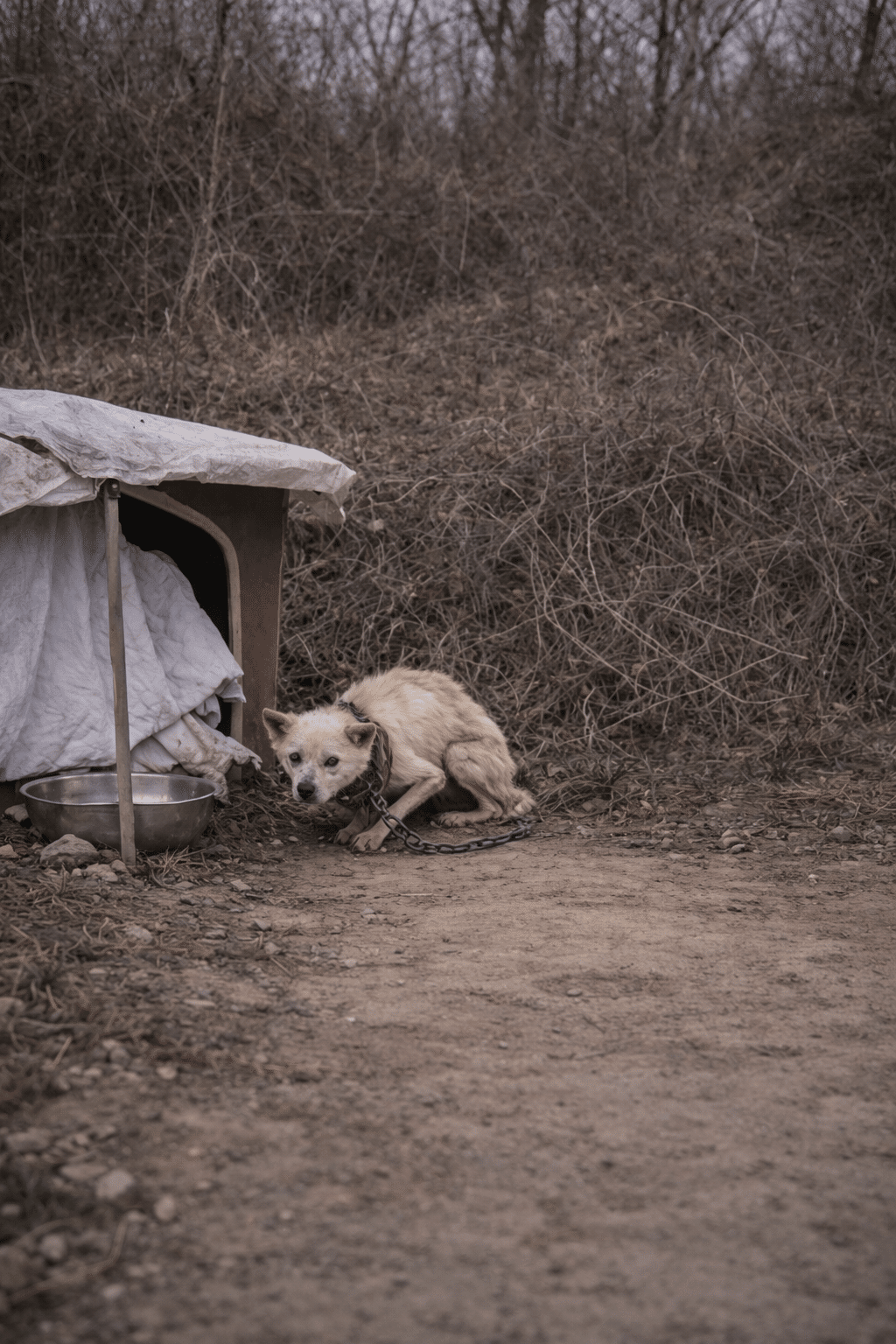
A short, heavy chain marked the limits of Leah’s world.
Around her stretched a harvested field where the crops were already gone. There was no shelter waiting nearby, no shade from the summer heat, and little protection when the weather turned cold.
Leah remained there alone.
Her thin body showed how much she had endured. Her ribs were sharply visible beneath her skin, while her legs appeared swollen and irritated after prolonged exposure outdoors.
And she trembled constantly.
Some of that trembling may have come from physical weakness.
But when anyone moved near her, another kind of fear became impossible to miss.
A Life Reduced to the Length of a Chain
By the time rescuers learned about Leah, her world had become painfully small.
The chain allowed her to move only within a limited circle of dry ground. Beyond that circle was open space she could see but could not reach.
There was little comfort in the place where she had been left.
More troubling was the way Leah responded to people.
Her eyes followed every movement. She remained tense and alert, as though she expected something unpleasant whenever a person came closer.
Whatever her complete history had been, the source made one thing clear: human contact had become frightening to her.
That meant removing the chain was only the beginning.
Rescuers would also have to convince Leah that the people approaching her were there to help.
When Help Looked Like Another Threat
The rescue team arrived intending to take Leah somewhere safe.
Leah could not understand that.
As they approached, she tried to escape despite having almost nowhere to go. The chain pulled tight while dust shifted beneath her paws.
Her reaction was not aggression.
It was panic.
Every instinct seemed to tell her to create distance between herself and the strangers coming toward her.
The rescuers did not force the moment faster than necessary. They lowered their voices, slowed their movements, and gave her time.
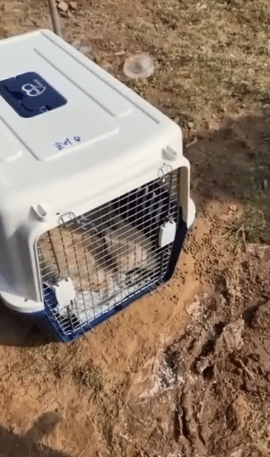
Even placing Leah into a transport crate became difficult because she resisted in confusion and fear.
For a dog that had learned to associate people with distress, kindness was not something she could recognize immediately.
So the rescuers stayed patient.
No sudden movements.
No unnecessary pressure.
Only a careful effort to get her away from the field without making an already frightening experience worse.
Eventually, Leah was secured for transport.
For the first time, the short chain and the barren patch of ground were behind her.
VIDEO: From a Short Chain in an Empty Field to Leah’s First Steps Toward Trust
Her Body Needed a Careful Beginning
Once Leah reached the veterinary clinic, the extent of her physical condition became clearer.
Testing confirmed heartworm disease.
She was also extremely malnourished and weighed only about 5 kilograms, far below a healthy weight for a dog of her size.
Her weakened condition meant that even something as ordinary as eating had to be handled carefully.
A normal-sized meal could not simply be placed in front of her.
Instead, food was divided into very small portions and offered gradually throughout the day so her fragile stomach could adjust.
Those meals became some of the earliest markers of progress.
A little food.
Then time to rest.
Then another carefully measured portion.
There was no quick way to rebuild the strength that prolonged neglect had taken away.
Leah’s recovery had to move at the pace her body could tolerate.
And while caregivers worked to restore her physical health, another kind of healing was happening much more quietly.
She was beginning to observe the people around her.
Ten Days Before She Took Food From a Hand
During Leah’s first week in care, fear still shaped much of her behavior.
Sudden movement could make her flinch.
Direct attention could cause her to pull back.
The field was gone and the chain was gone, but Leah had not yet learned that her new surroundings were different.
Safety can be provided in a moment.
Feeling safe can take much longer.
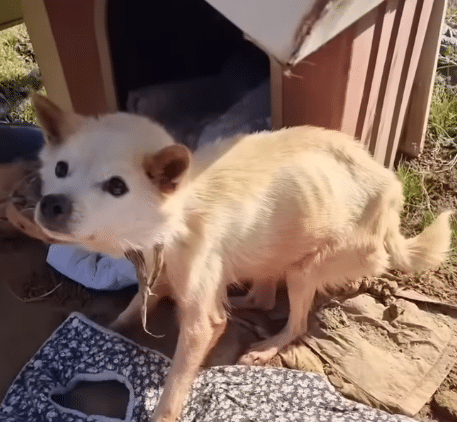
Caregivers continued with the same quiet routine.
Food arrived regularly.
Voices remained calm.
Hands approached carefully.
Nothing demanded instant trust from her.
Then, around the tenth day, Leah did something small that carried enormous meaning.
She accepted food directly from a rescuer’s hand.
There was no dramatic transformation.
She did not suddenly forget everything that had frightened her.
But she chose to move close enough to take the food.
That was new.
The gesture suggested that curiosity was beginning to compete with fear.
Her gaze also started to change. Instead of reacting anxiously to every nearby motion, she could sometimes simply watch.
The people around her were becoming familiar.
Their voices were familiar.
The routine was familiar.
And, little by little, familiarity was giving Leah something she had lacked for a long time: predictability.
Three Weeks Later, Her World Was Larger
Nearly three weeks of treatment and patient care brought visible changes.
Leah grew stronger.
According to the source, she eventually no longer needed supportive devices to move comfortably and could walk freely inside the shelter.
Those steps were still cautious.
But they were no longer the frantic movements of a dog trapped at the end of a chain.
Her surroundings had changed completely.
There was room to move.
There were people who approached gently.
There were other dogs nearby.
Leah slowly began interacting with them through brief sniffs and quiet introductions.
Nothing had to happen quickly.
Her recovery was being built through repetition rather than dramatic breakthroughs.
A meal that stayed down.
A few more comfortable steps.
A moment near another dog.
A hand she no longer immediately feared.
Each experience gave Leah another reason to understand that this new place was different from the field where she had been found.
Perhaps the most important difference could not be measured on a scale.
Leah was beginning to experience safety.
Healing Happened in Small Moments
Leah’s story is powerful precisely because her change was gradual.
She was not rescued from the field and instantly transformed into a carefree dog.
Her body needed treatment.
Her stomach needed careful feeding.
Her fear needed patience.
And trust had to be earned through the same gentle experiences repeated day after day.
That process can be easy to overlook.
Rescue is often remembered as the dramatic moment when an animal is removed from danger.
But for Leah, being carried away from the field was only the first step.
The days afterward mattered just as much.
They were the days when food arrived consistently.
The days when no one punished her for being afraid.
The days when calm voices replaced uncertainty.
The days when she was allowed to approach people at her own pace.
Around ten days into that process, she took food from a human hand.
A few weeks later, she was moving more freely and beginning to explore life around other dogs.
Those changes did not erase what had happened before.
They showed what patience could begin to build afterward.
From a Tiny Circle of Dirt to a Safer Life
When rescuers first saw Leah, the length of a chain determined how far she could go.
Her world was a small patch of exposed ground in an empty field.
She was painfully thin, physically unwell, and frightened by the very people trying to help her.
Weeks later, that circle was gone.
She could walk inside the shelter without being held to one place. She could cautiously approach other dogs. She could accept food from a gentle hand instead of retreating from it.
Her physical recovery was still a process, especially with heartworm disease and severe malnutrition requiring careful care.
But something important had already changed.
Leah had begun to discover that not every approaching person brought pain.
Some brought food.
Some brought treatment.
Some simply stayed nearby without forcing her to do anything.
That consistency gave trust room to return.
Leah’s journey is a reminder that healing does not always arrive through one extraordinary moment.
Sometimes it arrives through dozens of ordinary ones.
A quiet voice.
A measured meal.
A patient hand.
A few cautious steps.
For a dog who once trembled at the end of a short chain, those small moments opened a world that was finally larger than the ground beneath her feet.


